A French Word to Live By
Translate Inflation to English
/ɛ̃.fla.sjɔ̃/
L’inflation means inflation.
At the bakery, the baguette has gone up by five centimes — again. The baker shrugs, the queue shrugs back, and everyone says the word that explains every price in the country: l’inflation.
In this guide, you’ll learn what inflation means in English, how to use it with its articles, how to form its plural, and how it appears in everyday French. Explore French examples, English translations, and practice quizzes.
Understanding the French Noun Inflation
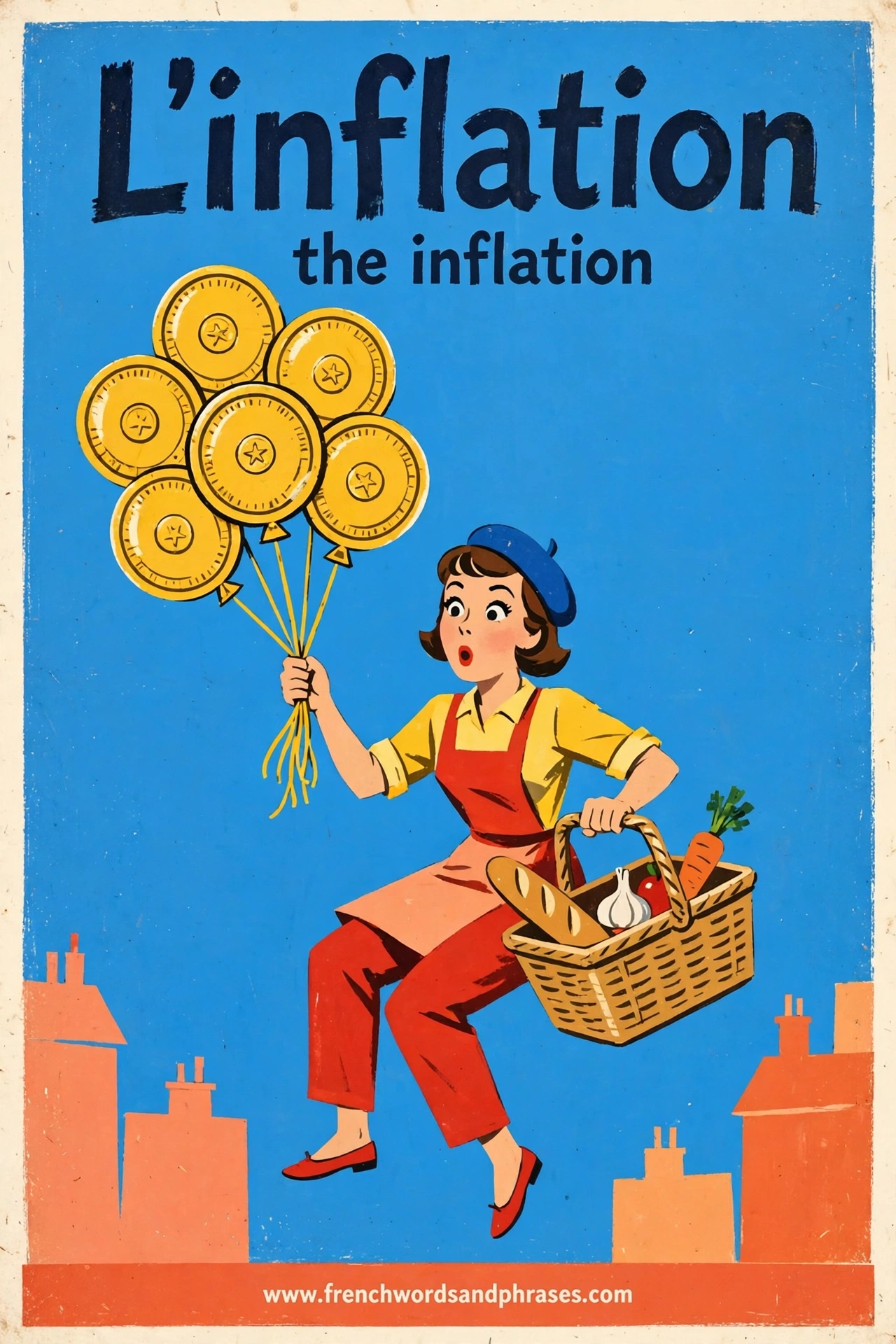
Inflation is a feminine French noun. It is learned together with its article: l’inflation, une inflation. Because it begins with a vowel, the definite article shrinks to l’. The word is built on the Latin for blowing up, swelling — prices that swell, month after month, like a balloon.
It means inflation — the general rise in prices over time, measured as a percentage: le taux d’inflation, the inflation rate. It is not one price going up, but nearly all of them together — bread, rent, energy, the café on the corner — which is why it is felt most sharply in the shopping basket and the monthly bill.
Gender: Feminine
Definite article: l’ — l’inflation (the inflation)
Indefinite article: une — une inflation (inflation, as in une inflation galopante)
Plural: les inflations (rare)
English equivalents: Inflation.
One important usage detail: in the street, French often skips the technical word and simply says les prix augmentent — prices are going up — or tout augmente, everything is going up. L’inflation is the name the news gives to what the shopping basket already knows.
Experience the Word
Inflation is more than a percentage. It is the quiet arithmetic of the supermarket trolley — the same basket, the same list, and a total that climbs a little higher every month.
Imagine the grandmother at the market, holding a melon like a judge: she remembers what it cost last summer, and the summer before that. She does not need the official rate. Elle le sait, l’inflation — she can feel it in her purse.
You have not just read an index. You have watched the value of money quietly shrink.
How to Use Inflation in French: Complete Guide
Let’s explore how inflation works in French, beginning with its articles.
Inflation with the Definite Article (L’, Les)
Inflation begins with a vowel, so le and la both shrink to l’ — l’inflation — while the rare plural is les inflations.
| Number | French |
|---|---|
| Singular | l’inflation |
| Plural | les inflations |
Example
L’inflation ralentit enfin après deux ans de hausse.
Inflation is finally slowing down after two years of rises.
Inflation with the Indefinite Article (Une, Des)
Used for a period of inflation in general — above all the famous runaway kind, une inflation galopante.
| Number | French |
|---|---|
| Singular | une inflation |
| Plural | des inflations |
Example
Le pays a connu une inflation galopante dans les années quatre-vingt.
The country experienced runaway inflation in the eighties.
Inflation at the Shops
Baskets, bills and bread — where l’inflation is actually felt.
| French | In English |
|---|---|
| la hausse des prix | the rise in prices |
| le panier de courses | the shopping basket |
| le pouvoir d’achat | purchasing power |
| le taux d’inflation | the inflation rate |
| le prix du pain | the price of bread |
| la facture d’énergie | the energy bill |
Example
Avec l’inflation, le panier de courses coûte dix euros de plus.
With inflation, the shopping basket costs ten euros more.
Quick Quiz 1
What is « une inflation galopante »?
Reveal the answer
Runaway inflation — prices galloping upwards, out of control.
Une inflation galopante fait grimper les prix très vite.
Runaway inflation pushes prices up very fast.
The Plural of Inflation
Inflation adds an -s in the plural, but the plural is rare — it appears when historians compare the inflationary periods of different decades.
| Number | French |
|---|---|
| Singular | l’inflation |
| Plural | les inflations |
Example
Les inflations des années soixante-dix ont marqué les esprits.
The inflations of the seventies left their mark on people’s minds.
Inflation with Possessive Adjectives (Mon, Ton, Son…)
A famous exception: inflation is feminine, but because it begins with a vowel it takes mon, ton, son — son inflation, never « sa inflation ».
| Owner | French |
|---|---|
| my | mon inflation |
| your (tu) | ton inflation |
| his / her | son inflation |
| our | notre inflation |
| your (vous) | votre inflation |
| their | leur inflation |
Example
Chaque pays mesure son inflation avec ses propres prix.
Each country measures its inflation with its own prices.
Quick Quiz 2
Complete the sentence:
Le pays lutte contre ______ inflation depuis deux ans. (Its)
Reveal the answer
son
Le pays lutte contre son inflation depuis deux ans.
The country has been fighting its inflation for two years — son, not sa, because inflation begins with a vowel.
Inflation with Demonstrative Adjectives (Cette, Ces)
Used to point: this inflation, the one we are living through now.
| Number | French |
|---|---|
| Singular | cette inflation |
| Plural | ces inflations |
Example
Cette inflation touche surtout l’alimentation.
This inflation mainly affects food.
Inflation with Adjectives
Adjectives agree with inflation, feminine — galopante, rampante, maîtrisée.
| Adjective | With Inflation |
|---|---|
| galopante (runaway) | une inflation galopante |
| rampante (creeping) | une inflation rampante |
| maîtrisée (under control) | une inflation maîtrisée |
| forte (high) | une forte inflation |
| faible (low) | une inflation faible |
Example
Une inflation maîtrisée rassure les familles.
Inflation under control reassures families.
Quick Quiz 3
Complete the sentence:
Une inflation ______ fait grimper les prix très vite. (runaway)
Reveal the answer
galopante
Une inflation galopante fait grimper les prix très vite.
Runaway inflation pushes prices up very fast.
Everyday Expressions with Inflation
Rates, rises and the return of the word itself — the inflation phrases of the week.
| Expression | In English |
|---|---|
| le taux d’inflation | the inflation rate |
| la hausse des prix | rising prices |
| lutter contre l’inflation | to fight inflation |
| à cause de l’inflation | because of inflation |
| le retour de l’inflation | the return of inflation |
| les prix grimpent | prices are climbing |
Example
À cause de l’inflation, le café coûte plus cher.
Because of inflation, coffee costs more.
Words from the Same Family as Inflation
Swelling, falling and paying — the words that travel with inflation.
| French | In English |
|---|---|
| gonfler | to inflate, to swell |
| la déflation | deflation |
| le prix | the price |
| cher | expensive |
| augmenter | to increase, to go up |
| le coût de la vie | the cost of living |
Example
Le coût de la vie augmente chaque année.
The cost of living rises every year.
Quick Quiz 4
The price of coffee doubles in your café. Is that, by itself, l’inflation?
Reveal the answer
Not by itself — inflation is the general rise of prices across the whole basket, not one price in one café.
L’inflation, c’est la hausse générale des prix.
Inflation is the general rise in prices.
Inflation in Everyday French: Real-Life Examples
Now that you know the word, let’s see how inflation appears in everyday French.
Example 1 — At the bakery
À cause de l’inflation, la baguette coûte un peu plus cher.
Because of inflation, the baguette costs a little more.
Example 2 — The news
L’inflation est le sujet principal du journal ce soir.
Inflation is the main story on the news tonight.
Example 3 — Wages
Les syndicats demandent des salaires qui suivent l’inflation.
The unions are asking for wages that keep up with inflation.
Example 4 — Relief
Bonne nouvelle, l’inflation ralentit depuis trois mois.
Good news, inflation has been slowing down for three months.
Example 5 — Pensioners
Les retraités souffrent le plus de l’inflation.
Pensioners suffer most from inflation.
Example 6 — At the market
Au marché, on parle de l’inflation entre les étals.
At the market, people talk about inflation between the stalls.
Beyond Translation: The Meaning of Inflation
Inflation is a balloon word: it comes from the Latin inflare, to blow into, to swell — the same image as gonfler un ballon. Economists kept the picture: prices swelling, money stretching thinner, until the same banknote buys a smaller basket than it did last year.
To say inflation is to watch money quietly lose its size.
It evokes the baker’s shrug and the grandmother’s memory of prices long gone — a word the news announces in percentages, but the market feels in centimes.
How to Remember the French Noun Inflation
Remember it this way: Inflation is inflation — feminine with l’, the general rise of prices, felt in every shopping basket.
- You feel it shopping — à cause de l’inflation, tout coûte plus cher.
- You dodge the exception — son inflation, pas sa inflation, because of the vowel.
- You name the extreme — une inflation galopante, runaway inflation.
The key idea is l’inflation swells every price at once.
Test Your Knowledge of Inflation
Let’s see how much you’ve learned. Try answering these questions before revealing the answers.
Question 1
Is inflation masculine or feminine?
Reveal the answer
Feminine — but with l’: l’inflation, une inflation.
Question 2
Why do we say son inflation and not sa inflation?
Reveal the answer
Because inflation begins with a vowel sound — feminine nouns starting with a vowel take mon, ton, son.
Question 3
Translate: Inflation is slowing down.
Reveal the answer
L’inflation ralentit.
Question 4
What does « une inflation galopante » mean?
Reveal the answer
Runaway inflation — prices galloping upwards, out of control.
Question 5
Complete the sentence:
À cause de ______, le pain coûte plus cher.
Reveal the answer
l’inflation
À cause de l’inflation, le pain coûte plus cher.
Because of inflation, bread costs more.
Your Final Challenge
Can You Use It?
How would you say this in French?
“Inflation is slowing down, but prices remain high.”
Reveal the answer
L’inflation ralentit, mais les prix restent élevés.
Inflation is slowing down, but prices remain high.
A little French. A little curiosity. A richer everyday life.
LEARN FRENCH ONE WORD AT A TIME