
A French Word to Live By
Translate Chômage to English
/ʃo.maʒ/
Le chômage means unemployment.
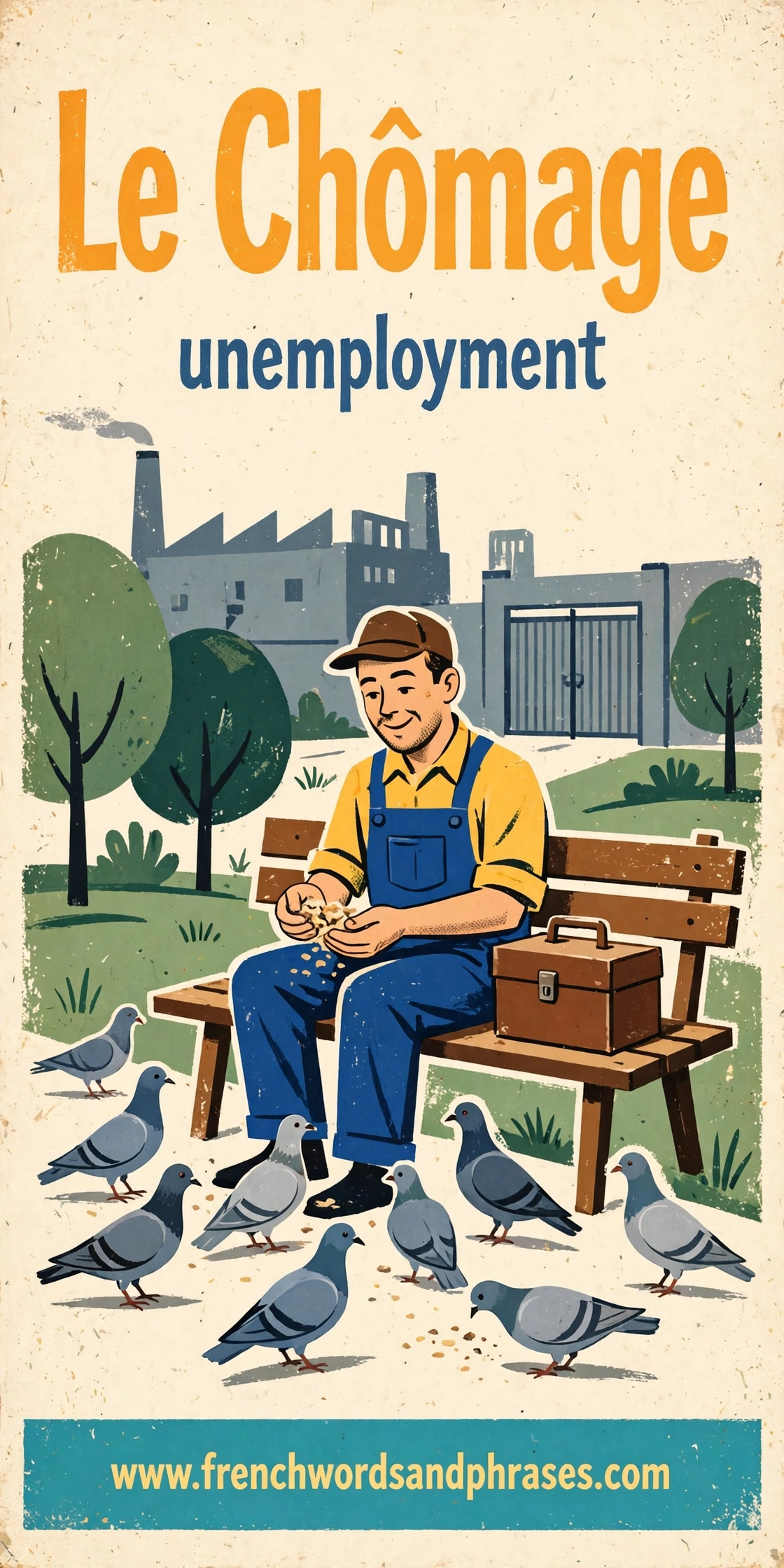
The factory gate closes at midday, for the last time. By evening, the whole town is using the same heavy word — at the café, at the kitchen table, on the phone to the family: le chômage.
In this guide, you’ll learn what chômage means in English, how to use it with its articles, how to form its plural, and how it appears in everyday French. Explore French examples, English translations, and practice quizzes.
Understanding the French Noun Chômage
Chômage is a masculine French noun. It is learned together with its article: le chômage. It is a mass noun — it names a situation, not a thing you can count — and it lives almost always in the singular. Its root is an old word for rest: the chômage was once the day the work stopped, the heat-day when the fields were left alone.
It means unemployment — first, the national figure: le taux de chômage, the unemployment rate, announced every few months and debated everywhere. But the word has a second, personal face: être au chômage is to be unemployed yourself, out of work and receiving benefit while you look for the next job. The statistic and the kitchen table share one word.
Gender: Masculine
Definite article: le — le chômage (unemployment)
Indefinite article: un — un chômage de longue durée (long-term unemployment)
Plural: Rarely used — chômage is a mass noun and lives in the singular
English equivalents: Unemployment; being unemployed, being on benefit.
One important usage detail: do not confuse chômage with a strike. Workers who down tools are en grève; workers who have no job at all are au chômage. And the person has his own word: un chômeur, une chômeuse — an unemployed person.
Experience the Word
Chômage is more than a statistic. It is the word that changes the shape of a family’s week — the alarm that no longer rings, the applications sent into silence, the training course that becomes a new beginning.
Imagine the morning after the announcement: no factory whistle, but a folder of papers on the table, a list of courses, a neighbour who knows of a job across town. Le chômage is a tunnel — and French families talk about sortir du chômage, coming out of it, like travellers into daylight.
You have not just lost a job. You have entered the country’s hardest waiting room.
How to Use Chômage in French: Complete Guide
Let’s explore how chômage works in French, beginning with its articles.
Chômage with the Definite Article (Le)
Chômage is a mass noun: it names a situation, so it lives in the singular with le.
| Number | French |
|---|---|
| Singular | le chômage |
| Plural | — (not used) |
Example
Le chômage baisse pour le troisième mois de suite.
Unemployment is falling for the third month in a row.
Chômage with the Indefinite Article (Un)
Un chômage almost never stands alone — it arrives with a qualifier that says what kind of unemployment it is.
| Number | French |
|---|---|
| Singular | un chômage de longue durée |
| Plural | — (not used) |
Example
Un chômage de longue durée touche surtout les plus de cinquante ans.
Long-term unemployment mainly affects people over fifty.
The World of Chômage
Rates, benefits and job hunts — the words that keep le chômage company.
| French | In English |
|---|---|
| le taux de chômage | the unemployment rate |
| être au chômage | to be unemployed |
| un chômeur, une chômeuse | an unemployed person |
| perdre son emploi | to lose your job |
| les allocations chômage | unemployment benefits |
| chercher un emploi | to look for a job |
Example
Après la fermeture de l’usine, il est au chômage depuis six mois.
Since the factory closed, he has been unemployed for six months.
Quick Quiz 1
What does « être au chômage » mean?
Reveal the answer
To be unemployed — out of work, and receiving benefit while you look for a job.
Elle est au chômage depuis la fermeture du magasin.
She has been unemployed since the shop closed.
The Plural of Chômage
There is no working plural: chômage is measured, not counted — in rates and percentages, not in ones and twos.
| Number | French |
|---|---|
| Singular | le chômage |
| Plural | — (mass noun) |
Example
Le chômage des jeunes reste le plus élevé.
Youth unemployment remains the highest.
Chômage with Possessive Adjectives (Mon, Ton, Son…)
Possessives agree with the noun, not with the owner — and chômage is masculine, so it takes mon, ton, son.
| Owner | French |
|---|---|
| my | mon chômage |
| your (tu) | ton chômage |
| his / her | son chômage |
| our | notre chômage |
| your (vous) | votre chômage |
| their | leur chômage |
Example
Il a profité de son chômage pour se former.
He used his time unemployed to retrain.
Quick Quiz 2
Complete the sentence:
Depuis la fermeture de l’usine, il est ______ chômage.
Reveal the answer
au
Il est au chômage.
He is unemployed — être au chômage is the fixed expression.
Chômage with Demonstrative Adjectives (Ce)
Used to point at a particular stretch of unemployment — this long, hard period.
| Number | French |
|---|---|
| Singular | ce chômage |
| Plural | — (not used) |
Example
Ce chômage de longue durée décourage les familles.
This long-term unemployment discourages families.
Chômage with Adjectives
Adjectives agree with chômage, masculine — élevé, massif, partiel.
| Adjective | With Chômage |
|---|---|
| élevé (high) | un chômage élevé |
| massif (massive) | un chômage massif |
| partiel (short-time) | le chômage partiel |
| de longue durée (long-term) | un chômage de longue durée |
| en baisse (falling) | un chômage en baisse |
Example
Le chômage partiel a sauvé beaucoup d’emplois pendant la crise.
Short-time working saved many jobs during the crisis.
Quick Quiz 3
Complete the sentence:
Un chômage ______ touche surtout les plus âgés. (long-term)
Reveal the answer
de longue durée
Un chômage de longue durée touche surtout les plus âgés.
Long-term unemployment mainly affects older people.
Everyday Expressions with Chômage
Registering, receiving, escaping — the chômage phrases of daily life.
| Expression | In English |
|---|---|
| être au chômage | to be unemployed |
| le taux de chômage | the unemployment rate |
| toucher le chômage | to receive unemployment benefit |
| s’inscrire au chômage | to register as unemployed |
| le chômage technique | layoff, short-time working |
| sortir du chômage | to come out of unemployment |
Example
Elle touche le chômage en attendant un nouveau poste.
She receives unemployment benefit while waiting for a new post.
Words from the Same Family as Chômage
Jobs, bosses and hiring — the words that travel with chômage.
| French | In English |
|---|---|
| un chômeur | an unemployed man |
| une chômeuse | an unemployed woman |
| un emploi | a job |
| un employeur | an employer |
| embaucher | to hire |
| licencier | to make redundant, to dismiss |
Example
L’entreprise embauche dix personnes ce printemps.
The company is hiring ten people this spring.
Quick Quiz 4
The factory workers have downed tools for a week. Are they « au chômage »?
Reveal the answer
No — they are « en grève », on strike. Au chômage means having no job at all.
Les ouvriers sont en grève, pas au chômage.
The workers are on strike, not unemployed.
Chômage in Everyday French: Real-Life Examples
Now that you know the word, let’s see how chômage appears in everyday French.
Example 1 — The headline
Le chômage baisse, annonce le journal ce matin.
Unemployment is falling, the paper announces this morning.
Example 2 — Personal news
Mon cousin est au chômage depuis la fermeture du magasin.
My cousin has been unemployed since the shop closed.
Example 3 — The rate
Le taux de chômage est de sept pour cent.
The unemployment rate is seven per cent.
Example 4 — Retraining
Pendant son chômage, elle suit une formation de cuisine.
While unemployed, she is doing a cookery course.
Example 5 — Good news
Bonne nouvelle : il sort du chômage le mois prochain.
Good news: he comes off unemployment next month.
Example 6 — Young people
Le chômage des jeunes reste un vrai problème ici.
Youth unemployment is still a real problem here.
Beyond Translation: The Meaning of Chômage
Chômage has a surprising ancestor: it comes from a Latin word for resting in the heat of the day, and in old French the chômage was the pause — the saint’s day, the heat-day — when work stopped by agreement. The modern word kept the stopping and lost the rest: today le chômage is the pause nobody chose.
To say chômage is to talk about work by talking about its absence.
It evokes the announced rate and the quiet kitchen in the same breath — ministers reading figures in Paris, and one family, somewhere, opening a folder of application letters at the table.
How to Remember the French Noun Chômage
Remember it this way: Chômage is unemployment — masculine, a mass noun, and être au chômage is to be unemployed yourself.
- You read the rate — le taux de chômage est de sept pour cent.
- You say it personally — être au chômage, toucher le chômage.
- You dodge the trap — a strike is une grève; chômage means no job at all.
The key idea is le chômage is the rate — être au chômage is the person.
Test Your Knowledge of Chômage
Let’s see how much you’ve learned. Try answering these questions before revealing the answers.
Question 1
Is chômage masculine or feminine?
Reveal the answer
Masculine — le chômage.
Question 2
How do you say the unemployment rate in French?
Reveal the answer
Le taux de chômage — the figure announced every few months.
Question 3
Translate: He has been unemployed since June.
Reveal the answer
Il est au chômage depuis juin.
Question 4
What is un chômeur?
Reveal the answer
An unemployed person — une chômeuse for a woman.
Question 5
Complete the sentence:
Les ouvriers sont en grève, pas au ______.
Reveal the answer
chômage
Les ouvriers sont en grève, pas au chômage.
The workers are on strike, not unemployed.
Your Final Challenge
Can You Use It?
How would you say this in French?
“Unemployment is falling in the region this year.”
Reveal the answer
Le chômage baisse dans la région cette année.
Unemployment is falling in the region this year.
A little French. A little curiosity. A richer everyday life.
LEARN FRENCH ONE WORD AT A TIME




