A French Word to Live By
Translate Pique-nique to English
/pik.nik/
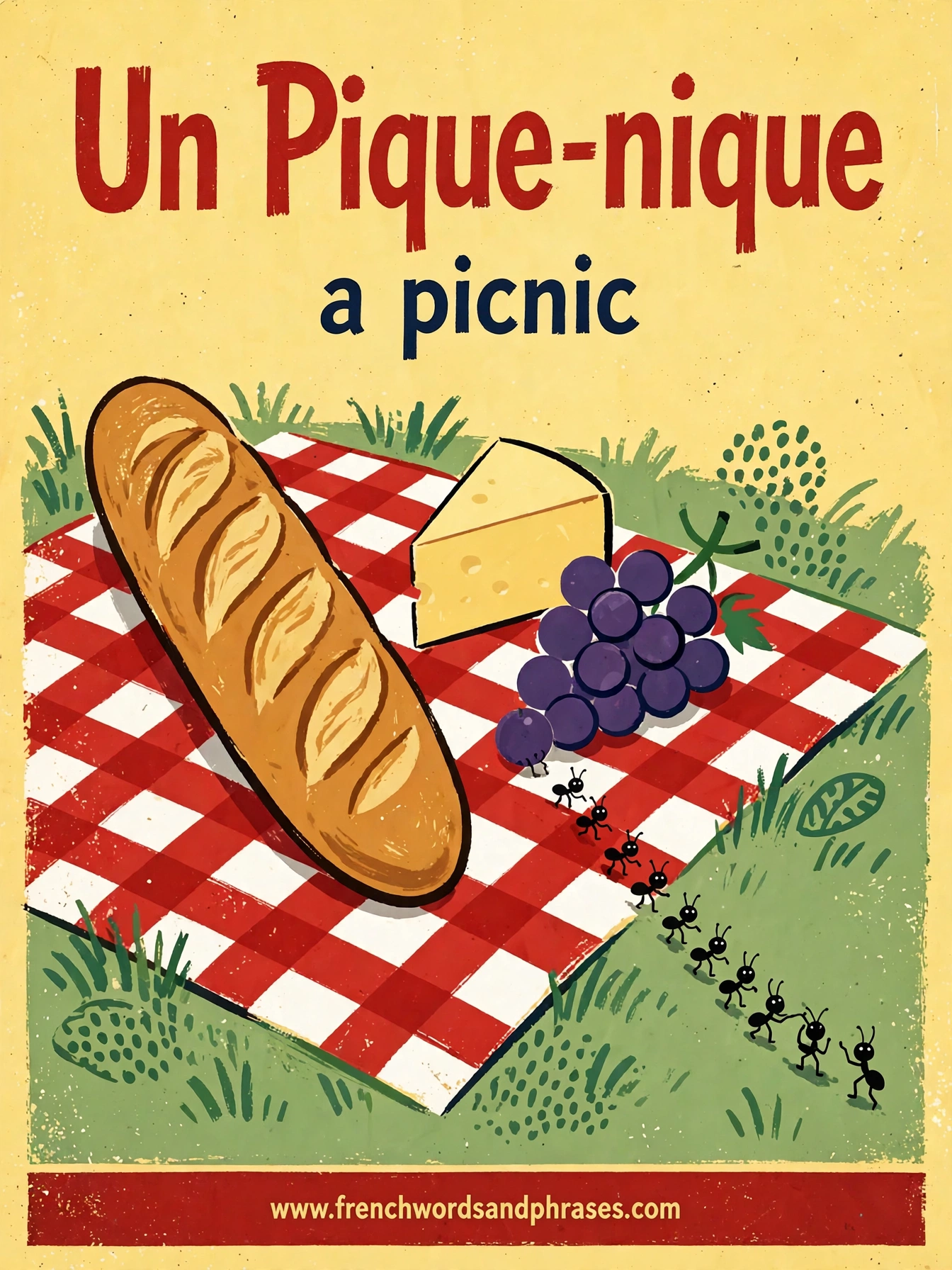
Le pique-nique means a picnic.
A blanket under the chestnut trees, a baguette broken by hand, cheese, tomatoes, a bottle opened with a satisfying pop. No table, no chairs, no reservation — the finest restaurant in France has no walls: le pique-nique.
In this guide, you’ll learn what pique-nique means in English, how to use it with its articles, how to form its plural, and how it appears in everyday French. Explore French examples, English translations, and practice quizzes.
Understanding the French Noun Pique-nique
Pique-nique is a masculine French noun. It is learned together with its article: le pique-nique, un pique-nique. It is a compound with a hyphen, built — so the story goes — from piquer, to peck or pick at, and an old word for a small thing: a meal of little things picked at, outdoors.
It means a picnic — a meal eaten outside, on a blanket or a bench, from a basket or a bag: sandwiches, salads, cheese, fruit, and something good to drink. The verb exists too: pique-niquer, to picnic. French takes the pique-nique seriously — it stops for it on country drives, builds whole holiday days around it, and argues happily about what belongs in the basket.
Gender: Masculine
Definite article: le — le pique-nique (the picnic)
Indefinite article: un — un pique-nique (a picnic)
Plural: les pique-niques — the hyphen stays, the -s goes at the end
English equivalents: A picnic.
One important usage detail: the spelling keeps its hyphen in the singular and the plural alike — un pique-nique, des pique-niques — and the plural -s attaches to the whole word, at the end. For the event, French says faire un pique-nique or organiser un pique-nique; for the action, pique-niquer: nous pique-niquons au bord de la rivière.
Experience the Word
Pique-nique is more than an outdoor meal. It is the art of the improvised feast — proof that a blanket, a view and good bread beat a white tablecloth every time.
Imagine the stop on the summer drive: the car parked under the trees, the boot turned into a kitchen, the cheese unwrapped like a present, and the whole valley laid out as your dining room.
You have not just eaten lunch. You have dined with the landscape as your guest.
How to Use Pique-nique in French: Complete Guide
Let’s explore how pique-nique works in French, beginning with its articles.
Pique-nique with the Definite Article (Le, Les)
Used for the picnic everyone is talking about — Sunday’s, the one by the river.
| Number | French |
|---|---|
| Singular | le pique-nique |
| Plural | les pique-niques |
Example
Le pique-nique commence à midi, sous les arbres.
The picnic starts at noon, under the trees.
Pique-nique with the Indefinite Article (Un, Des)
Used for a picnic in general — the one you are planning, the one the weather must approve.
| Number | French |
|---|---|
| Singular | un pique-nique |
| Plural | des pique-niques |
Example
Nous organisons un pique-nique pour dimanche.
We are organising a picnic for Sunday.
In the Basket: the Pique-nique Menu
Bread, cheese and fruit — the sacred contents of the French picnic basket.
| French | In English |
|---|---|
| le panier | the basket |
| la baguette | the baguette |
| le fromage | the cheese |
| les sandwichs | the sandwiches |
| la salade | the salad |
| les fruits | the fruit |
Example
Dans le panier du pique-nique, il y a du fromage et une baguette.
In the picnic basket, there is cheese and a baguette.
Quick Quiz 1
What is le panier, in a pique-nique?
Reveal the answer
The basket — the picnic’s portable kitchen, carrying bread, cheese and fruit.
Le panier est plein, le pique-nique peut commencer.
The basket is full; the picnic can begin.
The Plural of Pique-nique
The hyphen never moves and the -s goes at the very end: les pique-niques — not « piques-niques ».
| Number | French |
|---|---|
| Singular | le pique-nique |
| Plural | les pique-niques |
Example
Les pique-niques de l’été sont nos meilleurs souvenirs.
The summer’s picnics are our best memories.
Pique-nique with Possessive Adjectives (Mon, Ton, Son…)
Possessives agree with the noun, not with the owner — and pique-nique is masculine, so it takes mon, ton, son.
| Owner | French |
|---|---|
| my | mon pique-nique |
| your (tu) | ton pique-nique |
| his / her | son pique-nique |
| our | notre pique-nique |
| your (vous) | votre pique-nique |
| their | leur pique-nique |
Example
Notre pique-nique annuel a toujours lieu au bord du lac.
Our annual picnic always takes place by the lake.
Quick Quiz 2
Complete the sentence:
______ pique-nique de dimanche dépend du soleil. (Our)
Reveal the answer
Notre
Notre pique-nique de dimanche dépend du soleil.
Our Sunday picnic depends on the sun.
Pique-nique with Demonstrative Adjectives (Ce, Ces)
Used to point: this picnic here, those picnics there.
| Number | French |
|---|---|
| Singular | ce pique-nique |
| Plural | ces pique-niques |
Example
Ce pique-nique au bord de la rivière était parfait.
This picnic by the river was perfect.
Pique-nique with Adjectives
Adjectives agree with pique-nique, masculine — grand, simple, improvisé.
| Adjective | With Pique-nique |
|---|---|
| grand (big) | un grand pique-nique |
| simple (simple) | un pique-nique simple |
| improvisé (impromptu) | un pique-nique improvisé |
| familial (family) | un pique-nique familial |
| réussi (successful) | un pique-nique réussi |
Example
Un pique-nique improvisé vaut souvent mieux qu’un grand repas.
An impromptu picnic is often better than a big meal.
Quick Quiz 3
How do you write the plural — « les piques-niques » or « les pique-niques »?
Reveal the answer
Les pique-niques — the -s goes at the end of the whole word; the first part never changes.
Trois pique-niques en un été, quel bonheur !
Three picnics in one summer — what happiness!
Everyday Expressions with Pique-nique
Blankets, baskets and riverbanks — the pique-nique phrases of the season.
| Expression | In English |
|---|---|
| faire un pique-nique | to have a picnic |
| organiser un pique-nique | to organise a picnic |
| pique-niquer | to picnic (the verb) |
| un panier de pique-nique | a picnic basket |
| une aire de pique-nique | a picnic area |
| déjeuner sur l’herbe | to lunch on the grass |
Example
Il y a une aire de pique-nique à la sortie du village.
There is a picnic area at the edge of the village.
Words from the Same Family as Pique-nique
Eating outdoors — the words that travel with pique-nique.
| French | In English |
|---|---|
| pique-niquer | to picnic |
| le panier | the basket |
| la couverture | the blanket |
| l’herbe | the grass |
| déjeuner | to have lunch |
| le plein air | the open air |
Example
Ils déjeunent sur l’herbe, la couverture sous les arbres.
They lunch on the grass, the blanket under the trees.
Quick Quiz 4
What verb did French build from pique-nique?
Reveal the answer
Pique-niquer — to picnic. The meal became an action.
Nous pique-niquons au bord de la rivière.
We are picnicking by the river.
Pique-nique in Everyday French: Real-Life Examples
Now that you know the word, let’s see how pique-nique appears in everyday French.
Example 1 — The invitation
Dimanche, nous faisons un pique-nique au bord du lac.
On Sunday, we are having a picnic by the lake.
Example 2 — Packing
Elle prépare le panier du pique-nique dès le matin.
She packs the picnic basket first thing in the morning.
Example 3 — Finding the spot
Cette prairie est parfaite pour un pique-nique.
This meadow is perfect for a picnic.
Example 4 — The weather
S’il pleut, le pique-nique aura lieu sous le préau.
If it rains, the picnic will take place under the shelter.
Example 5 — School outing
Les enfants font un pique-nique dans le parc.
The children are having a picnic in the park.
Example 6 — Evening memory
Le pique-nique d’hier était le meilleur de l’été.
Yesterday’s picnic was the best of the summer.
Beyond Translation: The Meaning of Pique-nique
The pique-nique may be France’s most democratic meal: it asks for no reservation, no dress code and no kitchen — only a basket, a patch of grass and people you like. Painters knew it early: déjeuner sur l’herbe, lunch on the grass, became one of the most famous subjects in French art, and the country has been restaging the scene every fine Sunday since.
To say pique-nique is to open the basket and declare the meal begun.
It evokes the cork drawn under the chestnut trees, the ants politely ignored, the nap on the blanket after the cheese — lunch with the sky for a ceiling.
How to Remember the French Noun Pique-nique
Remember it this way: Pique-nique is the picnic — masculine, hyphenated, with the plural -s at the very end: les pique-niques.
- You plan it — nous organisons un pique-nique dimanche.
- You spell it — le trait d’union reste, le -s va à la fin : les pique-niques.
- You live it — on pique-nique au bord de la rivière.
The key idea is le pique-nique eats outdoors — the -s goes last.
Test Your Knowledge of Pique-nique
Let’s see how much you’ve learned. Try answering these questions before revealing the answers.
Question 1
Is pique-nique masculine or feminine?
Reveal the answer
Masculine — le pique-nique, un pique-nique.
Question 2
How do you say ‘to have a picnic’?
Reveal the answer
Faire un pique-nique — or use the verb pique-niquer.
Question 3
Translate: We are organising a picnic by the lake.
Reveal the answer
Nous organisons un pique-nique au bord du lac.
Question 4
How is the plural of pique-nique written?
Reveal the answer
Les pique-niques — hyphen kept, -s at the very end.
Question 5
Complete the sentence:
Dimanche, nous faisons ______ pique-nique dans la prairie.
Reveal the answer
un
Dimanche, nous faisons un pique-nique dans la prairie.
On Sunday, we are having a picnic in the meadow.
Your Final Challenge
Can You Use It?
How would you say this in French?
“On Sunday, we are having a picnic by the river.”
Reveal the answer
Dimanche, nous faisons un pique-nique au bord de la rivière.
On Sunday, we are having a picnic by the river.
A little French. A little curiosity. A richer everyday life.
LEARN FRENCH ONE WORD AT A TIME