
A French Word to Live By
Translate Sortie to English
/sɔʁ.ti/
La sortie means an outing.
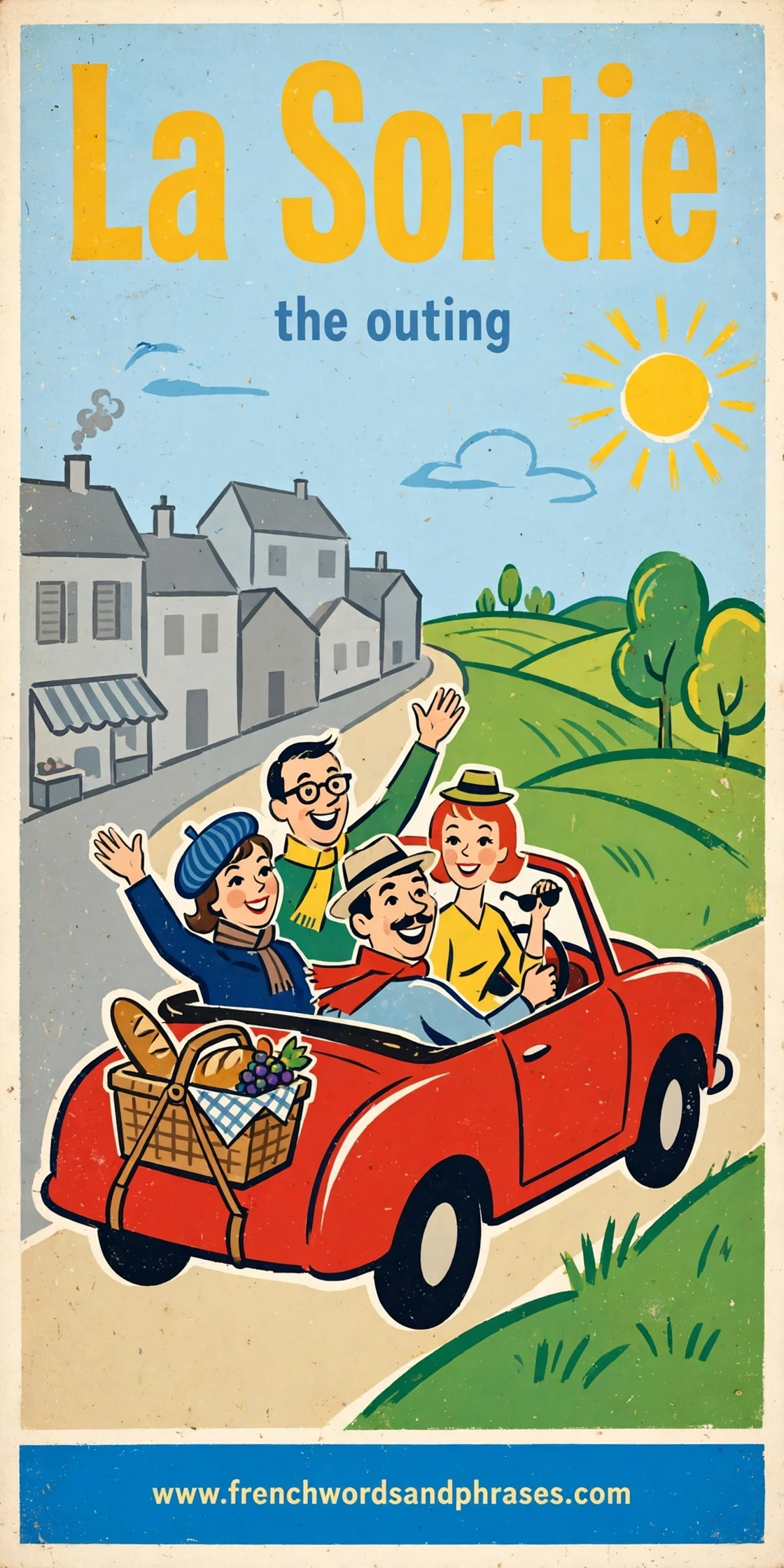
Saturday, nine o’clock. Coats are going on, the picnic bag is by the door, and the children are already arguing about who sits by the window. The best moment of the French week is about to begin — la sortie.
In this guide, you’ll learn what sortie means in English, how to use it with its articles, how to form its plural, and how it appears in everyday French. Explore French examples, English translations, and practice quizzes.
Understanding the French Noun Sortie
Sortie is a feminine French noun. It is learned together with its article: la sortie, une sortie. It comes from the verb sortir, to go out — a sortie is the going-out itself, turned into an event you can plan, book and look forward to.
It means an outing — a trip out of the house for pleasure: une sortie en famille (a family outing), une sortie au musée (an outing to the museum), une sortie scolaire (a school trip). It is the word French families, schools and clubs reach for whenever a day out is being organised, from a picnic in the park to an evening at the theatre.
Gender: Feminine
Definite article: la — la sortie (the outing)
Indefinite article: une — une sortie (an outing)
Plural: les sorties
English equivalents: An outing, a trip out — and, on doors and signs, an exit.
One important usage detail: the word works two shifts. Planned with friends, une sortie is an outing. Painted above a door, la sortie is the exit — la sortie de secours is the emergency exit. Context always tells you which one you are looking at: you organise an outing, but you look for the exit.
Experience the Word
Sortie is more than a trip out. It is the French art of leaving the house together — the planned pleasure that gives the week its shape.
Imagine the class trip: twenty children in matching caps, a teacher counting heads for the tenth time, sandwiches in every backpack, and the whole bus singing before it has even left the town.
You have not just gone out. You have made a sortie — the day out, French style.
How to Use Sortie in French: Complete Guide
Let’s explore how sortie works in French, beginning with its articles.
Sortie with the Definite Article (La, Les)
Used for the outing everyone in the conversation knows — the one planned for Saturday, the one in the diary.
| Number | French |
|---|---|
| Singular | la sortie |
| Plural | les sorties |
Example
La sortie de samedi est annulée à cause de la pluie.
Saturday’s outing is cancelled because of the rain.
Sortie with the Indefinite Article (Une, Des)
Used for an outing in general — the one you are suggesting, the one on the poster.
| Number | French |
|---|---|
| Singular | une sortie |
| Plural | des sorties |
Example
Nous organisons une sortie au bord de la mer.
We are organising an outing to the seaside.
Sorties for Every Occasion
Family, school or friends — there is a sortie for every group and every budget.
| French | In English |
|---|---|
| une sortie en famille | a family outing |
| une sortie scolaire | a school trip |
| une sortie au cinéma | a trip to the cinema |
| une sortie entre amis | an outing with friends |
| une sortie à vélo | a bike ride, a cycling outing |
| une sortie culturelle | a cultural outing |
Example
La sortie scolaire au château plaît beaucoup aux enfants.
The school trip to the castle delights the children.
Quick Quiz 1
What is une sortie scolaire?
Reveal the answer
A school trip — an outing organised by a school for its pupils.
La sortie scolaire a lieu vendredi prochain.
The school trip takes place next Friday.
The Plural of Sortie
Sortie adds an -s in the plural — les sorties, the outings of a busy month.
| Number | French |
|---|---|
| Singular | la sortie |
| Plural | les sorties |
Example
Les sorties du week-end sont le meilleur moment de la semaine.
The weekend outings are the best moment of the week.
Sortie with Possessive Adjectives (Ma, Ta, Sa…)
Possessives agree with the noun, not with the owner — and sortie is feminine, so it takes ma, ta, sa.
| Owner | French |
|---|---|
| my | ma sortie |
| your (tu) | ta sortie |
| his / her | sa sortie |
| our | notre sortie |
| your (vous) | votre sortie |
| their | leur sortie |
Example
Notre sortie commence à dix heures devant l’école.
Our outing starts at ten o’clock in front of the school.
Quick Quiz 2
Complete the sentence:
______ sortie est prévue demain matin. (Our)
Reveal the answer
Notre
Notre sortie est prévue demain matin.
Our outing is planned for tomorrow morning.
Sortie with Demonstrative Adjectives (Cette, Ces)
Used to point: this outing here, those outings there.
| Number | French |
|---|---|
| Singular | cette sortie |
| Plural | ces sorties |
Example
Cette sortie coûte dix euros par personne.
This outing costs ten euros per person.
Sortie with Adjectives
Adjectives agree with sortie, feminine — grande, petite, longue, belle.
| Adjective | With Sortie |
|---|---|
| grande (big) | une grande sortie |
| petite (small) | une petite sortie |
| longue (long) | une longue sortie |
| belle (lovely) | une belle sortie |
| culturelle (cultural) | une sortie culturelle |
Example
Une belle sortie demande un peu d’organisation.
A lovely outing takes a little organising.
Quick Quiz 3
Complete the sentence:
Une sortie ______ au musée est prévue vendredi. (school)
Reveal the answer
scolaire
Une sortie scolaire au musée est prévue vendredi.
A school outing to the museum is planned for Friday.
Everyday Expressions with Sortie
Planning, going and coming home — the sortie phrases of the week.
| Expression | In English |
|---|---|
| organiser une sortie | to organise an outing |
| faire une sortie | to go on an outing |
| partir en sortie | to set off on an outing |
| annuler une sortie | to cancel an outing |
| une sortie en groupe | a group outing |
| la sortie de l’école | the end of the school day, when school comes out |
Example
Nous faisons une sortie en groupe dimanche.
We are going on a group outing on Sunday.
Words from the Same Family as Sortie
Going out, coming back and finding the door — the words that travel with sortie.
| French | In English |
|---|---|
| sortir | to go out |
| la sortie de secours | the emergency exit |
| l’entrée | the entrance — the opposite door |
| le retour | the return |
| la balade | a walk, a stroll |
| l’excursion | an excursion, a day trip |
Example
La sortie de secours est derrière le bâtiment.
The emergency exit is behind the building.
Quick Quiz 4
You are in a museum and see SORTIE written above a door. Is it announcing an outing?
Reveal the answer
No — above a door, sortie means exit, the way out of the building. The outing sense belongs to plans and people.
La sortie est à gauche, après la boutique.
The exit is on the left, past the shop.
Sortie in Everyday French: Real-Life Examples
Now that you know the word, let’s see how sortie appears in everyday French.
Example 1 — Planning the weekend
Nous préparons une sortie pour samedi.
We are preparing an outing for Saturday.
Example 2 — At school
La classe fait une sortie au zoo.
The class is going on an outing to the zoo.
Example 3 — With friends
Une sortie entre amis, ça te dit ?
An outing with friends, how does that sound?
Example 4 — Bad weather
La sortie est reportée à cause de la pluie.
The outing is postponed because of the rain.
Example 5 — At the cinema
La sortie du cinéma est sur le côté.
The cinema exit is on the side.
Example 6 — Family day
Dimanche, c’est sortie en famille au parc.
On Sunday, it’s a family outing to the park.
Beyond Translation: The Meaning of Sortie
Sortie is the noun of the verb sortir, and it carries the energy of the verb inside it: a sortie is never an accident, it is a decision — coats on, door closed, the day claimed. French schools build their year around sorties scolaires, French clubs around sorties en groupe, and French families around the Sunday sortie that needs no reason at all.
To say sortie is to open the front door on a plan.
And the word never fully leaves the doorway: the same sortie that takes you out for pleasure also shows you the way out of the cinema — the exit sign and the day trip are one word, because both are about crossing the threshold.
How to Remember the French Noun Sortie
Remember it this way: Sortie is the outing — feminine, born from sortir, and above a door it becomes the exit.
- You plan it — nous organisons une sortie pour samedi.
- You sort the occasions — une sortie scolaire, une sortie en famille, une sortie entre amis.
- You read the signs — la sortie above a door is the exit, la sortie de secours the emergency exit.
The key idea is la sortie is the outing — and the way out.
Test Your Knowledge of Sortie
Let’s see how much you’ve learned. Try answering these questions before revealing the answers.
Question 1
Is sortie masculine or feminine?
Reveal the answer
Feminine — la sortie, une sortie.
Question 2
How do you say a school trip in French?
Reveal the answer
Une sortie scolaire — the school’s outing.
Question 3
Translate: We are organising an outing to the seaside.
Reveal the answer
Nous organisons une sortie au bord de la mer.
Question 4
What is la sortie de secours?
Reveal the answer
The emergency exit — above a door, sortie means the way out.
Question 5
Complete the sentence:
Dimanche, nous faisons ______ sortie en famille.
Reveal the answer
une
Dimanche, nous faisons une sortie en famille.
On Sunday, we are going on a family outing.
Your Final Challenge
Can You Use It?
How would you say this in French?
“We are organising an outing with the children on Sunday.”
Reveal the answer
Nous organisons une sortie avec les enfants dimanche.
We are organising an outing with the children on Sunday.
A little French. A little curiosity. A richer everyday life.
LEARN FRENCH ONE WORD AT A TIME




