
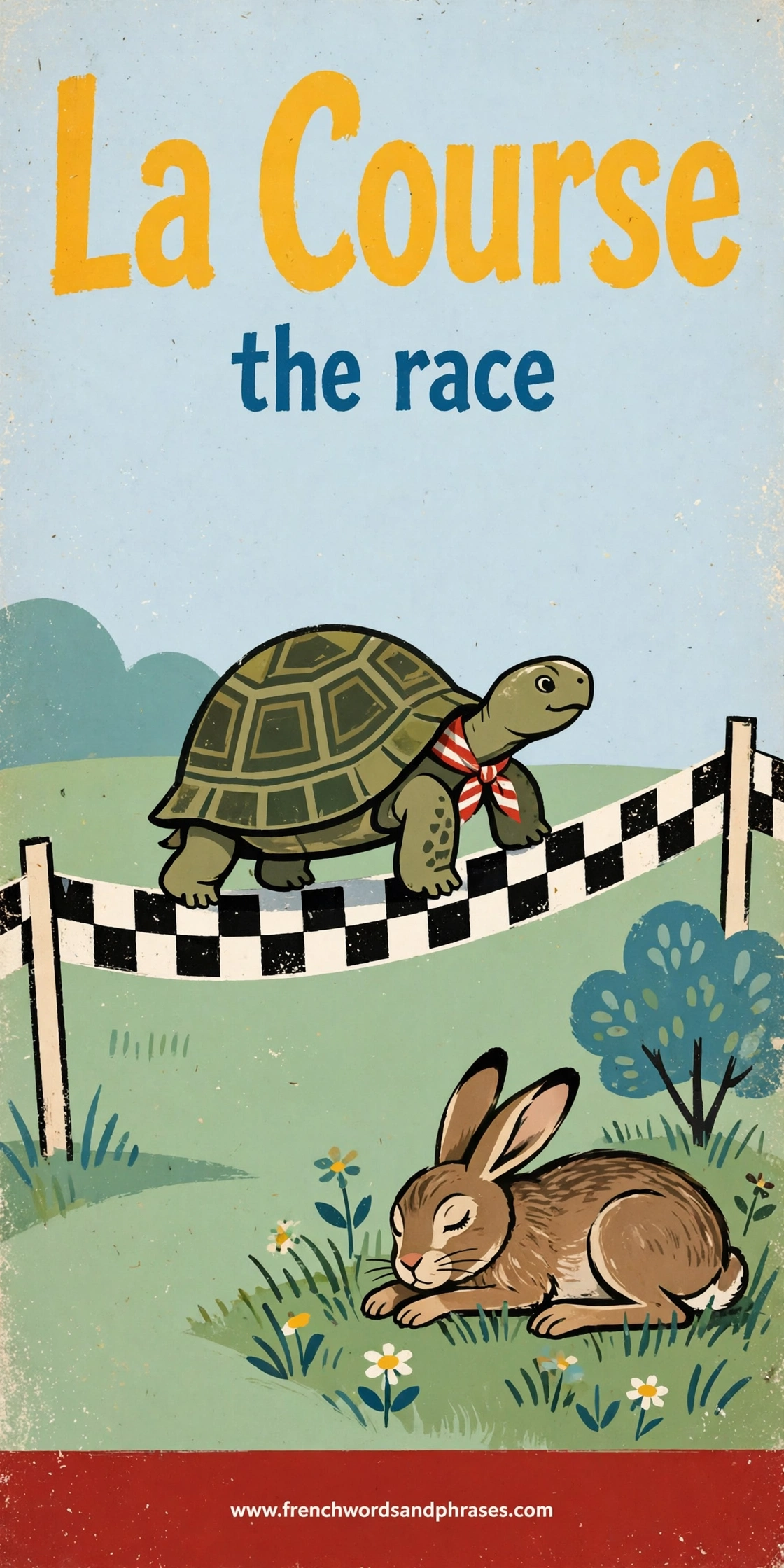
A French Word to Live By
Translate Course to English
/kuʁs/
La course means running, a race.
Saturday morning, the park fills up: lycra, water bottles, a banner over the path. Some are chasing a medal, most are chasing nothing but the pleasure of moving. All of them are here for the same thing — la course.
In this guide, you’ll learn what course means in English, how to use it with its articles, how to form its plural, and how it appears in everyday French. Explore French examples, English translations, and practice quizzes.
Understanding the French Noun Course
Course is a feminine French noun. It is learned together with its article: la course, une course. It comes from the verb courir, to run — and in the world of free time it names both the activity, running, and the event, a race.
It means running, and a race — the sport you practise alone at dawn (la course à pied, running, literally running on foot) and the organised event with numbers pinned to chests: une course de dix kilomètres, a ten-kilometre race. But handle the word with care: outside sport, les courses in the plural usually means the shopping, and une course can be a single errand — the traps section below untangles them.
Gender: Feminine
Definite article: la — la course (the race, the running)
Indefinite article: une — une course (a race)
Plural: les courses — careful: in everyday French, les courses usually means the shopping
English equivalents: Running; a race. In other contexts: an errand, the shopping.
One important usage detail: for the activity, French says faire de la course or, more fully, faire de la course à pied — I do some running. The event keeps the article: je participe à une course dimanche, I am taking part in a race on Sunday. And never confuse la course with le cours: le cours is a lesson or a class — a false friend hiding one letter away.
Experience the Word
Course is more than exercise. It is the simplest sport in the world — a pair of shoes, a door, and the road is yours.
Imagine the first cool hour of the day: the streets still empty, your breath settling into its rhythm, the town waking up one shutter at a time as you pass. No team, no timetable, no equipment to book.
You have not just burned calories. You have stolen an hour of the day for yourself — at a run.
How to Use Course in French: Complete Guide
Let’s explore how course works in French, beginning with its articles.
Course with the Definite Article (La, Les)
Used for the race everyone is talking about — the one on Sunday, the one in the park.
| Number | French |
|---|---|
| Singular | la course |
| Plural | les courses |
Example
La course commence à neuf heures précises.
The race starts at nine o’clock sharp.
Course with the Indefinite Article (Une, Des)
Used for a race in general — the one you are training for, the one you dream of finishing.
| Number | French |
|---|---|
| Singular | une course |
| Plural | des courses |
Example
Elle prépare une course de dix kilomètres pour le printemps.
She is training for a ten-kilometre race in the spring.
Course with the Partitive (De la)
For the activity itself — some running, done regularly — French uses de la with faire.
| French | In English |
|---|---|
| faire de la course | to go running, to do some running |
| faire de la course à pied | to go running (on foot) |
| faire un peu de course | to do a bit of running |
| je fais de la course le matin | I go running in the morning |
Example
Il fait de la course à pied trois fois par semaine.
He goes running three times a week.
Quick Quiz 1
How do you say ‘to go running’ as an activity?
Reveal the answer
Faire de la course (à pied) — the partitive turns the noun into an activity.
Je fais de la course à pied le dimanche matin.
I go running on Sunday mornings.
The Plural of Course
Course adds an -s in the plural — les courses. In sports talk these are races; in daily life, beware, they are usually the shopping.
| Number | French |
|---|---|
| Singular | la course |
| Plural | les courses |
Example
Il a gagné trois courses cette saison.
He has won three races this season.
Course with Possessive Adjectives (Ma, Ta, Sa…)
Possessives agree with the noun, not with the owner — and course is feminine, so it takes ma, ta, sa.
| Owner | French |
|---|---|
| my | ma course |
| your (tu) | ta course |
| his / her | sa course |
| our | notre course |
| your (vous) | votre course |
| their | leur course |
Example
Sa course du dimanche, il ne la rate jamais.
His Sunday run — he never misses it.
Quick Quiz 2
Complete the sentence:
______ course préférée a lieu en octobre. (My)
Reveal the answer
Ma
Ma course préférée a lieu en octobre.
My favourite race takes place in October.
Course with Demonstrative Adjectives (Cette, Ces)
Used to point: this race here, those races there.
| Number | French |
|---|---|
| Singular | cette course |
| Plural | ces courses |
Example
Cette course attire des coureurs de toute la région.
This race attracts runners from the whole region.
Course with Adjectives
Adjectives agree with course, feminine — longue, difficile, belle.
| Adjective | With Course |
|---|---|
| longue (long) | une longue course |
| courte (short) | une course courte |
| difficile (hard) | une course difficile |
| rapide (fast) | une course rapide |
| belle (beautiful) | une belle course |
Example
Après une longue course, rien ne vaut une bonne douche.
After a long run, nothing beats a good shower.
Quick Quiz 3
Your friend says: « Je vais faire les courses. » Is she going running?
Reveal the answer
No — faire les courses means doing the shopping. For running, it is faire de la course.
Elle va faire les courses au marché.
She is going shopping at the market.
Everyday Expressions with Course
Races, training and finish lines — the course phrases of the weekend.
| Expression | In English |
|---|---|
| la course à pied | running (on foot) |
| participer à une course | to take part in a race |
| gagner une course | to win a race |
| une course contre la montre | a race against the clock |
| être en pleine course | to be mid-run, in full stride |
| la ligne d’arrivée | the finish line |
Example
Des milliers de personnes participent à la course de dimanche.
Thousands of people are taking part in Sunday’s race.
Words from the Same Family as Course
Running, runners and racing — the words that travel with course.
| French | In English |
|---|---|
| courir | to run |
| un coureur / une coureuse | a runner |
| le parcours | the route, the course (of a race) |
| s’entraîner | to train |
| le marathon | the marathon |
| le sprint | the sprint |
Example
Les coureurs suivent le parcours le long de la rivière.
The runners follow the route along the river.
Quick Quiz 4
What is the difference between la course and le cours?
Reveal the answer
La course is the race or the running; le cours is a lesson — one letter changes everything.
Après le cours, je fais de la course.
After the lesson, I go running.
Course in Everyday French: Real-Life Examples
Now that you know the word, let’s see how course appears in everyday French.
Example 1 — Training
Je fais de la course à pied avant le petit déjeuner.
I go running before breakfast.
Example 2 — Race day
La course commence place de la Mairie.
The race starts in the town hall square.
Example 3 — Signing up
Nous nous inscrivons à une course de cinq kilomètres.
We are signing up for a five-kilometre race.
Example 4 — Watching
Les spectateurs encouragent les coureurs le long de la course.
The spectators cheer the runners on along the race.
Example 5 — The trap
Après la course, je dois encore faire les courses !
After the race, I still have to do the shopping!
Example 6 — Progress
Chaque semaine, ma course devient un peu plus facile.
Every week, my running gets a little easier.
Beyond Translation: The Meaning of Course
La course is the most democratic of sports: no pitch to rent, no partner to find, no season to wait for — just shoes and a street. France celebrates it everywhere, from the great Paris marathon to the smallest village fun run, where the mayor fires the starting pistol and the whole commune turns out to clap.
To say course is to lace up and go.
But keep your ear tuned: the same word does the shopping and runs the errands of daily life — les courses — as if French wanted to remind you that ordinary days, too, are run at a pace.
How to Remember the French Noun Course
Remember it this way: Course is running and the race — feminine, with la and une, from the verb courir, to run.
- You train — je fais de la course à pied.
- You compete — elle participe à une course dimanche.
- You dodge the trap — faire les courses, c’est le shopping, pas le sport.
The key idea is la course runs — les courses go shopping.
Test Your Knowledge of Course
Let’s see how much you’ve learned. Try answering these questions before revealing the answers.
Question 1
Is course masculine or feminine?
Reveal the answer
Feminine — la course, une course.
Question 2
How do you say running, the activity on foot?
Reveal the answer
La course à pied — faire de la course à pied, to go running.
Question 3
Translate: The race starts at nine o’clock.
Reveal the answer
La course commence à neuf heures.
Question 4
What does faire les courses mean?
Reveal the answer
To do the shopping — not to run races. The plural changes the word’s job.
Question 5
Complete the sentence:
Elle fait de ______ course tous les matins.
Reveal the answer
la
Elle fait de la course tous les matins.
She goes running every morning.
Your Final Challenge
Can You Use It?
How would you say this in French?
“On Sunday, I am taking part in a race in the park.”
Reveal the answer
Dimanche, je participe à une course dans le parc.
On Sunday, I am taking part in a race in the park.
A little French. A little curiosity. A richer everyday life.
LEARN FRENCH ONE WORD AT A TIME




