
A French Word to Live By
Translate Chanson to English
/ʃɑ̃.sɔ̃/
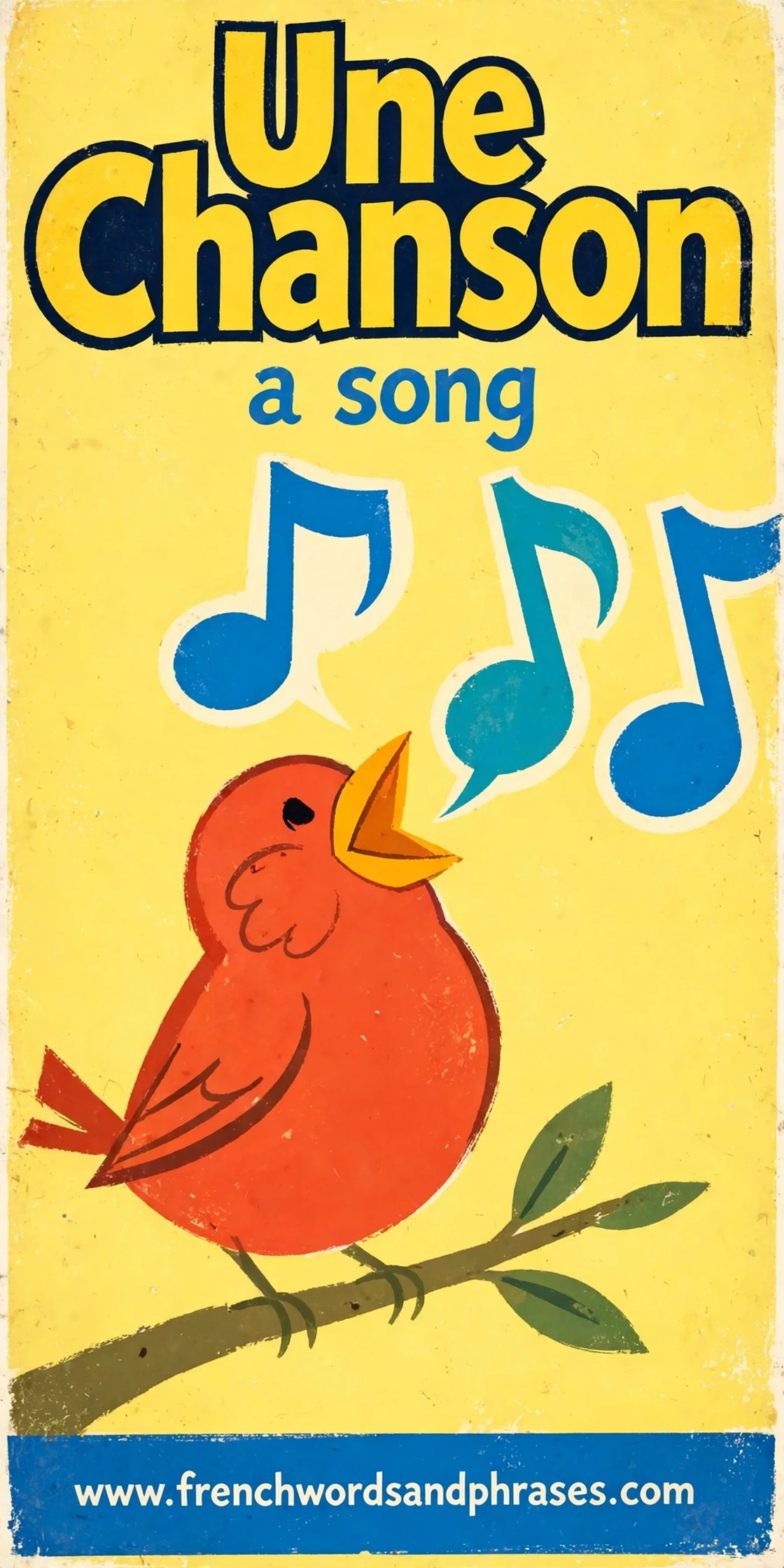
La chanson means a song.
In a café in Lyon, the old man at the next table hears three notes from the radio and starts to hum — then, quietly, to sing every word. It is a song from his youth, and the whole room seems to know it: une chanson.
In this guide, you’ll learn what chanson means in English, how to use it with its articles, how to form its plural, and how it appears in everyday French. Explore French examples, English translations, and practice quizzes.
Understanding the French Noun Chanson
Chanson is a feminine French noun. It is learned together with its article: la chanson, une chanson. France gave the word a whole genre of its own — la chanson française, the art of the crafted, poetic song, from Piaf and Brassens to Aznavour.
It means a song — a piece of music with words, made to be sung: une chanson d’amour, a love song; une chanson pour enfants, a children’s song. A chanson has des paroles (lyrics), un refrain (a chorus) that everyone joins in, and des couplets (verses) in between.
Gender: Feminine
Definite article: la — la chanson (the song)
Indefinite article: une — une chanson (a song)
Plural: les chansons
English equivalents: A song.
One important usage detail: chanson is the song you sing and hear on the radio. Its cousin le chant is singing itself, or a hymn, an anthem, birdsong — le chant des oiseaux. And in everyday speech, c’est toujours la même chanson means it is always the same old story.
Experience the Word
Chanson is more than three minutes of music. It is the song a whole country can sing from memory — the one at weddings, at funerals, on the radio of every café.
Imagine a family dinner: grandfather starts an old refrain, mother joins on the second line, and by the chorus the children are singing words older than the house itself.
You have not just heard a tune. You have inherited a chanson.
How to Use Chanson in French: Complete Guide
Let’s explore how chanson works in French, beginning with its articles.
Chanson with the Definite Article (La, Les)
Used for the song everyone knows — the one on the radio, the one we were just singing.
| Number | French |
|---|---|
| Singular | la chanson |
| Plural | les chansons |
Example
La chanson passe à la radio tous les matins.
The song plays on the radio every morning.
Chanson with the Indefinite Article (Une, Des)
Used for a song in general — the one you are writing, the one stuck in your head.
| Number | French |
|---|---|
| Singular | une chanson |
| Plural | des chansons |
Example
Il a écrit une chanson pour sa fille.
He wrote a song for his daughter.
Inside a Chanson: Verses and Chorus
Lyrics, chorus and melody — the parts every chanson is built from.
| French | In English |
|---|---|
| les paroles | the lyrics, the words |
| le refrain | the chorus |
| le couplet | the verse |
| la mélodie | the melody |
| le rythme | the rhythm |
| l’air | the tune |
Example
Tout le monde connaît le refrain de cette chanson.
Everyone knows the chorus of this song.
Quick Quiz 1
What is le refrain?
Reveal the answer
The chorus — the part of the song that comes back, the part everyone sings.
Les enfants chantent le refrain très fort.
The children sing the chorus very loudly.
The Plural of Chanson
Chanson adds an -s in the plural — les chansons, the songs of a singer, an album, a lifetime.
| Number | French |
|---|---|
| Singular | la chanson |
| Plural | les chansons |
Example
Les chansons de Brassens sont de petits poèmes.
Brassens’ songs are little poems.
Chanson with Possessive Adjectives (Ma, Ta, Sa…)
Possessives agree with the noun, not with the owner — and chanson is feminine, so it takes ma, ta, sa.
| Owner | French |
|---|---|
| my | ma chanson |
| your (tu) | ta chanson |
| his / her | sa chanson |
| our | notre chanson |
| your (vous) | votre chanson |
| their | leur chanson |
Example
Ma chanson préférée passe à la radio.
My favourite song is playing on the radio.
Quick Quiz 2
Complete the sentence:
______ chanson préférée est une vieille chanson d’amour. (Her)
Reveal the answer
Sa
Sa chanson préférée est une vieille chanson d’amour.
Her favourite song is an old love song.
Chanson with Demonstrative Adjectives (Cette, Ces)
Used to point: this song here, those songs there.
| Number | French |
|---|---|
| Singular | cette chanson |
| Plural | ces chansons |
Example
Cette chanson me rappelle mon enfance.
This song reminds me of my childhood.
Chanson with Adjectives
Adjectives agree with chanson, feminine — belle, douce, célèbre.
| Adjective | With Chanson |
|---|---|
| belle (beautiful) | une belle chanson |
| douce (gentle) | une chanson douce |
| célèbre (famous) | une chanson célèbre |
| entraînante (catchy) | une chanson entraînante |
| ancienne (old) | une ancienne chanson |
Example
C’est une chanson entraînante, impossible de l’oublier.
It’s a catchy song, impossible to forget.
Quick Quiz 3
Complete the sentence:
Nous chantons une ______ chanson de Brassens. (beautiful)
Reveal the answer
belle
Nous chantons une belle chanson de Brassens.
We are singing a beautiful song by Brassens.
Everyday Expressions with Chanson
Singing, learning by heart and the same old story — the chanson phrases of daily life.
| Expression | In English |
|---|---|
| chanter une chanson | to sing a song |
| une chanson d’amour | a love song |
| les paroles d’une chanson | the lyrics of a song |
| apprendre une chanson par cœur | to learn a song by heart |
| fredonner une chanson | to hum a song |
| c’est toujours la même chanson | it’s always the same old story |
Example
Les enfants apprennent une chanson par cœur pour la fête de l’école.
The children are learning a song by heart for the school festival.
Words from the Same Family as Chanson
Singing, singers and music — the words that travel with chanson.
| French | In English |
|---|---|
| chanter | to sing |
| le chanteur, la chanteuse | the singer |
| la musique | music |
| le refrain | the chorus |
| les paroles | the lyrics |
| composer | to compose |
Example
La chanteuse compose ses chansons elle-même.
The singer composes her songs herself.
Quick Quiz 4
Your colleague explains, for the third time this week, why his train was late, and someone murmurs: « C’est toujours la même chanson. » What do they mean?
Reveal the answer
It’s always the same old story — la même chanson, the same excuse heard a hundred times.
Encore en retard ? C’est toujours la même chanson !
Late again? It’s always the same old story!
Chanson in Everyday French: Real-Life Examples
Now that you know the word, let’s see how chanson appears in everyday French.
Example 1 — On the radio
J’adore cette chanson, monte le son !
I love this song, turn it up!
Example 2 — At a wedding
À la fin du repas, les invités chantent une chanson pour les mariés.
At the end of the meal, the guests sing a song for the newlyweds.
Example 3 — Learning by heart
Ma fille apprend une chanson par cœur pour l’école.
My daughter is learning a song by heart for school.
Example 4 — Humming
Il fredonne une chanson en travaillant dans le jardin.
He hums a song while working in the garden.
Example 5 — An old favourite
Cette chanson date des années soixante.
This song dates from the sixties.
Example 6 — The same old story
Il a encore oublié son parapluie, c’est toujours la même chanson.
He has forgotten his umbrella again, it’s always the same old story.
Beyond Translation: The Meaning of Chanson
La chanson française is a national treasure with its own rules: the words matter as much as the music, and the great chanteurs — Piaf, Brassens, Barbara, Aznavour — are remembered as poets as much as singers. A good chanson tells a whole life in three minutes.
To say chanson is to hear a whole room start to sing.
It evokes the refrain everyone knows, the lyrics learned by heart at school, the old song on the café radio that stops conversations — France’s memory, carried in feminine form.
How to Remember the French Noun Chanson
Remember it this way: Chanson is a song — feminine, with la and une, built from paroles, couplets and a refrain.
- You sing it — on chante une chanson à la fin du repas.
- You learn its heart — le refrain revient, les couplets racontent.
- You dodge the idiom — c’est toujours la même chanson, the same old story.
The key idea is une chanson — sing it, then learn its refrain by heart.
Test Your Knowledge of Chanson
Let’s see how much you’ve learned. Try answering these questions before revealing the answers.
Question 1
Is chanson masculine or feminine?
Reveal the answer
Feminine — la chanson, une chanson.
Question 2
What are les paroles of a song?
Reveal the answer
The lyrics — the words of the chanson.
Question 3
Translate: The children are singing a song.
Reveal the answer
Les enfants chantent une chanson.
Question 4
What is the difference between une chanson and le chant?
Reveal the answer
Une chanson is a song; le chant is singing itself, or a hymn, an anthem, birdsong.
Question 5
Complete the sentence:
Tout le monde connaît ______ chanson.
Reveal the answer
cette
Tout le monde connaît cette chanson.
Everyone knows this song.
Your Final Challenge
Can You Use It?
How would you say this in French?
“The children are learning a song for the school festival.”
Reveal the answer
Les enfants apprennent une chanson pour la fête de l’école.
The children are learning a song for the school festival.
A little French. A little curiosity. A richer everyday life.
LEARN FRENCH ONE WORD AT A TIME




