A French Word to Live By
Translate Cinéma to English
/si.ne.ma/
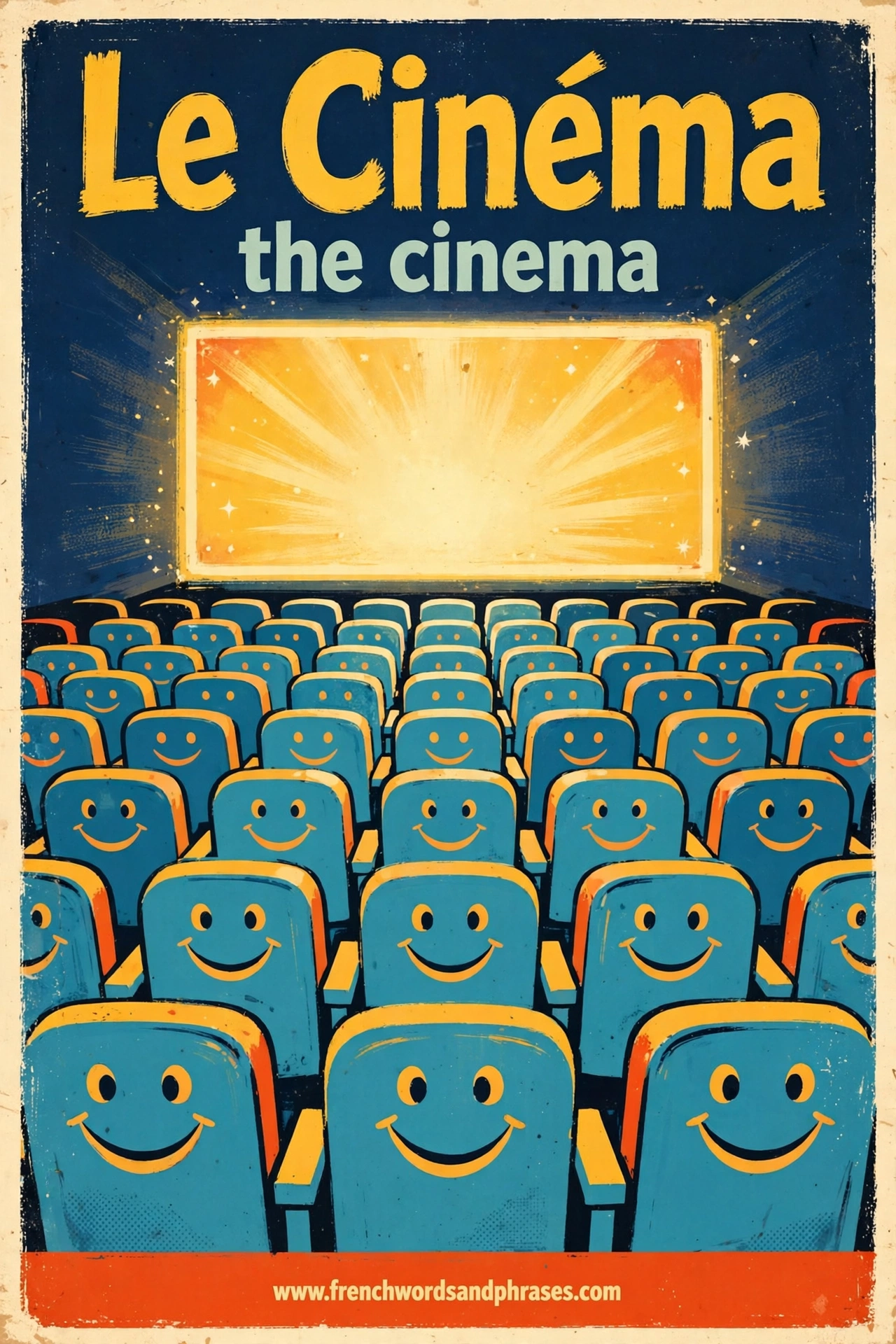
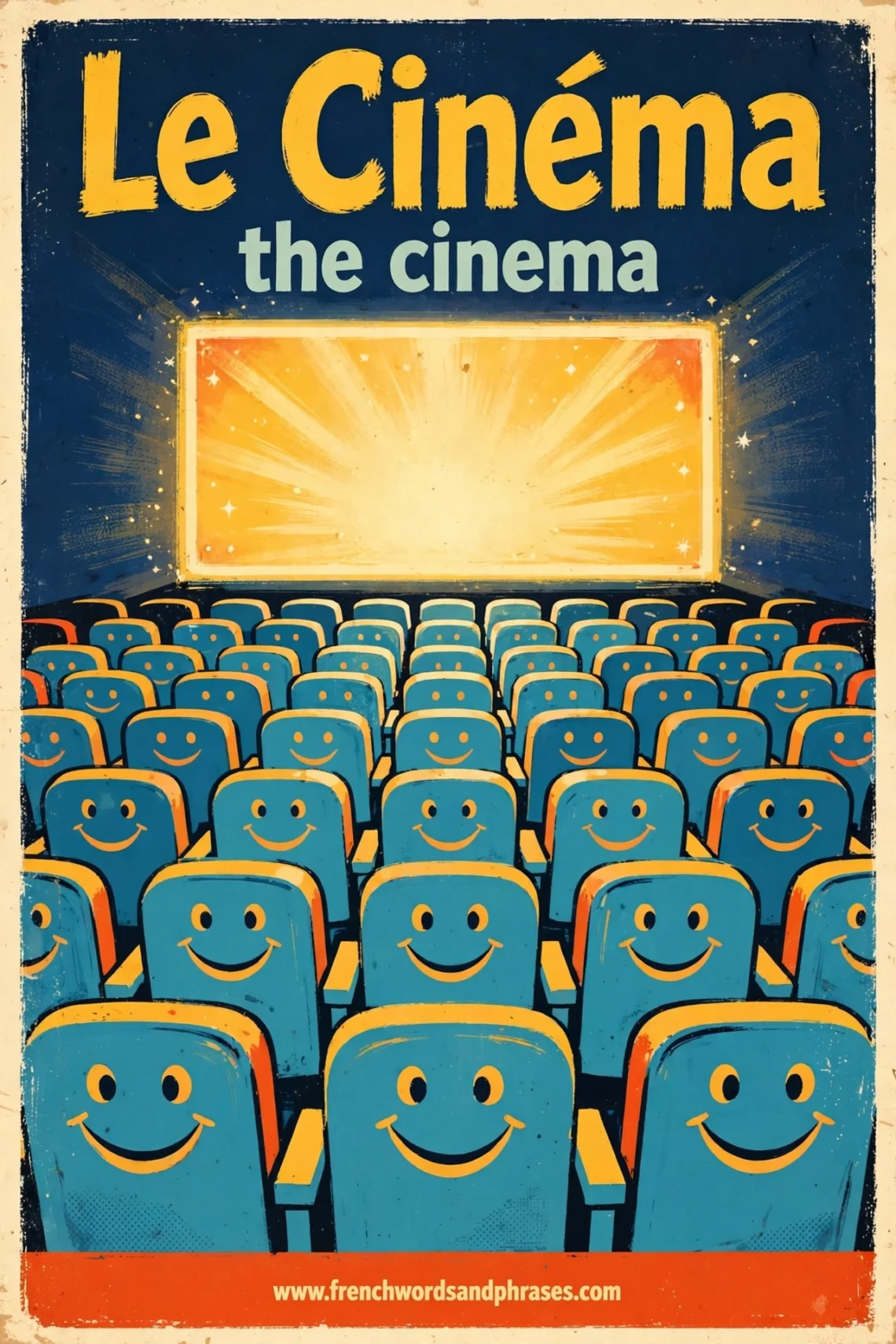
Le cinéma means the cinema.
Friday evening, the queue is already curling around the corner: students with popcorn, an old couple holding hands, everyone reading the posters one more time. In France, the week ends in the same place — le cinéma.
In this guide, you’ll learn what cinéma means in English, how to use it with its articles, how to form its plural, and how it appears in everyday French. Explore French examples, English translations, and practice quizzes.
Understanding the French Noun Cinéma
Cinéma is a masculine French noun. It is learned together with its article: le cinéma, un cinéma. The word is a shortened form of cinématographe, the Lumière brothers’ invention — and France, which gave the world its first film screening in 1895, has loved the word ever since.
It means the cinema — two things at once: the place, the building with its dark rooms and big screen where you watch un film, and the art itself, the world of films. Aller au cinéma, to go to the cinema, is one of the great French habits: the French go to the pictures more than almost anyone else in Europe.
Gender: Masculine
Definite article: le — le cinéma (the cinema)
Indefinite article: un — un cinéma (a cinema)
Plural: les cinémas
English equivalents: The cinema; a movie theatre — and, for the art, film, the movies.
One important usage detail: aller au cinéma is the everyday phrase — au, never à le. And beware the idiom: faire du cinéma does not mean making films; it means making a fuss, putting on an act — arrête de faire du cinéma, stop making such a scene!
Experience the Word
Cinéma is more than a building. It is the Friday-night ritual of French towns — the posters in the window, the queue at the guichet, the lights going down on a room full of strangers who have all come to dream the same dream.
Imagine the small cinema of a provincial town: red seats, a curtain, the beam of light over your head, and the whole village in the dark together, laughing at the same moment.
You have not just watched a film. You have shared the dark, the French way.
How to Use Cinéma in French: Complete Guide
Let’s explore how cinéma works in French, beginning with its articles.
Cinéma with the Definite Article (Le, Les)
Used for the cinema everyone knows — the one in your town, the one on the corner.
| Number | French |
|---|---|
| Singular | le cinéma |
| Plural | les cinémas |
Example
Le cinéma du quartier a trois salles.
The neighbourhood cinema has three screens.
Cinéma with the Indefinite Article (Un, Des)
Used for a cinema in general — the one in the advert, the one a town is dreaming of.
| Number | French |
|---|---|
| Singular | un cinéma |
| Plural | des cinémas |
Example
Il y a un cinéma juste à côté de la gare.
There is a cinema right next to the station.
At the Cinéma: the Evening Out
Screen, showing and ticket office — the words of a night at the pictures.
| French | In English |
|---|---|
| le film | the film |
| la séance | the showing, the screening |
| l’écran | the screen |
| la bande-annonce | the trailer |
| le guichet | the ticket office |
| une place | a seat |
Example
La séance de vingt heures est presque complète.
The eight o’clock showing is almost sold out.
Quick Quiz 1
What is la séance?
Reveal the answer
The showing — one screening of a film at a set time.
Nous prenons la séance de dix-huit heures.
We are taking the six o’clock showing.
The Plural of Cinéma
Cinéma adds an -s in the plural — les cinémas, the picture houses of a whole city.
| Number | French |
|---|---|
| Singular | le cinéma |
| Plural | les cinémas |
Example
Les cinémas du centre-ville sont pleins le samedi soir.
The cinemas in the town centre are full on Saturday evenings.
Cinéma with Possessive Adjectives (Mon, Ton, Son…)
Possessives agree with the noun, not with the owner — and cinéma is masculine, so it takes mon, ton, son.
| Owner | French |
|---|---|
| my | mon cinéma |
| your (tu) | ton cinéma |
| his / her | son cinéma |
| our | notre cinéma |
| your (vous) | votre cinéma |
| their | leur cinéma |
Example
Mon cinéma préféré est un petit cinéma de quartier.
My favourite cinema is a little neighbourhood cinema.
Quick Quiz 2
Complete the sentence:
______ cinéma est juste en face de la librairie. (Our)
Reveal the answer
Notre
Notre cinéma est juste en face de la librairie.
Our cinema is right opposite the bookshop.
Cinéma with Demonstrative Adjectives (Ce, Ces)
Used to point: this cinema here, those cinemas there.
| Number | French |
|---|---|
| Singular | ce cinéma |
| Plural | ces cinémas |
Example
Ce cinéma passe les films en version originale.
This cinema shows films in the original version.
Cinéma with Adjectives
Adjectives agree with cinéma, masculine — grand, petit, moderne.
| Adjective | With Cinéma |
|---|---|
| grand (big) | un grand cinéma |
| petit (small) | un petit cinéma |
| moderne (modern) | un cinéma moderne |
| ancien (old) | un ancien cinéma |
| en plein air (open-air) | un cinéma en plein air |
Example
En été, le village organise un cinéma en plein air.
In summer, the village organises an open-air cinema.
Quick Quiz 3
Complete the sentence:
C’est un ______ cinéma avec une seule salle. (small)
Reveal the answer
petit
C’est un petit cinéma avec une seule salle.
It’s a small cinema with a single screen.
Everyday Expressions with Cinéma
Going out, booking seats and making a fuss — the cinéma phrases of the week.
| Expression | In English |
|---|---|
| aller au cinéma | to go to the cinema |
| réserver des places | to book seats |
| le cinéma en plein air | open-air cinema |
| une séance de cinéma | a film showing |
| faire la queue au guichet | to queue at the ticket office |
| faire du cinéma | to make a fuss, to put on an act |
Example
On va au cinéma ce soir, le film commence à vingt heures.
We are going to the cinema tonight, the film starts at eight.
Words from the Same Family as Cinéma
Films, screens and the people in the dark — the words that travel with cinéma.
| French | In English |
|---|---|
| le film | the film |
| l’écran | the screen |
| l’acteur, l’actrice | the actor, the actress |
| le spectateur | the viewer, the audience member |
| la salle | the auditorium, the screen (room) |
| réaliser un film | to direct a film |
Example
Les spectateurs applaudissent à la fin du film.
The audience applauds at the end of the film.
Quick Quiz 4
Your little brother cries because the shop has no more sweets, and your mother says: « Arrête de faire du cinéma ! » What does she mean?
Reveal the answer
Stop making a fuss — faire du cinéma means putting on an act, not making films.
Il fait du cinéma pour un bonbon !
He is making a scene over a sweet!
Cinéma in Everyday French: Real-Life Examples
Now that you know the word, let’s see how cinéma appears in everyday French.
Example 1 — Friday night
Le vendredi soir, nous allons au cinéma.
On Friday evenings, we go to the cinema.
Example 2 — Booking seats
Je réserve deux places pour la séance de vingt heures.
I’m booking two seats for the eight o’clock showing.
Example 3 — In the queue
Il y a toujours la queue devant le cinéma le samedi.
There is always a queue in front of the cinema on Saturdays.
Example 4 — Summer evenings
Le cinéma en plein air commence à la tombée de la nuit.
The open-air cinema starts at nightfall.
Example 5 — Talking films
Le cinéma français est célèbre dans le monde entier.
French cinema is famous all over the world.
Example 6 — Making a fuss
Arrête de faire du cinéma, ce n’est pas grave.
Stop making a fuss, it’s not serious.
Beyond Translation: The Meaning of Cinéma
France invented the cinema — the Lumière brothers showed the first film to a paying audience in Paris in 1895 — and never fell out of love with it. The country protects its cinémas, funds its films, and fills its salles on Friday nights like nowhere else in Europe.
To say cinéma is to take your seat in the dark, among friends.
It evokes the red seats and the beam of light, the débats after the film on the café terrace, the small art-house salles that survive in every town — a whole national habit carried by one masculine word.
How to Remember the French Noun Cinéma
Remember it this way: Cinéma is the cinema — masculine, with le and un, the place and the art in a single word.
- You go out — on va au cinéma ce soir, jamais à le cinéma.
- You book the showing — la séance de vingt heures, au guichet du cinéma.
- You dodge the idiom — faire du cinéma, c’est faire des histoires, not making films.
The key idea is le cinéma — the place, the art, and never a fuss.
Test Your Knowledge of Cinéma
Let’s see how much you’ve learned. Try answering these questions before revealing the answers.
Question 1
Is cinéma masculine or feminine?
Reveal the answer
Masculine — le cinéma, un cinéma.
Question 2
How do you say to go to the cinema in French?
Reveal the answer
Aller au cinéma — with au, the everyday phrase for a night at the pictures.
Question 3
Translate: The film starts at eight o’clock.
Reveal the answer
Le film commence à vingt heures.
Question 4
What is la séance?
Reveal the answer
The showing — one screening of a film at a set time.
Question 5
Complete the sentence:
Nous allons ______ cinéma ce soir.
Reveal the answer
au
Nous allons au cinéma ce soir.
We are going to the cinema tonight.
Your Final Challenge
Can You Use It?
How would you say this in French?
“On Friday evening, we go to the cinema with our friends.”
Reveal the answer
Le vendredi soir, nous allons au cinéma avec nos amis.
On Friday evening, we go to the cinema with our friends.
A little French. A little curiosity. A richer everyday life.
LEARN FRENCH ONE WORD AT A TIME