A French Word to Live By
Translate Déçu to English
/de.sy/
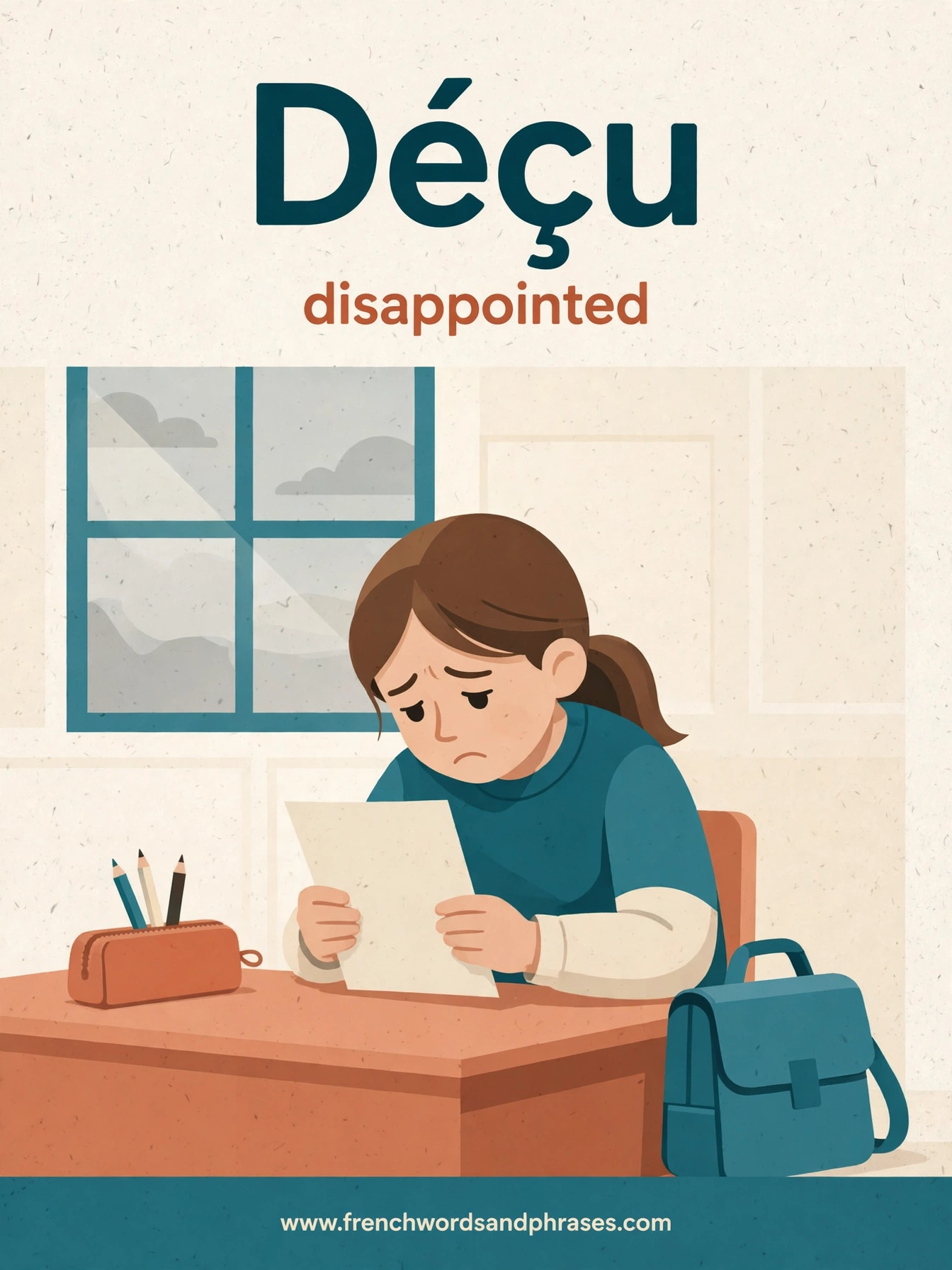
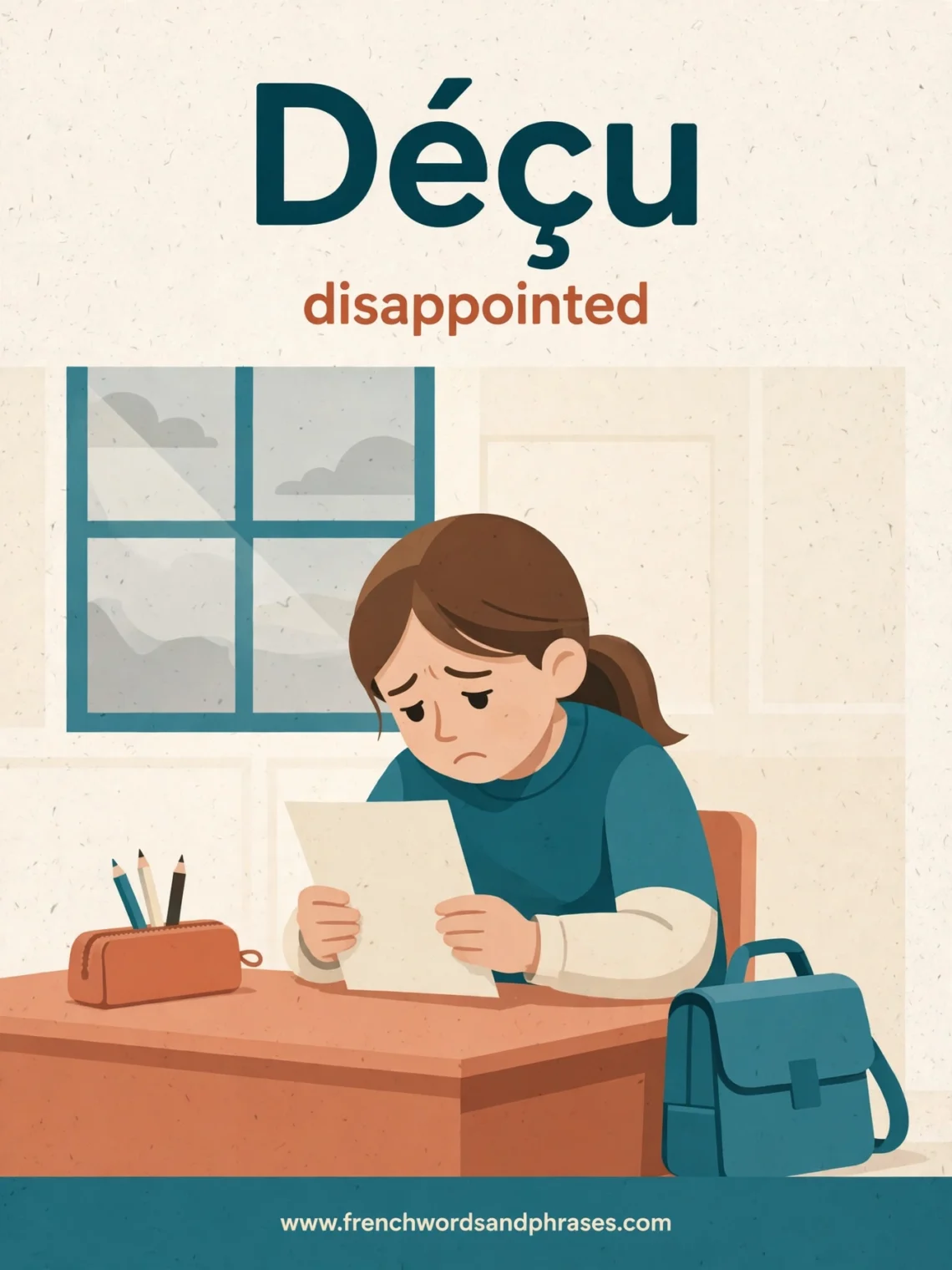
Déçu means disappointed.
The results are pinned to the school noticeboard at four o’clock. One boy walks up smiling, reads the list twice, and walks away slowly, his bag heavier than it was a minute ago. He is not angry, not in tears — just quietly déçu.
In this guide, you’ll learn what déçu means in English, why it wears a cedilla, how it pairs with de and par, and how it differs from its troublemaking twin décevant. Explore French examples, English translations, and practice quizzes.
Understanding the French Adjective Déçu
Déçu is a French adjective of feeling — the adjective of disappointment. It began life as the past participle of the verb décevoir, to disappoint, and it still behaves like one: it describes the person who feels the let-down, and it agrees with them — déçu, déçue, déçus, déçues.
It means disappointed — the flat feeling when reality comes in below the promise. Un enfant déçu, a disappointed child; déçu par le résultat, disappointed by the result; déçu de ne pas partir, disappointed not to be leaving. Wherever a hope meets a smaller reality, French reaches for déçu.
Type: Adjective of feeling — disappointment (from the verb décevoir)
Answers the question: How does someone feel? — disappointed
Changes form: Yes — déçu, déçue, déçus, déçues; the ç never changes
English equivalents: Disappointed; let down.
One important usage detail: déçu takes a partner — de or par. Use déçu de for the person you are disappointed in, and for the hope behind the feeling; use déçu par for the thing or event that did the disappointing — déçu de son ami, but déçu par le film, déçu par le résultat.
Experience the Word
Déçu is the adjective of the smaller reality — the moment the thing you imagined meets the thing that actually happened.
Imagine the cinema on a rainy Saturday: the film everyone praised, the poster you have looked at for a month. Two hours later you walk out into the wet street saying nothing, until someone asks. « J’ai été déçu. » Three small words, and the whole evening is explained.
You have not just described a feeling. You have measured the distance between a hope and a fact.
How to Use Déçu in French: Complete Guide
Let’s explore how déçu works in French, beginning with the whole word on one card.
Déçu at a Glance
Before the details, here is the whole word on one card.
The Whole Word on One Card
Meaning, type, position and forms — déçu in four lines.
| Point | Déçu |
|---|---|
| Meaning | disappointed |
| Type | adjective of feeling — the past participle of décevoir |
| Usual position | after être — je suis déçu |
| Form | déçu / déçue / déçus / déçues — the ç in every form |
Example
Je suis déçu par le résultat.
I am disappointed by the result.
The Four Forms of Déçu
Déçu agrees with the person who feels it: the feminine adds -e, the plurals add -s — and the cedilla under the c never moves, because it guards the soft s sound before u.
| Form | Déçu | Example |
|---|---|---|
| Masculine singular | déçu | un garçon déçu — a disappointed boy |
| Feminine singular | déçue | une fille déçue — a disappointed girl |
| Masculine plural | déçus | des garçons déçus — disappointed boys |
| Feminine plural | déçues | des filles déçues — disappointed girls |
Example
Les enfants étaient déçus par la pluie.
The children were disappointed by the rain.
Quick Quiz 1
Why does déçu wear a little hook under its c?
Reveal the answer
The cedilla (ç) keeps the c soft, like an s
Un enfant déçu, une fille déçue.
A disappointed boy, a disappointed girl.
Where Déçu Goes: After Être, with De or Par
Déçu lives after être, and it nearly always brings a partner: de for the person or hope behind the feeling, par for the thing or event that caused it.
| Pattern | Example |
|---|---|
| être déçu de + person | déçu de son frère — disappointed in his brother |
| être déçu par + thing | déçu par le film — disappointed by the film |
| déçu de + infinitive | déçu de ne pas venir — disappointed not to come |
| After the noun | un enfant déçu — a disappointed child |
Example
Elle est déçue de ne pas partir en vacances.
She is disappointed not to be going on holiday.
More Disappointed: Comparing with Déçu
Déçu compares the regular way, with plus, moins and aussi — and très does most of the everyday work.
| Degree | Example |
|---|---|
| As disappointed as | aussi déçu que — aussi déçu que moi |
| More disappointed | plus déçu — plus déçu que prévu |
| Less disappointed | moins déçu — less disappointed |
| The most disappointed | le plus déçu — le plus déçu des deux |
| Very disappointed | très déçu — très déçu par le résultat |
Example
Il était plus déçu qu’en colère.
He was more disappointed than angry.
Quick Quiz 2
The film let you down. Are you déçu or décevant?
Reveal the answer
Déçu — you feel it; the film is décevant, the thing that disappoints.
Je suis déçu, le film était décevant.
I am disappointed, the film was disappointing.
Everyday Expressions with Déçu
Déçu turns up wherever hopes are audited — at the cinema, at the results board, and in one very French understatement.
| Expression | In English |
|---|---|
| être déçu de quelqu’un | to be disappointed in someone |
| être déçu par quelque chose | to be disappointed by something |
| déçu de + infinitive | disappointed to do — or not to do — something |
| un air déçu | a disappointed look |
| amèrement déçu | bitterly disappointed |
| déçu en amour | disappointed in love |
Example
Il avait un air déçu en lisant la lettre.
He had a disappointed look as he read the letter.
Déçu and Its Neighbours
French grades its let-downs carefully. Déçu is the everyday word; its neighbours are rarer, sharper, or waiting at the opposite end of the scale.
| French | In English |
|---|---|
| désappointé | disappointed — formal and rare; déçu wins every day |
| dépité | put out, vexed — disappointment with a frown |
| frustré | frustrated — disappointment that itches |
| triste | sad — the feeling next door |
| content | pleased — the opposite |
| ravi | delighted — the far opposite |
Example
Elle était déçue, presque dépitée.
She was disappointed, almost put out.
Quick Quiz 3
What does un air déçu mean?
Reveal the answer
A disappointed look
Il est entré avec un air déçu.
He came in with a disappointed look.
Déçu Moments: Let-Downs in Daily Life
Déçu keeps a diary of small hopes: the film, the dessert, the results, the weather. A tour of its regular appointments.
| Moment | Example |
|---|---|
| At the cinema | déçu par la fin du film — disappointed by the end of the film |
| At the restaurant | déçu, le dessert était terminé — disappointed, the dessert had run out |
| On results day | déçue de sa note — disappointed with her grade |
| On holiday | déçus par la pluie — disappointed by the rain |
Example
Nous étions déçus par la pluie, alors nous avons visité un musée.
We were disappointed by the rain, so we visited a museum.
Watch Out: The Traps Around Déçu
Four traps wait around this word — the missing cedilla, the twin that means ‘disappointing’, the wrong partner, and the missing agreement.
| Trap | The truth |
|---|---|
| decu | never drop the cedilla: without it the c turns hard — always déçu |
| déçu / décevant | déçu is the feeler, décevant is the cause: je suis déçu, le film est décevant |
| déçu avec | no — the partners are de and par: déçu de son ami, déçu par le résultat |
| elle est déçu | the feminine adds -e: elle est déçue |
Example
Elle est déçue par ce film décevant.
She is disappointed by this disappointing film.
Quick Quiz 4
How do you say ‘a disappointed girl’ — une fille déçu or une fille déçue?
Reveal the answer
une fille déçue
The feminine adds -e, and the cedilla stays.
Une fille déçue — a disappointed girl.
Déçu in Everyday French: Real-Life Examples
Now that you know the word, let’s see how déçu appears in everyday French.
Example 1 — At the cinema
Je suis déçu, la fin du film était faible.
I am disappointed, the end of the film was weak.
Example 2 — Results day
Elle est déçue de sa note, elle espérait mieux.
She is disappointed with her grade, she was hoping for better.
Example 3 — At the restaurant
Nous étions déçus, le plat du jour était terminé.
We were disappointed, the dish of the day had run out.
Example 4 — About a friend
Il est déçu de son ami, qui n’est pas venu.
He is disappointed in his friend, who didn’t come.
Example 5 — The weather
Les enfants sont déçus par la pluie.
The children are disappointed by the rain.
Example 6 — Understatement
Déçu, oui, mais on reviendra l’année prochaine.
Disappointed, yes, but we’ll come back next year.
Beyond Translation: The Meaning of Déçu
English says disappointed for the meaning of déçu — but déçu carries its family history on its face: it is the past participle of décevoir, to deceive as much as to disappoint.
To be déçu is to feel the small gap between the story you were told and the thing that arrived.
French softens the blow with its favourite understatements — un peu déçu, plutôt déçu — a whole scale of let-downs, politely graded.
How to Remember the French Adjective Déçu
Remember it this way: Déçu is the feeler, not the cause — and it keeps its cedilla in every form, like a little hook holding the soft sound in place.
- You picture the hook under the c — déçu — keeping the sound soft in all four forms.
- You sort the pair: the person is déçu, the thing is décevant.
- You give it its partners — déçu de quelqu’un, déçu par quelque chose.
The key idea is déçu means disappointed — the feeler — and it pairs with de and par; the cause is décevant.
Test Your Knowledge of Déçu
Let’s see how much you’ve learned. Try answering these questions before revealing the answers.
Question 1
What does déçu mean?
Reveal the answer
Disappointed — let down, when reality comes in below the promise.
Question 2
What are the forms of déçu?
Reveal the answer
déçu, déçue, déçus, déçues — and the cedilla stays in every one.
Question 3
Translate: I am disappointed by the result.
Reveal the answer
Je suis déçu par le résultat.
Question 4
Which word describes the disappointing thing itself?
Reveal the answer
décevant
Le film est décevant, je suis déçu.
The film is disappointing, I am disappointed.
Question 5
Complete the sentence:
Elle est très ______ de ne pas partir.
Reveal the answer
déçue
Elle est très déçue de ne pas partir.
She is very disappointed not to be leaving.
Your Final Challenge
Can You Use It?
How would you say this in French?
“I am disappointed by the film, it was too slow.”
Reveal the answer
Je suis déçu par le film, il était trop lent.
I am disappointed by the film, it was too slow.
A little French. A little curiosity. A richer everyday life.
LEARN FRENCH ONE WORD AT A TIME