A French Word to Live By
Translate Excité to English
/ɛɡ.zi.te/
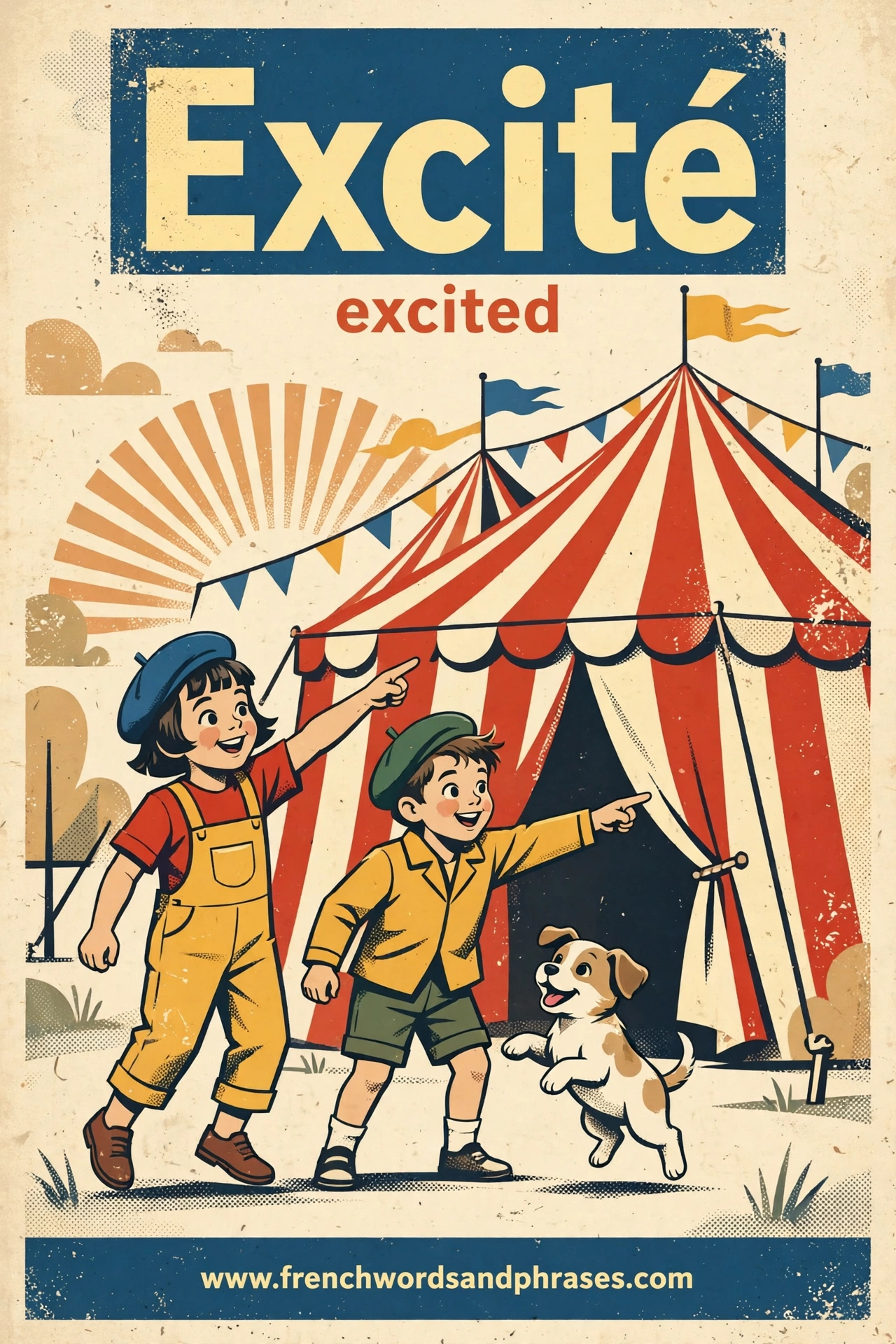
Excité means excited.
It is the last evening before the school trip. In a bedroom in Lyon, a small boy has packed his bag three times, laid out his shoes by the door, and asked eleven questions in ten minutes. Sleep is out of the question. He is excité — completely, joyfully excité.
In this guide, you’ll learn what excité means in English, when French uses it happily — children, crowds, dogs — and the one situation where adults quietly swap it for j’ai hâte instead. Explore French examples, English translations, and practice quizzes.
Understanding the French Adjective Excité
Excité is a French adjective of feeling — the adjective of being stirred up. It is the past participle of the verb exciter, and it describes someone buzzing with energy: a child before a party, a crowd before a match. For a woman it becomes excitée; in the plural, excités and excitées.
It means excited — but with more fizz than the English word. Les enfants sont excités, the children are excited and bouncing; un public excité, a stirred-up crowd. Excité describes energy that can barely sit still — which is exactly why adults sometimes choose a calmer phrase for their own plans, as the traps table below explains.
Type: Adjective of feeling — excitement (from the verb exciter)
Answers the question: How does someone feel? — excited, buzzing
Changes form: Yes, regularly — excité, excitée, excités, excitées
English equivalents: Excited; worked up; overexcited (for children).
One important usage detail: excité is perfect for children, crowds and dogs — but an adult announcing je suis excité about a holiday may raise a smile, because the word can also carry a physical, even sexual, charge. For plans you are looking forward to, French adults usually say j’ai hâte de partir — I can’t wait to leave.
Experience the Word
Excité is the adjective of the night before — too much energy for the size of the feeling.
Imagine the stand before the big match: scarves up, drums going, a whole crowd on its feet before a ball has been kicked. Nobody there is calmly ‘looking forward’. They are excités, and the noise proves it.
You have not just described a feeling. You have described energy looking for somewhere to go.
How to Use Excité in French: Complete Guide
Let’s explore how excité works in French, beginning with the whole word on one card.
Excité at a Glance
Before the details, here is the whole word on one card.
The Whole Word on One Card
Meaning, type, position and forms — excité in four lines.
| Point | Excité |
|---|---|
| Meaning | excited |
| Type | adjective of feeling — the past participle of exciter |
| Usual position | after être — les enfants sont excités |
| Form | excité / excitée / excités / excitées |
Example
Les enfants sont tout excités.
The children are all excited.
The Four Forms of Excité
Excité follows the regular -é pattern: the feminine adds -e, the plurals add -s. Nothing hides and nothing changes — the x keeps its ‘gz’ buzz in every form.
| Form | Excité | Example |
|---|---|---|
| Masculine singular | excité | un garçon excité — an excited boy |
| Feminine singular | excitée | une fille excitée — an excited girl |
| Masculine plural | excités | des garçons excités — excited boys |
| Feminine plural | excitées | des filles excitées — excited girls |
Example
Les filles étaient excitées par le spectacle.
The girls were excited by the show.
Quick Quiz 1
What is the feminine of excité?
Reveal the answer
excitée
Une fille excitée, des filles excitées.
An excited girl, excited girls.
Where Excité Goes: After Être and After the Noun
Excité follows être for feelings, and follows the noun for the people it describes. Its favourite partner for the cause is par, and tout slides in front to give ‘all excited’.
| Pattern | Example |
|---|---|
| être excité | il est excité — he is excited |
| tout excité | ils sont tout excités — they are all excited |
| noun + excité | un enfant excité — an excited child |
| excité par + cause | excitée par la nouvelle — excited by the news |
Example
Un chien excité attendait devant la porte.
An excited dog was waiting by the door.
More Excited: Comparing with Excité
Excité compares the regular way, with plus, moins and aussi — and everyday French adds its favourite booster, tout, for the full bounce.
| Degree | Example |
|---|---|
| As excited as | aussi excité que — aussi excité que son frère |
| More excited | plus excité — plus excité que l’année dernière |
| Less excited | moins excité — less excited |
| The most excited | le plus excité — le plus excité de la classe |
| All excited | tout excité — tout excité par le voyage |
Example
C’est l’enfant le plus excité de la classe.
He’s the most excited child in the class.
Quick Quiz 2
An adult is looking forward to her holiday. What does she usually say — je suis excitée or j’ai hâte de partir?
Reveal the answer
J’ai hâte de partir — ‘I can’t wait to leave’. Je suis excitée can carry a physical sense she probably doesn’t mean.
J’ai hâte de partir en vacances.
I can’t wait to go on holiday.
Everyday Expressions with Excité
Excité lives wherever energy overflows — in classrooms, in stadiums, and in one comparison involving a flea.
| Expression | In English |
|---|---|
| être tout excité | to be all excited |
| excité comme une puce | bouncing with excitement — literally ‘excited like a flea’ |
| excité à l’idée de + infinitive | excited at the thought of doing something |
| trop excité pour dormir | too excited to sleep |
| un public excité | a stirred-up crowd |
| exciter quelqu’un | to stir someone up, to get someone excited — the verb |
Example
Les élèves sont excités comme des puces avant la sortie.
The pupils are bouncing with excitement before the outing.
Excité and Its Neighbours
French fine-tunes its excitement. Excité is the buzzing word; its neighbours are eager, frantic or calm — and one of them, excitant, describes the cause instead of the feeler.
| French | In English |
|---|---|
| impatient | eager, impatient — the twin of j’ai hâte |
| enthousiaste | enthusiastic |
| surexcité | overexcited — one notch too far |
| agité | restless, worked up |
| excitant | exciting — the cause, not the feeler |
| calme | calm — the opposite |
Example
Le public, enthousiaste et un peu excité, chantait déjà.
The crowd, enthusiastic and a little stirred up, was already singing.
Quick Quiz 3
What does excité comme une puce mean?
Reveal the answer
Bouncing with excitement — literally, excited like a flea.
Il est excité comme une puce ce matin.
He’s bouncing with excitement this morning.
Excité Moments: Buzzing Through the Day
Excité keeps a busy diary: the night before a trip, the party, the stadium, the stage door. A tour of its loudest appointments.
| Moment | Example |
|---|---|
| The night before | trop excité pour dormir — too excited to sleep |
| At the party | des enfants excités partout — excited children everywhere |
| At the match | un public excité — a stirred-up crowd |
| Before the show | les acteurs, excités et nerveux — the actors, excited and nervous |
Example
La veille du départ, tout le monde était excité.
The night before the trip, everyone was excited.
Watch Out: The Traps Around Excité
One trap here is famous — the double sense of the word — and two more follow behind it: the twin excitant, and the missing agreement.
| Trap | The truth |
|---|---|
| je suis excité (an adult, about a trip) | excité can suggest physical or sexual excitement — adults usually say j’ai hâte de partir, I can’t wait to leave |
| excité / excitant | excité is the feeler, excitant is the cause: le match est excitant, les enfants sont excités |
| un excitant | as a noun it means a stimulant — le café est un excitant |
| elle est excité | the feminine adds -e: elle est excitée |
Example
J’ai hâte de voir ce film excitant !
I can’t wait to see this exciting film!
Quick Quiz 4
How do you say ‘an exciting match’ — un match excité or un match excitant?
Reveal the answer
un match excitant
The match causes the excitement, so it takes excitant; the fans who feel it are excités.
Un match excitant, des supporters excités.
Excité in Everyday French: Real-Life Examples
Now that you know the word, let’s see how excité appears in everyday French.
Example 1 — The night before
Les enfants sont trop excités pour dormir.
The children are too excited to sleep.
Example 2 — At the stadium
Le public excité chante depuis une heure.
The stirred-up crowd has been singing for an hour.
Example 3 — In the classroom
Les élèves sont tout excités, c’est le dernier jour.
The pupils are all excited, it’s the last day.
Example 4 — Looking forward
J’ai hâte de partir, je suis impatient de voir la mer.
I can’t wait to leave, I’m eager to see the sea.
Example 5 — The dog
Le chien excité tourne autour de la porte.
The excited dog is circling by the door.
Example 6 — Before the concert
Elle est excitée à l’idée de chanter sur scène.
She is excited at the thought of singing on stage.
Beyond Translation: The Meaning of Excité
English says excited for the meaning of excité — but excité is the stronger, fizzier word, and French knows it. That is why it is handed so freely to children, crowds and dogs, whose excitement is physical and noisy, and why adults reach for j’ai hâte when the feeling is quieter.
Excité is excitement you can see bouncing; hâte is excitement you can feel ticking.
Between the two, French draws a line English doesn’t — and knowing where the line runs is worth more than the word itself.
How to Remember the French Adjective Excité
Remember it this way: Excité is the bouncing word — perfect for children and crowds, while adults looking forward to something say j’ai hâte instead.
- You see the four regular forms — excité, excitée, excités, excitées — nothing up the sleeve.
- You sort the twins: the feeler is excité, the cause is excitant.
- You keep the adult swap ready: for a trip, j’ai hâte de partir, not je suis excité.
The key idea is excité means excited and buzzing — for children and crowds; adults say j’ai hâte for looking forward.
Test Your Knowledge of Excité
Let’s see how much you’ve learned. Try answering these questions before revealing the answers.
Question 1
What does excité mean?
Reveal the answer
Excited — stirred up, buzzing with energy.
Question 2
What are the forms of excité?
Reveal the answer
excité, excitée, excités, excitées — the regular -é pattern.
Question 3
Translate: the children are all excited.
Reveal the answer
Les enfants sont tout excités.
Question 4
What do adults usually say instead of je suis excité for a coming holiday?
Reveal the answer
J’ai hâte de partir — I can’t wait to leave; excité can carry a physical sense.
Question 5
Complete the sentence:
Le match était très ______, les supporters chantaient.
Reveal the answer
excitant
Le match était très excitant, les supporters chantaient.
The match was very exciting, the fans were singing.
Your Final Challenge
Can You Use It?
How would you say this in French?
“The children are too excited to sleep; tomorrow we leave for the sea.”
Reveal the answer
Les enfants sont trop excités pour dormir, demain nous partons pour la mer.
The children are too excited to sleep; tomorrow we leave for the sea.
A little French. A little curiosity. A richer everyday life.
LEARN FRENCH ONE WORD AT A TIME