A French Word to Live By
Translate Fâché to English
/fɑ.ʃe/
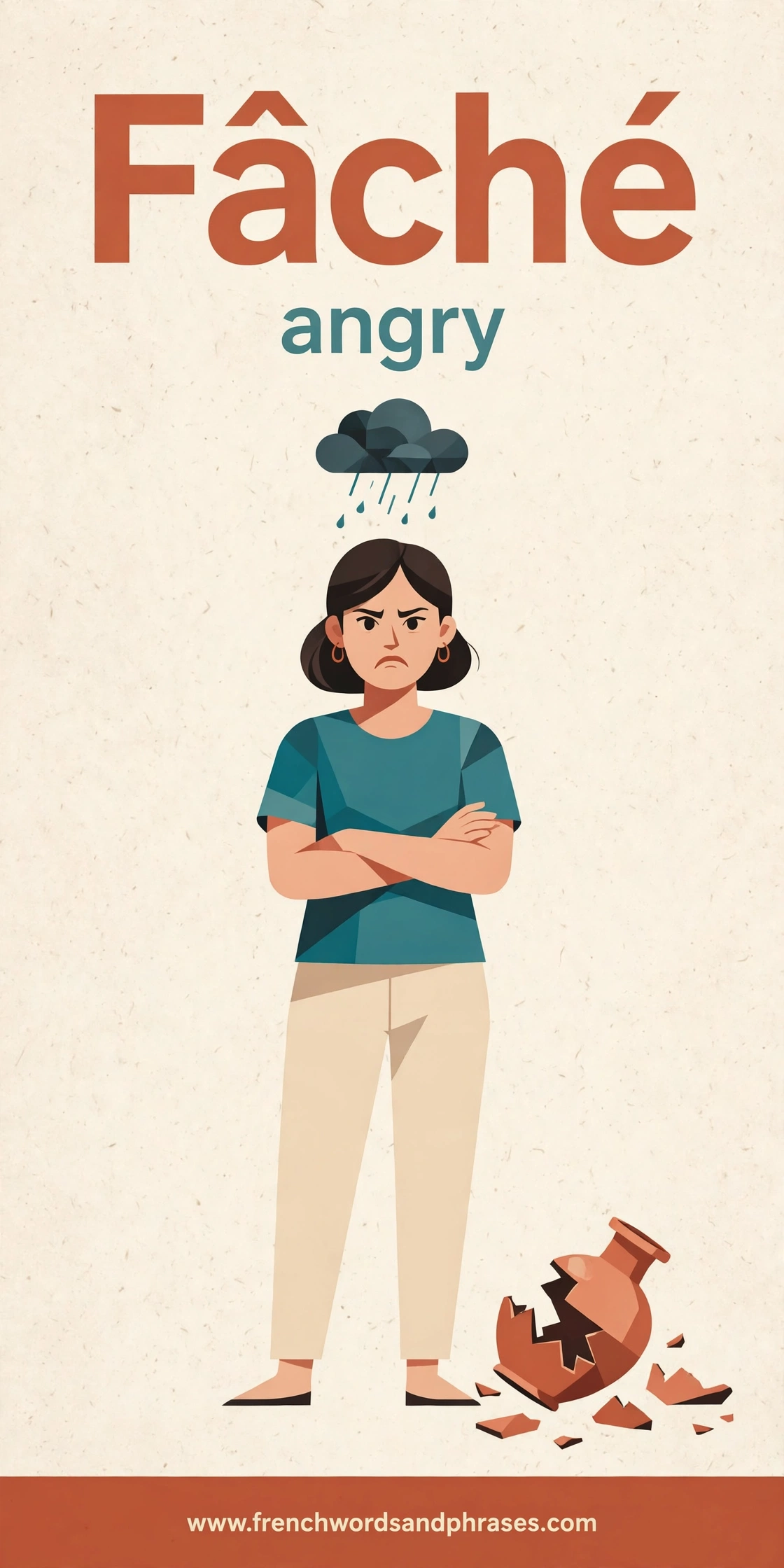
Fâché means angry.
Two brothers, one borrowed ladder, one dented car. At Sunday lunch the soup is served in silence and the bread is passed without a word. Nobody is shouting — that is not the way here. They are simply, coldly, fâchés.
In this guide, you’ll learn what fâché means in English, how to say exactly who you are angry WITH, how the verb se fâcher can also mean falling out with a friend, and how its four forms work. Explore French examples, English translations, and practice quizzes.
Understanding the French Adjective Fâché
Fâché is a French adjective of state — the past participle of the verb fâcher used as an adjective. It agrees like a regular -é adjective: fâché, fâchée, fâchés, fâchées. Its usual partner is contre: in French, you are fâché contre someone.
It means angry — cross, put out, annoyed at someone. French fâché is usually aimed at a person: il est fâché contre son frère, he is angry with his brother. It is stronger than énervé, worked up, but cooler than furieux, furious: this is the anger of the firmly closed door and the silent lunch, not of the shouting match.
Type: Adjective of state — anger (past participle of fâcher)
Answers the question: How does he/she feel? — angry
Changes form: Yes — fâché, fâchée, fâchés, fâchées
English equivalents: Angry; cross; annoyed (with someone).
One important usage detail: fâché almost always names its target with contre — être fâché contre quelqu’un, to be angry with someone. Leave contre out and the sentence feels unfinished; French wants to know who the anger is for.
Experience the Word
Fâché is the adjective of the cold shoulder — anger served quietly, in short sentences and doors closed a little too firmly.
Imagine the Sunday lunch again: the dented car is not mentioned once. The cheese is excellent, the coffee is perfect — and two brothers speak only to the people sitting between them. That silence has a name: ils sont fâchés.
You have not just described a row. You have felt the temperature of a room drop by five degrees.
How to Use Fâché in French: Complete Guide
Let’s explore how fâché works in French, beginning with the whole word on one card.
Fâché at a Glance
Before the details, here is the whole word on one card.
The Whole Word on One Card
Meaning, type, position and forms — fâché in four lines.
| Point | Fâché |
|---|---|
| Meaning | angry |
| Type | adjective of state — anger |
| Usual position | after être, with contre + the person — fâché contre son frère |
| Form | fâché / fâchée / fâchés / fâchées |
Example
Elle est fâchée contre son frère.
She is angry with her brother.
The Four Forms of Fâché
Fâché agrees like a regular -é adjective: the feminine adds an -e, and both plurals add an -s. The little hat on the â — the circumflex — never moves.
| Form | Fâché | Example |
|---|---|---|
| Masculine singular | fâché | un père fâché — an angry father |
| Feminine singular | fâchée | une mère fâchée — an angry mother |
| Masculine plural | fâchés | des parents fâchés — angry parents |
| Feminine plural | fâchées | des sœurs fâchées — angry sisters |
Example
Les deux sœurs sont fâchées depuis mardi.
The two sisters have been cross with each other since Tuesday.
Quick Quiz 1
Which form of fâché goes with sœur (feminine)?
Reveal the answer
fâchée
Ma sœur est fâchée.
My sister is angry.
Where Fâché Goes: After Être, with Contre
Fâché lives after être and travels with contre towards its target. Tout can slide in front of it for a whole, complete crossness.
| Pattern | Example |
|---|---|
| After être | il est fâché — he is angry |
| With the target | fâché contre son frère — angry with his brother |
| Intensified | tout fâché, il est parti — quite angry, he left |
| Before the noun | un fâché père — never; fâché goes after être or the noun |
Example
Ils sont fâchés contre leur voisin à cause du bruit.
They are angry with their neighbour because of the noise.
More Angry: Comparing with Fâché
Fâché compares the regular way, with plus, moins and aussi — and the superlative keeps the agreement: le plus fâché, la plus fâchée.
| Degree | Example |
|---|---|
| As angry as | aussi fâché que — as angry as |
| More angry | plus fâché — plus fâché que moi |
| Less angry | moins fâché — less angry |
| The most angry (masc.) | le plus fâché — le plus fâché des deux |
| The most angry (fem.) | la plus fâchée — la plus fâchée de la famille |
Example
Elle est plus fâchée que lui, et elle a raison.
She is angrier than he is, and she is right.
Quick Quiz 2
Which little word names the person you are angry with — contre or avec?
Reveal the answer
contre
Il est fâché contre son frère.
He is angry with his brother.
Everyday Expressions with Fâché
The verb fâcher carries this family into daily life — the state, the moment it starts, and the sadder meaning of a friendship breaking.
| Expression | In English |
|---|---|
| être fâché contre quelqu’un | to be angry with someone |
| se fâcher | to get angry |
| se fâcher avec quelqu’un | to fall out with someone |
| ça me fâche | that makes me angry, that annoys me |
| ne te fâche pas ! | don’t get angry! |
| tout fâché | quite cross, all worked up with anger |
Example
Ne te fâche pas, c’était un accident.
Don’t get angry, it was an accident.
Fâché and Its Neighbours
French keeps a careful thermometer of anger. Fâché sits in the middle — above énervé, below en colère and furieux — and its happy opposite is the making-up.
| French | In English |
|---|---|
| énervé | worked up, irritated — a step below |
| en colère | angry, in a temper — a step above |
| furieux | furious |
| contrarié | put out, upset |
| vexé | offended, hurt |
| réconcilié | reconciled, made up — the happy opposite |
Example
Énervé le matin, il était en colère le soir.
Worked up in the morning, he was angry by the evening.
Quick Quiz 3
What does se fâcher avec quelqu’un often mean, beyond ‘to get angry’?
Reveal the answer
To fall out with someone
Ils se sont fâchés pour une histoire d’argent.
They fell out over a money matter.
Fâché in the Family: A Tour of Small Wars
Fâché does its best work inside families: borrowed tools, missed phone calls and the last slice of cake. A tour of its battlefields — and its peace treaties.
| Scene | Example |
|---|---|
| The borrowed ladder | il est fâché contre son frère pour l’échelle — he is angry with his brother about the ladder |
| The missed call | elle est fâchée, il n’a jamais téléphoné — she is cross, he never called |
| The last slice | les enfants sont fâchés pour la dernière part de gâteau — the children are cross over the last slice of cake |
| The peace treaty | le dimanche suivant, ils ne sont plus fâchés — the following Sunday, they have made up |
Example
Pour une part de gâteau, les voilà fâchés !
Over a slice of cake — and now they’re cross with each other!
Watch Out: The Traps Around Fâché
Three traps wait around this word — the wrong partner word, the double meaning of se fâcher, and a cousin that means something else entirely.
| Trap | The truth |
|---|---|
| fâché avec | angry WITH someone is fâché contre quelqu’un — contre names the target |
| se fâcher avec | not ‘to be angry with’ — it often means to fall out, to break a friendship |
| fâcheux | looks like family but means unfortunate, regrettable: un incident fâcheux |
| faché sans accent | fâché keeps its circumflex: fâché, fâchée — the little hat is part of the word |
Example
C’est fâcheux, mais personne n’est fâché.
It’s unfortunate, but nobody is angry.
Quick Quiz 4
How do you say ‘he is angry with his neighbour’ — il est fâché avec son voisin or il est fâché contre son voisin?
Reveal the answer
il est fâché contre son voisin
Fâché names its target with contre.
Il est fâché contre son voisin — he is angry with his neighbour.
Fâché in Everyday French: Real-Life Examples
Now that you know the word, let’s see how fâché appears in everyday French.
Example 1 — Between brothers
Il est fâché contre son frère depuis dimanche.
He has been angry with his brother since Sunday.
Example 2 — At school
La maîtresse est fâchée, la classe fait trop de bruit.
The teacher is cross, the class is making too much noise.
Example 3 — The apology
Ne sois pas fâchée, je suis désolé.
Don’t be angry, I’m sorry.
Example 4 — The phone call
Ça me fâche, il n’a jamais rappelé.
It makes me angry, he never called back.
Example 5 — Falling out
Ils se sont fâchés pour une histoire de parking.
They fell out over a parking matter.
Example 6 — Making up
Le lendemain, ils n’étaient plus fâchés du tout.
The next day, they weren’t angry at all any more.
Beyond Translation: The Meaning of Fâché
English says angry for the meaning of fâché — but French anger, in this word, is a social event: it needs a target, introduced by contre, and it lives between people.
That is why se fâcher avec quelqu’un can mean to fall out with them — the anger is the breaking of a bond.
And the cure belongs to the same world: on se réconcilie, we make up — ideally, in France, around a table.
How to Remember the French Adjective Fâché
Remember it this way: Fâché is anger with an address: it always travels towards someone, and contre is the envelope it travels in.
- You aim the word with contre — fâché contre son frère — never left floating without a target.
- You learn the pair together: être fâché, the state — and se fâcher, the moment it starts, or the falling-out.
- You keep it below boiling: énervé below it, en colère and furieux above it.
The key idea is fâché means angry with someone — fâché contre — and se fâcher can mean to fall out.
Test Your Knowledge of Fâché
Let’s see how much you’ve learned. Try answering these questions before revealing the answers.
Question 1
What does fâché mean?
Reveal the answer
Angry — cross, annoyed with someone.
Question 2
Which word follows fâché to name the target?
Reveal the answer
Contre
Fâché contre son frère.
Angry with his brother.
Question 3
Translate: she is angry with her sister.
Reveal the answer
Elle est fâchée contre sa sœur.
Question 4
What are the forms of fâché?
Reveal the answer
fâché, fâchée, fâchés, fâchées — it agrees like a regular -é adjective.
Question 5
Complete the sentence:
Ils se sont ______ pour une histoire d’argent.
Reveal the answer
fâchés
Ils se sont fâchés pour une histoire d’argent.
They fell out over a money matter.
Your Final Challenge
Can You Use It?
How would you say this in French?
“He is angry with his brother, but on Sunday they will make up.”
Reveal the answer
Il est fâché contre son frère, mais dimanche ils vont se réconcilier.
He is angry with his brother, but on Sunday they will make up.
A little French. A little curiosity. A richer everyday life.
LEARN FRENCH ONE WORD AT A TIME