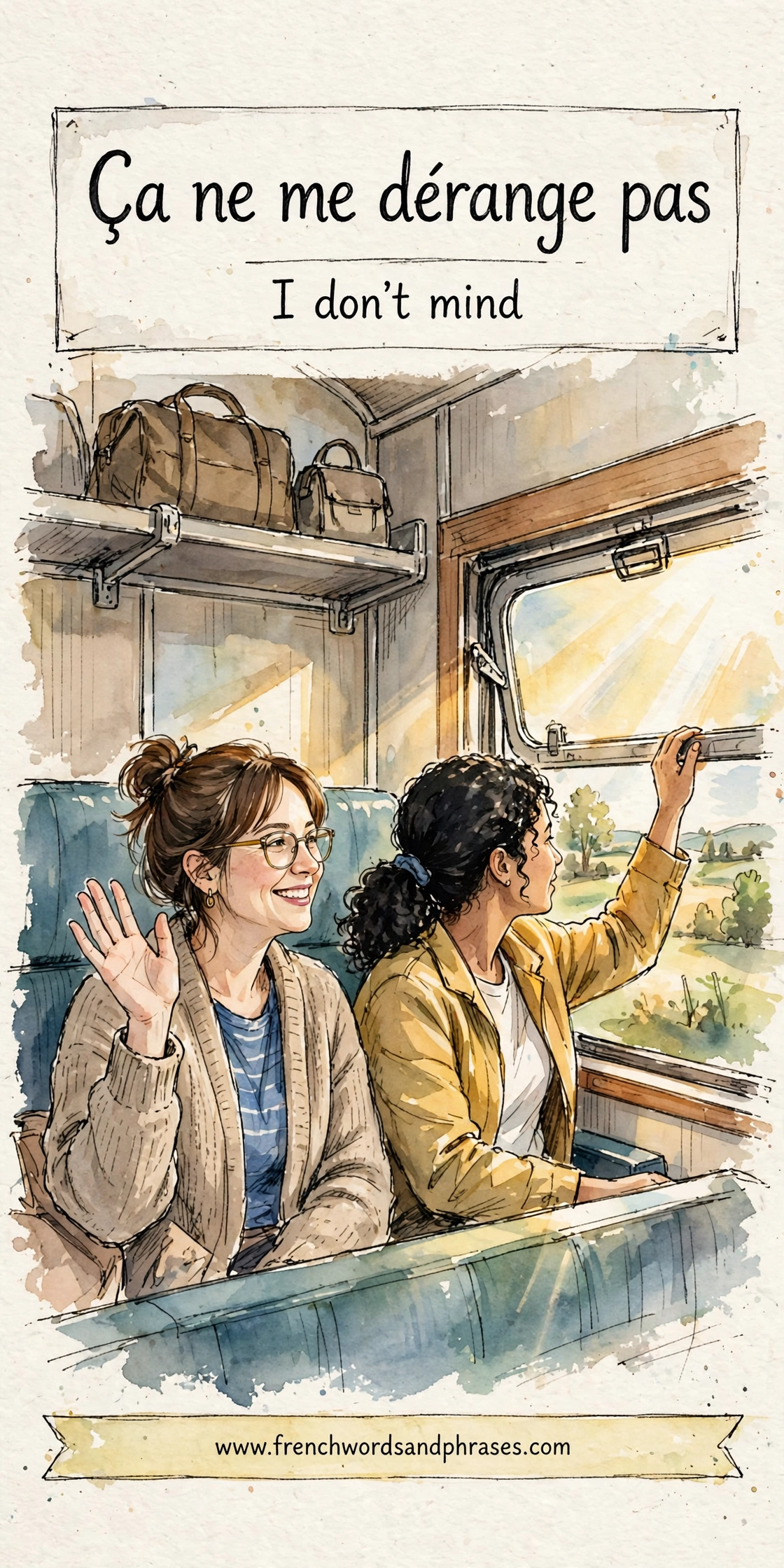
A French Word to Live By
Translate Ça ne me dérange pas to English
/sa nə mə de.ʁɑ̃ʒ pa/
Ça ne me dérange pas means I don’t mind.
‘Ça te dérange si j’ouvre la fenêtre ?’ your colleague asks, already apologising with her eyes. You wave the worry away with the warmest shrug in the French language: Ça ne me dérange pas.
Let’s explore how ça ne me dérange pas works in French, beginning with the whole phrase on one card.
Understanding the French Phrase Ça ne me dérange pas
Ça ne me dérange pas is a French everyday phrase built on the verb déranger, to disturb or bother. The little word me names the person who would be bothered — and the negative ne … pas cancels the bother entirely: it doesn’t bother me, I don’t mind.
It means I don’t mind — the gracious answer to ‘do you mind if…?’. English ‘mind’ hides in the head; French déranger is physical: to disturb, to unsettle, to move something from its place. Ça ne me dérange pas says: nothing in me has been moved. All is calm, go ahead.
Type: Everyday phrase — déranger (to bother) with a pronoun and the ne … pas negative
Answers the need: Giving permission warmly — answering ‘do you mind if…?’ with a genuine yes, go ahead
Register: Neutral and polite — colleagues, family, strangers in a train seat
Strength: Everyday — windows, music, seats, smoke, questions and small favours
One important usage detail: this phrase gives permission; it does not express indifference. For a shrug of ‘I don’t mind either way’, French uses ça m’est égal — warmer hosts choose ça ne me dérange pas, cooler ones ça m’est égal, and the difference is felt.
Experience the Word
Ça ne me dérange pas is one of the great social oils of French life — it opens windows, shares armrests and forgives a thousand small intrusions before they happen.
Imagine how many tiny negotiations fill a day: a seat, a song, a question, a dog under the table. Each one arrives wrapped in ‘ça te dérange si…?’, and each is dissolved by the same calm answer.
The phrase carries a small generosity inside it. It does not merely permit; it reassures — your request cost me nothing, my calm is intact, we are still friends.
How to Use Ça ne me dérange pas in French: Complete Guide
Let’s explore how ça ne me dérange pas works in French, beginning with the whole phrase on one card.
Ça ne me dérange pas at a Glance
The Whole Phrase on One Card
Real meaning, literal building blocks, English twin and register — ça ne me dérange pas in five lines.
| Point | Ça ne me dérange pas |
|---|---|
| What it really means | I don’t mind — go ahead, it doesn’t bother me at all |
| Word for word | that not me bothers not (ça + ne … pas, with me tucked before the verb) |
| English equivalent | I don’t mind / not at all / go ahead |
| Register | neutral and warm — safe everywhere |
| Use it for | answering ‘do you mind if…?’ — windows, seats, music, questions |
Example
Ça te dérange si je m’assieds ici ? — Pas du tout, ça ne me dérange pas.
Do you mind if I sit here? — Not at all, I don’t mind.
Word by Word: Building the Permission
Five pieces — a pointing word, a two-part ‘not’, a person, and a verb about being unsettled.
| Word | Literal meaning | Its job in the phrase |
|---|---|---|
| ça | that / it | the request itself — the window, the seat, the question |
| ne … pas | not | the negative sandwich that cancels the bother |
| me | me | the person who might be bothered — parked before the verb, inside the sandwich |
| dérange | bothers / disturbs | the present tense of déranger — to unsettle, to move from its place |
Example
La musique ne me dérange pas, je travaille très bien avec.
The music doesn’t bother me, I work very well with it.
Quick Quiz 1
Where does me sit in ça ne me dérange pas — before or after the verb?
Reveal the answer
Before the verb, tucked inside the negative sandwich: ne + me + dérange + pas.
Non, ça ne me dérange pas du tout.
No, it doesn’t bother me at all.
When You Say It: The Permission Moments
Ça ne me dérange pas belongs to the small negotiations that fill a shared day.
| Situation | Example |
|---|---|
| A window about to open | ça te dérange si j’ouvre ? — ça ne me dérange pas — do you mind if I open it? — I don’t mind |
| A seat being taken | cette place est libre ? ça ne vous dérange pas ? — is this seat free? it doesn’t bother you? |
| Music in the next room | la musique ne me dérange pas, monte le son — the music doesn’t bother me, turn it up |
| A personal question | je peux te poser une question ? — bien sûr, ça ne me dérange pas — can I ask you a question? — of course, I don’t mind |
| A dog joining the café | il reste sous la table, ça ne me dérange pas — he’ll stay under the table, I don’t mind |
Example
Tu peux laisser ta valise ici, ça ne me dérange pas.
You can leave your suitcase here, I don’t mind.
Make It Yours: Aiming the Permission
The phrase bends — change the person, add warmth, or ask the question yourself.
| Form | French | In English |
|---|---|---|
| To you (friend) | ça ne te dérange pas | it doesn’t bother you / you don’t mind |
| Polite you | ça ne vous dérange pas | it doesn’t bother you (polite) |
| Stronger warmth | ça ne me dérange pas du tout | it doesn’t bother me at all |
| Asking a friend | ça te dérange si… ? | do you mind if…? |
| Asking politely | ça vous dérange si… ? | do you mind if…? (polite) |
| The near twin | ça ne me gêne pas | it doesn’t bother me (gêner twin) |
Example
Ça vous dérange si je ferme la porte ? — Pas du tout.
Do you mind if I close the door? — Not at all.
Quick Quiz 2
You want to ask your elderly neighbour if you may park in front of her gate. Which question keeps it polite — ça te dérange or ça vous dérange?
Reveal the answer
Ça vous dérange — the vous form carries the politeness.
Ça vous dérange si je me gare ici ce soir ?
Do you mind if I park here this evening?
Everyday Expressions: Building on the Permission
Déranger grows a whole family of courtesy frames — learn these and no request ever lands awkwardly.
| Frame | In English |
|---|---|
| ça ne me dérange pas du tout | it doesn’t bother me at all |
| ça te dérange si + sentence | do you mind if…? |
| je te dérange ? | am I disturbing you? |
| ne te dérange pas | don’t put yourself out / don’t go to any trouble |
| pardon de vous déranger | sorry to disturb you (opening a call or a door) |
| ça me dérange | it bothers me (the honest opposite) |
Example
Pardon de vous déranger, c’est bien ici pour les inscriptions ?
Sorry to disturb you, is this the right place for registrations?
Close Cousins: The Other Warm Answers
French grades its permissions — each cousin gives a slightly different temperature of yes.
| Expression | The difference |
|---|---|
| pas de problème | no problem — the all-purpose modern answer, a degree more casual |
| avec plaisir | with pleasure — the permission becomes a welcome |
| je veux bien | I’m happy to / go ahead then — willing, slightly reluctant at the edges |
| ça m’est égal | it’s all the same to me — true indifference; cooler than ne me dérange pas |
| bien sûr, vas-y | of course, go ahead — the permission plus a push of encouragement |
Example
Je peux prendre le dernier morceau ? — Bien sûr, vas-y, avec plaisir.
Can I take the last piece? — Of course, go ahead, with pleasure.
Quick Quiz 3
Which answer sounds coolest and least warm — ça ne me dérange pas, avec plaisir, or ça m’est égal?
Reveal the answer
Ça m’est égal — it says ‘it’s all the same to me’, permission without warmth.
Ça m’est égal, fais comme tu veux.
It’s all the same to me, do as you like.
Ça ne me dérange pas and Its Neighbours
The déranger family at a glance — bothering and unbothering in every direction.
| French | In English |
|---|---|
| ça ne me dérange pas | I don’t mind |
| ça me dérange | it bothers me |
| ça te dérange ? | do you mind? |
| je te dérange ? | am I disturbing you? |
| ne te dérange pas | don’t put yourself out |
| dérangement | a disturbance / (also) a fault on the line |
Example
Ne te dérange pas pour moi, je prendrai le bus.
Don’t put yourself out for me, I’ll take the bus.
Watch Out: The Traps Around Ça ne me dérange pas
Three traps wait around this courteous phrase — step round them.
| Trap | The truth |
|---|---|
| Confusing déranger with ranger | ranger means to tidy or put away; déranger is its undoing — to unsettle, disturb, bother |
| Placing me after the verb | English says ‘bothers me’; French parks the person before the verb: ça ne me dérange pas |
| Answering with ça m’est égal by accident | that phrase means ‘I don’t care’ — permission, yes, but with a chill the speaker may not intend |
| Dropping the ne in writing | spoken French often drops ne, but careful writing keeps the full sandwich: ça ne me dérange pas |
Example
Range ta chambre, et ne dérange pas ton frère qui travaille.
Tidy your room, and don’t disturb your brother, who is working.
Quick Quiz 4
True or false: ne te dérange pas means ‘you don’t bother me’.
Reveal the answer
False — it is a kind command: don’t put yourself out, don’t go to any trouble.
Ne te dérange pas, je me sers moi-même.
Don’t put yourself out, I’ll help myself.
Ça ne me dérange pas in Everyday French: Real-Life Examples
Now that you know the word, let’s see how ça ne me dérange pas appears in everyday French.
Example 1 — The window
Ça te dérange si j’ouvre la fenêtre ? — Non, ça ne me dérange pas.
Do you mind if I open the window? — No, I don’t mind.
Example 2 — The train seat
Cette place est libre ? — Oui, et ça ne me dérange pas du tout.
Is this seat free? — Yes, and I don’t mind at all.
Example 3 — The music
La musique des voisins ne me dérange pas, elle est plutôt belle.
The neighbours’ music doesn’t bother me, it’s rather lovely.
Example 4 — The favour
Je peux te laisser mon chien samedi ? — Ça ne me dérange pas, je l’adore.
Can I leave my dog with you on Saturday? — I don’t mind, I adore him.
Example 5 — The question
Je te dérange avec mes questions ? — Pas du tout, ça ne me dérange pas.
Am I disturbing you with my questions? — Not at all, I don’t mind.
Example 6 — The honest opposite
Le bruit, par contre, ça me dérange pour dormir.
The noise, on the other hand, does bother me for sleeping.
Beyond Translation: The Meaning of Ça ne me dérange pas
Déranger is ranger turned inside out: ranger puts the world in its place, déranger knocks it out of place. That is why the phrase feels physical — a bother, in French, is a small displacement of the soul’s furniture. Ça ne me dérange pas promises that your furniture is exactly where you left it: the request arrived, and nothing in you had to move.
How to Remember the French Phrase Ça ne me dérange pas
Remember it this way: Ça ne me dérange pas promises that nothing inside you has been knocked out of place — déranger is ranger, tidying, with the world turned upside down.
- You picture your inner furniture, perfectly arranged — the request arrives and nothing moves.
- You park the person inside the sandwich: ne me dérange pas — ne, me, verb, pas.
- You keep ça m’est égal for true indifference — this phrase is the warm one, the host’s answer.
The key idea is ça ne me dérange pas means I don’t mind — déranger is to bother or unsettle, and the me sits before the verb.
Test Your Knowledge of Ça ne me dérange pas
Let’s see how much you’ve learned. Try answering these questions before revealing the answers.
Question 1
What does ça ne me dérange pas mean?
Reveal the answer
I don’t mind — it doesn’t bother me; go ahead.
Question 2
How do you ask a friend ‘do you mind if…?’
Reveal the answer
Ça te dérange si… ? — with te for a friend, vous for politeness.
Question 3
Where does me go in the phrase?
Reveal the answer
Before the verb, inside the negative: ça ne me dérange pas.
Question 4
Why is ça m’est égal a cooler answer than ça ne me dérange pas?
Reveal the answer
Because it expresses indifference — ‘it’s all the same to me’ — while ne me dérange pas warmly reassures.
Question 5
Complete the sentence:
Ça ne ______ dérange pas du tout. (It doesn’t bother me at all.)
Reveal the answer
me — Ça ne me dérange pas du tout.
Your Final Challenge
Can You Use It?
How would you say this in French?
“Do you mind if I open the window? No, I don’t mind at all.”
Reveal the answer
Ça te dérange si j’ouvre la fenêtre ? Non, ça ne me dérange pas du tout.
Do you mind if I open the window? No, I don’t mind at all.
A little French. A little curiosity. A richer everyday life.
LEARN FRENCH ONE WORD AT A TIME