A French Word to Live By
Translate Centre-Ville to English
/sɑ̃.tʁə.vil/
Le centre-ville means the city center, the downtown.
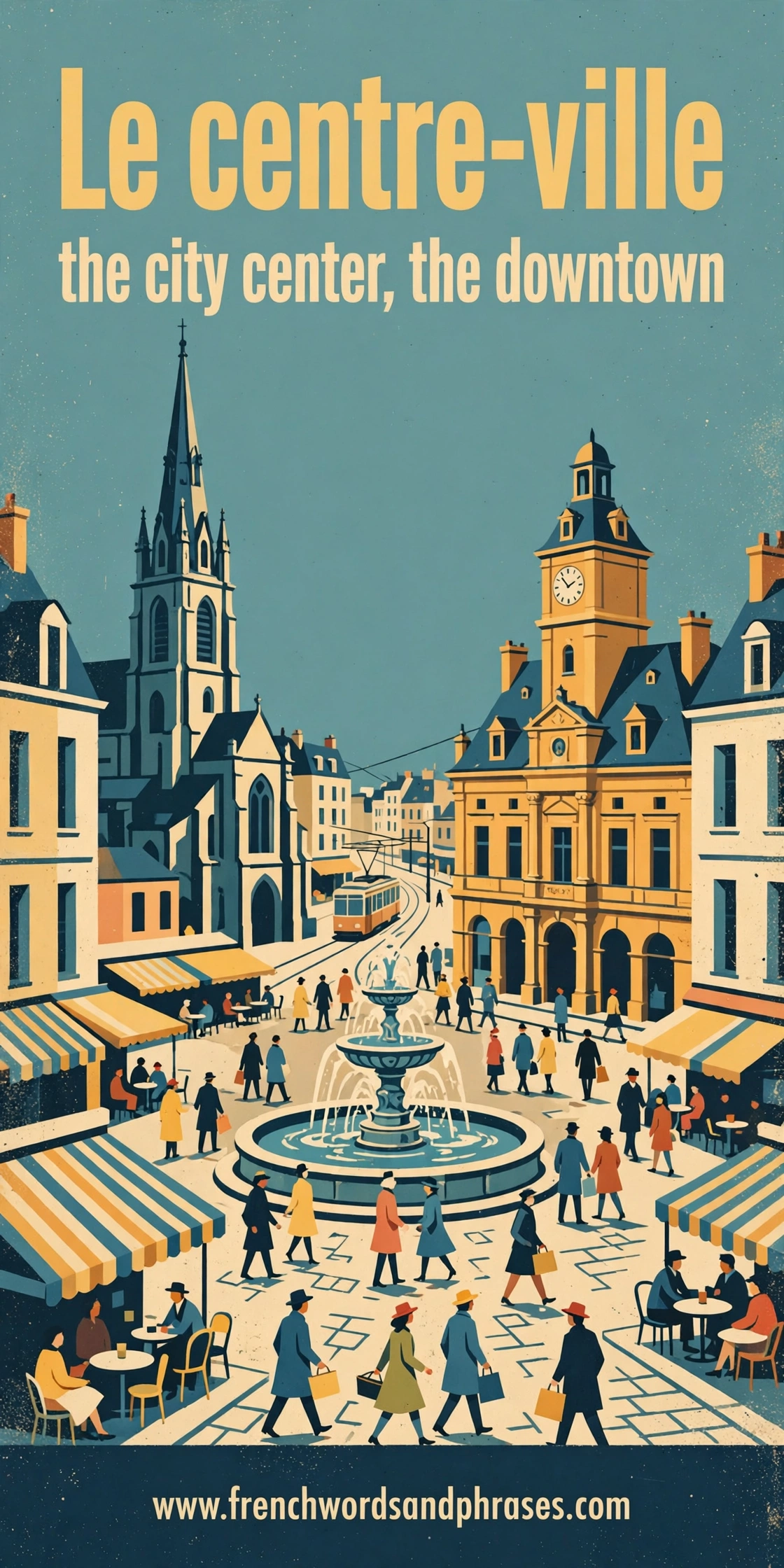
Church spire, market square, cafés spilling onto the pavement and every bus in town converging at one stop: le centre-ville, the city centre — the beating middle of a French town, where its history and its shopping share the same streets.
In this guide, you’ll learn what centre-ville means in English, how to use it with its articles, how to form its plural, and how it appears in everyday French. Explore French examples, English translations, and practice quizzes.
Understanding the French Noun Centre-Ville
Centre-ville is a masculine French noun, learned with its article: le centre-ville, un centre-ville. It is a compound of centre and ville, town — the centre of the town — joined by the hyphen French compounds wear. The plural adds an s to the first part only: des centres-villes.
It means the town or city centre, downtown — the central district of shops, offices and old streets: habiter en centre-ville, to live in the centre, le centre-ville historique, the historic centre. In France the centre-ville is usually the oldest part of town: the cathedral, the mairie, the place with its café terraces. Its opposite is la banlieue, the suburbs, and its modern rival is le centre commercial, the out-of-town shopping centre.
Gender: Masculine — le centre-ville
Definite article: le — le centre-ville (the city centre)
Indefinite article: un — un centre-ville (a city centre)
Plural: les centres-villes — the s goes on centre, the first part
Spelling note: a hyphenated compound: centre + ville, town
The opposite: la banlieue — the suburbs; la périphérie, the outskirts
English equivalents: The city centre, the downtown.
French most often uses the word inside a preposition: en centre-ville, in the centre (no article), aller en centre-ville, to go into town. For a village, the heart is simply le centre du village or le bourg. Signs on French roads abbreviate the idea to a single word — CENTRE — with an arrow into the oldest streets.
Experience the Word
Centre-ville is the town’s front room: the square, the church, the café where everyone eventually passes.
Imagine Saturday morning en centre-ville — the market stalls on the place, the boulangerie queue out of the door, the church bells marking eleven over the rooftops.
You have not just named a district. You have named the town’s heart — le centre-ville, the city centre, where the town meets itself.
How to Use Centre-Ville in French: Complete Guide
Let’s explore how centre-ville works in French, beginning with its articles — le centre-ville, un centre-ville, en centre-ville.
Centre-Ville with the Definite Article (Le, Les)
Used for a specific centre — the one in your town.
| Form | French |
|---|---|
| Masculine singular | le centre-ville |
| Plural | les centres-villes |
Example
Le centre-ville est piéton le samedi.
The city centre is pedestrianised on Saturdays.
Centre-Ville with the Indefinite Article (Un, Des)
Used for a centre in general — any town’s busy middle.
| Form | French |
|---|---|
| Masculine singular | un centre-ville |
| Plural | des centres-villes |
Example
C’est un centre-ville plein de petites rues.
It’s a city centre full of little streets.
In the Centre-Ville (Place, Mairie, Cathédrale…)
The landmarks every French centre-ville keeps — the heart’s furniture.
| Landmark | French |
|---|---|
| the main square | la place centrale |
| the town hall | la mairie |
| the cathedral | la cathédrale |
| the pedestrian streets | les rues piétonnes |
| the historic centre | le centre historique |
Example
La mairie se trouve en plein centre-ville.
The town hall is right in the city centre.
Quick Quiz 1
Complete the sentence:
______ centre-ville de Lyon est classé au patrimoine mondial. (the)
Reveal the answer
Le
Le centre-ville de Lyon est classé au patrimoine mondial.
Lyon’s city centre is a World Heritage site — centre-ville is masculine, so le.
The Plural of Centre-Ville
In this compound, only the first part takes the plural s: des centres-villes.
| Number | French |
|---|---|
| Singular | le centre-ville |
| Plural | les centres-villes |
Example
Les centres-villes français gardent leurs vieilles pierres.
French city centres keep their old stones.
Centre-Ville with Possessive Adjectives (Mon, Ton, Son…)
Possessives agree with the noun: centre-ville is masculine, so mon, ton, son in the singular.
| Owner | French |
|---|---|
| my | mon centre-ville |
| your (tu) | ton centre-ville |
| his / her | son centre-ville |
| our | notre centre-ville |
| your (vous) | votre centre-ville |
| their | leur centre-ville |
Example
Mon centre-ville a changé depuis mon enfance.
My city centre has changed since my childhood.
Quick Quiz 2
Complete the sentence:
Ils ont refait ______ centre-ville avec des rues piétonnes. (their)
Reveal the answer
leur
Ils ont refait leur centre-ville avec des rues piétonnes.
They rebuilt their city centre with pedestrian streets — leur, for one place owned by many.
Centre-Ville with Demonstrative Adjectives (Ce, Ces)
Used to point: ce centre-ville, this city centre — this one, with its old square.
| Form | French |
|---|---|
| Masculine singular | ce centre-ville |
| Plural | ces centres-villes |
Example
Ce centre-ville date du Moyen Âge.
This city centre dates from the Middle Ages.
Centre-Ville with Adjectives
Adjectives agree with centre-ville — masculine singular: un centre-ville animé, un vieux centre-ville.
| Adjective | With Centre-Ville |
|---|---|
| animé (lively) | un centre-ville animé |
| historique (historic) | un centre-ville historique |
| vieux (old) | un vieux centre-ville |
| piéton (pedestrianised) | un centre-ville piéton |
| commerçant (full of shops) | un centre-ville commerçant |
Example
Un centre-ville animé attire les jeunes familles.
A lively city centre attracts young families.
Quick Quiz 3
Complete the sentence:
Nous visitons un centre-ville très ______. (historic)
Reveal the answer
historique
Nous visitons un centre-ville très historique.
We are visiting a very historic city centre — historique agrees with the masculine noun.
Everyday Expressions with Centre-Ville
Shopping, squares and Saturdays — the centre-ville phrases of daily life.
| Expression | In English |
|---|---|
| en centre-ville | in the city centre |
| aller en centre-ville | to go into town |
| en plein centre-ville | right in the centre |
| le centre historique | the historic centre |
| les rues piétonnes | the pedestrian streets |
Example
Elle habite en plein centre-ville, au-dessus d’un café.
She lives right in the city centre, above a café.
Words from the Same Family as Centre-Ville
Town geography — the words that travel with centre-ville.
| French | In English |
|---|---|
| la ville | the town, the city |
| la banlieue | the suburbs |
| un quartier | a district, a neighbourhood |
| la mairie | the town hall |
| central | central (adjective) |
Example
Le quartier autour du centre-ville est très calme.
The district around the city centre is very quiet.
Quick Quiz 4
What does en plein centre-ville mean?
Reveal the answer
Right in the city centre — in the very heart of town.
L’hôtel est en plein centre-ville.
The hotel is right in the city centre.
Centre-Ville in Everyday French: Real-Life Examples
Now that you know the word, let’s see how centre-ville appears in everyday French.
Example 1 — Going shopping
Je vais en centre-ville cet après-midi.
I’m going into town this afternoon.
Example 2 — Living there
Elle habite en centre-ville, près de la gare.
She lives in the centre, near the station.
Example 3 — Saturday
Le centre-ville est noir de monde le samedi.
The city centre is packed on Saturdays.
Example 4 — History
Le centre-ville historique se visite à pied.
The historic centre is best visited on foot.
Example 5 — Parking
Se garer en centre-ville est difficile.
Parking in the city centre is difficult.
Example 6 — Evening
Les cafés du centre-ville sont pleins le soir.
The city centre cafés are full in the evening.
Beyond Translation: The Meaning of Centre-Ville
The French centre-ville is a thousand-year-old idea: church, market and town hall gathered inside walls, with the town’s life radiating outward. The twentieth century threatened it — cars, suburbs and out-of-town hypermarkets drained the old streets — and France answered with a counter-revolution: pedestrian squares, restored façades, markets brought back to the place. To defend the centre-ville became a point of national pride: a town without a heart, the French decided, is not a town at all.
To say centre-ville is to say a town still has a heart.
It evokes the Saturday market, the church bells and the café terrace — the middle of everything.
How to Remember the French Noun Centre-Ville
Remember it this way: Centre-ville is the city centre — masculine: le centre-ville. Most often you will meet it as en centre-ville, in the centre.
- Always masculine — le centre-ville, un centre-ville, mon centre-ville.
- The everyday phrase — en centre-ville, in the centre, with no article.
- The plural — les centres-villes: the s goes on centre only.
The key idea is le centre-ville — the city centre, masculine; en centre-ville = in the centre.
Test Your Knowledge of Centre-Ville
Let’s see how much you’ve learned. Try answering these questions before revealing the answers.
Question 1
Is centre-ville masculine or feminine?
Reveal the answer
Masculine — le centre-ville, un centre-ville.
Question 2
How do you say in the city centre?
Reveal the answer
En centre-ville — no article after en.
Question 3
Translate: She lives right in the city centre.
Reveal the answer
Elle habite en plein centre-ville.
Question 4
What is the plural of centre-ville?
Reveal the answer
Les centres-villes — only centre takes the s.
Question 5
Complete the sentence:
______ centres-villes gardent leurs vieilles pierres. (the)
Reveal the answer
Les
Les centres-villes gardent leurs vieilles pierres.
City centres keep their old stones.
Your Final Challenge
Can You Use It?
How would you say this in French?
“She lives right in the city centre.”
Reveal the answer
Elle habite en plein centre-ville.
She lives right in the city centre.
A little French. A little curiosity. A richer everyday life.
LEARN FRENCH ONE WORD AT A TIME