
A French Word to Live By
Translate J’ai presque fini to English
/ʒe pʁɛsk fi.ni/
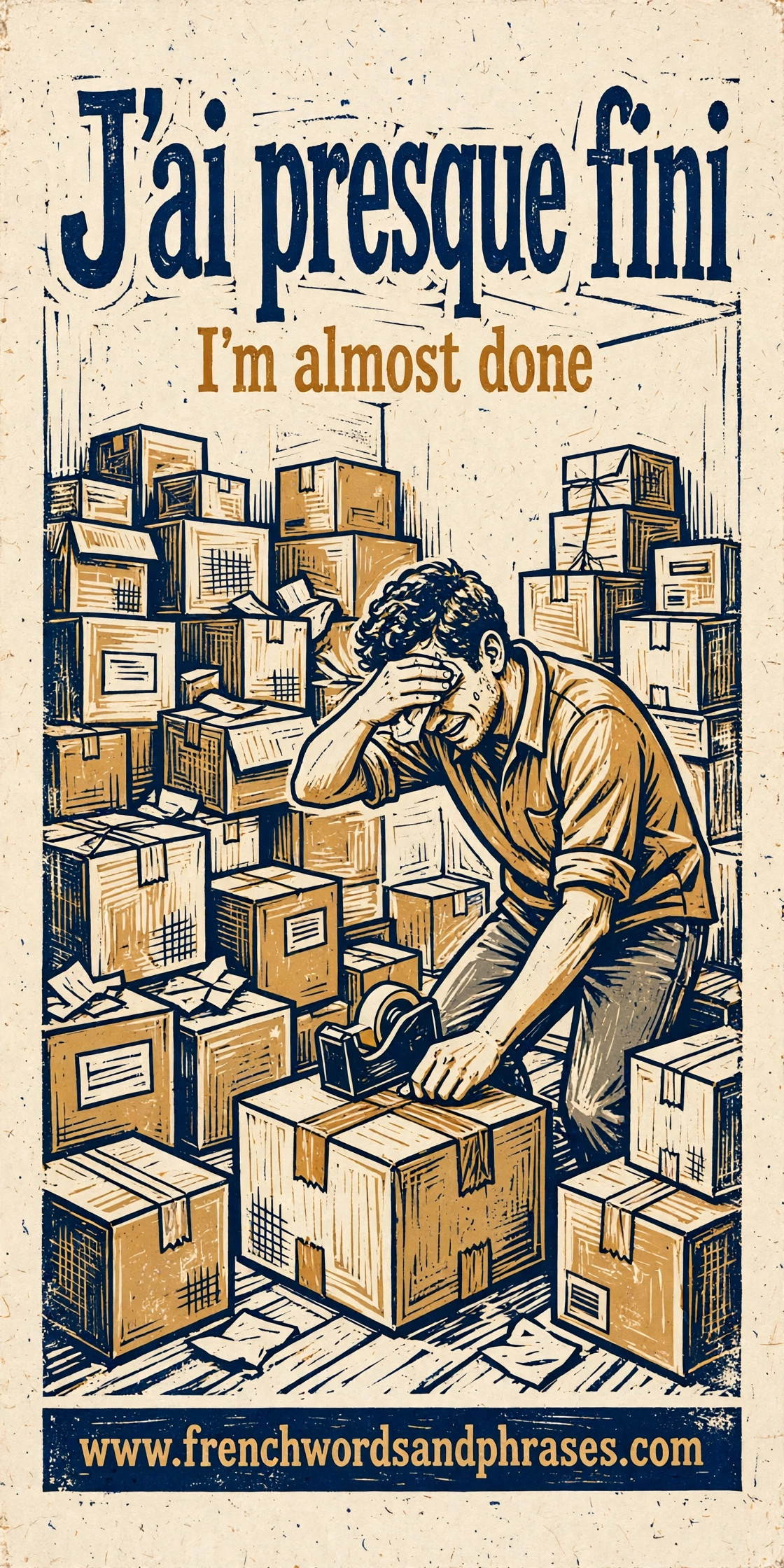
J’ai presque fini means I’m almost done.
The last box is being taped shut, the last email is half-written, and someone calls from the kitchen: ‘On mange !’ — dinner! You call back the hardest-working sentence of every nearly-finished task in France: J’ai presque fini !
Let’s explore how j’ai presque fini works in French, beginning with the whole phrase on one card.
Understanding the French Phrase J’ai presque fini
J’ai presque fini is a French everyday phrase — the passé composé of finir (to finish) with presque, almost, tucked inside it. It reports a task in its final minutes: not done, but close enough to promise.
It means I’m almost done — called out over half-packed boxes, half-written reports and gardens one flowerbed from finished. English says ‘almost done’; French builds it from avoir + the participle fini: I have almost finished. The avoir is the engine of the French past, and presque is the honest little word that keeps the promise true.
Type: Everyday phrase — passé composé of finir, with presque (almost) inside
Answers the need: Telling someone your task is in its last minutes — a promise and a small plea for patience
Register: Neutral — homes, offices, classrooms and building sites
Strength: Everyday — work, homework, cooking, packing, cleaning
One important usage detail: presque sits between the helper and the participle — j’ai presque fini, never ‘j’ai fini presque’. French adverbs of this family (presque, déjà, bientôt, toujours) park in the same slot: j’ai déjà fini, I’ve already finished.
Experience the Word
J’ai presque fini is the diplomacy of the last ten percent — it calms the person waiting and forgives the person working.
Imagine the scene it governs: a table half-laid, a suitcase half-zipped, a wall half-painted. The phrase does not describe the work; it negotiates the wait. It says: the end exists, I can see it from here, give me five more minutes of peace.
It is also a small act of honesty. The temptation is to cry ‘fini !’ — done! — but presque tells the truth, and French rewards the truth with patience.
How to Use J’ai presque fini in French: Complete Guide
Let’s explore how j’ai presque fini works in French, beginning with the whole phrase on one card.
J’ai presque fini at a Glance
The Whole Phrase on One Card
Real meaning, literal building blocks, English twin and register — j’ai presque fini in five lines.
| Point | J’ai presque fini |
|---|---|
| What it really means | I’m almost done — the task is in its final minutes |
| Word for word | I have almost finished (j’ai + presque + fini) |
| English equivalent | I’m almost done / I’m nearly finished |
| Register | neutral — safe everywhere |
| Use it for | work, homework, cooking, packing — any task someone is waiting on |
Example
J’ai presque fini, mets la table sans moi.
I’m almost done, lay the table without me.
Word by Word: Building the Nearly-Done
Three pieces — a helper verb, an ‘almost’, and a participle doing the finishing.
| Word | Literal meaning | Its job in the phrase |
|---|---|---|
| j’ai | I have | the helper of the passé composé — French builds this past with avoir, to have |
| presque | almost / nearly | the honesty word — parked between the helper and the participle |
| fini | finished | the past participle of finir, to finish |
Example
Il a presque fini ses devoirs.
He has almost finished his homework.
Quick Quiz 1
Where does presque go — j’ai presque fini or j’ai fini presque?
Reveal the answer
Between the helper and the participle — j’ai presque fini. The whole family parks there: déjà, bientôt, toujours.
J’ai déjà fini, moi !
I’ve already finished, me!
When You Say It: The Last-Minute Moments
J’ai presque fini belongs to the final stretch of any task with an audience.
| Situation | Example |
|---|---|
| Dinner is called | j’ai presque fini, commencez sans moi — I’m almost done, start without me |
| A report at work | j’ai presque fini le rapport, je te l’envoie dans dix minutes — I’ve almost finished the report, I’ll send it to you in ten minutes |
| Homework | maman, j’ai presque fini, plus que deux exercices — Mum, I’m almost done, only two exercises left |
| Packing to move | on a presque fini les cartons — we’ve almost finished the boxes |
| Cooking | c’est presque fini, goûte-moi cette sauce — it’s almost done, taste this sauce for me |
Example
J’ai presque fini, plus que le dessert à préparer.
I’m almost done, only the dessert left to prepare.
Make It Yours: Bending the Nearly-Done
The phrase bends — other people, other adverbs, and the triumphant opposite.
| Form | French | In English |
|---|---|---|
| She / he | elle a presque fini | she has almost finished |
| For a group | on a presque fini | we’ve almost finished |
| Already there | j’ai déjà fini | I’ve already finished |
| The triumph | j’ai fini ! | I’ve finished! / I’m done! |
| The honest delay | je n’ai pas encore fini | I haven’t finished yet |
| About a thing | c’est presque fini | it’s almost finished |
Example
Tu as fini ? — Pas encore, mais j’ai presque fini.
Have you finished? — Not yet, but I’m almost done.
Quick Quiz 2
Your manager asks if the report is sent. It is not — two pages remain. Which answer is honest — j’ai fini or j’ai presque fini?
Reveal the answer
J’ai presque fini — presque is the small word that keeps the promise true.
J’ai presque fini, je vous l’envoie dans un quart d’heure.
I’m almost done, I’ll send it to you in fifteen minutes.
Everyday Expressions: Building on the Finish
Finir grows a whole family of finishing frames — learn these and every task reports its progress.
| Frame | In English |
|---|---|
| j’ai presque fini | I’m almost done |
| j’ai fini ! | I’m done! |
| je n’ai pas encore fini | I haven’t finished yet |
| plus que + noun + à + verb | only … left to … |
| c’est bientôt fini | it’ll soon be over |
| finir par + infinitive | to end up doing |
Example
On a fini par tout ranger avant minuit.
We ended up tidying everything before midnight.
Close Cousins: The Other Progress Reports
French times the end of a task precisely — each cousin reports a different distance from done.
| Expression | The difference |
|---|---|
| je suis presque prêt | I’m almost ready — for people getting ready, not tasks being finished |
| c’est presque fini | it’s almost finished — said about the thing, not the person |
| plus que cinq minutes | only five minutes left — the countdown version |
| je suis en train de finir | I’m just finishing — the work is happening this second |
| ça y est ! | that’s it! — the cry at the exact moment of finishing |
Example
Ça y est, j’ai fini ! On peut partir.
That’s it, I’m done! We can go.
Quick Quiz 3
You zip the last suitcase shut. Which cousin is the cry of the exact moment — j’ai presque fini or ça y est?
Reveal the answer
Ça y est — presque fini lives before the finish line; ça y est is shouted on it.
Ça y est, la valise est fermée !
That’s it, the suitcase is closed!
J’ai presque fini and Its Neighbours
The finir family at a glance — finishes in every tense of hope.
| French | In English |
|---|---|
| j’ai presque fini | I’m almost done |
| j’ai fini | I’m done / I’ve finished |
| je finis | I’m finishing (right now) |
| je finirai demain | I’ll finish tomorrow |
| fini ! | done! / finished! |
| c’est fini | it’s over / it’s finished |
Example
C’est fini, les vacances… je finirai ce livre à la maison.
The holidays are over… I’ll finish this book at home.
Watch Out: The Traps Around J’ai presque fini
Three traps wait around this phrase — step round them.
| Trap | The truth |
|---|---|
| Placing presque after fini | the adverb parks inside the tense: j’ai presque fini — ‘j’ai fini presque’ is not French |
| The English false friend ‘finite’ | fini means finished, ended — it has nothing to do with limits or mathematics |
| Using être as the helper | finir builds its past with avoir: j’ai fini — never ‘je suis fini’ (which means ‘I’m done for!’) |
| Confusing fini and fin | la fin is the noun ‘the end’; fini is the participle ‘finished’ |
Example
Je suis fini si je n’ai pas fini ce rapport à midi !
I’m done for if I haven’t finished this report by noon!
Quick Quiz 4
True or false: je suis fini is the natural way to say ‘I’ve finished’.
Reveal the answer
False — je suis fini means ‘I’m done for, I’m finished off’. The task report is j’ai fini, with avoir.
J’ai fini mes devoirs, je ne suis pas fini, moi !
I’ve finished my homework — I’m not done for!
J’ai presque fini in Everyday French: Real-Life Examples
Now that you know the word, let’s see how j’ai presque fini appears in everyday French.
Example 1 — Moving day
On a presque fini les cartons, plus que la cuisine.
We’ve almost finished the boxes, only the kitchen left.
Example 2 — At the office
J’ai presque fini la présentation, elle est prête dans cinq minutes.
I’m almost done with the presentation, it’s ready in five minutes.
Example 3 — Homework
J’ai presque fini, maman, plus qu’un exercice de maths.
I’m almost done, Mum, only one maths exercise left.
Example 4 — In the kitchen
Le dîner ? J’ai presque fini, mets le couvert.
Dinner? I’m almost done, set the table.
Example 5 — The phone call
Je te rappelle, j’ai presque fini ma réunion.
I’ll call you back, I’m almost done with my meeting.
Example 6 — The triumph
Ça y est, j’ai fini ! Tout est rangé.
That’s it, I’m done! Everything is put away.
Beyond Translation: The Meaning of J’ai presque fini
Presque is one of French’s great diplomatic words — it turns a claim into a promise and a delay into a plan. English ‘almost’ can sound like failure (you almost caught the train), but French presque looks forward: the finish exists, it is visible, it is coming. J’ai presque fini is less a report than a small treaty between the worker and the waiter.
How to Remember the French Phrase J’ai presque fini
Remember it this way: J’ai presque fini parks its ‘almost’ inside the tense — helper, presque, participle — like a bookmark five pages from the end of a book.
- You see the bookmark near the end of the book — that is presque, and that is where it sits in the sentence.
- You build the past with avoir: j’ai fini — and you keep je suis fini for jokes about being done for.
- You answer the wait with a number when you can: plus que cinq minutes — only five minutes left.
The key idea is j’ai presque fini means I’m almost done — the passé composé of finir, with presque tucked between j’ai and fini.
Test Your Knowledge of J’ai presque fini
Let’s see how much you’ve learned. Try answering these questions before revealing the answers.
Question 1
What does j’ai presque fini mean?
Reveal the answer
I’m almost done — the task is in its final minutes.
Question 2
Where does presque sit in the phrase?
Reveal the answer
Between the helper and the participle — j’ai presque fini.
Question 3
How do you say ‘I haven’t finished yet’?
Reveal the answer
Je n’ai pas encore fini — the honest opposite of the triumph j’ai fini !
Question 4
Why is je suis fini a trap?
Reveal the answer
Because it means ‘I’m done for’ — finir takes avoir for its past: j’ai fini.
Question 5
Complete the sentence:
J’ai ______ fini, plus que deux pages. (I’m almost done, only two pages left.)
Reveal the answer
presque — J’ai presque fini, plus que deux pages.
Your Final Challenge
Can You Use It?
How would you say this in French?
“I’m almost done, start dinner without me.”
Reveal the answer
J’ai presque fini, commencez le dîner sans moi.
I’m almost done, start dinner without me.
A little French. A little curiosity. A richer everyday life.
LEARN FRENCH ONE WORD AT A TIME




