A French Vocabulary Lesson
Welcome to a little French lesson about measuring the world!
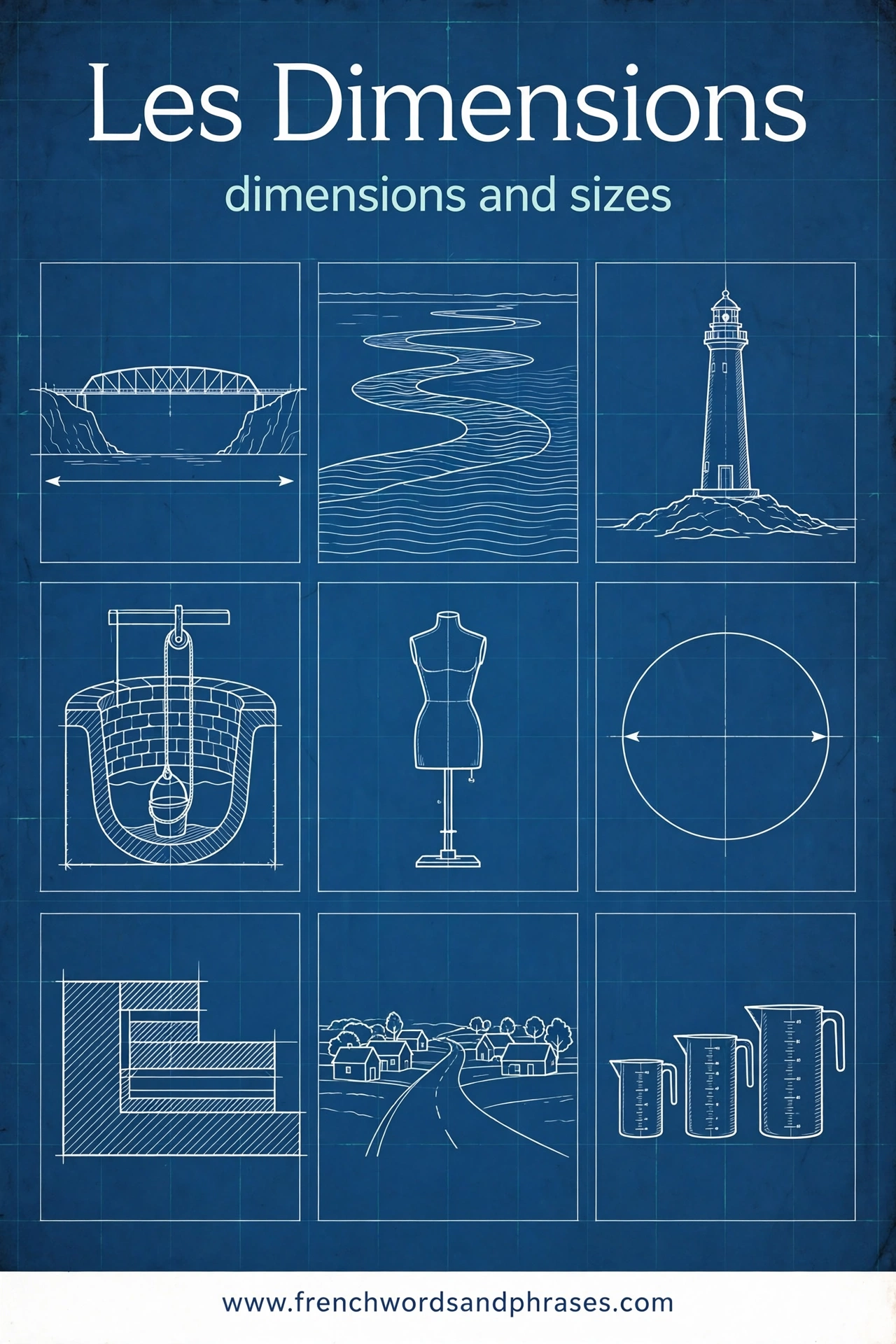
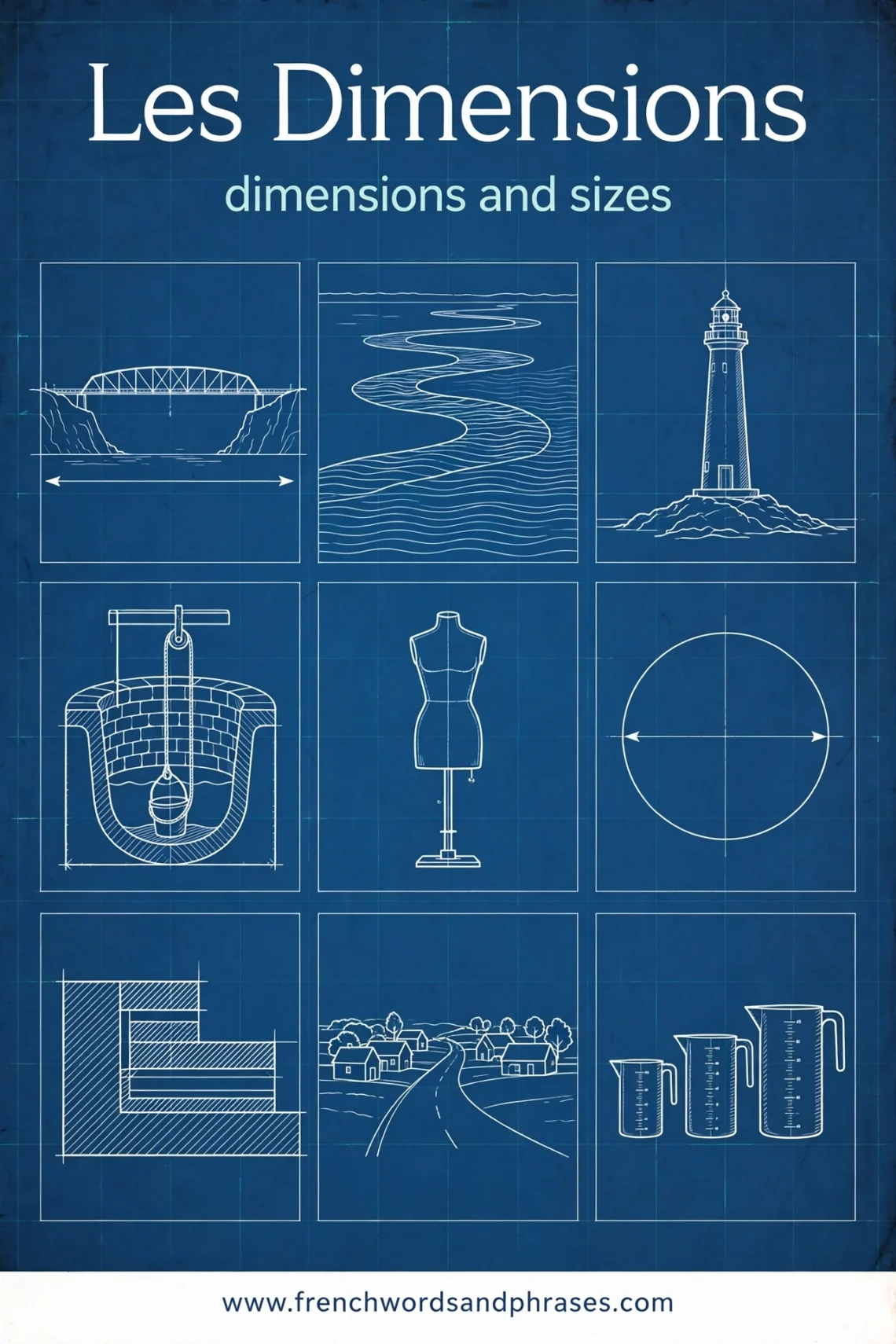
Les dimensions means dimensions and sizes. In this lesson, you’ll discover nine useful French words for measuring length, width, height — and everything in between.
Learning vocabulary is easier when you see words used in real situations. So instead of memorizing a list, let’s help a young couple measure their brand-new apartment, one room at a time.
Our Story: Un Nouvel Appartement
Imagine that Hugo and Emma have just received the keys to a new apartment. Before the furniture arrives, they spend Saturday with a tape measure, a notebook, and a lot of questions.
Read the story in French first. The English translation follows each passage to help you understand.
Le Jour des Mesures
Hugo déroule le mètre dans le salon. La longueur de la pièce est de cinq mètres, et la largeur est de quatre mètres. Le canapé va tenir, c’est sûr !
Hugo unrolls the tape measure in the living room. The length of the room is five metres, and the width is four metres. The sofa will fit, that’s certain!
Mais attention à la porte ! Emma mesure la largeur de la porte : soixante-quinze centimètres seulement. Le frigo, lui, fait quatre-vingt-dix centimètres de large. Problème !
But watch out for the door! Emma measures the width of the door: only seventy-five centimetres. The fridge, for its part, is ninety centimetres wide. Problem!
Dans la chambre, Hugo regarde le plafond. La hauteur sous plafond est de deux mètres soixante-dix. La grande armoire, avec ses deux mètres quarante de haut, passera sans problème.
In the bedroom, Hugo looks at the ceiling. The ceiling height is two metres seventy. The big wardrobe, at two metres forty high, will go in without a problem.
Pour la bibliothèque, il faut mesurer la profondeur du placard : soixante centimètres de profondeur. Parfait pour les livres et les dossiers.
For the bookcase, they must measure the depth of the cupboard: sixty centimetres deep. Perfect for the books and the files.
Emma choisit un tapis pour le salon. Elle compare les tailles : ce modèle existe en trois tailles. Elle prend la plus grande, bien sûr.
Emma chooses a rug for the living room. She compares the sizes: this model comes in three sizes. She takes the largest, of course.
La table ronde arrive mardi. Son diamètre est d’un mètre vingt. Hugo calcule déjà : six chaises autour, c’est possible.
The round table arrives on Tuesday. Its diameter is one metre twenty. Hugo is already working it out: six chairs around it, that’s possible.
Dans la chambre, le nouveau matelas est très confortable. Son épaisseur est de vingt-cinq centimètres ! Et les murs sont épais aussi : cinquante centimètres d’épaisseur, la maison est ancienne et solide.
In the bedroom, the new mattress is very comfortable. Its thickness is twenty-five centimetres! And the walls are thick too: fifty centimetres thick, the house is old and solid.
Le soir, Hugo regarde la carte. La distance entre l’appartement et la boulangerie est de deux cents mètres. Et le volume total des cartons ? Trente cartons… il faudra un grand camion !
In the evening, Hugo looks at the map. The distance between the apartment and the bakery is two hundred metres. And the total volume of the boxes? Thirty boxes… they’ll need a big van!
The Vocabulary: 9 French Words for Dimensions and Sizes
Now let’s look at the nine important words from our story. Try saying each French word aloud before looking at its English meaning.
| French | English |
|---|---|
| 1. La longueur | The length |
| 2. La largeur | The width |
| 3. La hauteur | The height |
| 4. La profondeur | The depth |
| 5. La taille | The size |
| 6. Le diamètre | The diameter |
| 7. L’épaisseur | The thickness |
| 8. La distance | The distance |
| 9. Le volume | The volume |
A small but useful language tip:
When French gives a measurement, the number usually travels with de plus the adjective, not the noun: a table three metres long is une table de trois mètres de long — of three metres of long. The same pattern gives de large (wide) and de haut (high). The nouns — la longueur, la largeur, la hauteur — name the measurement when you ask about it: quelle est la longueur de la table ?
French in Everyday Life: Useful Expressions
Knowing the names of the measurements is a good beginning. But how do you use these words in a conversation?
Here are some simple expressions you might hear or use when measuring, moving or shopping.
Example 1 — Asking about a room
Quelle est la longueur de la pièce ?
What is the length of the room?
Example 2 — A table that fits
La table fait deux mètres de long.
The table is two metres long.
Example 3 — At the pool
La profondeur du bassin est de trois mètres.
The depth of the pool is three metres.
Example 4 — In the clothes shop
Quelle taille faites-vous ?
What size are you?
Example 5 — Round things
Je cherche une poêle de vingt-huit centimètres de diamètre.
I’m looking for a twenty-eight-centimetre pan.
Example 6 — On the road
Le village est à dix kilomètres d’ici.
The village is ten kilometres from here.
A Little French Grammar: The -eur Sisters and Measuring with De
You may have noticed that five of our nine words end in -eur: longueur, largeur, hauteur, profondeur, épaisseur.
Each one is built from an adjective, and each one is feminine.
- long (long) → la longueur, the length.
- large (wide) → la largeur, the width.
- haut (high) → la hauteur, the height.
- profond (deep) → la profondeur, the depth.
- épais (thick) → l’épaisseur, the thickness.
Learn the pattern once, and French hands you its whole system of dimensions in a single lesson.
Then, to give the number, use de: deux mètres de long, un mètre de large, dix mètres de haut. Three of our words carry the number in their own name instead: soixante centimètres de profondeur, d’épaisseur, de diamètre.
Test Your Knowledge: French Dimensions
Let’s see how much you remember. Try each question before opening the answer.
Quick Quiz 1
Which French word means “the width”?
Reveal the answer
La largeur
Quick Quiz 2
Complete the sentence:
La table fait trois mètres de ______.
Reveal the answer
long
La table fait trois mètres de long.
The table is three metres long.
Quick Quiz 3
How do you say “the depth” in French?
Reveal the answer
La profondeur
Quick Quiz 4
Which word is the odd one out — the only masculine word among the five -eur sisters: longueur, largeur, diamètre, hauteur?
Reveal the answer
Le diamètre — it is masculine, and it is not an -eur word at all: it is the Greek measure across.
Quick Quiz 5
Complete the sentence:
Le placard fait soixante centimètres de ______.
Reveal the answer
profondeur
Le placard fait soixante centimètres de profondeur.
The cupboard is sixty centimetres deep.
Can You Translate These French Sentences?
Now let’s reverse the exercise. Read each French sentence and try to translate it into English.
Question 1
La longueur de la pièce est de cinq mètres.
What does this mean?
Reveal the answer
The length of the room is five metres.
Question 2
Le diamètre de la table est d’un mètre vingt.
What does this mean?
Reveal the answer
The diameter of the table is one metre twenty.
Question 3
Ce tapis existe en trois tailles.
What does this mean?
Reveal the answer
This rug comes in three sizes.
Question 4
La distance entre les deux villages est de cinq kilomètres.
What does this mean?
Reveal the answer
The distance between the two villages is five kilometres.
Question 5
Baisse le volume, le bébé dort !
What does this mean?
Reveal the answer
Turn the volume down, the baby is asleep! — volume’s second life: the sound, not the space.
Discover a Little French Culture: The Metric System
Here is something to be proud of on France’s behalf: the metric system — metres, litres, kilos — was born in France, during the Revolution, when scientists set out to give the whole world one fair, shared way of measuring.
The metre was defined from the Earth itself: one ten-millionth of the distance from the North Pole to the equator, measured through Paris. For a long time, a platinum bar kept near Paris was the official metre for the entire planet.
So when you measure a room in metres, you are using a French invention — the dimensions of this lesson are, quite literally, France’s gift to the world’s tape measures.
And here’s a useful expression:
Être à la hauteur.
To be up to it — to rise to the occasion.
It is built on our word la hauteur: to be at the height of the task. May all your measurements — and your occasions — find you à la hauteur.
How to Remember Your New French Words
The easiest way to remember vocabulary is to connect each word to something familiar.
Try this little exercise in your own home:
- When you measure a wall, say la longueur.
- When you check a doorway, think la largeur.
- When you reach for a high shelf, think la hauteur.
- When you open a deep cupboard, think la profondeur.
- When you buy clothes, ask for la taille.
- When you turn the music down, remember le volume.
A few minutes of practice each day can make these words part of your everyday French vocabulary.
Your Final Challenge
Can You Measure Your Room in French?
Imagine that you are describing your living room to a French-speaking friend who will help you move.
Can you give its length and width, and mention at least three of the vocabulary words from this lesson?
Here is a little example to get you started:
Mon salon a une longueur de six mètres et une largeur de quatre mètres. La table ronde a un diamètre d’un mètre vingt, et le placard fait soixante centimètres de profondeur.
My living room has a length of six metres and a width of four metres. The round table has a diameter of one metre twenty, and the cupboard is sixty centimetres deep.
Now it’s your turn!
Try writing a few sentences about your own room in French. Don’t worry about making mistakes. Every new sentence is another step toward speaking French.
Today’s Lesson: Les Dimensions — Dimensions and Sizes
Nine new words. A little story. A little French culture.
Learn French one lesson at a time!