
A French Word to Live By
Translate Malodorant to English
/ma.lɔ.dɔ.ʁɑ̃/
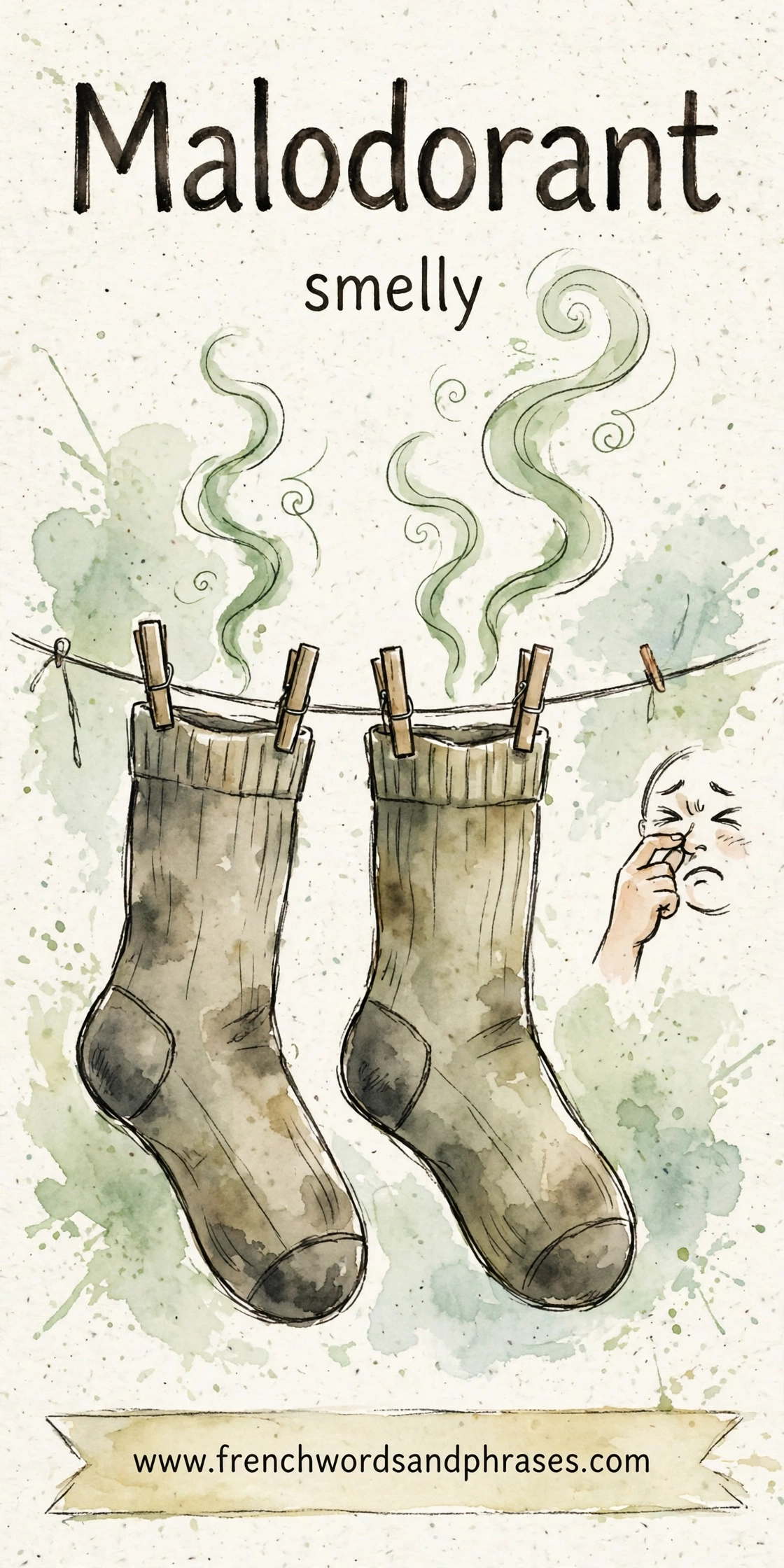
Malodorant means smelly.
The sports bag has been closed since Friday. On Monday morning, someone unzips it — and the whole kitchen steps back. The socks inside are officially malodorantes, smelly.
In this guide, you’ll learn what malodorant means in English, its four forms, why it is the polite word for a rude fact, and the stronger words waiting behind it. Explore French examples, English translations, and practice quizzes.
Understanding the French Adjective Malodorant
Malodorant is a French adjective built in two pieces: mal, badly, and odorant, smelling — badly-smelling. It is the formal, almost scientific word for smelly, the one used on labels and in polite company. It agrees with the noun it describes: un fromage malodorant, des chaussettes malodorantes.
It means smelly, bad-smelling — giving off an unpleasant odour: les chaussettes malodorantes of the sports bag, un égout malodorant, a smelly drain. Everyday French more often says qui sent mauvais or, stronger and ruder, puant. Malodorant is the word that keeps its gloves on.
Type: Adjective — mal (badly) + odorant (smelling)
Answers the question: What is it like? — smelly
Changes form: Yes — malodorant, malodorante, malodorants, malodorantes
English equivalents: Smelly, bad-smelling; everyday French: qui sent mauvais; strong: puant.
One important usage detail: malodorant is the polite register. To a friend about his socks, French says elles sentent mauvais or elles puent (they stink — rude but honest). Save malodorant for writing, labels and diplomacy: des déchets malodorants, smelly waste, on the council notice.
Experience the Word
Malodorant is the adjective of the held breath — the bag unzipped on Monday, the drain in the summer street, the cheese that announces itself before the plate arrives.
Imagine the referee of smells: the fridge door opened after the holidays, everyone leaning in, everyone leaning back, and the verdict delivered in the politest French available.
You have not just smelled something bad. You have named it — politely.
How to Use Malodorant in French: Complete Guide
Let’s explore how malodorant works in French, beginning with the whole word on one card.
Malodorant at a Glance
Before the details, here is the whole word on one card.
The Whole Word on One Card
Meaning, type, position and forms — malodorant in four lines.
| Point | Malodorant |
|---|---|
| Meaning | smelly, bad-smelling |
| Type | adjective — mal + odorant |
| Usual position | after the noun — des chaussettes malodorantes |
| Forms | malodorant / malodorante / malodorants / malodorantes |
Example
Les chaussettes malodorantes vont directement à la machine.
The smelly socks go straight into the machine.
The Four Forms of Malodorant
Malodorant agrees with the noun it describes — the -ant pattern: feminine adds -e, plurals add -s.
| Form | Malodorant | Example |
|---|---|---|
| Masculine singular | malodorant | un fromage malodorant — a smelly cheese |
| Feminine singular | malodorante | une poubelle malodorante — a smelly bin |
| Masculine plural | malodorants | des égouts malodorants — smelly drains |
| Feminine plural | malodorantes | des chaussettes malodorantes — smelly socks |
Example
Il jette les fleurs malodorantes du vase.
He throws away the smelly flowers from the vase.
Quick Quiz 1
Which form of malodorant goes with chaussettes (feminine plural)?
Reveal the answer
malodorantes
Des chaussettes malodorantes.
Smelly socks.
Built in Two Pieces: Mal + Odorant
Malodorant is transparent: mal, badly, + odorant, smelling, from une odeur, a smell. Its opposite family is the perfumed one — odorant alone can be pleasant.
| French | In English |
|---|---|
| une odeur | a smell, an odour |
| odorant | smelling, fragrant |
| malodorant | bad-smelling |
| une bonne odeur | a nice smell |
| sentir mauvais | to smell bad (everyday) |
| le parfum | the perfume, the scent |
Example
Une bonne odeur de pain chaud sort de la boulangerie.
A lovely smell of warm bread comes from the bakery.
Where Malodorant Goes: After the Noun
Malodorant follows the noun like most describing adjectives — the thing first, then its smell: des chaussettes malodorantes.
| Pattern | Example |
|---|---|
| noun + malodorant | des chaussettes malodorantes — smelly socks |
| After être | la poubelle est malodorante — the bin is smelly |
| With très | très malodorant — very smelly |
| Before the noun | des malodorantes chaussettes — never; malodorant goes after |
Example
Ce fromage est très malodorant mais délicieux.
This cheese is very smelly but delicious.
Quick Quiz 2
Where does malodorant stand — before or after the noun?
Reveal the answer
After
Des chaussettes malodorantes, un fromage malodorant.
Smelly socks, a smelly cheese.
More Smelly: Comparing with Malodorant
Malodorant compares the regular way — and the strongest degree is usually delivered holding your nose.
| Degree | Example |
|---|---|
| As smelly as | aussi malodorant que — as smelly as |
| More smelly | plus malodorant — smellier |
| The most smelly | le plus malodorant — the smelliest |
| Slightly smelly | un peu malodorant — a bit smelly |
| Unbearably smelly | puant — stinking (the strong word) |
Example
Lequel est le plus malodorant, le sac ou les chaussures ?
Which is the smelliest, the bag or the shoes?
Everyday Expressions with Malodorant
Smells have their regulars — and French grades its honesty from the polite malodorant to the blunt puant.
| Expression | In English |
|---|---|
| des déchets malodorants | smelly waste (official, polite) |
| sentir mauvais | to smell bad (everyday) |
| puer | to stink (strong, familiar) |
| un fromage malodorant | a smelly cheese — often a compliment in disguise |
| ça sent ! | it smells! (you can smell it) |
| se boucher le nez | to hold your nose |
Example
Ouvre la fenêtre, ça sent dans la cuisine !
Open the window, it smells in the kitchen!
Quick Quiz 3
Your friend opens his sports bag and says: « Ça pue ! » Is he being polite?
Reveal the answer
No — puer is the strong word, to stink. Malodorant is the polite version of the same verdict.
Ça pue, ces chaussettes sont malodorantes.
It stinks — these socks are smelly.
Malodorant and Its Neighbours
On the smell shelf, malodorant is the diplomat — its neighbours say the same thing with less and less ceremony.
| French | In English |
|---|---|
| qui sent mauvais | that smells bad — the everyday phrase |
| puant | stinking — strong |
| nauséabond | nauseating, foul-smelling — formal and severe |
| parfumé | scented, fragrant — the opposite |
| frais, fraîche | fresh |
| inodore | odourless |
Example
Du parfumé au puant, le fromage français couvre tout.
From fragrant to stinking, French cheese covers everything.
Watch Out: The Traps Around Malodorant
The register trap above all — malodorant is polite; daily life usually is not.
| Trap | The truth |
|---|---|
| malodorant in casual chat | grammatical but formal — friends say ça sent mauvais |
| odorant alone | can be pleasant — it just means smelling |
| malodorant before the noun | no — it follows: des chaussettes malodorantes |
| un malodorant | not a noun — never « un malodorant » for a smell; say une mauvaise odeur |
Example
Quelle mauvaise odeur près de la poubelle !
What a bad smell near the bin!
Quick Quiz 4
How do you say ‘smelly socks’ — des malodorantes chaussettes or des chaussettes malodorantes?
Reveal the answer
des chaussettes malodorantes
Malodorant follows the noun, and chaussettes is feminine plural.
Des chaussettes malodorantes — smelly socks.
Malodorant in Everyday French: Real-Life Examples
Now that you know the word, let’s see how malodorant appears in everyday French.
Example 1 — The sports bag
Ces chaussettes malodorantes vont à la machine.
These smelly socks are going in the machine.
Example 2 — Cheese
Ce fromage malodorant est un délice.
This smelly cheese is a delight.
Example 3 — The bin
La poubelle est malodorante en été.
The bin is smelly in summer.
Example 4 — Everyday honesty
Tes chaussures sentent mauvais, franchement.
Your shoes smell bad, honestly.
Example 5 — The drain
Un égout malodorant passe sous la rue.
A smelly drain runs under the street.
Example 6 — Flowers
Jette ces fleurs malodorantes, elles sont fanées.
Throw those smelly flowers away, they’ve wilted.
See malodorant in a story: The State of Clothes: French Vocabulary (L’état des Vêtements) — laundry day with the Martin family.
Beyond Translation: The Meaning of Malodorant
English says smelly for the meaning of malodorant — but where English is blunt, French is diplomatic: malodorant is the word of notices and labels, the verdict with its gloves on, while daily life says ça sent mauvais and friends say ça pue. The word’s honesty is in its construction — mal + odorant, badly smelling — a smell judged in the open.
To say malodorant is to deliver the verdict politely.
It evokes the Monday sports bag, the summer bin, and the great French paradox: the most malodorant cheeses are often the most loved.
How to Remember the French Adjective Malodorant
Remember it this way: Malodorant is smelly — mal plus odorant, the polite word for a rude fact, standing after the noun.
- You build it openly — mal + odorant, badly smelling.
- You keep it polite — malodorant for writing; ça sent mauvais for friends.
- You agree it — des chaussettes malodorantes, after the noun.
The key idea is malodorant is the polite verdict — ça pue is the honest one.
Test Your Knowledge of Malodorant
Let’s see how much you’ve learned. Try answering these questions before revealing the answers.
Question 1
What does malodorant mean?
Reveal the answer
Smelly, bad-smelling — mal (badly) + odorant (smelling).
Question 2
What are the forms of malodorant?
Reveal the answer
malodorant, malodorante, malodorants, malodorantes.
Question 3
Translate: The smelly socks go in the machine.
Reveal the answer
Les chaussettes malodorantes vont à la machine.
Question 4
What is the everyday way to say something smells bad?
Reveal the answer
Ça sent mauvais — and stronger still, ça pue, it stinks.
Question 5
Complete the sentence:
La poubelle est ______ en été.
Reveal the answer
malodorante
La poubelle est malodorante en été.
The bin is smelly in summer.
Your Final Challenge
Can You Use It?
How would you say this in French?
“These smelly socks are going straight in the machine.”
Reveal the answer
Ces chaussettes malodorantes vont directement à la machine.
These smelly socks are going straight in the machine.
A little French. A little curiosity. A richer everyday life.
LEARN FRENCH ONE WORD AT A TIME




