A French Vocabulary Lesson
Welcome to a little French lesson about the home!
La maison means the house. In this lesson, you’ll discover twelve useful French words for the rooms, features, and spaces around a home.
Learning vocabulary is easier when you see words used in real situations. So instead of memorizing a list, let’s visit a lovely French house and discover what’s inside.
Our Story: Une Visite de la Maison
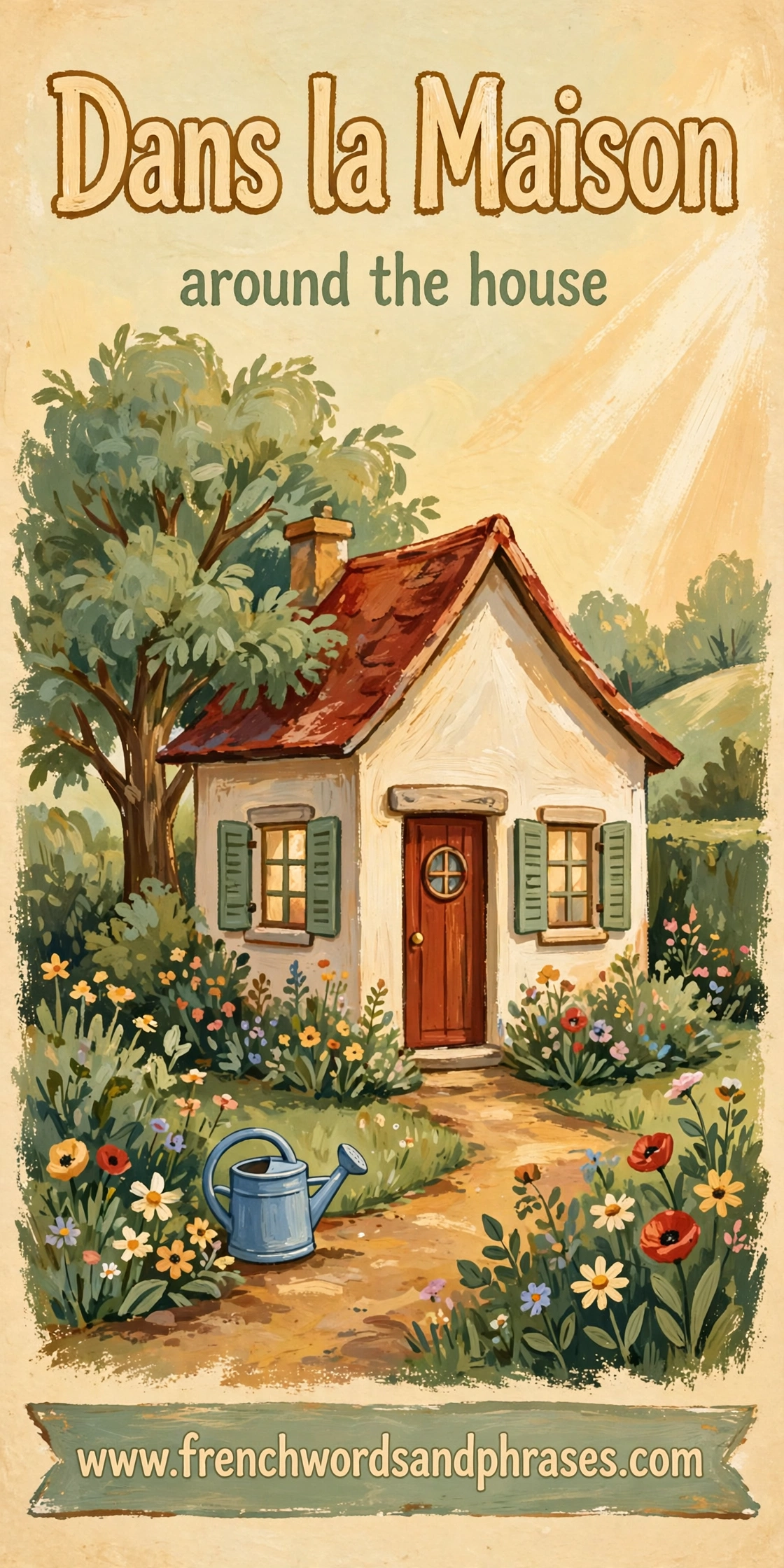
Imagine that you have been invited to visit your French friend Camille. She lives in a charming little house with a red roof, a beautiful garden, and plenty of interesting rooms to explore.
Camille opens the door and welcomes you inside.
Read the story in French first. The English translation follows each passage to help you understand.
Bienvenue chez Camille !
Voici la maison de Camille. C’est une jolie maison avec un toit rouge et un grand jardin.
Here is Camille’s house. It’s a pretty house with a red roof and a large garden.
Devant la maison, il y a une belle porte et plusieurs fenêtres. Dans le jardin, il y a des fleurs, un grand arbre et un petit arrosoir bleu.
In front of the house, there is a beautiful door and several windows. In the garden, there are flowers, a large tree, and a little blue watering can.
Camille ouvre la porte. Nous entrons dans l’entrée. À gauche, il y a un petit meuble et un porte-manteau.
Camille opens the door. We enter the entrance hall. On the left, there is a small piece of furniture and a coat rack.
Voici le salon ! C’est une grande pièce avec un canapé confortable, une table basse et une belle fenêtre. Camille aime lire et écouter de la musique dans le salon.
Here is the living room! It’s a large room with a comfortable sofa, a coffee table, and a beautiful window. Camille likes to read and listen to music in the living room.
À côté du salon, il y a la salle à manger. La famille prend ses repas autour de la table. Aujourd’hui, il y a des fruits sur la table.
Next to the living room, there is the dining room. The family eats its meals around the table. Today, there is fruit on the table.
Maintenant, visitons la cuisine ! Elle est lumineuse et bien équipée. Il y a un réfrigérateur jaune, une cuisinière, un évier et plusieurs placards. Camille prépare un délicieux déjeuner.
Now, let’s visit the kitchen! It is bright and well equipped. There is a yellow refrigerator, a stove, a sink, and several cupboards. Camille is preparing a delicious lunch.
Après le déjeuner, nous montons l’escalier pour visiter l’étage. Voici la chambre de Camille. Il y a un grand lit, une armoire et une petite table de nuit.
After lunch, we go up the stairs to visit the upper floor. Here is Camille’s bedroom. There is a large bed, a wardrobe, and a small bedside table.
À côté de la chambre, il y a la salle de bain. Elle a une baignoire, un lavabo et un miroir. Les toilettes sont juste à côté.
Next to the bedroom, there is the bathroom. It has a bathtub, a sink, and a mirror. The toilet is right next door.
Notre visite est terminée ! Camille nous invite à retourner dans le jardin pour profiter du soleil. Quelle belle maison !
Our tour is finished! Camille invites us to return to the garden to enjoy the sunshine. What a beautiful house!
The Vocabulary: 12 French Words Around the House
Now let’s look at the twelve important words from our story. Try saying each French word aloud before looking at its English meaning.
| French | English |
|---|---|
| 1. Le salon | The living room |
| 2. La cuisine | The kitchen |
| 3. La chambre | The bedroom |
| 4. La salle de bain | The bathroom |
| 5. La toilette | The toilet |
| 6. La salle à manger | The dining room |
| 7. L’entrée | The entrance / hall |
| 8. L’escalier | The stairs / staircase |
| 9. Le jardin | The garden |
| 10. La porte | The door |
| 11. La fenêtre | The window |
| 12. Le toit | The roof |
A small but useful language tip:
In everyday French, people generally say les toilettes when referring to the toilet room. Although the vocabulary illustration uses la toilette, remember that les toilettes is the expression you’ll most often hear in this context.
French in Everyday Life: Useful Expressions
Knowing the names of rooms is a good beginning. But how do you use these words in a conversation?
Here are some simple expressions you might hear or use when talking about a house.
Example 1 — Asking about the living room
Où est le salon ?
Where is the living room?
Example 2 — Talking about the kitchen
La cuisine est très jolie.
The kitchen is very pretty.
Example 3 — Describing a bedroom
Ma chambre est à l’étage.
My bedroom is upstairs.
Example 4 — Talking about the garden
Nous mangeons dans le jardin.
We eat in the garden.
Example 5 — Finding the bathroom
Où sont les toilettes, s’il vous plaît ?
Where is the toilet, please?
Example 6 — Opening the door
Ferme la porte, s’il te plaît.
Close the door, please.
A Little French Grammar: Le, La and L’
You may have noticed that some French words begin with le, others with la, and some with l’.
These are French definite articles. They all mean the in English.
French nouns have grammatical gender.
- Le is used with masculine nouns: le salon, le jardin, le toit.
- La is used with feminine nouns: la cuisine, la chambre, la porte.
- L’ is used before a vowel sound: l’entrée, l’escalier.
There is no simple rule that tells you the gender of every French noun. The best habit is to learn each new word together with its article.
For example, learn la cuisine, not just cuisine.
Test Your Knowledge: French House Vocabulary
Let’s see how much you remember. Try each question before opening the answer.
Quick Quiz 1
Which French word means “the living room”?
Reveal the answer
Le salon
Quick Quiz 2
Complete the sentence:
Camille prépare le déjeuner dans la ______.
Reveal the answer
cuisine
Camille prépare le déjeuner dans la cuisine.
Camille prepares lunch in the kitchen.
Quick Quiz 3
How do you say “the bedroom” in French?
Reveal the answer
La chambre
Quick Quiz 4
Which word means “the garden”?
Reveal the answer
Le jardin
Quick Quiz 5
Complete the sentence:
Nous montons ______ pour aller à l’étage.
Reveal the answer
l’escalier
Nous montons l’escalier pour aller à l’étage.
We go up the stairs to go to the upper floor.
Can You Translate These French Sentences?
Now let’s reverse the exercise. Read each French sentence and try to translate it into English.
Question 1
La fenêtre est ouverte.
What does this mean?
Reveal the answer
The window is open.
Question 2
Le toit est rouge.
What does this mean?
Reveal the answer
The roof is red.
Question 3
La salle à manger est grande.
What does this mean?
Reveal the answer
The dining room is large.
Question 4
La porte est fermée.
What does this mean?
Reveal the answer
The door is closed.
Question 5
La salle de bain est à côté de la chambre.
What does this mean?
Reveal the answer
The bathroom is next to the bedroom.
Discover a Little French Home Culture
A French home is often described as une maison (a house) or un appartement (an apartment).
In France, especially in towns and cities, many people live in apartments rather than detached houses. Older buildings may have high ceilings, tall windows, wooden floors, and beautiful staircases.
French homes also often have a separate dining room, although this depends on the size and layout of the home.
And here’s a useful expression:
Je suis chez moi.
I’m at home.
Notice that French uses chez moi to express the idea of being at my home or my place. It is a very common expression you’ll hear in everyday conversation.
How to Remember Your New French Words
The easiest way to remember vocabulary is to connect each word to something familiar.
Try this little exercise in your own home:
- When you enter your home, say l’entrée.
- When you sit on the sofa, think le salon.
- When you prepare a meal, think la cuisine.
- When you look outside, think la fenêtre.
- When you go upstairs, think l’escalier.
- When you step outside, think le jardin.
A few minutes of practice each day can make these words part of your everyday French vocabulary.
Your Final Challenge
Can You Describe Your Own Home in French?
Imagine that a French-speaking friend is visiting your home.
Can you describe three rooms and mention at least three of the vocabulary words from this lesson?
Here is a little example to get you started:
Ma maison a un grand salon, une belle cuisine et un petit jardin. Ma chambre est à l’étage.
My house has a large living room, a beautiful kitchen, and a small garden. My bedroom is upstairs.
Now it’s your turn!
Try writing a few sentences about your own home in French. Don’t worry about making mistakes. Every new sentence is another step toward speaking French.
Today’s Lesson: Dans la Maison — Around the House
Twelve new words. A little story. A little French culture.
Learn French one lesson at a time!