
A French Word to Live By
Translate Porte to English
/pɔʁt/
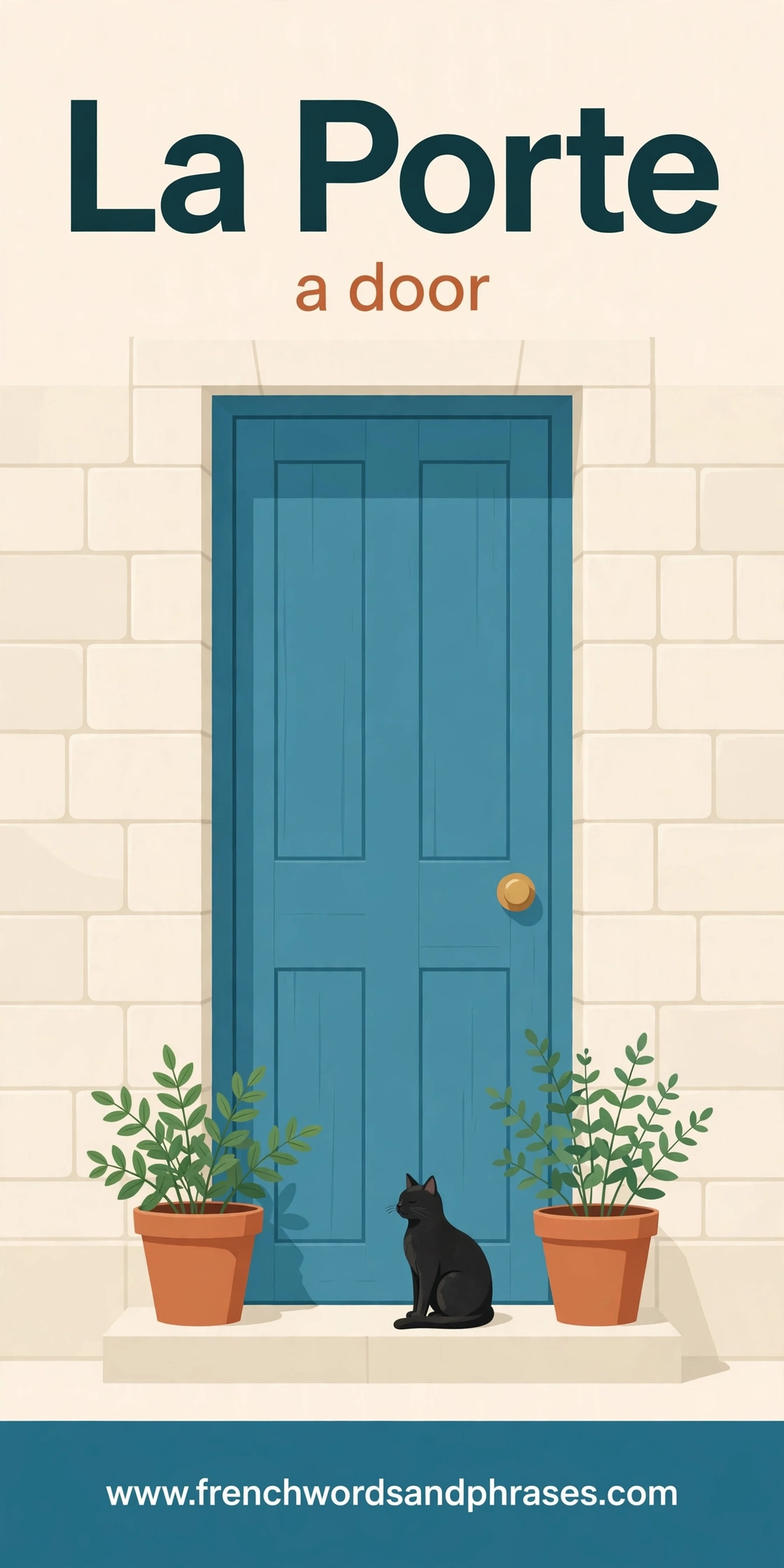
La porte means a door.
A knock in the evening, a key in the lock, the door opening on lamplight and familiar voices — every arrival and every farewell passes through la porte.
In this guide, you’ll learn what porte means in English, how to use it with its articles, how to form its plural, and how it appears in everyday French. Explore French examples, English translations, and practice quizzes.
Understanding the French Noun Porte
Porte is a feminine French noun. Like every French noun, it has a gender, and it is learned together with its article: la porte.
It means a door — the front door of the house, the bedroom door, the door you knock on and the door you lock at night. Few words work harder: the porte opens, closes, and stands between the street and home.
Gender: Feminine
Definite article: la — la porte (the door)
Indefinite article: une — une porte (a door)
Plural: les portes (the doors)
English equivalents: A door.
One important usage detail: listen for à la porte. Frapper à la porte is to knock at the door — but mettre quelqu’un à la porte is something else entirely: to show someone the door, to fire them.
Experience the Word
Porte is more than a panel of wood. It is the border of home: everything outside stays outside, everything inside is safe, warm and yours.
Imagine the last sound of the evening — the key turning, the bolt sliding, the whole house settling behind a closed door.
You have not just named an object. You have named the threshold of home.
How to Use Porte in French: Complete Guide
Let’s explore how porte works in French, beginning with its articles.
Porte and Its Articles
French nouns are almost never used alone. The small word in front of the noun — the article — does a great deal of work.
Porte with the Definite Article (La, Les)
Used for a particular door both speakers know about, or for the door as a place in general.
| Number | French |
|---|---|
| Singular | la porte |
| Plural | les portes |
Example
La porte est fermée à clé.
The door is locked.
Porte with the Indefinite Article (Une, Des)
Used to introduce a door for the first time: one door, or some doors.
| Number | French |
|---|---|
| Singular | une porte |
| Plural | des portes |
Example
Il y a une porte au bout du couloir.
There is a door at the end of the corridor.
Porte with Numbers and Quantities
Porte is a count noun — you count doors one by one, so instead of a partitive article, French uses numbers and quantity words.
| Quantity | French |
|---|---|
| deux (two) | deux portes |
| trois (three) | trois portes |
| plusieurs (several) | plusieurs portes |
| beaucoup de (a lot of) | beaucoup de portes |
| toutes les (all the) | toutes les portes |
| chaque (each) | chaque porte |
Example
Toutes les portes de la maison sont blanches.
All the doors in the house are white.
Quick Quiz 1
How do you say some doors in French?
Reveal the answer
des portes
L’appartement a des portes en bois.
The flat has wooden doors.
The Plural of Porte
Like most French nouns, porte simply adds an -s in the plural — a letter you see but do not hear.
| Number | French |
|---|---|
| Singular | la porte |
| Plural | les portes |
Example
Les portes ferment à vingt-deux heures.
The doors close at ten in the evening.
Porte with Possessive Adjectives (Ma, Ta, Sa…)
Possessives agree with the noun, not with the owner — and porte is feminine, so it takes ma, ta, sa in the singular.
| Owner | French |
|---|---|
| my | ma porte |
| your (tu) | ta porte |
| his / her | sa porte |
| our | notre porte |
| your (vous) | votre porte |
| their | leur porte |
Example
Elle ouvre sa porte aux invités.
She opens her door to the guests.
Quick Quiz 2
Complete the sentence:
Elle ouvre ______ porte aux invités. (her)
Reveal the answer
sa
Elle ouvre sa porte aux invités.
She opens her door to the guests.
Porte with Demonstrative Adjectives (Cette, Ces)
Used to point: this door here, those doors there. Feminine singular takes cette.
| Number | French |
|---|---|
| Singular | cette porte |
| Plural | ces portes |
Example
Cette porte donne sur le jardin.
This door opens onto the garden.
Porte with Adjectives
Adjectives agree with the noun, so they take feminine forms with porte. Most come after the noun: la porte fermée, la porte vitrée.
| Adjective | With Porte |
|---|---|
| ouverte (open) | la porte ouverte |
| fermée (closed) | la porte fermée |
| grande (big) | la grande porte |
| vitrée (glass) | la porte vitrée |
| blindée (reinforced) | la porte blindée |
| ancienne (old) | la porte ancienne |
Example
Laissez la porte ouverte, s’il vous plaît.
Leave the door open, please.
Quick Quiz 3
Complete the sentence:
La porte est ______ (closed).
Reveal the answer
fermée
La porte est fermée.
The door is closed. (Fermée is the feminine form.)
Everyday Expressions with Porte
Porte is in the phrases of arrival and departure — knocking, locking, opening and being shown the door.
| Expression | In English |
|---|---|
| frapper à la porte | to knock at the door |
| fermer la porte à clé | to lock the door |
| la porte d’entrée | the front door |
| la porte de derrière | the back door |
| ouvrir la porte | to open the door |
| mettre à la porte | to fire, to throw out |
Example
On frappe à la porte !
Someone is knocking at the door!
Words from the Same Family as Porte
Learn these together and the whole entrance falls into place.
| French | In English |
|---|---|
| la clé | the key |
| la serrure | the lock |
| la poignée | the handle |
| la sonnette | the doorbell |
| le seuil | the doorstep, the threshold |
| la fenêtre | the window |
Example
N’oublie pas ta clé pour la porte de derrière.
Do not forget your key for the back door.
Quick Quiz 4
What does frapper à la porte mean?
Reveal the answer
To knock at the door
On frappe à la porte !
Someone is knocking at the door!
Porte in Everyday French: Real-Life Examples
Now that you know the word, let’s see how porte appears in everyday French.
Example 1 — Closing up
Elle ferme la porte doucement pour ne pas réveiller le bébé.
She closes the door quietly so as not to wake the baby.
Example 2 — A visitor
On frappe à la porte !
Someone is knocking at the door!
Example 3 — Locked up
La porte d’entrée est fermée à clé.
The front door is locked.
Example 4 — Welcoming guests
Elle ouvre la porte aux invités.
She opens the door to the guests.
Example 5 — All white
Les portes de la maison sont blanches.
The doors of the house are white.
Example 6 — Do not forget
N’oublie pas ta clé pour la porte de derrière.
Do not forget your key for the back door.
See la porte in a story: Around the House: French Vocabulary (Dans la Maison) — a visit to Camille’s house, room by room.
Beyond Translation: The Meaning of Porte
English says door for the meaning of porte — but the French word carries the whole drama of the threshold. It is knocked on, locked, opened to friends and, in the cruellest phrase of all, used to dismiss: mettre à la porte.
To say porte is to say: you may come in.
It evokes the knock in the evening, the key in the lock, the front door painted your colour — the exact line where the street ends and home begins.
How to Remember the French Noun Porte
Remember it this way: Porte is the door, feminine — knocked on, locked, and opened to friends.
- You come home late — tu ouvres la porte sans faire de bruit.
- You hear a visitor — on frappe à la porte.
- You make the house safe — tu fermes la porte à clé.
The key idea is la porte for the door, frapper à la porte for to knock.
Test Your Knowledge of Porte
Let’s see how much you’ve learned. Try answering these questions before revealing the answers.
Question 1
Is porte masculine or feminine?
Reveal the answer
Feminine — la porte.
Question 2
How do you say the doors in French?
Reveal the answer
Les portes.
Question 3
Translate: She closes the door quietly.
Reveal the answer
Elle ferme la porte doucement.
Question 4
What does la porte d’entrée mean?
Reveal the answer
The front door.
Question 5
Complete the sentence:
On ______ à la porte ! (is knocking)
Reveal the answer
frappe
On frappe à la porte !
Someone is knocking at the door!
Your Final Challenge
Can You Use It?
How would you say this in French?
“Someone is knocking at the door.”
Reveal the answer
On frappe à la porte.
Someone is knocking at the door.
A little French. A little curiosity. A richer everyday life.
LEARN FRENCH ONE WORD AT A TIME




