A French Word to Live By
How to Conjugate Klaxonner in French
/klak.sɔ.ne/
Klaxonner means to honk, to beep, or to toot one’s horn.
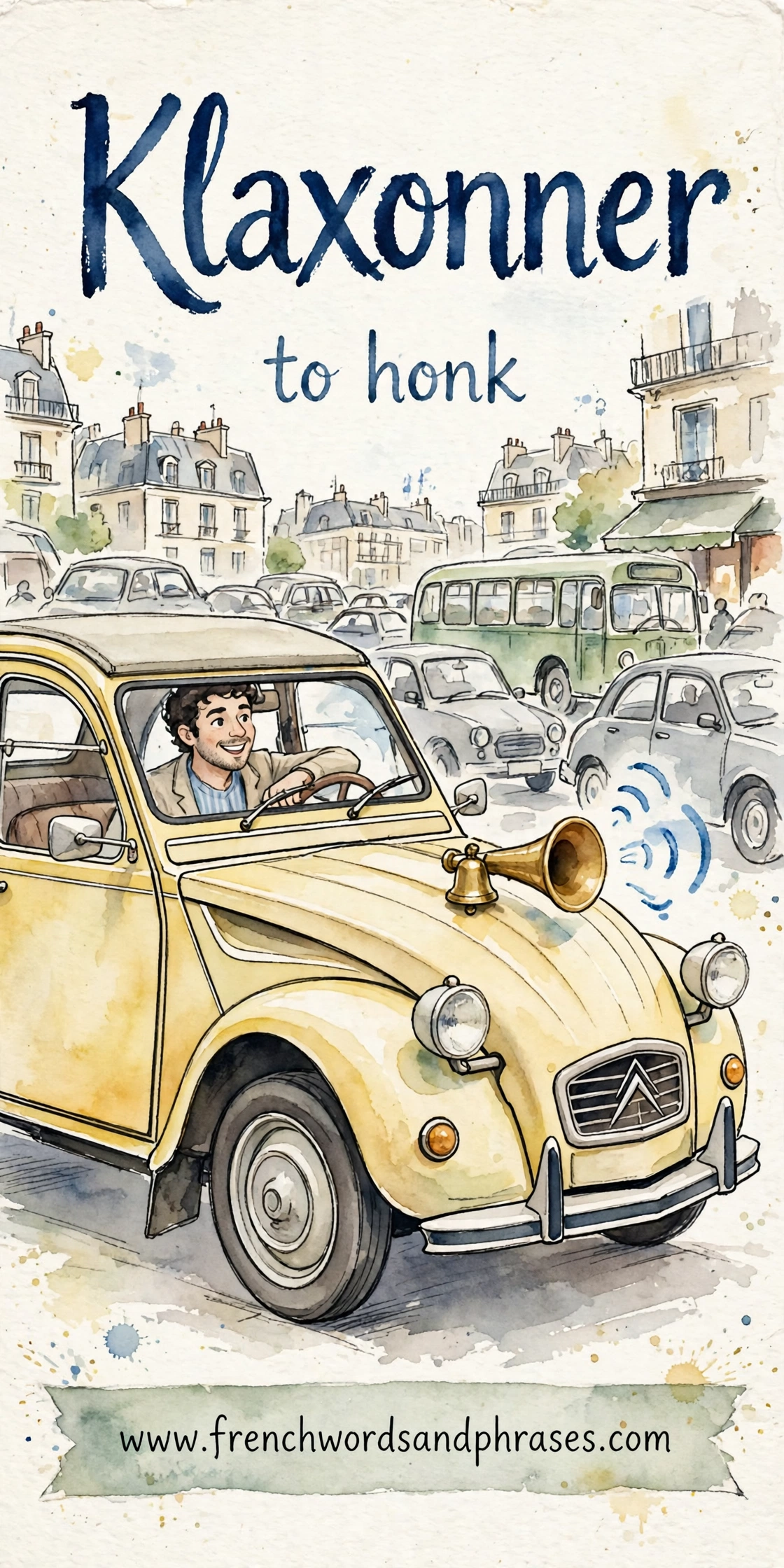
Traffic jams, blocked junctions and one impatient hand pressed flat on the steering wheel — the sharp sound that cuts through the noise of a French street is klaxonner. A short beep warns, a long blast complains, and two friendly toots say you have arrived.
In this guide, you’ll learn how to conjugate klaxonner in all the major French tenses and moods. Explore complete conjugation tables, French examples, English translations, and practice quizzes.
Understanding the French Verb Klaxonner
Klaxonner is a regular French verb belonging to the first group of verbs, those ending in -er.
It means to honk, to beep, or to toot one’s horn. It is commonly used for drivers sounding a car horn in traffic, for a short warning beep at a junction, and for impatient honking in a jam. Its partner noun is le klaxon — the horn itself.
Verb classification: First group (-er)
Auxiliary verb: Avoir
Past participle: klaxonné
Present participle: klaxonnant
English equivalents: To honk, to beep, to toot one’s horn, to sound the horn.
One important detail: klaxonner keeps its double n everywhere. The stem is klaxonn-, so you write je klaxonne, nous klaxonnons and ils klaxonnent — never a single n. It takes avoir as its auxiliary verb in compound tenses: il a klaxonné (he honked).
Experience the Word
Klaxonner is the sound of the French street — a short beep of warning, a long blast of frustration, a friendly toot outside a friend’s house.
Imagine driving through Paris at rush hour. The traffic stops, a scooter slips past, a delivery van blocks the lane — and all around you, horns speak before anyone says a word.
You have not just made a noise. You have been heard.
How to Conjugate Klaxonner: Complete French Conjugation Guide
Let’s explore every major conjugation of klaxonner, beginning with the indicative mood.
How to Conjugate Klaxonner in the Indicative Mood
The indicative mood is used to express facts, observations, actions, and events.
How to Conjugate Klaxonner in the Present Tense (Présent)
Used for actions happening now, habitual actions, and general truths.
| Subject | Conjugation |
|---|---|
| je | klaxonne |
| tu | klaxonnes |
| il / elle | klaxonne |
| nous | klaxonnons |
| vous | klaxonnez |
| ils / elles | klaxonnent |
Example
Le chauffeur klaxonne devant le passage piéton.
The driver honks in front of the pedestrian crossing.
Quick Quiz 1
Complete the sentence:
Nous ______ devant le portail.
Reveal the answer
klaxonnons
Nous klaxonnons devant le portail.
We are honking in front of the gate.
How to Conjugate Klaxonner in the Passé Composé
Used for completed actions in the past. Klaxonner takes the auxiliary verb avoir.
| Subject | Conjugation |
|---|---|
| j’ | ai klaxonné |
| tu | as klaxonné |
| il / elle | a klaxonné |
| nous | avons klaxonné |
| vous | avez klaxonné |
| ils / elles | ont klaxonné |
Example
Elle a klaxonné deux fois avant de partir.
She honked twice before leaving.
How to Conjugate Klaxonner in the Imparfait (Imperfect Tense)
Used for habitual past actions, descriptions, and ongoing situations in the past.
| Subject | Conjugation |
|---|---|
| je | klaxonnais |
| tu | klaxonnais |
| il / elle | klaxonnait |
| nous | klaxonnions |
| vous | klaxonniez |
| ils / elles | klaxonnaient |
Example
Quand j’étais enfant, mon père klaxonnait devant la maison de mes grands-parents.
When I was a child, my father used to honk in front of my grandparents’ house.
Quick Quiz 2
Choose the correct form:
When we were young, we used to honk outside the house.
Quand nous étions jeunes, nous ______ devant la maison.
Reveal the answer
klaxonnions
Quand nous étions jeunes, nous klaxonnions devant la maison.
How to Conjugate Klaxonner in the Plus-que-parfait
Used to describe an action that had already been completed before another past event.
| Subject | Conjugation |
|---|---|
| j’ | avais klaxonné |
| tu | avais klaxonné |
| il / elle | avait klaxonné |
| nous | avions klaxonné |
| vous | aviez klaxonné |
| ils / elles | avaient klaxonné |
Example
Il avait déjà klaxonné quand le feu est passé au vert.
He had already honked when the light turned green.
How to Conjugate Klaxonner in the Passé Simple
Primarily used in formal writing, literature, and historical narratives. It is rarely used in everyday conversation.
| Subject | Conjugation |
|---|---|
| je | klaxonnai |
| tu | klaxonnas |
| il / elle | klaxonna |
| nous | klaxonnâmes |
| vous | klaxonnâtes |
| ils / elles | klaxonnèrent |
Example
Le conducteur klaxonna brusquement dans le tunnel.
The driver honked suddenly in the tunnel.
How to Conjugate Klaxonner in the Passé Antérieur
A literary tense used to express an action completed immediately before another past action, generally in the passé simple.
| Subject | Conjugation |
|---|---|
| j’ | eus klaxonné |
| tu | eus klaxonné |
| il / elle | eut klaxonné |
| nous | eûmes klaxonné |
| vous | eûtes klaxonné |
| ils / elles | eurent klaxonné |
Example
Dès qu’il eut klaxonné, la voiture devant lui avança.
As soon as he had honked, the car in front of him moved forward.
How to Conjugate Klaxonner in the Future Tense (Futur Simple)
Used to describe actions that will take place in the future.
| Subject | Conjugation |
|---|---|
| je | klaxonnerai |
| tu | klaxonneras |
| il / elle | klaxonnera |
| nous | klaxonnerons |
| vous | klaxonnerez |
| ils / elles | klaxonneront |
Example
Demain, je klaxonnerai devant chez toi à huit heures.
Tomorrow, I will honk outside your house at eight o’clock.
How to Conjugate Klaxonner in the Futur Antérieur (Future Perfect)
Used for an action that will have been completed before a particular point in the future.
| Subject | Conjugation |
|---|---|
| j’ | aurai klaxonné |
| tu | auras klaxonné |
| il / elle | aura klaxonné |
| nous | aurons klaxonné |
| vous | aurez klaxonné |
| ils / elles | auront klaxonné |
Example
À midi, il aura déjà klaxonné trois fois dans les embouteillages.
By noon, he will already have honked three times in the traffic jams.
How to Conjugate Klaxonner in the Near Future (Futur Proche)
Used to describe something that is going to happen soon. Formed with aller + infinitive.
| Subject | Conjugation |
|---|---|
| je | vais klaxonner |
| tu | vas klaxonner |
| il / elle | va klaxonner |
| nous | allons klaxonner |
| vous | allez klaxonner |
| ils / elles | vont klaxonner |
Example
Je vais klaxonner si le camion ne bouge pas.
I am going to honk if the truck does not move.
How to Conjugate Klaxonner in the Conditional Mood
The conditional mood expresses what would happen under certain circumstances. It is also frequently used to make polite requests or express wishes.
How to Conjugate Klaxonner in the Present Conditional
| Subject | Conjugation |
|---|---|
| je | klaxonnerais |
| tu | klaxonnerais |
| il / elle | klaxonnerait |
| nous | klaxonnerions |
| vous | klaxonneriez |
| ils / elles | klaxonneraient |
Example
Je klaxonnerais si la route était bloquée.
I would honk if the road were blocked.
How to Conjugate Klaxonner in the Past Conditional
| Subject | Conjugation |
|---|---|
| j’ | aurais klaxonné |
| tu | aurais klaxonné |
| il / elle | aurait klaxonné |
| nous | aurions klaxonné |
| vous | auriez klaxonné |
| ils / elles | auraient klaxonné |
Example
J’aurais klaxonné si j’avais vu le danger.
I would have honked if I had seen the danger.
Klaxonner in the Literary Past Conditional Form
This less common literary form uses the imperfect subjunctive of avoir.
| Subject | Conjugation |
|---|---|
| j’ | eusse klaxonné |
| tu | eusses klaxonné |
| il / elle | eût klaxonné |
| nous | eussions klaxonné |
| vous | eussiez klaxonné |
| ils / elles | eussent klaxonné |
Example
Il eût klaxonné plus tôt s’il avait été moins patient.
He would have honked earlier if he had been less patient.
How to Conjugate Klaxonner in the Subjunctive Mood
The subjunctive is used to express wishes, emotions, doubts, necessity, and uncertainty. It frequently follows expressions such as il faut que (it is necessary that) or bien que (although).
How to Conjugate Klaxonner in the Present Subjunctive
| Subject | Conjugation |
|---|---|
| que je | klaxonne |
| que tu | klaxonnes |
| qu’il / qu’elle | klaxonne |
| que nous | klaxonnions |
| que vous | klaxonniez |
| qu’ils / qu’elles | klaxonnent |
Example
Il faut que tu klaxonnes avant ce virage dangereux.
You need to honk before this dangerous bend.
Quick Quiz 3
Complete the sentence using the subjunctive:
Il faut que vous ______ avant le virage.
Reveal the answer
klaxonniez
Il faut que vous klaxonniez avant le virage.
You need to honk before the bend.
How to Conjugate Klaxonner in the Imperfect Subjunctive
A literary tense, rarely encountered in modern spoken French.
| Subject | Conjugation |
|---|---|
| que je | klaxonnasse |
| que tu | klaxonnasses |
| qu’il / qu’elle | klaxonnât |
| que nous | klaxonnassions |
| que vous | klaxonnassiez |
| qu’ils / qu’elles | klaxonnassent |
Example
Il voulait qu’elle klaxonnât doucement.
He wanted her to honk gently.
How to Conjugate Klaxonner in the Pluperfect Subjunctive
A literary construction used to express an action completed before another past action.
| Subject | Conjugation |
|---|---|
| que j’ | eusse klaxonné |
| que tu | eusses klaxonné |
| qu’il / qu’elle | eût klaxonné |
| que nous | eussions klaxonné |
| que vous | eussiez klaxonné |
| qu’ils / qu’elles | eussent klaxonné |
Example
Il regrettait que nous eussions klaxonné si fort.
He regretted that we had honked so loudly.
How to Conjugate Klaxonner in the Past Subjunctive
| Subject | Conjugation |
|---|---|
| que j’ | aie klaxonné |
| que tu | aies klaxonné |
| qu’il / qu’elle | ait klaxonné |
| que nous | ayons klaxonné |
| que vous | ayez klaxonné |
| qu’ils / qu’elles | aient klaxonné |
Example
Je suis content que tu aies klaxonné pour me prévenir.
I am glad you honked to warn me.
How to Conjugate Klaxonner in the Imperative
The imperative is used to give commands, instructions, invitations, or suggestions. Subject pronouns are omitted.
How to Conjugate Klaxonner in the Present Imperative
| Person | Conjugation |
|---|---|
| (tu) | klaxonne |
| (nous) | klaxonnons |
| (vous) | klaxonnez |
Example
Klaxonne doucement, les voisins dorment !
Honk gently, the neighbors are sleeping!
Quick Quiz 4
How would you say Honk, using the tu form?
Reveal the answer
Klaxonne !
French Participles of Klaxonner
Participles are verb forms that can be used in compound tenses and other grammatical constructions.
Present Participle of Klaxonner
klaxonnant
En klaxonnant, il a fait sursauter le cycliste.
While honking, he startled the cyclist.
Past Participle of Klaxonner
klaxonné
Le chauffeur a klaxonné longuement dans l’embouteillage.
The driver honked at length in the traffic jam.
Klaxonner in Everyday French: Real-Life Examples
Now that you know the conjugations, let’s see how klaxonner appears in everyday French.
Example 1 — Present
Le taxi klaxonne dans la rue.
The taxi is honking in the street.
Example 2 — Passé composé
Elle a klaxonné pour dire bonjour.
She honked to say hello.
Example 3 — Imparfait
Les voitures klaxonnaient sans arrêt hier soir.
The cars were honking non-stop last night.
Example 4 — Future
Je klaxonnerai quand j’arriverai.
I will honk when I arrive.
Example 5 — Conditional
Tu klaxonnerais à ma place ?
Would you honk in my place?
Example 6 — Subjunctive
Bien que je klaxonne, le piéton ne bouge pas.
Although I honk, the pedestrian does not move.
Beyond Translation: The Meaning of Klaxonner
English needs several phrases where French uses just klaxonner: honk, beep, toot, sound the horn. What holds them together is one gesture — a hand on the horn, and a message sent in sound instead of words.
And klaxonner carries a brand name inside it.
The word comes from le klaxon, the horn itself, named after the Klaxon company, whose loud electric horns equipped the first generations of cars. The noun came first and the verb followed: press le klaxon, and you klaxonnez. Few French verbs wear their history so noisily.
How to Remember the French Verb Klaxonner
Remember it this way: Klaxonner is about sounding the horn — a warning, a greeting, or a burst of impatience in traffic.
- You press the horn at a junction to warn a cyclist — you klaxonnez.
- You give two short beeps outside a friend’s house — tu klaxonnes.
- You sit stuck in a jam while horns sound all around — tout le monde klaxonne.
The key idea is sounding the horn — a warning, a greeting, or a burst of impatience in traffic.
Test Your Knowledge of Klaxonner
Let’s see how much you’ve learned. Try answering these questions before revealing the answers.
Question 1
What auxiliary verb is used with klaxonner in compound tenses?
Reveal the answer
Avoir
Question 2
How do you say I will honk in French?
Reveal the answer
Je klaxonnerai.
Question 3
Translate: She honked twice.
Reveal the answer
Elle a klaxonné deux fois.
Question 4
What is the past participle of klaxonner?
Reveal the answer
Klaxonné.
Question 5
Complete the sentence:
Si le camion ne bougeait pas, je ______.
Reveal the answer
klaxonnerais
Si le camion ne bougeait pas, je klaxonnerais.
If the truck did not move, I would honk.
Your Final Challenge
Can You Use It?
How would you say this in French?
Tomorrow, I will honk twice outside your house.
Reveal the answer
Demain, je klaxonnerai deux fois devant ta maison.
Tomorrow, I will honk twice outside your house.
A little French. A little curiosity. A richer everyday life.
LEARN FRENCH ONE WORD AT A TIME