A French Word to Live By
Translate Wagon to English
/va.ɡɔ̃/
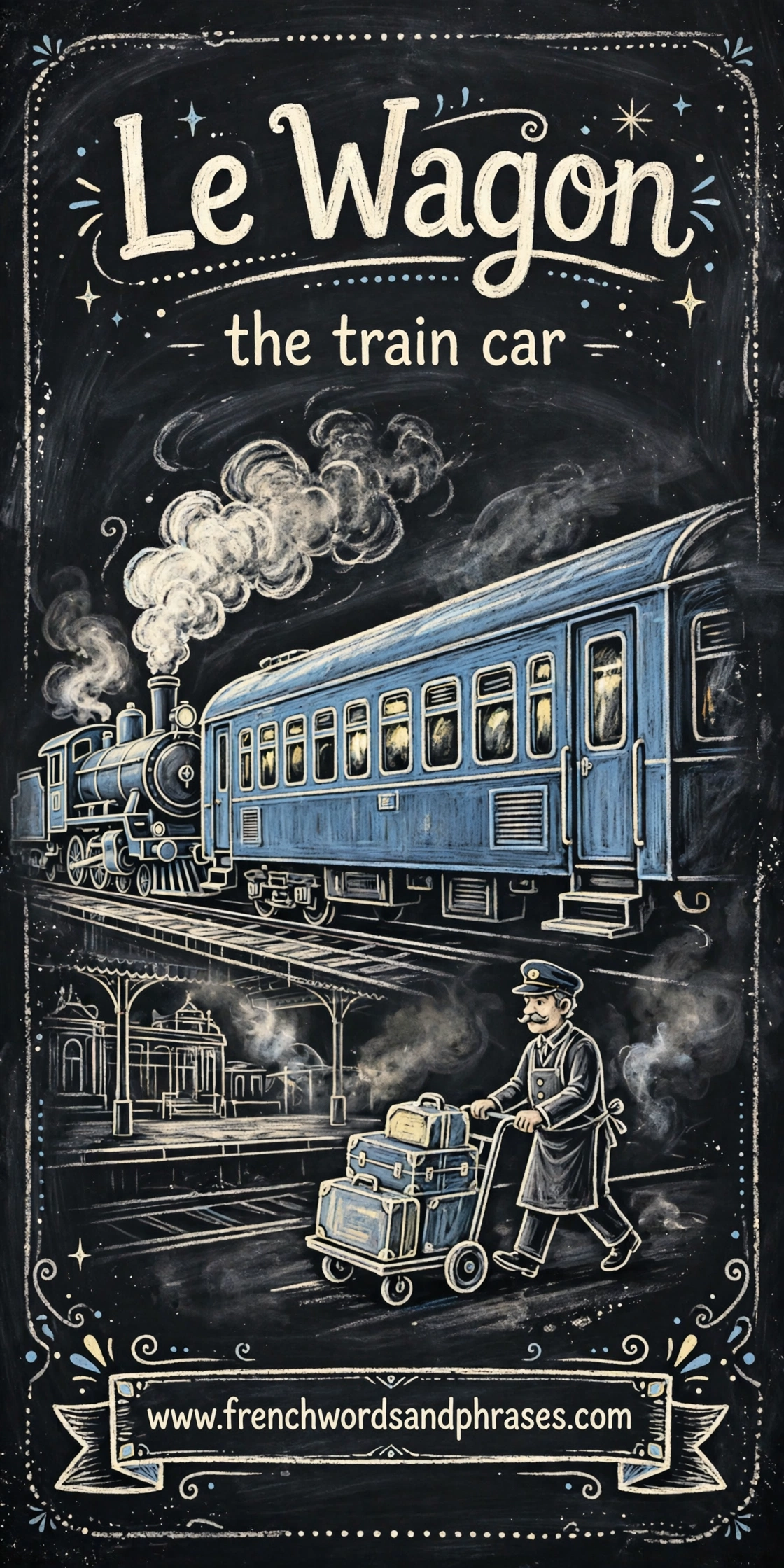
Le wagon means a train car.
The loudspeaker crackles, the train slows into the station, and a long line of blue carriages slides past the platform, window after window. Find your number, climb aboard — your place is in le wagon seven.
In this guide, you’ll learn what wagon means in English, how to use it with its articles, how to form its plural, and how it appears in everyday French. Explore French examples, English translations, and practice quizzes.
Understanding the French Noun Wagon
Wagon is a masculine French noun. It is learned together with its article: le wagon, un wagon. It is a word of Germanic origin, and its first letter is a trap: the French W is pronounced like a V.
It means a train car — a railway carriage. A French train is a string of wagons behind a locomotive, and the word builds the whole family of rail travel: le wagon-lit is the sleeper car, le wagon-restaurant the dining car. Watch out for the false friend: the horse-drawn or farm wagon of English is not a wagon in French at all — it is un chariot.
Gender: Masculine
Definite article: le — le wagon (the train car)
Indefinite article: un — un wagon (a train car)
Plural: les wagons
English equivalents: A train car; a railway carriage.
One important usage detail: pronounce the W like a V — wagon sounds like « va-gon », never like the English word. That is its Germanic origin showing: in German, W is also pronounced V. Say le vagon in sound, but always write le wagon.
Experience the Word
Wagon is more than a carriage. It is the unit of the French journey — your seat, your window, your little kingdom of the rails between two stations.
Imagine the night train south: the corridor dark, the couchettes folded down, the rhythm of the wheels counting the kilometres while the wagon rocks you to sleep.
You have not just taken a train. You have travelled by wagon, the French way.
How to Use Wagon in French: Complete Guide
Let’s explore how wagon works in French, beginning with its articles.
Wagon with the Definite Article (Le, Les)
Used for the particular carriage you are looking for — the one on your ticket, the one at the end of the train.
| Number | French |
|---|---|
| Singular | le wagon |
| Plural | les wagons |
Example
Le wagon de tête est presque vide.
The front carriage is almost empty.
Wagon with the Indefinite Article (Un, Des)
Used for one carriage among others, or for carriages in general.
| Number | French |
|---|---|
| Singular | un wagon |
| Plural | des wagons |
Example
Ils ont ajouté un wagon au train de nuit.
They added a carriage to the night train.
Types of Wagon on a French Train
A train is a family of specialised wagons — learn their names and the whole journey opens up.
| French | In English |
|---|---|
| le wagon-lit | the sleeper car |
| le wagon-restaurant | the dining car |
| le wagon de voyageurs | the passenger carriage |
| le wagon de marchandises | the freight wagon |
| le wagon-bar | the bar car |
Example
Nous avons réservé deux couchettes dans le wagon-lit.
We booked two berths in the sleeper car.
Quick Quiz 1
What is le wagon-restaurant?
Reveal the answer
The dining car — the carriage where passengers eat.
On peut dîner dans le wagon-restaurant.
You can have dinner in the dining car.
The Plural of Wagon
Wagon simply adds an -s in the plural — les wagons, a letter you write but do not hear.
| Number | French |
|---|---|
| Singular | le wagon |
| Plural | les wagons |
Example
Les wagons du train de nuit sont bleus.
The carriages of the night train are blue.
Wagon with Possessive Adjectives (Mon, Ton, Son…)
Possessives agree with the noun, not with the owner — and wagon is masculine, so it takes mon, ton, son.
| Owner | French |
|---|---|
| my | mon wagon |
| your (tu) | ton wagon |
| his / her | son wagon |
| our | notre wagon |
| your (vous) | votre wagon |
| their | leur wagon |
Example
Mon wagon est le troisième après la locomotive.
My carriage is the third one after the locomotive.
Quick Quiz 2
Complete the sentence:
Nous montons dans ______ wagon, le numéro cinq.
Reveal the answer
notre
Nous montons dans notre wagon, le numéro cinq.
We are getting into our carriage, number five.
Wagon with Demonstrative Adjectives (Ce, Ces)
Used to point: this carriage here, those carriages there.
| Number | French |
|---|---|
| Singular | ce wagon |
| Plural | ces wagons |
Example
Ce wagon est réservé aux voyageurs de première classe.
This carriage is reserved for first-class passengers.
Wagon with Adjectives
Adjectives agree with wagon, masculine — and every traveller hopes for un wagon calme and fears un wagon plein.
| Adjective | With Wagon |
|---|---|
| confortable (comfortable) | un wagon confortable |
| plein (full) | un wagon plein |
| vide (empty) | un wagon vide |
| dernier (last) | le dernier wagon |
| climatisé (air-conditioned) | un wagon climatisé |
Example
Le dernier wagon est souvent le plus calme.
The last carriage is often the quietest.
Quick Quiz 3
Complete the sentence:
Le ______ wagon est le plus calme. (last)
Reveal the answer
dernier
Le dernier wagon est le plus calme.
The last carriage is the quietest.
Everyday Expressions with Wagon
From the platform to the dining car, these are the wagon phrases of rail travel.
| Expression | In English |
|---|---|
| monter dans le wagon | to get into the carriage |
| descendre du wagon | to get off the carriage |
| être dans le bon wagon | to be in the right carriage |
| le wagon de queue | the rear carriage |
| un train de dix wagons | a ten-carriage train |
| le wagon-lit | the sleeper car |
Example
Vite, monte dans le wagon, le train va partir !
Quick, get into the carriage, the train is about to leave!
Words from the Same Family as Wagon
Trains, platforms and passengers — the words that travel with wagon, including its false friend.
| French | In English |
|---|---|
| le train | the train |
| la locomotive | the locomotive |
| le quai | the platform |
| le voyageur | the passenger |
| la couchette | the couchette, the berth |
| le chariot | the cart (the English ‘wagon’) |
Example
Les voyageurs attendent le train sur le quai.
The passengers are waiting for the train on the platform.
Quick Quiz 4
What is the difference between un wagon and un chariot?
Reveal the answer
Un wagon is a railway carriage; un chariot is a cart, the farm vehicle of the English word.
Le fermier charge son chariot de foin.
The farmer loads his cart with hay.
Wagon in Everyday French: Real-Life Examples
Now that you know the word, let’s see how wagon appears in everyday French.
Example 1 — At the station
Notre wagon est le numéro sept, tout au bout du quai.
Our carriage is number seven, right at the end of the platform.
Example 2 — On the night train
Nous dormons dans un wagon-lit jusqu’à Marseille.
We are sleeping in a sleeper car as far as Marseille.
Example 3 — At dinner
Le wagon-restaurant ouvre à dix-neuf heures.
The dining car opens at seven in the evening.
Example 4 — Finding a seat
Ce wagon est complet, essayons le suivant.
This carriage is full, let’s try the next one.
Example 5 — Talking to a friend
Tu as vu ? Le train a douze wagons !
Did you see? The train has twelve carriages!
Example 6 — Arriving
Descends du wagon avec ta valise, nous sommes arrivés.
Get off the carriage with your suitcase, we have arrived.
Beyond Translation: The Meaning of Wagon
The word came into French from the Germanic languages, cousins of the English wagon and the German Wagen — which is why its W is still pronounced like a V, a little piece of Germany riding on French rails.
To say wagon is to hear the great age of the train.
It evokes the blue wagons-lits of the Orient Express, waiters in the wagon-restaurant, porters on lamplit platforms — the romance of a continent crossed slowly, one carriage at a time.
How to Remember the French Noun Wagon
Remember it this way: Wagon is a railway carriage — masculine, with le and un, and its W is pronounced like a V.
- You find your carriage — je cherche mon wagon, le numéro sept.
- You sleep on the train — je dors dans le wagon-lit.
- You avoid the trap — un wagon for the train, un chariot for the cart.
The key idea is le wagon for the train car, le chariot for the cart.
Test Your Knowledge of Wagon
Let’s see how much you’ve learned. Try answering these questions before revealing the answers.
Question 1
Is wagon masculine or feminine?
Reveal the answer
Masculine — le wagon, un wagon.
Question 2
How is the W of wagon pronounced in French?
Reveal the answer
Like a V — wagon sounds like « va-gon ».
Question 3
Translate: We booked two berths in the sleeper car.
Reveal the answer
Nous avons réservé deux couchettes dans le wagon-lit.
Question 4
What is the difference between un wagon and un chariot?
Reveal the answer
Un wagon is a railway carriage; un chariot is a cart.
Question 5
Complete the sentence:
Nous dînons dans le wagon-______ ce soir.
Reveal the answer
restaurant
Nous dînons dans le wagon-restaurant ce soir.
We are having dinner in the dining car tonight.
Your Final Challenge
Can You Use It?
How would you say this in French?
“Our carriage is number seven, at the end of the platform.”
Reveal the answer
Notre wagon est le numéro sept, au bout du quai.
Our carriage is number seven, at the end of the platform.
A little French. A little curiosity. A richer everyday life.
LEARN FRENCH ONE WORD AT A TIME