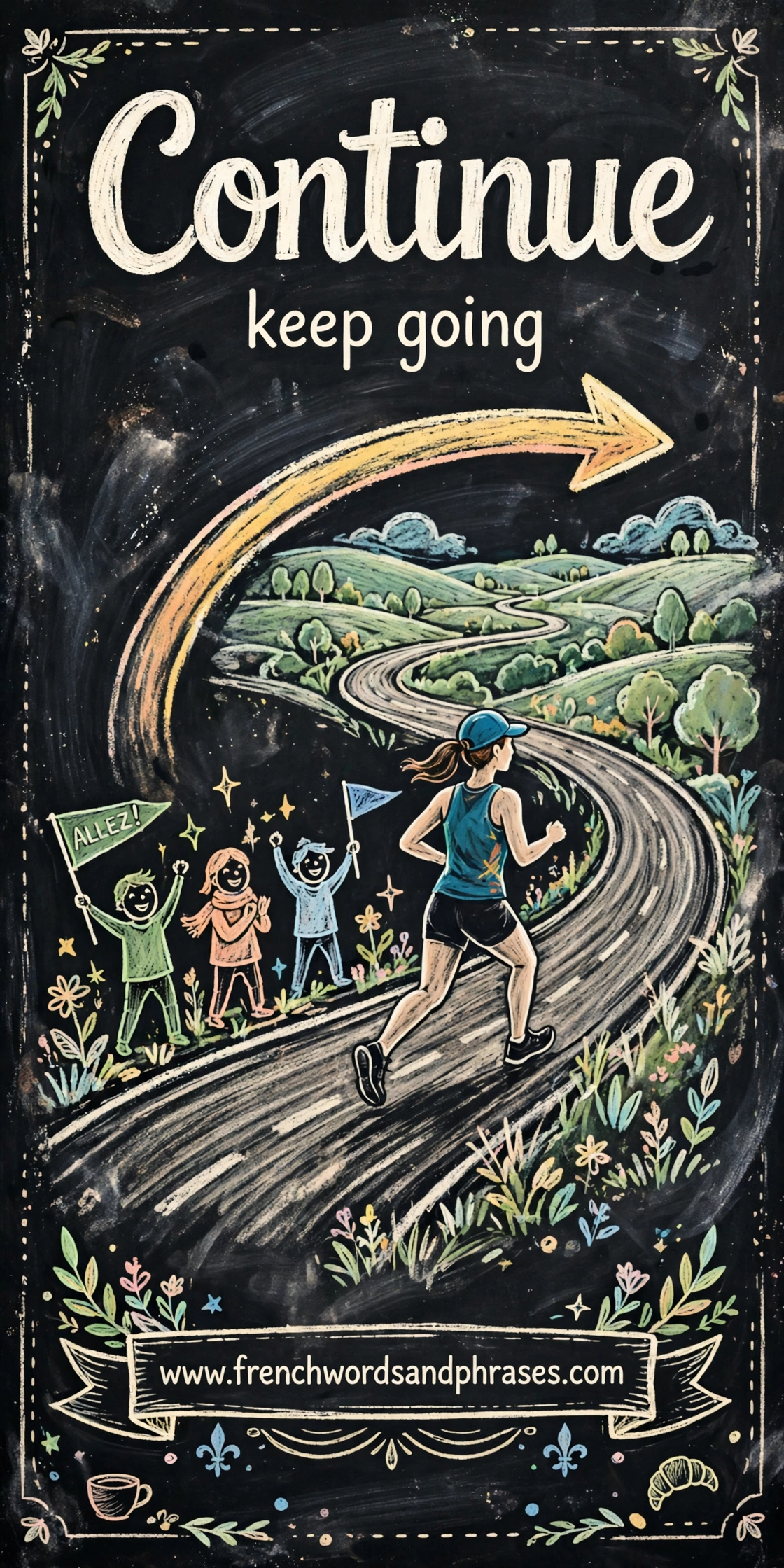
A French Word to Live By
Translate Continue to English
/kɔ̃.ti.ny/
Continue means keep going (the imperative of continuer, used to urge someone on).
A little girl at a piano plays three careful notes, then stops and looks up, waiting to be told she has failed. Her teacher just smiles and nods at the keys: « Continue. » One small word, and the music starts again — that is all the permission she needed.
Let’s explore how continue works in French, beginning with the whole phrase on one card.
Understanding the French Phrase Continue
Continue is a French imperative — the tu command form of the verb continuer (to continue, to carry on). It is a whole instruction in a single word: no subject, no extras, just the gentle push to keep going.
It means keep going, carry on — said to someone who has paused, hesitated or looked up for permission. A piano teacher says it, a running coach shouts it, a friend listening to your story murmurs it. The warmth or firmness lives entirely in the voice.
Type: One-word imperative — the tu form of continuer (to continue, to carry on)
Answers the need: Urging someone to keep going when they pause or hesitate
Register: Neutral and everyday — teachers, coaches, parents and friends all use it
Strength: Gentle to firm — the tone of voice sets it, from encouragement to instruction
One important usage detail: continue is the tu form, for one person you know well. To a group, a stranger or anyone you would call vous, the form is continuez. And watch the spelling: the statement tu continues (you are continuing) keeps its final s, but the command drops it — continue !
Experience the Word
Continue is the smallest pep talk in French — one word that says: you are doing fine, do not stop now.
Imagine a grandfather teaching his grandson to ride a bicycle, running alongside with one hand hovering near the saddle: « Continue de pédaler, je suis là ! » Keep pedalling, I am right here.
French classrooms, kitchens and sports fields run on this word. It turns a pause back into a movement.
How to Use Continue in French: Complete Guide
Let’s explore how continue works in French, beginning with the whole phrase on one card.
Continue at a Glance
The Whole Phrase on One Card
Real meaning, literal build, English twin and register — continue in five lines.
| Point | Continue |
|---|---|
| What it really means | keep going — do not stop what you are doing |
| Word for word | continue! — one word, a command form of continuer |
| English equivalent | keep going / carry on / go on |
| Register | neutral, everyday — classrooms, sports fields, kitchens, offices |
| Use it for | encouragement or calm instruction when someone pauses |
Example
Continue, c’est très bien comme ça.
Keep going, that’s very good just like that.
Word by Word: One Word, Whole Command
There is only one word — but it has a verb, a hidden ‘you’ and a dropped letter inside it.
| Word | Literal meaning | Its job in the phrase |
|---|---|---|
| continuer | to continue, to carry on | the verb the command comes from |
| continue | keep going! | the tu imperative — the ‘you’ is built in, so no pronoun is needed |
| the missing s | tu continues (statement) loses its s | for -er verbs, the tu command drops the final s: continues becomes continue |
| continuez | keep going! (vous) | the form for a group, a stranger, or anyone you call vous |
Example
Continue de lire, je t’écoute.
Keep reading, I’m listening.
Quick Quiz 1
What is the vous form of continue — the one for a group or a stranger?
Reveal the answer
Continuez — the imperative follows the person: continue for tu, continuez for vous.
Continuez, s’il vous plaît, je vous écoute.
Please go on, I’m listening.
When You Say It: The Pause Moments
Continue fires at moments like these — someone stops, looks up, and waits for the word.
| Situation | Example |
|---|---|
| A music lesson | continue, c’est joli — keep going, it’s lovely |
| A child reading aloud | continue, tu lis très bien — go on, you’re reading beautifully |
| A runner slowing down | continue, tu y es presque ! — keep going, you’re nearly there! |
| A friend telling a story | et après ? continue ! — and then? go on! |
| A cooking lesson | continue de mélanger doucement — keep stirring gently |
Example
Continue, ne t’arrête pas maintenant !
Keep going, don’t stop now!
Make It Yours: The Other Forms of the Command
The command changes with the person — and flips into its opposite with ne… pas.
| Form | French | In English |
|---|---|---|
| To one friend (tu) | continue | keep going |
| To a group or politely (vous) | continuez | keep going |
| Let’s… (nous) | continuons | let’s carry on |
| Keep doing something | continue à lire / continue de lire | keep reading |
| The opposite order (tu) | ne continue pas | stop that / don’t carry on |
| With a cheer | allez, continue ! | come on, keep going! |
Example
Continuons, il ne reste que deux pages.
Let’s carry on, there are only two pages left.
Quick Quiz 2
Your teacher is telling the class a story and pauses. Which form do you call out — continue or continuez?
Reveal the answer
Continuez — a teacher is vous, so the command takes the vous form.
Continuez, madame, on veut la fin !
Go on, miss, we want the ending!
Everyday Expressions: Building on the Phrase
Continue slots into these everyday frames — each one ready to use as it stands.
| Frame | In English |
|---|---|
| continue comme ça | keep going like that |
| continue, je t’écoute | go on, I’m listening |
| allez, continue | come on, keep going |
| continue jusqu’au bout | keep going right to the end |
| on continue ? | shall we carry on? |
Example
Continue comme ça, tu fais des progrès.
Keep going like that, you’re making progress.
Close Cousins: The Other Encouragements
French has a whole shelf of ways to push someone kindly onwards — continue is the steady one; its cousins differ in job and timing.
| Expression | The difference |
|---|---|
| continue | keep going — for something already started |
| vas-y | go for it — launches something new, before the start |
| allez | come on — the general-purpose cheer, for starts and middles alike |
| courage | hang in there — sympathy for something hard, not just unfinished |
| encore | again / more — asks for a repeat or a refill, not a continuation |
| ne t’arrête pas | don’t stop — the same push, said from the other side |
Example
Vas-y, commence, et après continue jusqu’au bout !
Go on, start, and then keep going right to the end!
Quick Quiz 3
Your friend is halfway through a song at the piano. Do you say vas-y or continue?
Reveal the answer
Continue — vas-y launches something that has not started; continue keeps something already moving.
Continue, c’est magnifique !
Keep going, it’s wonderful!
Continue and Its Neighbours
The encouragement shelf around continue — and the words that stop the music at the other end.
| French | In English |
|---|---|
| vas-y | go for it (the launch) |
| continue | keep going (the middle) |
| tu y es presque | you’re nearly there (the final stretch) |
| tiens bon | hang in there (when it’s hard) |
| doucement | gently, steady (slowing the pace, not stopping) |
| arrête | stop (the true opposite) |
Example
Tu y es presque, continue encore un peu !
You’re nearly there, keep going a little more!
Watch Out: The Traps Around Continue
The traps: the wrong person, the extra s, and the negative that changes the job completely.
| Trap | The truth |
|---|---|
| saying continue to a teacher or a group | that is the tu form — for vous, say continuez |
| writing continues with an s | tu continues is a statement (you are continuing); the command drops the s — continue ! |
| reading it as English ‘continue’ | the bare French word is an order or encouragement to one person, not the infinitive — that is continuer |
| missing what ne continue pas means | it flips the job: ‘stop doing that’ — a telling-off, not encouragement |
| confusing it with continu | continu is an adjective (continuous, unbroken) — the command is continue |
Example
Continuez, monsieur, je vous en prie.
Please go on, sir, I insist.
Quick Quiz 4
Spot the two mistakes in “Continues, madame !” called out to a teacher.
Reveal the answer
The s and the tu form — a teacher is vous, and the command drops the s anyway: continuez.
Continuez, madame, on vous écoute !
Go on, miss, we’re listening!
Continue in Everyday French: Real-Life Examples
Now that you know the word, let’s see how continue appears in everyday French.
Example Example 1 — Piano lesson
Continue, c’est très bien comme ça.
Keep going, that’s very good just like that.
Example Example 2 — Reading aloud
Continue, je t’écoute.
Go on, I’m listening.
Example Example 3 — Running coach
Continue, tu y es presque !
Keep going, you’re nearly there!
Example Example 4 — A friend’s story
Et après ? Continue !
And then? Go on!
Example Example 5 — Dance class
Continue, ne t’arrête pas.
Keep going, don’t stop.
Example Example 6 — Learning to ride a bike
Continue de pédaler, je te tiens !
Keep pedalling, I’ve got you!
Beyond Translation: The Meaning of Continue
Every language needs a word for the moment a learner, a runner or a musician looks up, half expecting to be told to stop — and is told the opposite. In French that word is continue.
To say continue is to give someone permission to trust what they are already doing.
That is why it belongs to teachers and grandfathers as much as to coaches: it costs nothing, it takes one second, and it turns a pause back into progress.
How to Remember the French Phrase Continue
Remember it this way: Remember it this way: Continue is continuer with a hidden ‘you’ inside — one word that pushes gently onwards.
- You picture the pause — someone stops, looks up, and hears continue.
- You drop the s — statements keep it (tu continues), commands lose it (continue !).
- You switch for vous — continuez for groups, strangers and teachers.
The key idea is continue means keep going — the tu command of continuer, with the s dropped.
Test Your Knowledge of Continue
Let’s see how much you’ve learned. Try answering these questions before revealing the answers.
Question 1
What does continue mean, said on its own?
Reveal the answer
Keep going / carry on. It is the tu imperative of continuer, used to urge someone on.
Question 2
What is the vous form of the command?
Reveal the answer
Continuez — for a group, a stranger, or anyone you call vous.
Question 3
Why is there no s at the end of the command continue?
Reveal the answer
Because -er verb imperatives drop it — tu continues states a fact; continue gives the order.
Question 4
Translate: Keep going, you’re nearly there!
Reveal the answer
Continue, tu y es presque !
Question 5
Complete the sentence:
______, je t’écoute. (Go on, I’m listening.)
Reveal the answer
Continue
Continue, je t’écoute.
Go on, I’m listening.
Your Final Challenge
Can You Use It?
How would you say this in French?
“How would you say this in French?”
Reveal the answer
Continue, tu y es presque !
Keep going, you’re nearly there!
A little French. A little curiosity. A richer everyday life.
LEARN FRENCH ONE WORD AT A TIME