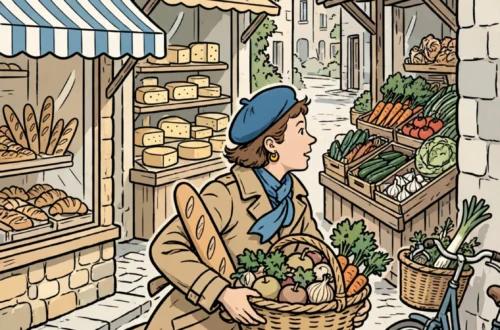
A French Word to Live By
Translate Laisse tomber to English
/lɛs tɔ̃.be/
Laisse tomber means never mind — let it go, forget it.
Your friend has spent twenty minutes explaining, apologising and re-explaining a tiny mistake nobody else remembers. You take the empty glasses to the kitchen, smile over your shoulder, and free her with two words: « Laisse tomber. » Gone. The evening moves on.
Let’s explore how laisse tomber works in French, beginning with the whole phrase on one card.
Understanding the French Phrase Laisse tomber
Laisse tomber is a French imperative phrase — laisser (to let) plus tomber (to fall): literally, let it fall. It is the tu form; laissez tomber serves vous and groups. One phrase does two jobs — dropping a subject, and giving something up — and French speakers slide between them without thinking.
It means never mind — let it go, forget it, drop it. Whatever ‘it’ is — a worry, an apology, a broken plan, a hopeless attempt — the phrase opens your hand and lets it fall. Said gently it forgives; said sharply it ends an argument; said with a sigh it admits defeat.
Type: Imperative phrase — laisser (to let) + tomber (to fall), a picture of opening your hand
Answers the need: Closing a subject — or abandoning an attempt that is going nowhere
Register: Informal and everyday — tu form; laissez tomber for vous
Strength: Tone decides everything — gentle forgiveness or a slammed door
One important usage detail: context splits the two meanings. After an apology or an explanation, laisse tomber means ‘never mind, forget it’. In front of a broken machine or a hopeless task, it means ‘give up, drop it’. If your listener could take it the wrong way, add a smile — or a ce n’est pas grave.
Experience the Word
Laisse tomber is the sound of a weight leaving a conversation — two words and the room is lighter.
Imagine two students in a library in Bordeaux at midnight, wrestling with one impossible exercise for an hour. One closes the book, stretches, and grins: « Laisse tomber, on verra demain. » The giving-up is not defeat. It is wisdom with tired eyes.
French knows when holding on stops being noble. Laisse tomber is the art of the open hand.
How to Use Laisse tomber in French: Complete Guide
Let’s explore how laisse tomber works in French, beginning with the whole phrase on one card.
Laisse tomber at a Glance
The Whole Phrase on One Card
Real meaning, literal picture, English twin and register — laisse tomber in five lines.
| Point | Laisse tomber |
|---|---|
| What it really means | never mind — let it go, forget it, drop it |
| Word for word | let fall (laisse = let, tomber = to fall) |
| English equivalent | never mind / forget it / drop it / let it go |
| Register | informal, everyday — tu form; laissez tomber for vous |
| Use it for | ending apologies, dropping topics, abandoning hopeless attempts |
Example
Laisse tomber, ce n’est vraiment pas grave.
Never mind, it’s really not serious.
Word by Word: The Open Hand
Two pieces — a letting-go, and a fall. Together they are one gesture.
| Word | Literal meaning | Its job in the phrase |
|---|---|---|
| laisse | let / leave | the tu imperative of laisser — the hand opening |
| tomber | to fall | the infinitive stays whole after laisser — what is let go simply falls |
| laisse tomber (together) | never mind / drop it | one gesture with two jobs — dropping a subject, or dropping a task |
Example
Laisse tomber cette histoire, elle est finie.
Let that story go, it’s over.
Quick Quiz 1
What is the literal picture inside laisse tomber?
Reveal the answer
Letting something fall — laisser (to let) + tomber (to fall): the open hand that stops holding.
Laisse tomber, on passe à autre chose.
Let it go, let’s move on to something else.
When You Say It: The Letting-Go Moments
Laisse tomber appears wherever holding on has stopped helping — a subject, a plan, an apology.
| Situation | Example |
|---|---|
| Ending an apology | laisse tomber, je ne suis pas fâché — never mind, I’m not angry |
| A topic going in circles | laisse tomber, on ne sera jamais d’accord — forget it, we’ll never agree |
| A hopeless repair | laisse tomber, ce moteur est mort — give up, this engine is dead |
| Forgiving a small debt | laisse tomber les cinq euros, c’est pour moi — forget the five euros, it’s on me |
| A plan that keeps failing | laisse tomber pour ce soir, on essaiera demain — drop it for tonight, we’ll try tomorrow |
Example
Laisse tomber, je vais le faire moi-même.
Never mind, I’ll do it myself.
Make It Yours: Naming What Falls
The phrase takes pronouns and objects — you can drop an idea, a project, a whole plan.
| Form | French | In English |
|---|---|---|
| Tu (friend, child) | laisse tomber | never mind / drop it |
| Vous / a group | laissez tomber | never mind / drop it |
| With its object named | laisse tomber cette idée | drop that idea |
| With a pronoun | laisse-le tomber | drop it / let it go (le = it, masculine) |
| Statement — I form | je laisse tomber | I’m giving up / I’m letting it go |
| The group decision | on laisse tomber ? | shall we drop it? |
Example
Ce projet ? Laisse-le tomber, il coûte trop cher.
That project? Drop it, it costs too much.
Quick Quiz 2
How do you tell a whole group to drop the idea?
Reveal the answer
Laissez tomber — the vous imperative of laisser covers groups and polite singulars alike.
Laissez tomber, les amis, j’ai une autre idée.
Forget it, friends, I have another idea.
Everyday Expressions: Building on the Phrase
Laisse tomber slots into these everyday frames — each one ready to use as it stands.
| Frame | In English |
|---|---|
| laisse tomber, c’est pas grave | never mind, it’s no big deal |
| laisse tomber, j’ai trouvé | forget it, I found it |
| laisse tomber pour aujourd’hui | drop it for today |
| allez, laisse tomber | come on, let it go |
| laisse tomber, on passe à autre chose | let it go, let’s move on |
Example
Allez, laisse tomber, la soirée ne fait que commencer.
Come on, let it go, the evening is only just beginning.
Close Cousins: The Other Ways to Close a Subject
French closes subjects in several ways — laisse tomber opens the hand; its cousins shrug, forget, or politely adjourn.
| Expression | The difference |
|---|---|
| laisse tomber | the classic — drop the subject or the attempt |
| oublie ça | forget that — aims at the memory, not the hand |
| tant pis | too bad / oh well — accepts a loss instead of ordering a drop |
| n’en parlons plus | let’s not talk about it any more — the polite, formal closer |
| laisse faire | let it be / leave it alone — means do not intervene, a different job |
Example
Tant pis pour le concert, on ira au prochain.
Too bad for the concert, we’ll go to the next one.
Quick Quiz 3
Which cousin accepts a loss rather than ordering a drop — tant pis or laisse tomber?
Reveal the answer
Tant pis — it shrugs at fate (‘too bad’); laisse tomber actively opens the hand.
Tant pis, le magasin est fermé.
Too bad, the shop is closed.
Laisse tomber and Its Neighbours
The letting-go shelf around the phrase — gentle partners, and the exact opposite advice.
| French | In English |
|---|---|
| laisse tomber | never mind / let it go |
| ce n’est pas grave | it’s not serious (the gentle partner phrase) |
| ne t’inquiète pas | don’t worry (for fears rather than subjects) |
| oublie-le | forget him / forget it (with the person or thing attached) |
| tiens bon | hang in there (the exact opposite advice) |
| on passe à autre chose | let’s move on (where the phrase usually leads) |
Example
Ne t’inquiète pas et laisse tomber, tout va bien.
Don’t worry and let it go, everything is fine.
Watch Out: The Traps Around Laisse tomber
The traps: a tone that can slam doors, a grip it cannot release, and sorrows it is too light for.
| Trap | The truth |
|---|---|
| the sharp tone | snapped out, laisse tomber ! means ‘drop it!’ — it can end an argument or start one; soften it with a smile or a ce n’est pas grave |
| expecting a physical drop | in conversation nothing falls — the phrase is about subjects and efforts, not objects in hands |
| confusing laisser with lâcher | for a physical grip French uses lâcher: lâche ma main ! (let go of my hand!) — laisser tomber never holds anything |
| using it for real sorrow | to someone grieving, never mind is far too light — listening and presence come first |
Example
Lâche ma main, tu me fais mal !
Let go of my hand, you’re hurting me!
Quick Quiz 4
True or false: laisse tomber is the right phrase when someone is physically gripping your arm.
Reveal the answer
False — for a real grip, French uses lâcher: lâche mon bras ! Laisse tomber drops subjects, not hands.
Lâche mon bras, s’il te plaît.
Let go of my arm, please.
Laisse tomber in Everyday French: Real-Life Examples
Now that you know the word, let’s see how laisse tomber appears in everyday French.
Example Example 1 — A long apology
Laisse tomber, je t’ai déjà pardonné.
Never mind, I’ve already forgiven you.
Example Example 2 — A broken phone
Laisse tomber, il était vieux de toute façon.
Forget it, it was old anyway.
Example Example 3 — Lost keys, found
Non, laisse tomber, je les ai retrouvées !
No, never mind, I found them!
Example Example 4 — A failed recipe
Laisse tomber le soufflé, fais une salade.
Drop the soufflé, make a salad.
Example Example 5 — An old argument
Laisse tomber cette histoire, c’était il y a dix ans.
Let that story go, it was ten years ago.
Example Example 6 — End of the day
Laisse tomber le ménage, repose-toi.
Forget the housework, rest.
Beyond Translation: The Meaning of Laisse tomber
Laisse tomber is the wisdom of the open hand. French culture, so often painted as stubborn, keeps this small door of escape in every conversation: the right to stop — stop explaining, stop apologising, stop pushing a plan uphill.
To say laisse tomber is to declare that the evening matters more than the argument.
And its opposite number proves the point: tiens bon, hold on. Between the two phrases, French covers the whole art of effort — knowing when to grip, and knowing when to let go.
How to Remember the French Phrase Laisse tomber
Remember it this way: Remember it this way: Laisse tomber is an open hand — whatever you were holding, a worry or a task, just let it fall.
- You see the hand open — laisser lets, tomber falls, and the subject is dropped.
- You let the tone choose the meaning — gentle is forgiveness, sharp is ‘drop it, now’.
- You keep lâcher for real grips — hands and arms take lâche, conversations take laisse tomber.
The key idea is laisse tomber means never mind, let it go — the open hand, with laissez for vous.
Test Your Knowledge of Laisse tomber
Let’s see how much you’ve learned. Try answering these questions before revealing the answers.
Question 1
What does laisse tomber mean?
Reveal the answer
Never mind — let it go, forget it, drop it. One phrase for dropping a subject or an attempt.
Question 2
How do you say it to a group?
Reveal the answer
Laissez tomber — the vous imperative of laisser.
Question 3
Translate: Never mind, it’s not serious.
Reveal the answer
Laisse tomber, ce n’est pas grave.
Question 4
What are the two jobs of laisse tomber?
Reveal the answer
Dropping a subject (never mind) and abandoning an attempt (give up) — context and tone tell them apart.
Question 5
Complete the sentence:
______ tomber, on passe à autre chose. (Let it go, let’s move on to something else.)
Reveal the answer
Laisse
Laisse tomber, on passe à autre chose.
Let it go, let’s move on to something else.
Your Final Challenge
Can You Use It?
How would you say this in French?
“How would you say this in French?”
Reveal the answer
Laisse tomber, ce n’est pas grave.
Never mind, it’s not serious.
A little French. A little curiosity. A richer everyday life.
LEARN FRENCH ONE WORD AT A TIME