
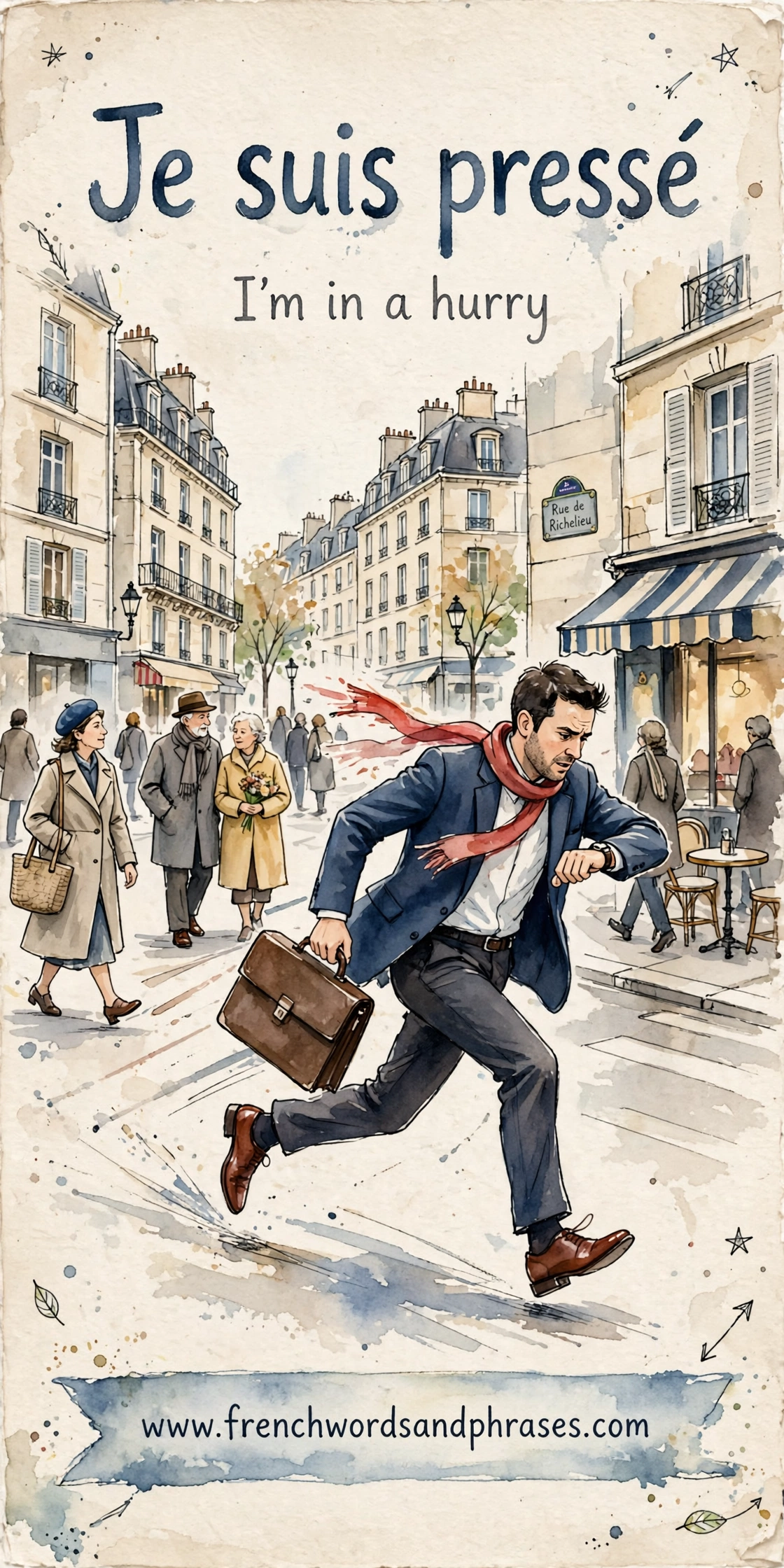
A French Word to Live By
Translate Je suis pressé to English
/ʒə sɥi pʁe.se/
Je suis pressé means I’m in a hurry.
Coat half on, keys in hand, one shoe still by the door — your friend is doing three things at once and talking at double speed. She laughs, points at the clock, and gives you the whole explanation in three words: « Je suis pressée ! » In French, being in a hurry means being pressed — and you can almost see the clock doing the pressing.
Let’s explore how je suis pressé works in French, beginning with the whole phrase on one card.
Understanding the French Phrase Je suis pressé
Je suis pressé is a French statement of state, built with être (to be) plus pressé, the past participle of presser (to press, to squeeze) working as an adjective. It describes a person squeezed by the clock — and because pressé is an adjective, it agrees with the speaker: a woman writes je suis pressée.
It means I am in a hurry — I have very little time. French pictures hurry as pressure: time presses on you from all sides, the way a press squeezes an orange. The phrase explains a quick exit, a short phone call or a skipped dessert, all in three words.
Type: A statement of state — être (to be) plus the adjective pressé
Answers the need: Explaining that you have no time — and excusing a quick exit
Register: Neutral and everyday — safe in speech and writing alike
Strength: Adjustable — soften it with un peu, load it with très or vraiment
One important agreement detail: pressé behaves like an adjective, so it matches the speaker. A man writes je suis pressé; a woman writes je suis pressée — the extra e changes nothing you can hear, only what you see on the page. A group says nous sommes pressés (or pressées for a group of women).
Experience the Word
Je suis pressé is the sound of modern life in three words — the clock pressing, the train leaving, the meeting starting without you.
Imagine a Parisian at a café counter, coffee in one hand, metro ticket in the other, glancing at the clock above the till: « Je suis pressé, c’est combien ? » I am in a hurry, how much is it?
Say it with a smile and it is an apology; say it breathlessly and it is a weather report. Either way, everyone understands instantly — no long explanation needed.
How to Use Je suis pressé in French: Complete Guide
Let’s explore how je suis pressé works in French, beginning with the whole phrase on one card.
Je suis pressé at a Glance
The Whole Phrase on One Card
Real meaning, literal picture, English twin and register — je suis pressé in five lines.
| Point | Je suis pressé |
|---|---|
| What it really means | I am in a hurry — I have very little time |
| Word for word | I am pressed (squeezed) |
| English equivalent | I’m in a hurry / I’m pressed for time |
| Register | neutral, everyday — safe everywhere |
| Use it for | excusing a quick exit, a short call, a skipped course |
Example
Je suis pressé, mon train part dans dix minutes.
I’m in a hurry, my train leaves in ten minutes.
Word by Word: Building the Picture
Three small pieces — and the last one carries the whole picture of the clock pressing down.
| Word | Literal meaning | Its job in the phrase |
|---|---|---|
| je | I | the speaker — the person the clock is chasing |
| suis | am | from être, to be — the state verb |
| pressé | pressed, squeezed | from presser, to press — time pressing on you like a press on an orange |
| pressée | pressed (feminine spelling) | the same word with an extra e when the speaker is a woman — identical sound |
Example
Elle est pressée, elle court à la gare.
She is in a hurry, she’s running to the station.
Quick Quiz 1
What does pressé literally mean in je suis pressé?
Reveal the answer
Pressed — squeezed, like an orange in a press; the picture is time squeezing you.
Je suis pressé ce matin.
I’m in a hurry this morning.
When You Say It: The No-Time Moments
Je suis pressé fires at moments like these — the clock chooses the moment, you just report it.
| Situation | Example |
|---|---|
| Catching a train | je suis pressé, le train part dans cinq minutes — I’m in a hurry, the train leaves in five minutes |
| Cutting a phone call short | je suis pressé, je te rappelle ce soir — I’m in a hurry, I’ll call you back tonight |
| Leaving lunch early | pardon, je suis pressé, je dois retourner au travail — sorry, I’m in a hurry, I have to get back to work |
| In a taxi | je suis pressé, l’aéroport, s’il vous plaît — I’m in a hurry, the airport, please |
| Skipping dessert | non merci, je suis un peu pressé — no thanks, I’m a bit pressed for time |
Example
Je suis pressé, la réunion commence dans deux minutes !
I’m in a hurry, the meeting starts in two minutes!
Make It Yours: Persons, Degrees and the Opposite
The adjective dresses for the speaker — and the phrase softens, strengthens and flips.
| Form | French | In English |
|---|---|---|
| A man speaking | je suis pressé | I’m in a hurry |
| A woman speaking | je suis pressée | I’m in a hurry (extra e, same sound) |
| Asking a friend | tu es pressé ? / tu es pressée ? | are you in a hurry? |
| A group | nous sommes pressés | we’re in a hurry |
| In the past | j’étais pressé | I was in a hurry |
| The relaxed opposite | je ne suis pas pressé | I’m in no hurry |
Example
Tu es pressée ? On peut parler plus tard.
Are you in a hurry? We can talk later.
Quick Quiz 2
A woman writes the phrase down. What changes — the spelling or the sound?
Reveal the answer
Only the spelling — je suis pressée, with an extra e; spoken aloud, pressé and pressée sound exactly the same.
Elle est pressée aujourd’hui.
She is in a hurry today.
Everyday Expressions: Building on the Phrase
Je suis pressé slots into these everyday frames — each one ready to use as it stands.
| Frame | In English |
|---|---|
| je suis pressé, je dois partir | I’m in a hurry, I have to go |
| désolé, je suis un peu pressé | sorry, I’m a bit pressed for time |
| je suis pressé ce matin | I’m in a hurry this morning |
| je suis pressé, on se parle plus tard | I’m in a hurry, we’ll talk later |
| pas le temps, je suis pressé | no time, I’m in a hurry |
Example
Je suis pressé, je dois partir dans cinq minutes.
I’m in a hurry, I have to leave in five minutes.
Close Cousins: The Other No-Time Phrases
French has a whole shelf of clock phrases — je suis pressé is about time pressing ahead of you; its cousins each point somewhere slightly different.
| Expression | The difference |
|---|---|
| je suis pressé | I’m in a hurry — time is short, the deadline is ahead |
| je suis en retard | I’m late — the deadline is already behind you |
| je me dépêche | I’m hurrying — the action, feet moving, not the state |
| je dois y aller | I have to go — the exit line itself, no reason given |
| je n’ai pas le temps | I don’t have time — blunter, about the task, not the clock |
| je suis débordé | I’m snowed under — too much work, not necessarily a deadline |
Example
Je suis pressé et en plus je suis en retard !
I’m in a hurry and on top of that I’m late!
Quick Quiz 3
Your train leaves in ten minutes and you are still at home. Are you pressé or en retard?
Reveal the answer
Pressé — the deadline is still ahead of you; en retard means it has already passed.
Vite, je suis pressé, le train part bientôt !
Quick, I’m in a hurry, the train leaves soon!
Je suis pressé and Its Neighbours
The clock shelf around the phrase, from full sprint to total calm.
| French | In English |
|---|---|
| dépêche-toi | hurry up! (to a friend — the command) |
| je me dépêche | I’m hurrying (the action) |
| je suis pressé | I’m in a hurry (the state) |
| vite ! | quick! (one urgent word) |
| je ne suis pas pressé | I’m in no hurry (the calm middle) |
| j’ai tout mon temps | I have all the time in the world (the true opposite) |
Example
Dépêche-toi, on est pressés !
Hurry up, we’re in a rush!
Watch Out: The Traps Around Je suis pressé
The traps: the silent extra e, the stress confusion, and the same word in the kitchen.
| Trap | The truth |
|---|---|
| forgetting the extra e in writing | a woman writes je suis pressée — the e is silent but it must be on the page |
| using it to mean ‘I am stressed’ | stressed is stressé — pressé is only about the clock |
| demanding faster service with it | said flatly to a waiter it can sound rude — soften it: excusez-moi, je suis un peu pressé |
| meeting pressé in a café | un jus d’orange pressé is freshly squeezed juice — same word, kitchen meaning |
| saying je presse for the state | je me presse is the action ‘I’m hurrying’; the state needs être — je suis pressé |
Example
Excusez-moi, je suis un peu pressée, c’est combien ?
Excuse me, I’m in a bit of a hurry, how much is it?
Quick Quiz 4
True or false: a woman says je suis pressée and the last word sounds different from a man’s pressé.
Reveal the answer
False — the extra e is written, never heard; pressé and pressée are pronounced identically.
Elle est pressée, elle aussi.
She is in a hurry too.
Je suis pressé in Everyday French: Real-Life Examples
Now that you know the word, let’s see how je suis pressé appears in everyday French.
Example Example 1 — At the station
Je suis pressé, mon train part dans cinq minutes.
I’m in a hurry, my train leaves in five minutes.
Example Example 2 — A short phone call
Je suis pressé, je te rappelle ce soir.
I’m in a hurry, I’ll call you back tonight.
Example Example 3 — Leaving lunch
Pardon, je suis pressé, je dois retourner au bureau.
Sorry, I’m in a hurry, I have to get back to the office.
Example Example 4 — In a taxi
Je suis pressé, l’aéroport, s’il vous plaît.
I’m in a hurry, the airport, please.
Example Example 5 — A mother at the door
Je suis pressée ce matin, on se parle ce soir !
I’m in a hurry this morning, we’ll talk tonight!
Example Example 6 — At the office
Je suis pressé, la réunion commence !
I’m in a hurry, the meeting is starting!
Beyond Translation: The Meaning of Je suis pressé
Pressé comes from presser, to press — the verb of olive presses, wine presses and orange squeezers. French simply points the same machine at the clock: to be in a hurry is to be squeezed by time itself.
To say je suis pressé is to blame the press, not yourself.
That little picture makes the phrase polite as well as useful. You are not impatient, you are not rude — you are pressed, the way fruit is pressed, and everyone who has ever watched a clock understands at once.
How to Remember the French Phrase Je suis pressé
Remember it this way: Remember it this way: Je suis pressé pictures you in a press — the clock squeezing you like an orange.
- You see the press — pressé is squeezed, and time does the squeezing.
- You build it with être — je suis plus pressé, a state, not an action.
- You add the silent e if you are a woman — je suis pressée on paper, identical in the ear.
The key idea is je suis pressé means I’m in a hurry — pressed by the clock; women write pressée.
Test Your Knowledge of Je suis pressé
Let’s see how much you’ve learned. Try answering these questions before revealing the answers.
Question 1
What does je suis pressé mean?
Reveal the answer
I’m in a hurry. Literally ‘I am pressed’ — time is squeezing you.
Question 2
What is the literal picture inside pressé?
Reveal the answer
Being pressed or squeezed, like an orange in a press — pressé comes from presser, to press.
Question 3
How does a woman write the phrase?
Reveal the answer
Je suis pressée — with an extra e on pressée; the sound does not change.
Question 4
What is the difference between je suis pressé and je suis en retard?
Reveal the answer
Pressé means the deadline is ahead and time is short; en retard means the deadline has already passed — you are late.
Question 5
Complete the sentence:
Désolé, je suis ______, mon train part dans cinq minutes. (Sorry, I’m in a hurry, my train leaves in five minutes.)
Reveal the answer
pressé
Désolé, je suis pressé, mon train part dans cinq minutes.
Sorry, I’m in a hurry, my train leaves in five minutes.
Your Final Challenge
Can You Use It?
How would you say this in French?
“How would you say this in French?”
Reveal the answer
Je suis pressé, mon train part dans cinq minutes !
I’m in a hurry, my train leaves in five minutes!
A little French. A little curiosity. A richer everyday life.
LEARN FRENCH ONE WORD AT A TIME




