A French Word to Live By
Translate Ne t’inquiète pas to English
/nə tɛ̃.kjɛt pa/
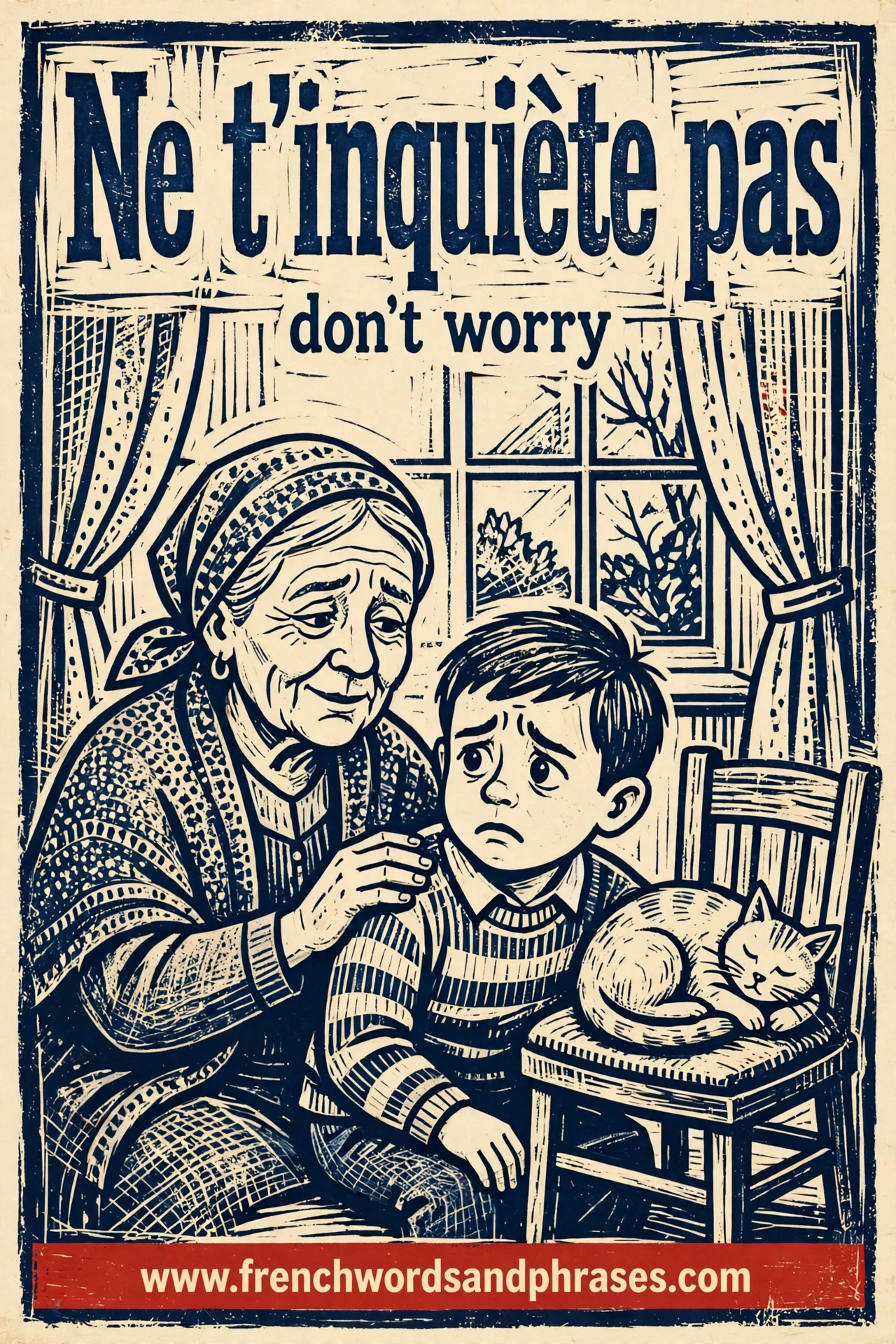
Ne t’inquiète pas means don’t worry.
The exam results are posted at noon, and your friend has been refreshing the page since dawn, pale and silent. You put a hand on her shoulder, smile, and pour the calmest sentence in French over the whole morning: « Ne t’inquiète pas. »
Let’s explore how ne t’inquiète pas works in French, beginning with the whole phrase on one card.
Understanding the French Phrase Ne t’inquiète pas
Ne t’inquiète pas is a French negative imperative — a ‘don’t’ built from the reflexive verb s’inquiéter (to worry). The little t’ is the reflexive pronoun, part of the verb itself; the vous form, ne vous inquiétez pas, is the one you will hear from doctors, officials and hotel staff.
It means don’t worry — stop carrying this fear, it is not needed. French builds the reassurance as an order: not ‘there is nothing to fear’ but a direct, kind instruction to the worry itself. Said softly, it is a hand on the shoulder in sentence form.
Type: Negative imperative — a gentle ‘don’t’ built on s’inquiéter (to worry)
Answers the need: Reassuring — removing a fear before it grows
Register: Warm and everyday — tu form here; ne vous inquiétez pas for vous
Strength: Soft but firm — a reassurance, not a dismissal
One important usage detail: the accent dances. The infinitive is s’inquiéter with an é, but in the present and the imperative the stem vowel changes — je m’inquiète, ne t’inquiète pas, with a grave è. Same verb, two spellings of its heart.
Experience the Word
Ne t’inquiète pas is the phrase French childhoods are built on — from mothers at school gates to friends before exams, it is the national lullaby for adults.
Imagine a young cook in a busy Paris kitchen who has just dropped a sauce an hour before service. The old chef does not shout. He tastes, nods, and says: « Ne t’inquiète pas, on recommence. » Don’t worry, we start again. The kitchen breathes.
Worry is a weight carried alone. Ne t’inquiète pas is the moment someone else takes a corner of it.
How to Use Ne t’inquiète pas in French: Complete Guide
Let’s explore how ne t’inquiète pas works in French, beginning with the whole phrase on one card.
Ne t’inquiète pas at a Glance
The Whole Phrase on One Card
Real meaning, literal picture, English twin and register — ne t’inquiète pas in five lines.
| Point | Ne t’inquiète pas |
|---|---|
| What it really means | don’t worry — stop being afraid, it will be fine |
| Word for word | do not worry yourself (s’inquiéter = to worry) |
| English equivalent | don’t worry / don’t fret / it’s all right |
| Register | warm, everyday — tu form; ne vous inquiétez pas for vous |
| Use it for | exams, journeys, health, money — any fear you want to shrink |
Example
Ne t’inquiète pas, tout va bien se passer.
Don’t worry, everything will turn out fine.
Word by Word: The Hug Around the Verb
Three pieces — the two halves of ‘don’t’ hug a verb that always carries its little pronoun.
| Word | Literal meaning | Its job in the phrase |
|---|---|---|
| ne … pas | do not | the two halves of the French ‘don’t’ — they hug the verb |
| t’ | yourself | the reflexive pronoun (te, shortened) — s’inquiéter always carries one |
| inquiète | worry | from s’inquiéter — note the grave accent, è, in this form |
Example
Ne t’inquiète pas pour moi, je vais bien.
Don’t worry about me, I’m fine.
Quick Quiz 1
What is the little t’ doing in ne t’inquiète pas?
Reveal the answer
It is the reflexive pronoun ‘yourself’ — s’inquiéter is a reflexive verb and always carries one.
Ne t’inquiète pas, je suis là.
Don’t worry, I’m here.
When You Say It: The Reassurance Moments
Ne t’inquiète pas appears wherever fear is growing faster than the facts.
| Situation | Example |
|---|---|
| Before exam results | ne t’inquiète pas, tu as bien travaillé — don’t worry, you worked hard |
| A parent’s first flight | ne t’inquiète pas, l’avion est très sûr — don’t worry, planes are very safe |
| A friend running late | ne t’inquiète pas, je t’attends — don’t worry, I’ll wait for you |
| Money worries | ne t’inquiète pas pour l’argent, on va trouver une solution — don’t worry about money, we’ll find a solution |
| A child in a storm | ne t’inquiète pas, c’est juste le tonnerre — don’t worry, it’s just thunder |
Example
Ne t’inquiète pas, je reste avec toi ce soir.
Don’t worry, I’m staying with you tonight.
Make It Yours: Persons, Pronouns and the Twin
The reassurance changes its pronoun with the person — and it has an informal twin you will hear everywhere.
| Form | French | In English |
|---|---|---|
| Tu (friend, child) | ne t’inquiète pas | don’t worry |
| Vous (polite, official) | ne vous inquiétez pas | don’t worry |
| Don’t worry any more | ne t’inquiète plus | don’t worry any more |
| Informal twin | ne t’en fais pas | don’t fret / don’t worry about it |
| Vous version of the twin | ne vous en faites pas | don’t worry about it |
| Statement — I form | je ne m’inquiète pas | I’m not worried |
Example
Ne vous inquiétez pas, madame, le médecin arrive.
Don’t worry, madam, the doctor is coming.
Quick Quiz 2
A doctor wants to reassure an elderly patient. Which form — ne t’inquiète pas or ne vous inquiétez pas?
Reveal the answer
Ne vous inquiétez pas — the vous form, for politeness and professional distance.
Ne vous inquiétez pas, tout va bien.
Don’t worry, everything is fine.
Everyday Expressions: Building on the Phrase
Ne t’inquiète pas slots into these everyday frames — each one ready to use as it stands.
| Frame | In English |
|---|---|
| ne t’inquiète pas, je m’en occupe | don’t worry, I’ll take care of it |
| ne t’inquiète pas pour moi | don’t worry about me |
| ne t’inquiète pas, on a le temps | don’t worry, we have time |
| ne t’inquiète pas, tout va bien | don’t worry, everything is fine |
| ne t’inquiète pas, je suis là | don’t worry, I’m here |
Example
Ne t’inquiète pas, je m’en occupe dès demain.
Don’t worry, I’ll take care of it tomorrow.
Close Cousins: The Other Ways to Say Don’t Worry
French reassurance has a whole shelf — ne t’inquiète pas is the warm standard; its cousins are twinnier or more dramatic.
| Expression | The difference |
|---|---|
| ne t’inquiète pas | the warm standard — don’t worry, said to one person you know |
| ne t’en fais pas | don’t fret — the informal twin, maybe even more common in speech |
| pas de panique | no panic! — for a crowd or a sudden scare, more dramatic |
| ça va aller | it’ll be OK — a promise about the future instead of an order |
| ne vous en faites pas | the vous twin of ne t’en fais pas — officials and doctors love it |
Example
Ne t’en fais pas, c’est déjà réparé.
Don’t fret, it’s already fixed.
Quick Quiz 3
Which cousin is the informal twin of this phrase — pas de panique or ne t’en fais pas?
Reveal the answer
Ne t’en fais pas — literally ‘don’t make any of it for yourself’; the everyday twin of ne t’inquiète pas.
Ne t’en fais pas pour le retard.
Don’t worry about the delay.
Ne t’inquiète pas and Its Neighbours
The calm shelf around the phrase — for the hurried, the suffering, and the simply afraid.
| French | In English |
|---|---|
| ne t’inquiète pas | don’t worry |
| prends ton temps | take your time (calm for the hurried) |
| tiens bon | hang in there (calm for the suffering) |
| tout va bien | everything is fine (the report that proves it) |
| calme-toi | calm down (the same job, but blunter — an order, not a hug) |
| c’est grave ? | is it serious? (the worried question this phrase answers) |
Example
C’est grave ? — Non, ne t’inquiète pas.
Is it serious? — No, don’t worry.
Watch Out: The Traps Around Ne t’inquiète pas
The traps: losing the little pronoun, swapping the accent, and worrying the wrong person.
| Trap | The truth |
|---|---|
| dropping the t’ | ne inquiète pas does not exist — the reflexive pronoun is part of the verb |
| the accent swap | infinitive s’inquiéter (é) but ne t’inquiète pas (è) — the stem vowel changes in the present |
| confusing it with tu m’inquiètes | that one means ‘you’re worrying me’ — inquiéter someone else is a different, transitive job |
| saying it to real grief | for a genuine disaster it can sound light — sometimes je suis là (I’m here) is the kinder sentence |
Example
Tu m’inquiètes, toi, à force de ne pas dormir.
You’re worrying me, not sleeping like this.
Quick Quiz 4
Spot the mistake: “Ne inquiète pas, tout va bien.“
Reveal the answer
The reflexive t’ is missing — s’inquiéter cannot stand without its pronoun.
Ne t’inquiète pas, tout va bien.
Don’t worry, everything is fine.
Ne t’inquiète pas in Everyday French: Real-Life Examples
Now that you know the word, let’s see how ne t’inquiète pas appears in everyday French.
Example Example 1 — Exam morning
Ne t’inquiète pas, tu connais tes leçons.
Don’t worry, you know your lessons.
Example Example 2 — A delayed train
Ne t’inquiète pas, je préviens Marie.
Don’t worry, I’ll let Marie know.
Example Example 3 — Before a flight
Ne t’inquiète pas, on atterrit dans deux heures.
Don’t worry, we land in two hours.
Example Example 4 — A broken vase
Ne t’inquiète pas, ce n’est pas grave.
Don’t worry, it’s not serious.
Example Example 5 — Waiting for news
Ne t’inquiète pas, ils vont appeler ce soir.
Don’t worry, they’ll call tonight.
Example Example 6 — A child at night
Ne t’inquiète pas, je suis juste à côté.
Don’t worry, I’m right next door.
Beyond Translation: The Meaning of Ne t’inquiète pas
Every culture reassures, but French reassures by command: do not worry. It sounds strict and is anything but — it is the grammar of someone taking charge of your fear for you, the way a parent takes a heavy bag from a child’s hand.
To say ne t’inquiète pas is to stand between a person and their fear.
Notice how often it travels with a promise: je suis là, je m’en occupe, tout va bien. The order opens the door, and the promise walks through it.
How to Remember the French Phrase Ne t’inquiète pas
Remember it this way: Remember it this way: Ne t’inquiète pas is a hand on the shoulder, built as an order: do not carry that fear.
- You keep the t’ — the reflexive pronoun is part of the verb and never leaves.
- You hear the accent change — s’inquiéter in the dictionary, inquiète with è in your mouth.
- You follow it with a promise — je suis là or je m’en occupe makes it land.
The key idea is ne t’inquiète pas means don’t worry — keep the t’, and switch to vous for politeness.
Test Your Knowledge of Ne t’inquiète pas
Let’s see how much you’ve learned. Try answering these questions before revealing the answers.
Question 1
What does ne t’inquiète pas mean?
Reveal the answer
Don’t worry — a kind order to stop being afraid.
Question 2
How do you say it to a stranger or an official?
Reveal the answer
Ne vous inquiétez pas — the vous form of the same verb.
Question 3
Translate: Don’t worry, I’ll take care of it.
Reveal the answer
Ne t’inquiète pas, je m’en occupe.
Question 4
Why does inquiète have a grave accent here when the infinitive is s’inquiéter?
Reveal the answer
The stem vowel changes in the present forms — je m’inquiète, tu t’inquiètes, ne t’inquiète pas all take è.
Question 5
Complete the sentence:
Ne t’______ pas, tout va bien se passer. (Don’t worry, everything will turn out fine.)
Reveal the answer
inquiète
Ne t’inquiète pas, tout va bien se passer.
Don’t worry, everything will turn out fine.
Your Final Challenge
Can You Use It?
How would you say this in French?
“How would you say this in French?”
Reveal the answer
Ne t’inquiète pas, je suis là.
Don’t worry, I’m here.
A little French. A little curiosity. A richer everyday life.
LEARN FRENCH ONE WORD AT A TIME