A French Word to Live By
Translate Je t’écoute to English
/ʒə te.kut/
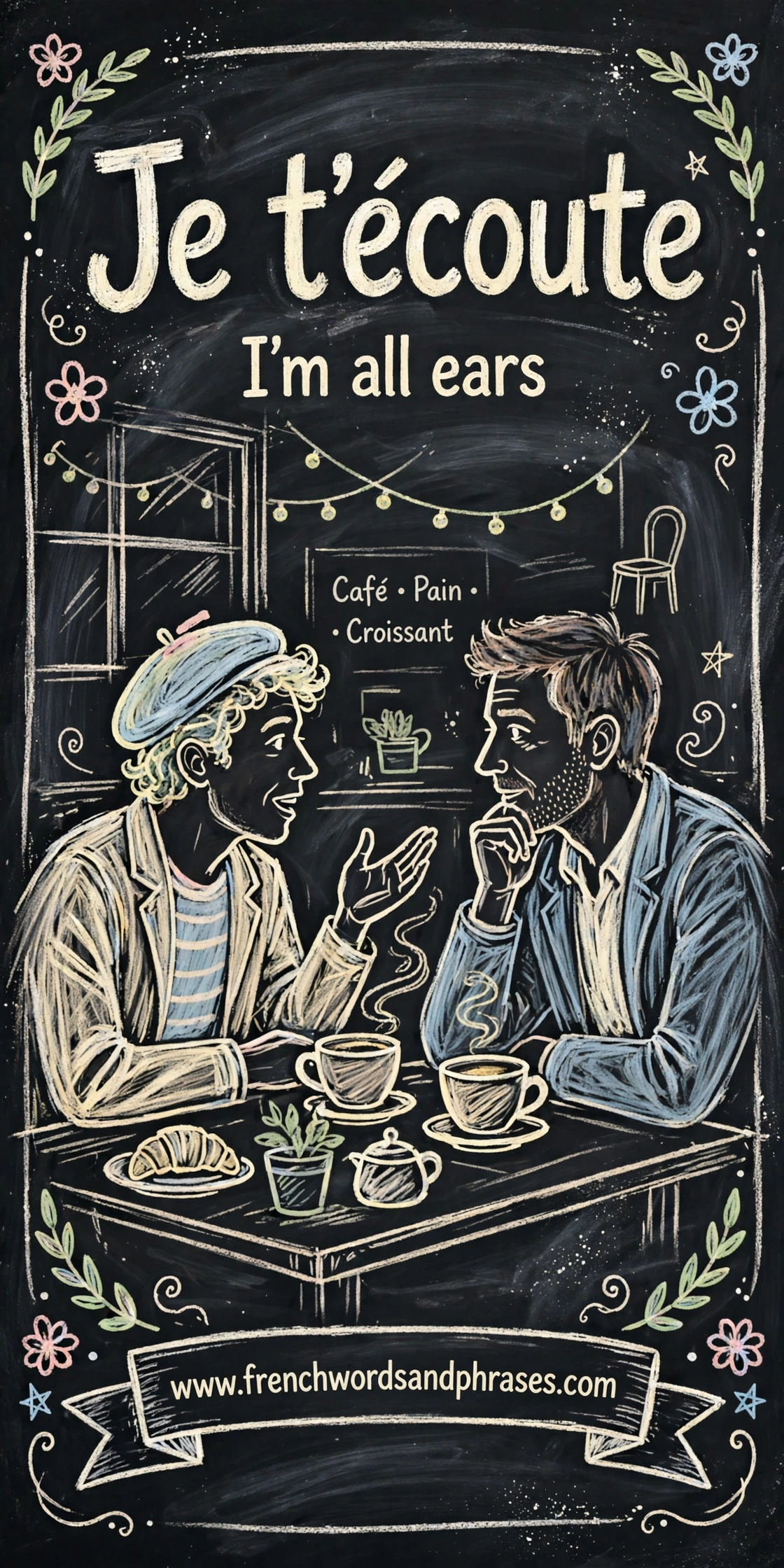
Je t’écoute means I’m all ears — I’m listening, go ahead.
Your friend has been quiet all evening, turning her glass in slow circles. Finally she looks up and says she needs to tell you something. You put your phone face-down on the table, lean in, and open the door with three quiet words: « Je t’écoute. »
Let’s explore how je t’écoute works in French, beginning with the whole phrase on one card.
Understanding the French Phrase Je t’écoute
Je t’écoute is a French statement of attention — the verb écouter (to listen to) with the object pronoun te placed before it, as French grammar demands. The vous form, je vous écoute, doubles as the classic opening line of French shopkeepers, doctors and helplines: I am listening, go ahead.
It means I’m all ears — I’m listening, go ahead, the floor is yours. It is more than silence: je t’écoute is a promise that the listening will be active, patient and complete. On the telephone it is also how France answers the world: allô, je t’écoute — yes, I’m here, speak.
Type: Statement of attention — écouter (to listen to) + object pronoun before the verb
Answers the need: Handing over the floor — inviting someone to speak, promising attention
Register: Warm and universal — je vous écoute is the polite and professional twin
Strength: Quiet and total — three words that clear the whole stage
One important usage detail: écouter is not entendre. Je t’entends means ‘I can hear you’ — a fact about sound, said into bad phone lines. Je t’écoute means ‘I am listening to you’ — a fact about attention. The whole warmth of the phrase lives in that difference.
Experience the Word
Je t’écoute is the sound of a door opening — nothing is demanded, everything is allowed.
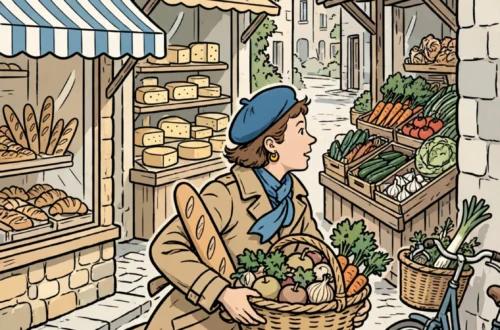
Imagine a little cheese shop in the Alps: the bell rings, you step in half-frozen, and the owner wipes her hands, smiles and says « Je vous écoute ! » In France, being listened to is the first service anyone offers.
Real listening is rare enough to feel like a gift. Je t’écoute is how French gives it in three words.
How to Use Je t’écoute in French: Complete Guide
Let’s explore how je t’écoute works in French, beginning with the whole phrase on one card.
Je t’écoute at a Glance
The Whole Phrase on One Card
Real meaning, literal picture, English twin and register — je t’écoute in five lines.
| Point | Je t’écoute |
|---|---|
| What it really means | I’m all ears — I’m listening, go ahead |
| Word for word | I you-listen (je = I, t’ = you, écoute = listen) |
| English equivalent | I’m listening / go ahead / I’m all ears |
| Register | warm, universal — je vous écoute for politeness and service |
| Use it for | confidences, phone calls, shops, doctors — any offered floor |
Example
Vas-y, je t’écoute, raconte-moi tout.
Go on, I’m listening, tell me everything.
Word by Word: Attention, Packaged
Three pieces — the listener, the listened-to, and the listening itself, in French order.
| Word | Literal meaning | Its job in the phrase |
|---|---|---|
| je | I | the listener — the one offering the attention |
| t’ | you | the object pronoun (te, shortened) — French puts it before the verb |
| écoute | am listening | from écouter, to listen to — active, deliberate attention |
Example
Je t’écoute, qu’est-ce qui se passe ?
I’m listening, what’s going on?
Quick Quiz 1
Why does the t’ stand before écoute and not after it?
Reveal the answer
French object pronouns always go before their verb — je t’écoute, never ‘je écoute toi’.
Je t’écoute depuis le début.
I’ve been listening to you from the start.
When You Say It: The Open-Door Moments
Je t’écoute appears whenever someone needs the floor — and your full attention with it.
| Situation | Example |
|---|---|
| A friend with a problem | je t’écoute, prends ton temps — I’m listening, take your time |
| Answering the phone | allô ? oui, je t’écoute — hello? yes, I’m listening |
| A child with a long story | je t’écoute, et après ? — I’m listening, and then what? |
| A colleague with an idea | je t’écoute, explique-moi ton plan — I’m listening, explain your plan to me |
| In a shop (vous form) | bonjour madame, je vous écoute — good morning, how can I help you |
Example
Assieds-toi, je t’écoute.
Sit down, I’m listening.
Make It Yours: Polite Forms and Reversed Roles
One pronoun swap makes it professional; one word swap hands the listening back.
| Form | French | In English |
|---|---|---|
| Tu — one friend | je t’écoute | I’m listening |
| Vous — polite, professional | je vous écoute | I’m listening / how can I help you |
| A whole room listening | on t’écoute | we’re all listening |
| With the green light | je t’écoute, vas-y | I’m listening, go ahead |
| Roles reversed | écoute-moi | listen to me |
| Asking for the story | je t’écoute, raconte | I’m listening, tell me |
Example
Bonjour, je vous écoute, que puis-je faire pour vous ?
Hello, I’m listening, what can I do for you?
Quick Quiz 2
A shopkeeper greets you with this phrase. Which form, and what does she really mean?
Reveal the answer
Je vous écoute — the vous form; she means ‘how can I help you, go ahead and tell me’.
Bonjour monsieur, je vous écoute.
Good morning sir, how can I help you.
Everyday Expressions: Building on the Phrase
Je t’écoute slots into these everyday frames — each one ready to use as it stands.
| Frame | In English |
|---|---|
| oui, je t’écoute | yes, I’m listening |
| je t’écoute, vas-y | I’m listening, go ahead |
| je t’écoute, qu’est-ce qui se passe ? | I’m listening, what’s happening? |
| je t’écoute depuis le début | I’ve been listening from the start |
| allô, je t’écoute | hello, I’m listening (on the phone) |
Example
Oui, je t’écoute, dis-moi ce qui ne va pas.
Yes, I’m listening, tell me what’s wrong.
Close Cousins: The Other Open Doors
French opens conversations in several ways — je t’écoute is the warm standard; one cousin is the true ‘all ears’.
| Expression | The difference |
|---|---|
| je t’écoute | the warm standard — attention offered, floor handed over |
| je suis tout ouïe | I’m all ears — the literal French idiom (ouïe = hearing); charming, slightly old-fashioned |
| raconte-moi | tell me — the invitation with more appetite |
| allez-y, je vous écoute | go ahead, I’m listening — the full polite service formula |
| dis-moi | tell me — shorter, more casual, between close friends |
Example
Je suis tout ouïe, commence par le début.
I’m all ears, start at the beginning.
Quick Quiz 3
What is the literal French version of ‘I’m all ears’ — je t’écoute or je suis tout ouïe?
Reveal the answer
Je suis tout ouïe — ouïe is the sense of hearing, so it literally says ‘I am all hearing’.
Je suis tout ouïe, vas-y.
I’m all ears, go ahead.
Je t’écoute and Its Neighbours
The conversation shelf around the phrase — teasers, invitations, and reactions.
| French | In English |
|---|---|
| je t’écoute | I’m listening |
| devine quoi | guess what (the teaser this phrase answers) |
| raconte ! | tell me! (the eager version) |
| quoi de neuf ? | what’s new? (the small-talk opener) |
| à toi de voir | it’s up to you (handing over a decision, not the floor) |
| tu plaisantes ! | you’re kidding! (what the listening often produces) |
Example
Devine quoi ? — Je t’écoute !
Guess what? — I’m listening!
Watch Out: The Traps Around Je t’écoute
The traps: hearing versus listening, pronouns in the wrong place, and promising attention you don’t give.
| Trap | The truth |
|---|---|
| confusing écouter with entendre | je t’entends = I can hear you (sound); je t’écoute = I am listening (attention) — on a bad phone line, only the first one fits |
| putting the pronoun after the verb | je écoute toi is impossible — French pronouns move in front: je t’écoute |
| adding à after écouter | écouter takes its object directly — je t’écoute, with no little word between you and the listening |
| saying it while looking at your phone | the phrase is a promise — eyes up, phone down, or the three words ring hollow |
Example
Je t’entends mal, mais je t’écoute, répète doucement.
I can’t hear you well, but I’m listening, say it again slowly.
Quick Quiz 4
On a crackling phone line, which do you say — je t’écoute mal or je t’entends mal?
Reveal the answer
Je t’entends mal — entendre is about sound reaching your ears; écouter is about attention.
Je t’entends mal, tu peux répéter ?
I can’t hear you well, can you repeat that?
Je t’écoute in Everyday French: Real-Life Examples
Now that you know the word, let’s see how je t’écoute appears in everyday French.
Example Example 1 — A friend in tears
Je t’écoute, pleure si tu veux.
I’m listening, cry if you need to.
Example Example 2 — On the phone
Allô, oui, je t’écoute.
Hello, yes, I’m listening.
Example Example 3 — A child’s story
Je t’écoute, et le dragon, il fait quoi ?
I’m listening, and the dragon, what does he do?
Example Example 4 — At the bakery (vous)
Bonjour, je vous écoute !
Hello, how can I help you!
Example Example 5 — A work idea
Je t’écoute, ton idée m’intéresse.
I’m listening, your idea interests me.
Example Example 6 — Late-night talk
Je t’écoute, on a toute la nuit.
I’m listening, we have all night.
Beyond Translation: The Meaning of Je t’écoute
In a world of half-listened conversations, je t’écoute is almost radical: it announces attention before a single fact has been shared. French service culture runs on it — the baker, the doctor, the woman at the mairie all open with the same promise: your words will land somewhere.
To say je t’écoute is to make room in your head and hand over the key.
And notice its patience: it never says ‘hurry’. Whatever is coming — a complaint, a confession, a shopping list — will be heard to the end.
How to Remember the French Phrase Je t’écoute
Remember it this way: Remember it this way: Je t’écoute puts the ‘you’ before the verb — in the sentence, and in the room.
- You park the pronoun in front — je t’écoute, because French objects always travel before their verb.
- You choose attention over sound — écouter listens, entendre merely hears.
- You switch to je vous écoute for service and strangers — France’s official open door.
The key idea is je t’écoute means I’m all ears — attention offered, with the pronoun before the verb.
Test Your Knowledge of Je t’écoute
Let’s see how much you’ve learned. Try answering these questions before revealing the answers.
Question 1
What does je t’écoute mean?
Reveal the answer
I’m listening — I’m all ears, go ahead. An offer of full attention.
Question 2
What does a shopkeeper mean by je vous écoute?
Reveal the answer
‘How can I help you’ — it is the standard polite invitation to say what you need.
Question 3
Translate: I’m listening, tell me what’s wrong.
Reveal the answer
Je t’écoute, dis-moi ce qui ne va pas.
Question 4
What is the difference between je t’écoute and je t’entends?
Reveal the answer
Écouter is attention, entendre is sound — je t’entends says the voice reaches you; je t’écoute says you are listening to it.
Question 5
Complete the sentence:
Vas-y, je ______ écoute. (Go ahead, I’m listening to you.)
Reveal the answer
t’
Vas-y, je t’écoute.
Go ahead, I’m listening.
Your Final Challenge
Can You Use It?
How would you say this in French?
“How would you say this in French?”
Reveal the answer
Je t’écoute, vas-y, raconte.
I’m listening, go on, tell me.
A little French. A little curiosity. A richer everyday life.
LEARN FRENCH ONE WORD AT A TIME