A French Word to Live By
Translate Coûter les yeux de la tête to English
/ku.te le.z‿jø də la tɛt/
Coûter les yeux de la tête means to cost an arm and a leg — to be very expensive.
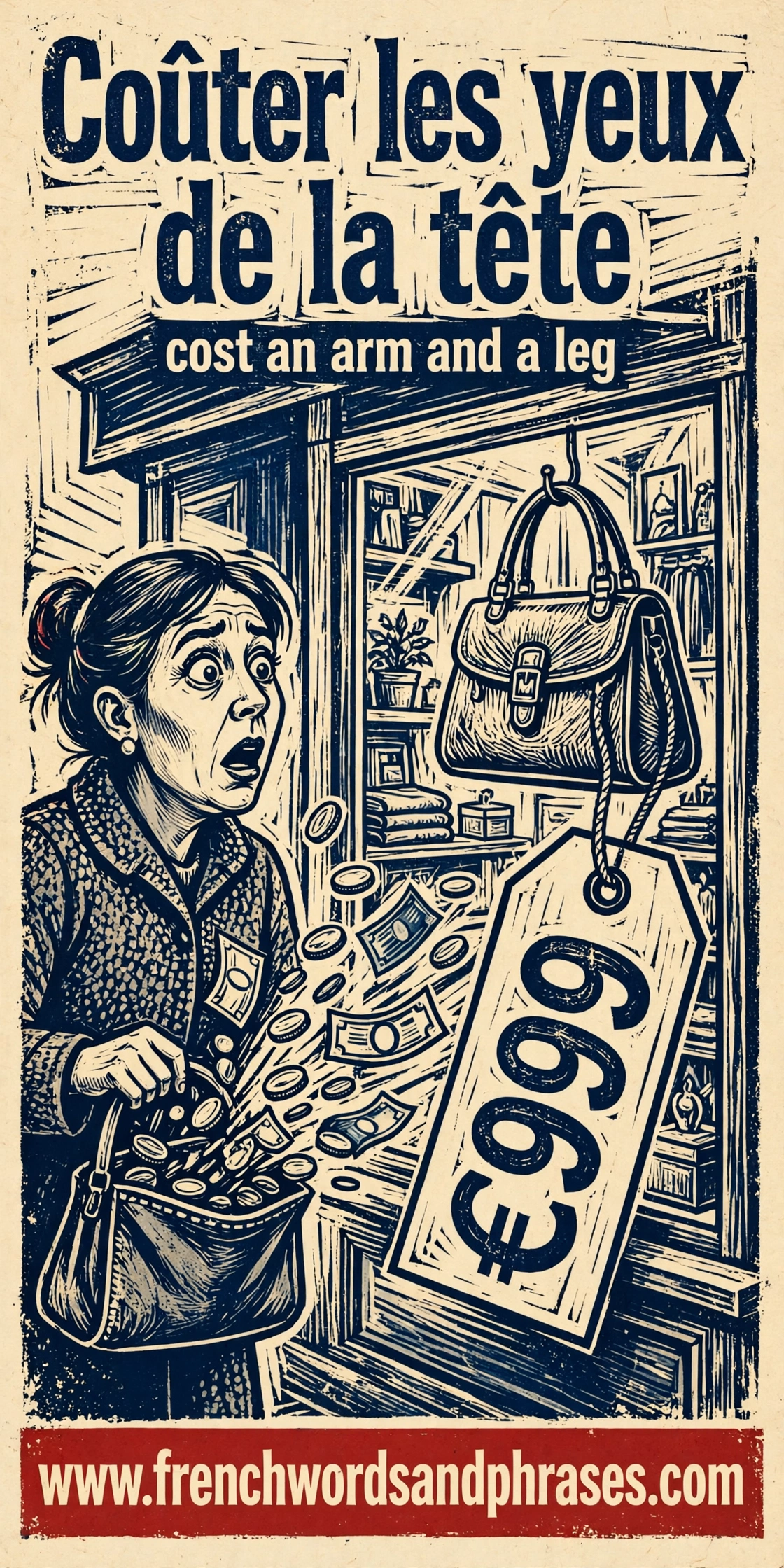
In a Paris boutique window, a handbag catches your eye — small, elegant, perfect. Then you see the price tag and take a step back with a whistle. Your friend laughs: some things do not just cost money. In French, they cost you your eyes: « Ça coûte les yeux de la tête ! »
Let’s explore how coûter les yeux de la tête works in French, beginning with the whole phrase on one card.
Understanding the French Phrase Coûter les yeux de la tête
Coûter les yeux de la tête is a French idiomatic expression built from coûter (to cost) and les yeux de la tête (the eyes out of your head). The price is pictured as a body part: it is so high, it takes something precious from you.
It means to cost an arm and a leg — to be extremely expensive. English pays with limbs; French pays with eyes. Both languages agree on the logic: some prices feel less like a purchase and more like a small amputation.
Type: Idiomatic expression — price (verb + body part)
Answers the need: Saying something is very expensive — with feeling
Register: Neutral to informal — everyday speech, vivid but polite
Strength: Very strong — real shock at a price, not just ‘a bit dear’
One important usage detail: the thing costs, as in English — the subject is the object, or ça, never the buyer. And the victim can be named: ça m’a coûté les yeux de la tête — it cost ME the eyes out of my head — with me, te, lui, nous, vous or leur slipped in front of the verb.
Experience the Word
Coûter les yeux de la tête turns a price tag into a tiny horror story — you read the number and check that your eyes are still in place.
Imagine the first quote for repairing an old roof: the roofer names his figure, the room goes quiet, and somebody finally breathes the only possible verdict. The house keeps its roof. The owners keep their eyes — just barely.
Every language prices shock in body parts. Count the cost in eyes, and no one asks ‘how much exactly?’ — they already know: too much.
How to Use Coûter les yeux de la tête in French: Complete Guide
Let’s explore how coûter les yeux de la tête works in French, beginning with the whole phrase on one card.
Coûter les yeux de la tête at a Glance
The Whole Phrase on One Card
Real meaning, literal picture, English twin and register — coûter les yeux de la tête in five lines.
| Point | Coûter les yeux de la tête |
|---|---|
| What it really means | to be very expensive — to cost a fortune |
| Word for word | to cost the eyes of the head |
| English equivalent | to cost an arm and a leg |
| Register | neutral to informal — spoken and expressive |
| Use it for | prices that shock: cars, repairs, rent, designer goods |
Example
Cette voiture coûte les yeux de la tête.
This car costs an arm and a leg.
Word by Word: Building the Picture
Four small pieces — take them one by one and the price becomes a body part.
| Word | Literal meaning | Its job in the phrase |
|---|---|---|
| coûter | to cost | the verb — the thing does the costing, not the buyer |
| les yeux | the eyes | the price’s victim — yeux is the irregular plural of œil, an eye |
| de la tête | of the head | where the eyes come from — out of your very head |
Example
Les réparations ont coûté les yeux de la tête.
The repairs cost an arm and a leg.
Quick Quiz 1
Yeux is an irregular plural. What is the singular — one eye?
Reveal the answer
Un œil — one eye is un œil, two are des yeux; the word changes completely.
Ce sac coûte les yeux de la tête.
This bag costs an arm and a leg.
When You Say It: The Price-Shock Moments
Coûter les yeux de la tête fires at moments like these — wherever a number makes the room go quiet.
| Situation | Example |
|---|---|
| Seeing a price tag | ça coûte les yeux de la tête, ce sac ! — that bag costs an arm and a leg! |
| A repair bill | la réparation a coûté les yeux de la tête — the repair cost a fortune |
| Talking rent | les loyers à Paris coûtent les yeux de la tête — rents in Paris cost an arm and a leg |
| A wedding | leur mariage a coûté les yeux de la tête — their wedding cost a fortune |
| Warning kindly | ça va nous coûter les yeux de la tête, cette toiture — this roof is going to cost us an arm and a leg |
Example
Un appartement ici ? Ça coûte les yeux de la tête.
A flat here? It costs an arm and a leg.
Make It Yours: Tenses and Victims
Coûter conjugates like a regular -er verb — and the person who pays can slip in before it.
| Form | French | In English |
|---|---|---|
| Present | ça coûte les yeux de la tête | it costs an arm and a leg |
| Past | ça a coûté les yeux de la tête | it cost an arm and a leg |
| It cost me | ça m’a coûté les yeux de la tête | it cost me an arm and a leg |
| Future | ça va coûter les yeux de la tête | it’s going to cost an arm and a leg |
| Negative — relief | ça ne coûte pas les yeux de la tête | it doesn’t cost an arm and a leg |
| Question | ça coûte les yeux de la tête, non ? | it costs a fortune, doesn’t it? |
Example
Ce vélo m’a coûté les yeux de la tête.
This bike cost me an arm and a leg.
Quick Quiz 2
How do you say “it cost ME an arm and a leg”?
Reveal the answer
Ça m’a coûté les yeux de la tête — the little m’ names the victim before the verb.
Cette voiture m’a coûté les yeux de la tête.
This car cost me an arm and a leg.
Everyday Expressions: Building on the Phrase
Coûter les yeux de la tête slots into these everyday frames — each one ready to use as it stands.
| Frame | In English |
|---|---|
| coûter les yeux de la tête à quelqu’un | to cost someone an arm and a leg |
| sans coûter les yeux de la tête | without costing an arm and a leg |
| ça coûte les yeux de la tête, mais… | it costs a fortune, but… |
| pour ne pas coûter les yeux de la tête | so as not to cost an arm and a leg |
| les yeux de la tête, je te dis ! | an arm and a leg, I tell you! |
Example
On peut rénover sans que ça coûte les yeux de la tête.
You can renovate without it costing an arm and a leg.
Close Cousins: The Other Ways to Say Expensive
French has a whole shelf of pricey phrases — les yeux de la tête is the body-part classic; its cousins are plainer, newer or drier.
| Expression | The difference |
|---|---|
| coûter les yeux de la tête | cost an arm and a leg — the classic, vivid and everywhere |
| coûter une fortune | to cost a fortune — plain, fits anywhere |
| coûter un bras | to cost an arm — the modern informal variant, borrowed from the English picture |
| coûter bonbon | to cost a packet — informal, a little old-fashioned, literally ‘to cost sweetie’ |
| ne pas être donné | to not be cheap — an understatement: ‘it’s not given away’ |
Example
Ce manteau n’est pas donné, mais il est magnifique.
This coat isn’t cheap, but it’s beautiful.
Quick Quiz 3
Which cousin is the modern variant borrowed from the English picture — coûter un bras or coûter bonbon?
Reveal the answer
Coûter un bras — ‘to cost an arm’, the English arm-and-a-leg picture arriving in French.
Son téléphone lui a coûté un bras.
His phone cost him an arm.
Coûter les yeux de la tête and Its Neighbours
The price shelf around the phrase — from the outrageous to the practically free.
| French | In English |
|---|---|
| hors de prix | outrageously expensive — literally ‘outside price’ |
| un prix fou | a crazy price |
| exorbitant | exorbitant — the formal word |
| coûter les yeux de la tête | to cost an arm and a leg |
| pour une bouchée de pain | for next to nothing — the opposite: a mouthful of bread |
| donné | a steal — practically given away, the opposite with a smile |
Example
À ce prix-là, c’est donné, prends-le.
At that price, it’s a steal, take it.
Watch Out: The Traps Around Coûter les yeux de la tête
The traps: mixing the two languages’ body parts, and making the buyer do the costing.
| Trap | The truth |
|---|---|
| translating the body parts | English pays an arm and a leg, French pays eyes — never mix the two pictures |
| who does the costing | the thing costs — say ça coûte; never ‘je coûte’ to mean I pay |
| yeux and its liaison | les yeux is pronounced /le.z‿jø/ — the s of les sounds, and yeux is the plural of œil |
| strength | save it for real shocks — for merely pricey things, c’est cher or ce n’est pas donné is enough |
Example
C’est la maison qui coûte les yeux de la tête, pas moi !
It’s the house that costs an arm and a leg, not me!
Quick Quiz 4
Spot the mistake: “Je coûte les yeux de la tête au magasin.“
Reveal the answer
The buyer never ‘costs’ — the thing does: ça coûte les yeux de la tête.
Ce manteau coûte les yeux de la tête.
This coat costs an arm and a leg.
Coûter les yeux de la tête in Everyday French: Real-Life Examples
Now that you know the word, let’s see how coûter les yeux de la tête appears in everyday French.
Example Example 1 — A handbag
Ce sac coûte les yeux de la tête, regarde l’étiquette.
This bag costs an arm and a leg, look at the tag.
Example Example 2 — Roof repairs
La nouvelle toiture a coûté les yeux de la tête.
The new roof cost an arm and a leg.
Example Example 3 — Paris rent
Se loger à Paris coûte les yeux de la tête.
Housing in Paris costs an arm and a leg.
Example Example 4 — A wedding
Leur mariage va coûter les yeux de la tête.
Their wedding is going to cost an arm and a leg.
Example Example 5 — A bike
Mon vélo m’a coûté les yeux de la tête, mais je l’adore.
My bike cost me an arm and a leg, but I love it.
Example Example 6 — A relief
Rassure-toi, l’hôtel ne coûte pas les yeux de la tête.
Don’t worry, the hotel doesn’t cost an arm and a leg.
Beyond Translation: The Meaning of Coûter les yeux de la tête
Why eyes? Of all the body’s treasures, sight is the one we would surrender last — which makes it the perfect currency for an impossible price. English, more rough and ready, pays with an arm and a leg; French, precise as ever, goes straight for the most precious thing in the head.
To say coûter les yeux de la tête is to price the object against your own body — and find the body cheaper.
The hyperbole is the honesty: nobody remembers the exact figure of a shocking bill, but everybody remembers that it cost them their eyes.
How to Remember the French Phrase Coûter les yeux de la tête
Remember it this way: Remember it this way: Coûter les yeux de la tête is the price that takes your eyes — too precious to pay, too vivid to forget.
- You picture the boutique window — the tag is so high it takes les yeux de la tête, the eyes out of your head.
- You let the thing do the costing — ça coûte, and the victim slips in: ça m’a coûté…
- You respect the plural — one eye is un œil, the price takes both: les yeux, pronounced /le.z‿jø/.
The key idea is coûter les yeux de la tête means to cost an arm and a leg — French pays in eyes, not limbs.
Test Your Knowledge of Coûter les yeux de la tête
Let’s see how much you’ve learned. Try answering these questions before revealing the answers.
Question 1
What does coûter les yeux de la tête mean?
Reveal the answer
To cost an arm and a leg — to be very expensive.
Question 2
What is the literal, word-for-word meaning?
Reveal the answer
To cost the eyes of the head — the price takes the eyes out of your head.
Question 3
How do you say ‘it cost me an arm and a leg’?
Reveal the answer
Ça m’a coûté les yeux de la tête — the victim (m’) slips in before the verb.
Question 4
What is the opposite — costing next to nothing?
Reveal the answer
Pour une bouchée de pain — ‘for a mouthful of bread’: practically free.
Question 5
Complete the sentence:
Ça ______ les yeux de la tête ! (It costs an arm and a leg!)
Reveal the answer
coûte
Ça coûte les yeux de la tête !
It costs an arm and a leg!
Your Final Challenge
Can You Use It?
How would you say this in French?
“How would you say this in French?”
Reveal the answer
Ça coûte les yeux de la tête !
It costs an arm and a leg!
A little French. A little curiosity. A richer everyday life.
LEARN FRENCH ONE WORD AT A TIME