A French Word to Live By
Translate Tous les trente-six du mois to English
/tus le tʁɑ̃t sis dy mwa/
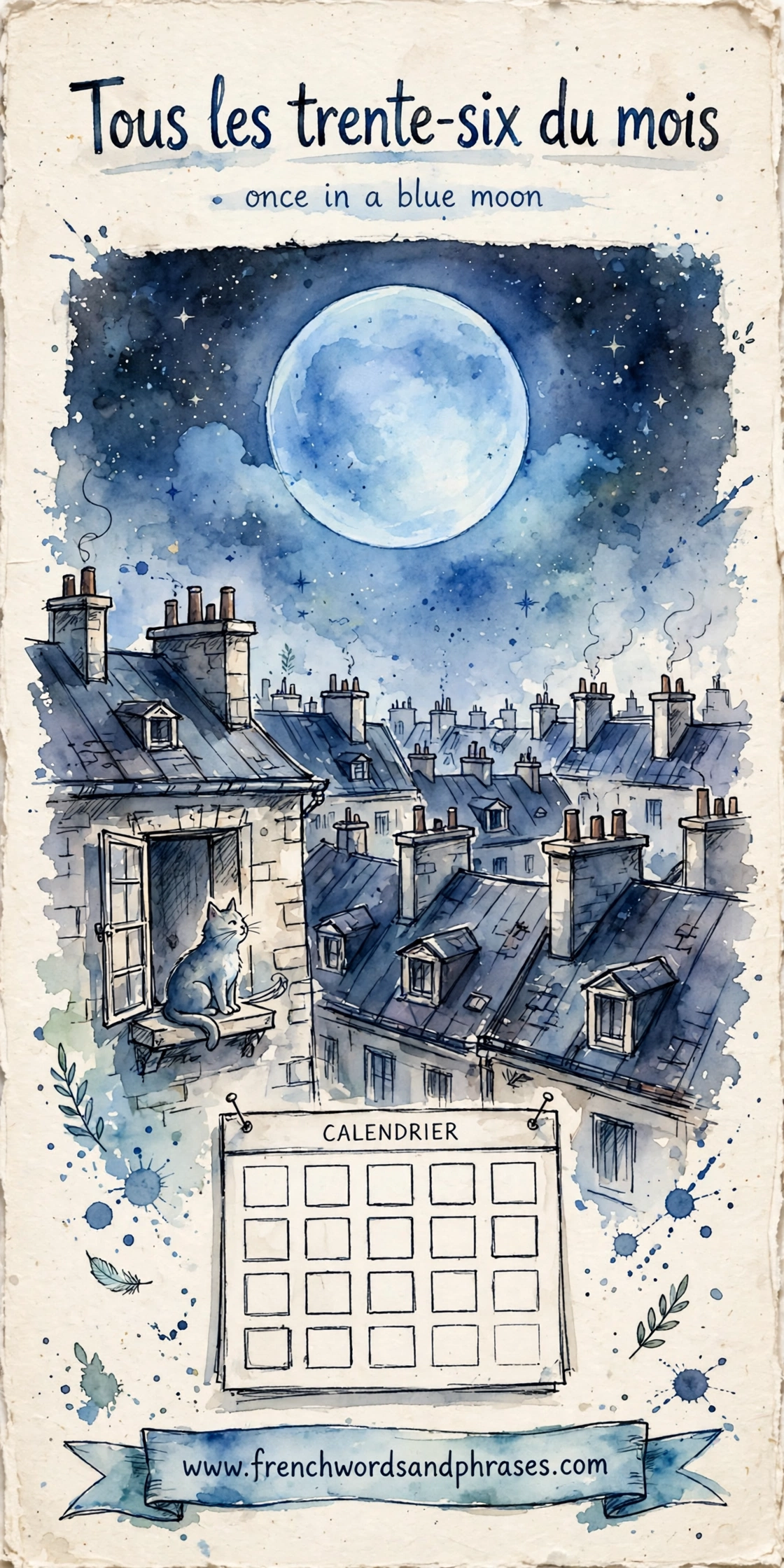
Tous les trente-six du mois means once in a blue moon — very rarely.
Your cousin promises to come and help you repaint the kitchen — ‘soon, definitely soon’. Six months later, the walls are still waiting. When he promises again, the family exchanges a smile: his visits, like his help, arrive on a very special date — « tous les trente-six du mois ».
Let’s explore how tous les trente-six du mois works in French, beginning with the whole phrase on one card.
Understanding the French Phrase Tous les trente-six du mois
Tous les trente-six du mois is a French humorous idiom built like a calendar date that cannot exist: ‘every thirty-sixth of the month’. Since no month has thirty-six days, the phrase means something happens almost never — very rarely indeed.
It means once in a blue moon — extremely rarely. The joke is in the calendar: a thirty-sixth day would need a month that does not exist, so an event scheduled ‘every 36th’ is an event you will wait for a very long time. Said with a smile, it teases without accusing.
Type: Humorous idiom — an impossible date (frequency)
Answers the need: Saying something happens very rarely — with a joke instead of a statistic
Register: Informal and playful — spoken French, never formal writing
Strength: Almost never — a whisker away from jamais (never)
One important usage detail: the phrase keeps a door open that ‘never’ closes. Tous les trente-six du mois means it does happen — just so rarely that the calendar jokes about it. For absolute never, French has its own joke dates: à la Saint-Glinglin, or aux calendes grecques in a more literary tone.
Experience the Word
Tous les trente-six du mois is a wink disguised as a date — the calendar itself joins in the teasing.
Imagine the village bus that is always late, the uncle who answers messages weeks later, the rain that falls only on your day off. French does not count these rarities. It gives them a birthday that does not exist.
Humour softens every complaint. To say trente-six du mois is to grumble and grin in the same breath.
How to Use Tous les trente-six du mois in French: Complete Guide
Let’s explore how tous les trente-six du mois works in French, beginning with the whole phrase on one card.
Tous les trente-six du mois at a Glance
The Whole Phrase on One Card
Real meaning, literal picture, English twin and register — tous les trente-six du mois in five lines.
| Point | Tous les trente-six du mois |
|---|---|
| What it really means | once in a blue moon — very rarely |
| Word for word | every thirty-sixth of the month |
| English equivalent | once in a blue moon |
| Register | informal and playful — a spoken joke |
| Use it for | rare visits, rare events, rare luck — anything scarce |
Example
Il vient nous voir tous les trente-six du mois.
He comes to see us once in a blue moon.
Word by Word: Building the Picture
Four small pieces — take them one by one and the impossible date appears.
| Word | Literal meaning | Its job in the phrase |
|---|---|---|
| tous | every | tous les + a date is the French pattern for ‘every…’ — tous les jours is every day |
| les | the | part of that same pattern |
| trente-six | thirty-six | the impossible number — chosen because no month ever reaches it |
| du mois | of the month | pins the joke to the calendar |
Example
Tous les jours, non — tous les trente-six du mois !
Every day, no — once in a blue moon!
Quick Quiz 1
Why thirty-six? What is the joke in the number?
Reveal the answer
No month has thirty-six days — the date cannot exist, so the event practically never happens.
On se voit tous les trente-six du mois.
We see each other once in a blue moon.
When You Say It: The Rare Moments
Tous les trente-six du mois fires at moments like these — wherever something scarce deserves a tease.
| Situation | Example |
|---|---|
| A rare visitor | il passe tous les trente-six du mois — he drops by once in a blue moon |
| Rare weather luck | il fait beau le dimanche tous les trente-six du mois — Sunday sunshine happens once in a blue moon |
| A rare win | elle gagne au loto tous les trente-six du mois — she wins the lottery once in a blue moon |
| Rare tidiness | tu ranges ta chambre tous les trente-six du mois ! — you tidy your room once in a blue moon! |
| Rare agreement | ils sont d’accord tous les trente-six du mois — they agree once in a blue moon |
Example
On se voit tous les trente-six du mois, c’est dommage.
We see each other once in a blue moon, it’s a shame.
Make It Yours: The Phrase at Work
The phrase parks itself after almost any verb — and the impossible date can even stand alone as a joke appointment.
| Form | French | In English |
|---|---|---|
| With a verb of coming | il vient tous les trente-six du mois | he comes once in a blue moon |
| With ça arrive | ça arrive tous les trente-six du mois | that happens once in a blue moon |
| With ‘once’ said out loud | une fois tous les trente-six du mois | once in a blue moon |
| Teasing question | tu m’appelles tous les trente-six du mois ? | you call me once in a blue moon? |
| The impossible date alone | rendez-vous le trente-six du mois ! | see you on the thirty-sixth! (joking — never) |
Example
Ça n’arrive que tous les trente-six du mois.
That only happens once in a blue moon.
Quick Quiz 2
Does tous les trente-six du mois mean never?
Reveal the answer
Not quite — it means very rarely: the event does happen, just almost never.
Il écrit tous les trente-six du mois, mais il écrit.
He writes once in a blue moon, but he writes.
Everyday Expressions: Building on the Phrase
Tous les trente-six du mois slots into these everyday frames — each one ready to use as it stands.
| Frame | In English |
|---|---|
| tous les trente-six du mois, le dimanche | once in a blue moon, on a Sunday — the classic teasing addition |
| le trente-six du mois | the thirty-sixth of the month — the impossible date, used as a joke appointment |
| une fois tous les trente-six du mois | once in a blue moon — with the ‘once’ said out loud |
| pas tous les jours | not every day — the gentler understatement of the same idea |
Example
On se donne rendez-vous le trente-six du mois, alors.
We’ll meet on the thirty-sixth, then. (joking)
Close Cousins: The Other Rarity Words
French has a shelf of rarity expressions — trente-six is the joking one; its cousins are plainer, or close the door completely.
| Expression | The difference |
|---|---|
| tous les trente-six du mois | once in a blue moon — rare, joking, spoken |
| rarement | rarely — the plain word, no joke, fits anywhere |
| presque jamais | hardly ever — a shade stronger, still honest |
| à la Saint-Glinglin | never — on a saint’s day that does not exist; humorous, a little dated |
| aux calendes grecques | never — the literary joke, from a Greek calendar that never existed |
Example
Il répondra à la Saint-Glinglin, c’est-à-dire jamais.
He’ll reply on St Glinglin’s day, that is to say never.
Quick Quiz 3
Which cousin closes the door completely — rarement or à la Saint-Glinglin?
Reveal the answer
À la Saint-Glinglin — the feast day of a saint who does not exist: it means never.
Il rangera sa chambre à la Saint-Glinglin.
He’ll tidy his room when pigs fly — never.
Tous les trente-six du mois and Its Neighbours
The frequency shelf around the phrase, from always to never — the phrase sits one step from the end.
| French | In English |
|---|---|
| toujours | always |
| souvent | often |
| de temps en temps | from time to time |
| rarement | rarely |
| tous les trente-six du mois | once in a blue moon |
| jamais | never — the end of the shelf |
Example
Souvent en retard, jamais à l’heure — enfin, tous les trente-six du mois.
Often late, never on time — well, once in a blue moon.
Watch Out: The Traps Around Tous les trente-six du mois
The traps: taking the joke into formal writing, and swallowing the s of tous.
| Trap | The truth |
|---|---|
| formal writing | the joke belongs to speech — in a report, write rarement |
| pronouncing tous | here tous is /tus/ — the s is sounded before les |
| the number | trente-six keeps its hyphen and never changes — trente-six du mois, always |
| meaning drift | it teases about rarity, not about the number 36 itself — nobody is counting |
Example
Dans le rapport, écrivez « rarement », pas « trente-six du mois ».
In the report, write ‘rarely’, not ‘thirty-sixth of the month’.
Quick Quiz 4
True or false: tous les trente-six du mois means never.
Reveal the answer
False — it means very rarely; the door stays open a crack, unlike à la Saint-Glinglin.
Il vient tous les trente-six du mois — mais il vient.
He comes once in a blue moon — but he comes.
Tous les trente-six du mois in Everyday French: Real-Life Examples
Now that you know the word, let’s see how tous les trente-six du mois appears in everyday French.
Example Example 1 — A cousin’s visits
Mon cousin passe nous voir tous les trente-six du mois.
My cousin drops by once in a blue moon.
Example Example 2 — A washing-up tease
Tu fais la vaisselle tous les trente-six du mois !
You do the washing-up once in a blue moon!
Example Example 3 — A sunny Sunday
Un dimanche de soleil, ça arrive tous les trente-six du mois.
A sunny Sunday happens once in a blue moon.
Example Example 4 — A friend calling
Elle téléphone tous les trente-six du mois, alors j’ai décroché vite.
She phones once in a blue moon, so I picked up quickly.
Example Example 5 — Winning at cards
Je gagne aux cartes tous les trente-six du mois.
I win at cards once in a blue moon.
Example Example 6 — The plumber
Le plombier vient demain — ça arrive tous les trente-six du mois.
The plumber is coming tomorrow — that happens once in a blue moon.
Beyond Translation: The Meaning of Tous les trente-six du mois
Every language hides a joke in its calendar. English looks up at a second full moon in a month — rare, but real. French stays at the desk and invents a date that cannot exist at all, which is somehow funnier: the appointment is scheduled, precise, and impossible.
To say tous les trente-six du mois is to put the rarest things in the diary — on a day that will never come.
And yet the phrase is kinder than ‘never’. The thirty-sixth does not exist, but the cousin does occasionally walk through the door — usually when nobody expects him.
How to Remember the French Phrase Tous les trente-six du mois
Remember it this way: Remember it this way: Tous les trente-six du mois is the appointment on the day that does not exist.
- You count the month — no month has thirty-six days, and that is the whole joke.
- You keep the door open a crack — it means rarely, not never; never is à la Saint-Glinglin.
- You keep it spoken — on paper, the same idea is simply rarement.
The key idea is tous les trente-six du mois means once in a blue moon — the date that does not exist.
Test Your Knowledge of Tous les trente-six du mois
Let’s see how much you’ve learned. Try answering these questions before revealing the answers.
Question 1
What does tous les trente-six du mois mean?
Reveal the answer
Once in a blue moon — very rarely, said as a joke about an impossible calendar date.
Question 2
Why the number thirty-six?
Reveal the answer
Because no month has thirty-six days — an event on ‘every 36th’ practically never happens.
Question 3
Does it mean never?
Reveal the answer
No — very rarely. For never, French jokes with à la Saint-Glinglin, a saint’s day that does not exist.
Question 4
What is the plain, formal word for the same idea?
Reveal the answer
Rarement — rarely: no joke, suitable for writing.
Question 5
Complete the sentence:
Il vient tous les ______ du mois. (He comes once in a blue moon.)
Reveal the answer
trente-six
Il vient tous les trente-six du mois.
He comes once in a blue moon.
Your Final Challenge
Can You Use It?
How would you say this in French?
“How would you say this in French?”
Reveal the answer
Il nous rend visite tous les trente-six du mois !
He visits us once in a blue moon!
A little French. A little curiosity. A richer everyday life.
LEARN FRENCH ONE WORD AT A TIME