
A French Word to Live By
How to Conjugate Pourrir in French
/pu.ʁiʁ/
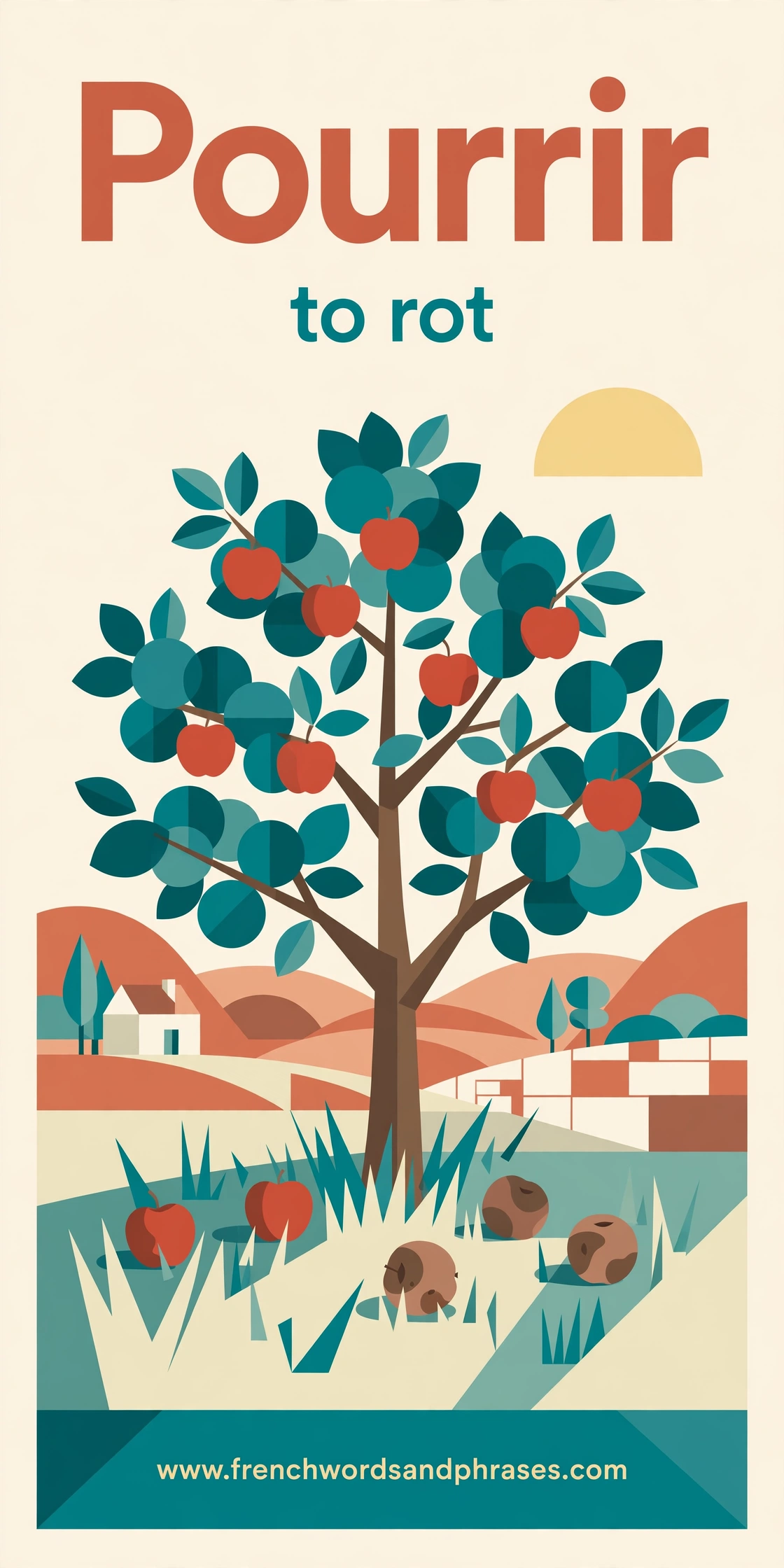
Pourrir means to rot, or to go rotten.
Apples forgotten in the cellar, a beam softened by the rain, milk left in the sun. Decay has its own slow verb in French, and it is pourrir.
In this guide, you’ll learn how to conjugate pourrir in all the major French tenses and moods. Explore complete conjugation tables, French examples, English translations, and practice quizzes.
Understanding the French Verb Pourrir
Pourrir is a regular French verb belonging to the second group of verbs, those ending in -ir.
It means to rot, or to go rotten. It is commonly used for fruit, wood and food going bad, and figuratively for a situation or a relationship decaying.
Verb classification: Second group (-ir)
Auxiliary verb: Avoir or être, depending on the construction
Past participle: pourri
Present participle: pourrissant
English equivalents: To rot, to go rotten, to decay.
One important detail: pourrir works with two auxiliary verbs. When it has a direct object — something rots something else — it takes avoir: la pluie a pourri le bois (the rain rotted the wood). When it means going rotten with no object, modern French also uses avoir: les pommes ont pourri (the apples rotted). Être survives in older and literary use, to describe the resulting state — les fruits sont pourris (the fruit is rotten) — where the participle behaves almost like an adjective. The tables on this page use avoir, the auxiliary of modern French.
Experience the Word
Pourrir is decay at work — the slow undoing of fresh things by time and damp.
Imagine opening the cellar door after the holidays and finding the basket of apples you meant to eat in October: soft, spotted, and smelling of vinegar. Time did the work while nobody watched.
You have not just found bad fruit. You have found pourrir itself — rot, caught in the act.
How to Conjugate Pourrir: Complete French Conjugation Guide
Let’s explore every major conjugation of pourrir, beginning with the indicative mood.
How to Conjugate Pourrir in the Indicative Mood
The indicative mood is used to express facts, observations, actions, and events.
How to Conjugate Pourrir in the Present Tense (Présent)
Used for actions happening now, habitual actions, and general truths.
| Subject | Conjugation |
|---|---|
| je | pourris |
| tu | pourris |
| il / elle | pourrit |
| nous | pourrissons |
| vous | pourrissez |
| ils / elles | pourrissent |
Example
Les pommes pourrissent dans la cave.
The apples are rotting in the cellar.
Quick Quiz 1
Complete the sentence:
Les pommes ______ dans la cave.
Reveal the answer
pourrissent
Les pommes pourrissent dans la cave.
The apples are rotting in the cellar.
How to Conjugate Pourrir in the Passé Composé
Used for completed actions in the past. Pourrir takes the auxiliary verb avoir or être, depending on the construction.
| Subject | Conjugation |
|---|---|
| j’ | ai pourri |
| tu | as pourri |
| il / elle | a pourri |
| nous | avons pourri |
| vous | avez pourri |
| ils / elles | ont pourri |
Example
Les fruits ont pourri pendant l’été.
The fruit rotted during the summer.
How to Conjugate Pourrir in the Imparfait (Imperfect Tense)
Used for habitual past actions, descriptions, and ongoing situations in the past.
| Subject | Conjugation |
|---|---|
| je | pourrissais |
| tu | pourrissais |
| il / elle | pourrissait |
| nous | pourrissions |
| vous | pourrissiez |
| ils / elles | pourrissaient |
Example
Le bois pourrissait lentement dans l’humidité.
The wood was slowly rotting in the damp.
Quick Quiz 2
Choose the correct form:
The fruit has rotted.
Les fruits ______ . (ont pourri / sont pourris)
Reveal the answer
ont pourri
Les fruits ont pourri.
In modern French, the change takes avoir; être belongs to the older state form.
How to Conjugate Pourrir in the Plus-que-parfait
Used to describe an action that had already been completed before another past event.
| Subject | Conjugation |
|---|---|
| j’ | avais pourri |
| tu | avais pourri |
| il / elle | avait pourri |
| nous | avions pourri |
| vous | aviez pourri |
| ils / elles | avaient pourri |
Example
La pomme avait pourri avant la récolte.
The apple had rotted before the harvest.
How to Conjugate Pourrir in the Passé Simple
Primarily used in formal writing, literature, and historical narratives. It is rarely used in everyday conversation.
| Subject | Conjugation |
|---|---|
| je | pourris |
| tu | pourris |
| il / elle | pourrit |
| nous | pourrîmes |
| vous | pourrîtes |
| ils / elles | pourrirent |
Example
Le fruit pourrit sur la branche.
The fruit rotted on the branch.
How to Conjugate Pourrir in the Passé Antérieur
A literary tense used to express an action completed immediately before another past action, generally in the passé simple.
| Subject | Conjugation |
|---|---|
| j’ | eus pourri |
| tu | eus pourri |
| il / elle | eut pourri |
| nous | eûmes pourri |
| vous | eûtes pourri |
| ils / elles | eurent pourri |
Example
Dès qu’il eut pourri, le bois céda.
As soon as it had rotted, the wood gave way.
How to Conjugate Pourrir in the Future Tense (Futur Simple)
Used to describe actions that will take place in the future.
| Subject | Conjugation |
|---|---|
| je | pourrirai |
| tu | pourriras |
| il / elle | pourrira |
| nous | pourrirons |
| vous | pourrirez |
| ils / elles | pourriront |
Example
Sans réfrigérateur, le lait pourrira vite.
Without a fridge, the milk will go off quickly.
How to Conjugate Pourrir in the Futur Antérieur (Future Perfect)
Used for an action that will have been completed before a particular point in the future.
| Subject | Conjugation |
|---|---|
| j’ | aurai pourri |
| tu | auras pourri |
| il / elle | aura pourri |
| nous | aurons pourri |
| vous | aurez pourri |
| ils / elles | auront pourri |
Example
À la fin du mois, les pommes auront pourri.
By the end of the month, the apples will have rotted.
How to Conjugate Pourrir in the Near Future (Futur Proche)
Used to describe something that is going to happen soon. Formed with aller + infinitive.
| Subject | Conjugation |
|---|---|
| je | vais pourrir |
| tu | vas pourrir |
| il / elle | va pourrir |
| nous | allons pourrir |
| vous | allez pourrir |
| ils / elles | vont pourrir |
Example
La viande va pourrir si on ne la met pas au frais.
The meat is going to go off if we don’t put it somewhere cool.
How to Conjugate Pourrir in the Conditional Mood
The conditional mood expresses what would happen under certain circumstances. It is also frequently used to make polite requests or express wishes.
How to Conjugate Pourrir in the Present Conditional
| Subject | Conjugation |
|---|---|
| je | pourrirais |
| tu | pourrirais |
| il / elle | pourrirait |
| nous | pourririons |
| vous | pourririez |
| ils / elles | pourriraient |
Example
Avec cette chaleur, le pain pourrirait en deux jours.
In this heat, the bread would rot in two days.
How to Conjugate Pourrir in the Past Conditional
| Subject | Conjugation |
|---|---|
| j’ | aurais pourri |
| tu | aurais pourri |
| il / elle | aurait pourri |
| nous | aurions pourri |
| vous | auriez pourri |
| ils / elles | auraient pourri |
Example
Le bois aurait pourri sans le vernis.
The wood would have rotted without the varnish.
Pourrir in the Literary Past Conditional Form
This less common literary form uses the imperfect subjunctive of avoir or être, depending on the construction.
| Subject | Conjugation |
|---|---|
| j’ | eusse pourri |
| tu | eusses pourri |
| il / elle | eût pourri |
| nous | eussions pourri |
| vous | eussiez pourri |
| ils / elles | eussent pourri |
Example
La pomme eût pourri dans la cave si on l’avait oubliée.
The apple would have rotted in the cellar if it had been forgotten.
How to Conjugate Pourrir in the Subjunctive Mood
The subjunctive is used to express wishes, emotions, doubts, necessity, and uncertainty. It frequently follows expressions such as il faut que (it is necessary that) or bien que (although).
How to Conjugate Pourrir in the Present Subjunctive
| Subject | Conjugation |
|---|---|
| que je | pourrisse |
| que tu | pourrisses |
| qu’il / qu’elle | pourrisse |
| que nous | pourrissions |
| que vous | pourrissiez |
| qu’ils / qu’elles | pourrissent |
Example
Il faut que les pommes ne pourrissent pas avant la fête.
The apples must not rot before the party.
Quick Quiz 3
Complete the sentence using the subjunctive:
Il faut que les pommes ne ______ pas avant la fête.
Reveal the answer
pourrissent
Il faut que les pommes ne pourrissent pas avant la fête.
The apples must not rot before the party.
How to Conjugate Pourrir in the Imperfect Subjunctive
A literary tense, rarely encountered in modern spoken French.
| Subject | Conjugation |
|---|---|
| que je | pourrisse |
| que tu | pourrisses |
| qu’il / qu’elle | pourrît |
| que nous | pourrissions |
| que vous | pourrissiez |
| qu’ils / qu’elles | pourrissent |
Example
Il voulait que le bois ne pourrît pas.
He wanted the wood not to rot.
How to Conjugate Pourrir in the Pluperfect Subjunctive
A literary construction used to express an action completed before another past action.
| Subject | Conjugation |
|---|---|
| que j’ | eusse pourri |
| que tu | eusses pourri |
| qu’il / qu’elle | eût pourri |
| que nous | eussions pourri |
| que vous | eussiez pourri |
| qu’ils / qu’elles | eussent pourri |
Example
Il regrettait que les fruits eussent pourri si vite.
He regretted that the fruit had rotted so quickly.
How to Conjugate Pourrir in the Past Subjunctive
| Subject | Conjugation |
|---|---|
| que j’ | aie pourri |
| que tu | aies pourri |
| qu’il / qu’elle | ait pourri |
| que nous | ayons pourri |
| que vous | ayez pourri |
| qu’ils / qu’elles | aient pourri |
Example
Je suis content que les pommes n’aient pas pourri.
I am glad the apples did not rot.
How to Conjugate Pourrir in the Imperative
The imperative is used to give commands, instructions, invitations, or suggestions. Subject pronouns are omitted.
How to Conjugate Pourrir in the Present Imperative
| Person | Conjugation |
|---|---|
| (tu) | pourris |
| (nous) | pourrissons |
| (vous) | pourrissez |
Example
Ne pourris pas sur la branche !
Don’t rot on the branch!
Quick Quiz 4
How would you say Don’t rot on the branch, using the tu form?
Reveal the answer
Ne pourris pas sur la branche !
French Participles of Pourrir
Participles are verb forms that can be used in compound tenses and other grammatical constructions.
Present Participle of Pourrir
pourrissant
En pourrissant, les pommes attirent les guêpes.
While rotting, the apples attract the wasps.
Past Participle of Pourrir
pourri
Les fruits sont pourris depuis hier.
The fruit has been rotten since yesterday.
Pourrir in Everyday French: Real-Life Examples
Now that you know the conjugations, let’s see how pourrir appears in everyday French.
Example 1 — Present
Les pommes pourrissent vite en été.
Apples rot quickly in summer.
Example 2 — Passé composé — avoir
Les fruits ont pourri pendant les vacances.
The fruit rotted during the holidays.
Example 3 — Passé composé — être (older use)
Les pommes sont pourries.
The apples are rotten.
Example 4 — Imparfait
Le bois pourrissait dans la cave.
The wood was rotting in the cellar.
Example 5 — Future
Le lait pourrira sans réfrigérateur.
The milk will go off without a fridge.
Example 6 — Conditional
Avec cette chaleur, le pain pourrirait vite.
In this heat, the bread would rot quickly.
Beyond Translation: The Meaning of Pourrir
English says ‘rot’ and moves on; French lets pourrir spread from the fruit bowl to the whole of life — a situation can pourrir, a debate can pourrir, a talent left unused can pourrir. Decay, in French, is a verb for everything that spoils when nobody cares for it.
And pourrir carries the same lesson as its -ir cousins.
The rotting itself takes avoir — les pommes ont pourri. Only the finished state, the rottenness already in place, still takes être in older French: les fruits sont pourris. Process or state — watch which one you mean, and the auxiliary follows.
How to Remember the French Verb Pourrir
Remember it this way: Pourrir is about rotting — avoir for the rotting, être only for the rotten state.
- Fruit or wood goes rotten — les pommes ont pourri: auxiliary avoir.
- Something rots something else — la pluie a pourri le bois: auxiliary avoir.
- Only the finished state, in older French, takes être — les fruits sont pourris.
The key idea is rotting — avoir for the rotting, être only for the rotten state.
Test Your Knowledge of Pourrir
Let’s see how much you’ve learned. Try answering these questions before revealing the answers.
Question 1
When does pourrir take être?
Reveal the answer
Only in older or literary use, to describe the resulting state — les fruits sont pourris. In modern French the change takes avoir: les pommes ont pourri.
Question 2
How do you say The milk will go off in French?
Reveal the answer
Le lait pourrira.
Question 3
Translate: The fruit rotted during the summer.
Reveal the answer
Les fruits ont pourri pendant l’été.
Question 4
What is the past participle of pourrir?
Reveal the answer
Pourri.
Question 5
Complete the sentence:
Si tu laissais les pommes dehors, elles ______ vite.
Reveal the answer
pourriraient
Si tu laissais les pommes dehors, elles pourriraient vite.
If you left the apples outside, they would rot quickly.
Your Final Challenge
Can You Use It?
How would you say this in French?
The apples rotted in the cellar.
Reveal the answer
Les pommes ont pourri dans la cave.
The apples rotted in the cellar.
A little French. A little curiosity. A richer everyday life.
LEARN FRENCH ONE WORD AT A TIME




