A French Word to Live By
How to Conjugate Rajeunir in French
/ʁa.ʒœ.niʁ/
Rajeunir means to make younger-looking, or to become younger.
A new haircut, a week by the sea, a dress that changes everything — and suddenly ten years have fallen away. Looking younger, or making something look younger, is rajeunir.
In this guide, you’ll learn how to conjugate rajeunir in all the major French tenses and moods. Explore complete conjugation tables, French examples, English translations, and practice quizzes.
Understanding the French Verb Rajeunir
Rajeunir is a regular French verb belonging to the second group of verbs, those ending in -ir.
It means to make younger-looking, or to become younger. It is commonly used for looking younger after a haircut, a holiday or good news, and for making a room, a house or a wardrobe look newer.
Verb classification: Second group (-ir)
Auxiliary verb: Avoir or être, depending on the construction
Past participle: rajeuni
Present participle: rajeunissant
English equivalents: To make younger, to become younger, to rejuvenate.
One important detail: rajeunir works with two auxiliary verbs. When it has a direct object — something makes someone look younger — it takes avoir: cette coupe l’a rajeunie (this haircut made her look younger). When it means looking younger with no object, modern French also uses avoir: il a rajeuni de dix ans (he looks ten years younger). Être survives in older and literary use, to describe the resulting state — elle est rajeunie (she looks rejuvenated) — where the participle behaves almost like an adjective. The tables on this page use avoir, the auxiliary of modern French.
Experience the Word
Rajeunir is vieillir in reverse — the verb of the second spring.
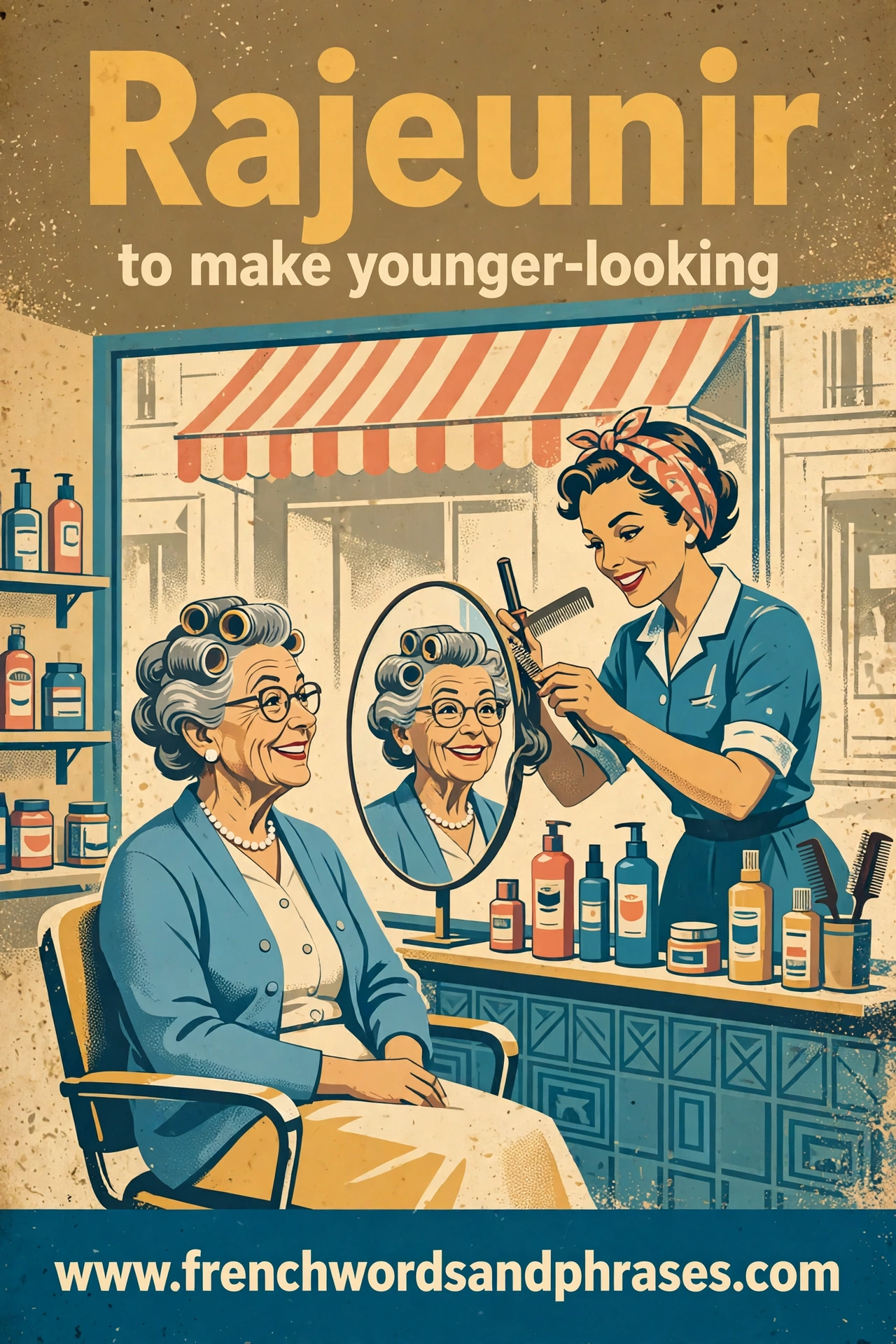
Imagine a grandmother coming home from the hairdresser with a new cut and a new dress. Her grandchildren stare: she looks ten years younger, and she knows it.
You have not just changed a hairstyle. You have turned back the clock — and rajeunir is its verb.
How to Conjugate Rajeunir: Complete French Conjugation Guide
Let’s explore every major conjugation of rajeunir, beginning with the indicative mood.
How to Conjugate Rajeunir in the Indicative Mood
The indicative mood is used to express facts, observations, actions, and events.
How to Conjugate Rajeunir in the Present Tense (Présent)
Used for actions happening now, habitual actions, and general truths.
| Subject | Conjugation |
|---|---|
| je | rajeunis |
| tu | rajeunis |
| il / elle | rajeunit |
| nous | rajeunissons |
| vous | rajeunissez |
| ils / elles | rajeunissent |
Example
Cette coupe rajeunit beaucoup.
This haircut makes you look much younger.
Quick Quiz 1
Complete the sentence:
Cette coupe ______ beaucoup.
Reveal the answer
rajeunit
Cette coupe rajeunit beaucoup.
This haircut makes you look much younger.
How to Conjugate Rajeunir in the Passé Composé
Used for completed actions in the past. Rajeunir takes the auxiliary verb avoir or être, depending on the construction.
| Subject | Conjugation |
|---|---|
| j’ | ai rajeuni |
| tu | as rajeuni |
| il / elle | a rajeuni |
| nous | avons rajeuni |
| vous | avez rajeuni |
| ils / elles | ont rajeuni |
Example
Il a rajeuni de dix ans depuis ses vacances.
He looks ten years younger since his holidays.
How to Conjugate Rajeunir in the Imparfait (Imperfect Tense)
Used for habitual past actions, descriptions, and ongoing situations in the past.
| Subject | Conjugation |
|---|---|
| je | rajeunissais |
| tu | rajeunissais |
| il / elle | rajeunissait |
| nous | rajeunissions |
| vous | rajeunissiez |
| ils / elles | rajeunissaient |
Example
Elle rajeunissait à chaque voyage.
She looked younger with every trip.
Quick Quiz 2
Choose the correct form:
He looks ten years younger.
Il ______ de dix ans. (a rajeuni / est rajeuni)
Reveal the answer
a rajeuni
Il a rajeuni de dix ans.
In modern French, rajeunir takes avoir for the change.
How to Conjugate Rajeunir in the Plus-que-parfait
Used to describe an action that had already been completed before another past event.
| Subject | Conjugation |
|---|---|
| j’ | avais rajeuni |
| tu | avais rajeuni |
| il / elle | avait rajeuni |
| nous | avions rajeuni |
| vous | aviez rajeuni |
| ils / elles | avaient rajeuni |
Example
Il avait rajeuni après son retour.
He had looked younger after his return.
How to Conjugate Rajeunir in the Passé Simple
Primarily used in formal writing, literature, and historical narratives. It is rarely used in everyday conversation.
| Subject | Conjugation |
|---|---|
| je | rajeunis |
| tu | rajeunis |
| il / elle | rajeunit |
| nous | rajeunîmes |
| vous | rajeunîtes |
| ils / elles | rajeunirent |
Example
La peinture rajeunit la façade.
The paint made the facade look younger.
How to Conjugate Rajeunir in the Passé Antérieur
A literary tense used to express an action completed immediately before another past action, generally in the passé simple.
| Subject | Conjugation |
|---|---|
| j’ | eus rajeuni |
| tu | eus rajeuni |
| il / elle | eut rajeuni |
| nous | eûmes rajeuni |
| vous | eûtes rajeuni |
| ils / elles | eurent rajeuni |
Example
Dès qu’elle eut rajeuni la pièce, elle invita ses amis.
As soon as she had made the room look younger, she invited her friends.
How to Conjugate Rajeunir in the Future Tense (Futur Simple)
Used to describe actions that will take place in the future.
| Subject | Conjugation |
|---|---|
| je | rajeunirai |
| tu | rajeuniras |
| il / elle | rajeunira |
| nous | rajeunirons |
| vous | rajeunirez |
| ils / elles | rajeuniront |
Example
Cette robe te rajeunira de cinq ans.
This dress will make you look five years younger.
How to Conjugate Rajeunir in the Futur Antérieur (Future Perfect)
Used for an action that will have been completed before a particular point in the future.
| Subject | Conjugation |
|---|---|
| j’ | aurai rajeuni |
| tu | auras rajeuni |
| il / elle | aura rajeuni |
| nous | aurons rajeuni |
| vous | aurez rajeuni |
| ils / elles | auront rajeuni |
Example
À la fin du mois, elle aura rajeuni de dix ans.
By the end of the month, she will look ten years younger.
How to Conjugate Rajeunir in the Near Future (Futur Proche)
Used to describe something that is going to happen soon. Formed with aller + infinitive.
| Subject | Conjugation |
|---|---|
| je | vais rajeunir |
| tu | vas rajeunir |
| il / elle | va rajeunir |
| nous | allons rajeunir |
| vous | allez rajeunir |
| ils / elles | vont rajeunir |
Example
Je vais rajeunir avec cette coupe.
I am going to look younger with this haircut.
How to Conjugate Rajeunir in the Conditional Mood
The conditional mood expresses what would happen under certain circumstances. It is also frequently used to make polite requests or express wishes.
How to Conjugate Rajeunir in the Present Conditional
| Subject | Conjugation |
|---|---|
| je | rajeunirais |
| tu | rajeunirais |
| il / elle | rajeunirait |
| nous | rajeunirions |
| vous | rajeuniriez |
| ils / elles | rajeuniraient |
Example
Avec un peu de soleil, tu rajeunirais vite.
With a little sun, you would soon look younger.
How to Conjugate Rajeunir in the Past Conditional
| Subject | Conjugation |
|---|---|
| j’ | aurais rajeuni |
| tu | aurais rajeuni |
| il / elle | aurait rajeuni |
| nous | aurions rajeuni |
| vous | auriez rajeuni |
| ils / elles | auraient rajeuni |
Example
Il aurait rajeuni avec une coupe plus courte.
He would have looked younger with a shorter haircut.
Rajeunir in the Literary Past Conditional Form
This less common literary form uses the imperfect subjunctive of avoir or être, depending on the construction.
| Subject | Conjugation |
|---|---|
| j’ | eusse rajeuni |
| tu | eusses rajeuni |
| il / elle | eût rajeuni |
| nous | eussions rajeuni |
| vous | eussiez rajeuni |
| ils / elles | eussent rajeuni |
Example
Elle eût rajeuni avec une robe plus claire.
She would have looked younger with a lighter dress.
How to Conjugate Rajeunir in the Subjunctive Mood
The subjunctive is used to express wishes, emotions, doubts, necessity, and uncertainty. It frequently follows expressions such as il faut que (it is necessary that) or bien que (although).
How to Conjugate Rajeunir in the Present Subjunctive
| Subject | Conjugation |
|---|---|
| que je | rajeunisse |
| que tu | rajeunisses |
| qu’il / qu’elle | rajeunisse |
| que nous | rajeunissions |
| que vous | rajeunissiez |
| qu’ils / qu’elles | rajeunissent |
Example
Il faut que tu rajeunisses un peu ta garde-robe.
You need to make your wardrobe look a little younger.
Quick Quiz 3
Complete the sentence using the subjunctive:
Il faut que tu ______ un peu ta garde-robe.
Reveal the answer
rajeunisses
Il faut que tu rajeunisses un peu ta garde-robe.
You need to make your wardrobe look a little younger.
How to Conjugate Rajeunir in the Imperfect Subjunctive
A literary tense, rarely encountered in modern spoken French.
| Subject | Conjugation |
|---|---|
| que je | rajeunisse |
| que tu | rajeunisses |
| qu’il / qu’elle | rajeunît |
| que nous | rajeunissions |
| que vous | rajeunissiez |
| qu’ils / qu’elles | rajeunissent |
Example
Il voulait qu’elle rajeunît la maison.
He wanted her to make the house look younger.
How to Conjugate Rajeunir in the Pluperfect Subjunctive
A literary construction used to express an action completed before another past action.
| Subject | Conjugation |
|---|---|
| que j’ | eusse rajeuni |
| que tu | eusses rajeuni |
| qu’il / qu’elle | eût rajeuni |
| que nous | eussions rajeuni |
| que vous | eussiez rajeuni |
| qu’ils / qu’elles | eussent rajeuni |
Example
Il regrettait que la maison eût rajeuni si peu.
He regretted that the house had looked so little younger.
How to Conjugate Rajeunir in the Past Subjunctive
| Subject | Conjugation |
|---|---|
| que j’ | aie rajeuni |
| que tu | aies rajeuni |
| qu’il / qu’elle | ait rajeuni |
| que nous | ayons rajeuni |
| que vous | ayez rajeuni |
| qu’ils / qu’elles | aient rajeuni |
Example
Je suis content que tu aies rajeuni après tes vacances.
I am glad you look younger after your holidays.
How to Conjugate Rajeunir in the Imperative
The imperative is used to give commands, instructions, invitations, or suggestions. Subject pronouns are omitted.
How to Conjugate Rajeunir in the Present Imperative
| Person | Conjugation |
|---|---|
| (tu) | rajeunis |
| (nous) | rajeunissons |
| (vous) | rajeunissez |
Example
Rajeunis ta garde-robe, tu verras !
Make your wardrobe look younger, you’ll see!
Quick Quiz 4
How would you say Make your wardrobe look younger, using the tu form?
Reveal the answer
Rajeunis ta garde-robe !
French Participles of Rajeunir
Participles are verb forms that can be used in compound tenses and other grammatical constructions.
Present Participle of Rajeunir
rajeunissant
En rajeunissant, elle retrouvait le sourire.
While looking younger, she found her smile again.
Past Participle of Rajeunir
rajeuni
Elle est rajeunie depuis sa nouvelle coupe.
She looks rejuvenated since her new haircut.
Rajeunir in Everyday French: Real-Life Examples
Now that you know the conjugations, let’s see how rajeunir appears in everyday French.
Example 1 — Present
Cette coupe rajeunit beaucoup.
This haircut makes you look much younger.
Example 2 — Passé composé — avoir
Il a rajeuni de dix ans.
He looks ten years younger.
Example 3 — Passé composé — être (older use)
Elle est rajeunie depuis ses vacances.
She looks rejuvenated since her holidays.
Example 4 — Imparfait
Elle rajeunissait à chaque voyage.
She looked younger with every trip.
Example 5 — Future
Cette robe te rajeunira de cinq ans.
This dress will make you look five years younger.
Example 6 — Conditional
Avec un peu de soleil, tu rajeunirais vite.
With a little sun, you would soon look younger.
Beyond Translation: The Meaning of Rajeunir
English needs a whole phrase — ‘make someone look younger’; French does it with one word: rajeunir. It is the cheerful opposite of vieillir, and it works on faces, houses, gardens and wardrobes alike.
And rajeunir carries the same lesson as its -ir cousins.
The change itself — looking younger — takes avoir in modern French: il a rajeuni de dix ans. Only the finished state, the rejuvenated result, still takes être in older French: elle est rajeunie. Process or state — watch which one you mean, and the auxiliary follows.
How to Remember the French Verb Rajeunir
Remember it this way: Rajeunir is about looking younger — avoir for the change, être only for the rejuvenated state.
- A haircut makes you look younger — cette coupe l’a rajeunie: auxiliary avoir.
- You look younger yourself — il a rajeuni de dix ans: modern French still uses avoir.
- Only the finished state, in older French, takes être — elle est rajeunie.
The key idea is looking younger — avoir for the change, être only for the rejuvenated state.
Test Your Knowledge of Rajeunir
Let’s see how much you’ve learned. Try answering these questions before revealing the answers.
Question 1
When does rajeunir take être?
Reveal the answer
Only in older or literary use, to describe the resulting state — elle est rajeunie. In modern French the change takes avoir: il a rajeuni de dix ans.
Question 2
How do you say This dress will make you look younger in French?
Reveal the answer
Cette robe te rajeunira.
Question 3
Translate: He looks ten years younger since his holidays.
Reveal the answer
Il a rajeuni de dix ans depuis ses vacances.
Question 4
What is the past participle of rajeunir?
Reveal the answer
Rajeuni.
Question 5
Complete the sentence:
Si tu changeais de coupe, tu ______ de cinq ans.
Reveal the answer
rajeunirais
Si tu changeais de coupe, tu rajeunirais de cinq ans.
If you changed your haircut, you would look five years younger.
Your Final Challenge
Can You Use It?
How would you say this in French?
This haircut makes her look ten years younger.
Reveal the answer
Cette coupe la rajeunit de dix ans.
This haircut makes her look ten years younger.
A little French. A little curiosity. A richer everyday life.
LEARN FRENCH ONE WORD AT A TIME