
A French Word to Live By
How to Conjugate Crouler in French
/kʁu.le/
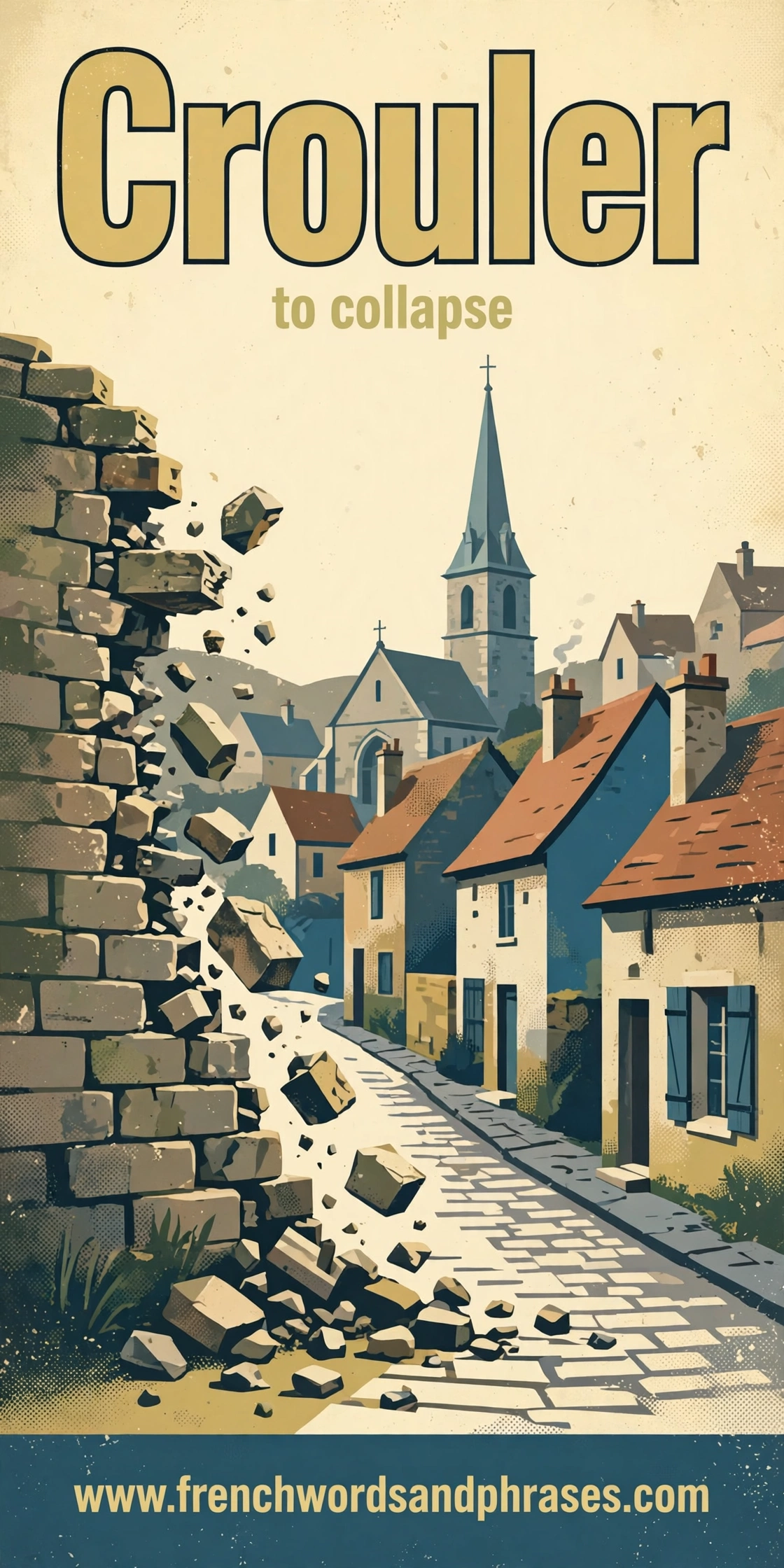
Crouler means to collapse, to crumble, or to cave in.
An old barn after the storm, a cliff eaten away by the sea, a shelf asked to carry one book too many — some structures stand for years and then, in a single moment, give up. In French, that giving up is crouler.
In this guide, you’ll learn how to conjugate crouler in all the major French tenses and moods. Explore complete conjugation tables, French examples, English translations, and practice quizzes.
Understanding the French Verb Crouler
Crouler is a regular French verb belonging to the first group of verbs, those ending in -er.
It means to collapse, to crumble, or to cave in. It is used for walls, roofs, cliffs and buildings that fall down, and figuratively for people swamped by something: crouler sous le travail, crouler sous les dettes — and even crouler de rire, to collapse with laughter.
Verb classification: First group (-er)
Auxiliary verb: Avoir or être, depending on the construction
Past participle: croulé
Present participle: croulant
English equivalents: To collapse, to crumble, to cave in, to be swamped.
One important detail: crouler is conjugated with avoir for the event itself — le mur a croulé (the wall collapsed). Older and literary French also used être to stress the resulting state — la maison est croulée (the house is in ruins) — but that construction has largely faded, and modern French overwhelmingly chooses avoir. The tables on this page use avoir.
Experience the Word
Crouler is the verb of the slow surrender — the crack that widens for years before the wall finally comes down.
Imagine an old stone barn at the edge of a village. Every winter the frost works at its walls a little more, until one spring morning the roof sighs, slips, and settles into the grass.
You have not just seen damage. You have seen something give up standing.
How to Conjugate Crouler: Complete French Conjugation Guide
Let’s explore every major conjugation of crouler, beginning with the indicative mood.
How to Conjugate Crouler in the Indicative Mood
The indicative mood is used to express facts, observations, actions, and events.
How to Conjugate Crouler in the Present Tense (Présent)
Used for actions happening now, habitual actions, and general truths.
| Subject | Conjugation |
|---|---|
| je | croule |
| tu | croules |
| il / elle | croule |
| nous | croulons |
| vous | croulez |
| ils / elles | croulent |
Example
Le vieux mur croule lentement.
The old wall is slowly collapsing.
Quick Quiz 1
Complete the sentence:
Les ruines ______ lentement depuis des siècles.
Reveal the answer
croulent
Les ruines croulent lentement depuis des siècles.
The ruins have been crumbling slowly for centuries.
How to Conjugate Crouler in the Passé Composé
Used for completed actions in the past. Crouler takes the auxiliary verb avoir or être, depending on the construction.
| Subject | Conjugation |
|---|---|
| j’ | ai croulé |
| tu | as croulé |
| il / elle | a croulé |
| nous | avons croulé |
| vous | avez croulé |
| ils / elles | ont croulé |
Example
Le toit a croulé sous le poids de la neige.
The roof collapsed under the weight of the snow.
How to Conjugate Crouler in the Imparfait (Imperfect Tense)
Used for habitual past actions, descriptions, and ongoing situations in the past.
| Subject | Conjugation |
|---|---|
| je | croulais |
| tu | croulais |
| il / elle | croulait |
| nous | croulions |
| vous | crouliez |
| ils / elles | croulaient |
Example
Autrefois, les falaises croulaient après chaque tempête.
In the past, the cliffs used to crumble after every storm.
Quick Quiz 2
Choose the correct form:
The roof collapsed under the snow.
Le toit ______ sous la neige. (a croulé / est croulé)
Reveal the answer
a croulé
Le toit a croulé sous la neige.
The collapse is an event, so crouler takes avoir in modern French; est croulé is the older way of describing the state afterwards.
How to Conjugate Crouler in the Plus-que-parfait
Used to describe an action that had already been completed before another past event.
| Subject | Conjugation |
|---|---|
| j’ | avais croulé |
| tu | avais croulé |
| il / elle | avait croulé |
| nous | avions croulé |
| vous | aviez croulé |
| ils / elles | avaient croulé |
Example
Le pont avait déjà croulé quand les secours sont arrivés.
The bridge had already collapsed when help arrived.
How to Conjugate Crouler in the Passé Simple
Primarily used in formal writing, literature, and historical narratives. It is rarely used in everyday conversation.
| Subject | Conjugation |
|---|---|
| je | croulai |
| tu | croulas |
| il / elle | croula |
| nous | croulâmes |
| vous | croulâtes |
| ils / elles | croulèrent |
Example
La tour croula dans un nuage de poussière.
The tower collapsed in a cloud of dust.
How to Conjugate Crouler in the Passé Antérieur
A literary tense used to express an action completed immediately before another past action, generally in the passé simple.
| Subject | Conjugation |
|---|---|
| j’ | eus croulé |
| tu | eus croulé |
| il / elle | eut croulé |
| nous | eûmes croulé |
| vous | eûtes croulé |
| ils / elles | eurent croulé |
Example
Dès que le mur eut croulé, on ferma la rue.
As soon as the wall had collapsed, the street was closed.
How to Conjugate Crouler in the Future Tense (Futur Simple)
Used to describe actions that will take place in the future.
| Subject | Conjugation |
|---|---|
| je | croulerai |
| tu | crouleras |
| il / elle | croulera |
| nous | croulerons |
| vous | croulerez |
| ils / elles | crouleront |
Example
Si personne ne le répare, ce plafond croulera.
If nobody repairs it, this ceiling will collapse.
How to Conjugate Crouler in the Futur Antérieur (Future Perfect)
Used for an action that will have been completed before a particular point in the future.
| Subject | Conjugation |
|---|---|
| j’ | aurai croulé |
| tu | auras croulé |
| il / elle | aura croulé |
| nous | aurons croulé |
| vous | aurez croulé |
| ils / elles | auront croulé |
Example
Sans étai, le mur aura croulé avant l’hiver.
Without a prop, the wall will have collapsed before winter.
How to Conjugate Crouler in the Near Future (Futur Proche)
Used to describe something that is going to happen soon. Formed with aller + infinitive.
| Subject | Conjugation |
|---|---|
| je | vais crouler |
| tu | vas crouler |
| il / elle | va crouler |
| nous | allons crouler |
| vous | allez crouler |
| ils / elles | vont crouler |
Example
Regarde cette fissure : le mur va crouler !
Look at that crack: the wall is going to collapse!
How to Conjugate Crouler in the Conditional Mood
The conditional mood expresses what would happen under certain circumstances. It is also frequently used to make polite requests or express wishes.
How to Conjugate Crouler in the Present Conditional
| Subject | Conjugation |
|---|---|
| je | croulerais |
| tu | croulerais |
| il / elle | croulerait |
| nous | croulerions |
| vous | crouleriez |
| ils / elles | crouleraient |
Example
Avec un peu plus de neige, le toit croulerait.
With a little more snow, the roof would collapse.
How to Conjugate Crouler in the Past Conditional
| Subject | Conjugation |
|---|---|
| j’ | aurais croulé |
| tu | aurais croulé |
| il / elle | aurait croulé |
| nous | aurions croulé |
| vous | auriez croulé |
| ils / elles | auraient croulé |
Example
Le bâtiment aurait croulé sans les travaux de l’an dernier.
The building would have collapsed without last year’s repairs.
Crouler in the Literary Past Conditional Form
This less common literary form uses the imperfect subjunctive of avoir or être, depending on the construction.
| Subject | Conjugation |
|---|---|
| j’ | eusse croulé |
| tu | eusses croulé |
| il / elle | eût croulé |
| nous | eussions croulé |
| vous | eussiez croulé |
| ils / elles | eussent croulé |
Example
Le mur eût croulé si la pluie avait continué.
The wall would have collapsed if the rain had continued.
How to Conjugate Crouler in the Subjunctive Mood
The subjunctive is used to express wishes, emotions, doubts, necessity, and uncertainty. It frequently follows expressions such as il faut que (it is necessary that) or bien que (although).
How to Conjugate Crouler in the Present Subjunctive
| Subject | Conjugation |
|---|---|
| que je | croule |
| que tu | croules |
| qu’il / qu’elle | croule |
| que nous | croulions |
| que vous | crouliez |
| qu’ils / qu’elles | croulent |
Example
Je crains que la falaise ne croule un jour.
I fear the cliff will collapse one day.
Quick Quiz 3
Complete the sentence using the subjunctive:
Je crains que ce mur ne ______.
Reveal the answer
croule
Je crains que ce mur ne croule.
I fear this wall will collapse.
How to Conjugate Crouler in the Imperfect Subjunctive
A literary tense, rarely encountered in modern spoken French.
| Subject | Conjugation |
|---|---|
| que je | croulasse |
| que tu | croulasses |
| qu’il / qu’elle | croulât |
| que nous | croulassions |
| que vous | croulassiez |
| qu’ils / qu’elles | croulassent |
Example
Il fallait agir avant que le plafond ne croulât.
Something had to be done before the ceiling collapsed.
How to Conjugate Crouler in the Pluperfect Subjunctive
A literary construction used to express an action completed before another past action.
| Subject | Conjugation |
|---|---|
| que j’ | eusse croulé |
| que tu | eusses croulé |
| qu’il / qu’elle | eût croulé |
| que nous | eussions croulé |
| que vous | eussiez croulé |
| qu’ils / qu’elles | eussent croulé |
Example
Il regrettait que le vieux hangar eût croulé avant sa visite.
He regretted that the old barn had collapsed before his visit.
How to Conjugate Crouler in the Past Subjunctive
| Subject | Conjugation |
|---|---|
| que j’ | aie croulé |
| que tu | aies croulé |
| qu’il / qu’elle | ait croulé |
| que nous | ayons croulé |
| que vous | ayez croulé |
| qu’ils / qu’elles | aient croulé |
Example
C’est dommage que le mur ait croulé pendant l’hiver.
It is a pity the wall collapsed during the winter.
How to Conjugate Crouler in the Imperative
The imperative is used to give commands, instructions, invitations, or suggestions. Subject pronouns are omitted.
How to Conjugate Crouler in the Present Imperative
| Person | Conjugation |
|---|---|
| (tu) | croule |
| (nous) | croulons |
| (vous) | croulez |
Example
Allez, croule une bonne fois, vieux mur !
Go on, collapse once and for all, old wall!
Quick Quiz 4
How would you say Collapse, using the tu form?
Reveal the answer
Croule !
French Participles of Crouler
Participles are verb forms that can be used in compound tenses and other grammatical constructions.
Present Participle of Crouler
croulant
En croulant, la falaise a emporté le sentier.
As it crumbled, the cliff took the path with it.
Past Participle of Crouler
croulé
La grange est croulée depuis des années.
The barn has been in ruins for years.
Crouler in Everyday French: Real-Life Examples
Now that you know the conjugations, let’s see how crouler appears in everyday French.
Example 1 — Present
La falaise croule un peu plus chaque année.
The cliff crumbles a little more each year.
Example 2 — Passé composé — avoir
L’étagère a croulé sous les livres.
The shelf collapsed under the books.
Example 3 — Passé composé — être (older, state)
Le hangar est croulé depuis la tempête.
The barn has lain collapsed since the storm.
Example 4 — Imparfait
Le château croulait déjà au siècle dernier.
The castle was already crumbling last century.
Example 5 — Future
Ce pont ne croulera jamais, il est solide.
This bridge will never collapse, it is solid.
Example 6 — Conditional
Je croulerais sous le travail sans ton aide.
I would be swamped with work without your help.
Beyond Translation: The Meaning of Crouler
English collapse is a hard, sudden word; French crouler keeps the slowness inside it — a wall can crouler stone by stone for a century before it falls.
And French lets almost anything crouler.
A cliff, a ceiling, a budget, a tired parent at Christmas — crouler sous les cadeaux, crouler de fatigue — the image of a structure giving way carries them all.
How to Remember the French Verb Crouler
Remember it this way: Crouler is about collapsing — avoir for the fall, être only in older French for the state after the fall.
- The fall itself takes avoir — le toit a croulé (the roof collapsed).
- Être with croulé belongs to older French and stresses the state after the fall — la maison est croulée; today it sounds literary.
- Think figuratively too: crouler sous le travail — to be swamped with work.
The key idea is collapsing — avoir for the fall, être only in older French for the state after the fall.
Test Your Knowledge of Crouler
Let’s see how much you’ve learned. Try answering these questions before revealing the answers.
Question 1
When does crouler take avoir, and when was être used with it?
Reveal the answer
Avoir for the collapse itself — le mur a croulé. Être was used in older, literary French for the resulting state — la maison est croulée — but modern French chooses avoir.
Question 2
How do you say the roof will collapse in French?
Reveal the answer
Le toit croulera.
Question 3
Translate: The shelf collapsed under the books.
Reveal the answer
L’étagère a croulé sous les livres.
Question 4
What is the past participle of crouler?
Reveal the answer
Croulé.
Question 5
Complete the sentence:
Sans réparations, le vieux pont ______ un jour ou l’autre.
Reveal the answer
croulera
Sans réparations, le vieux pont croulera un jour ou l’autre.
Without repairs, the old bridge will collapse sooner or later.
Your Final Challenge
Can You Use It?
How would you say this in French?
The old wall collapsed during the storm.
Reveal the answer
Le vieux mur a croulé pendant la tempête.
The old wall collapsed during the storm.
A little French. A little curiosity. A richer everyday life.
LEARN FRENCH ONE WORD AT A TIME




