A French Word to Live By
Translate Quoi to English
/kwa/
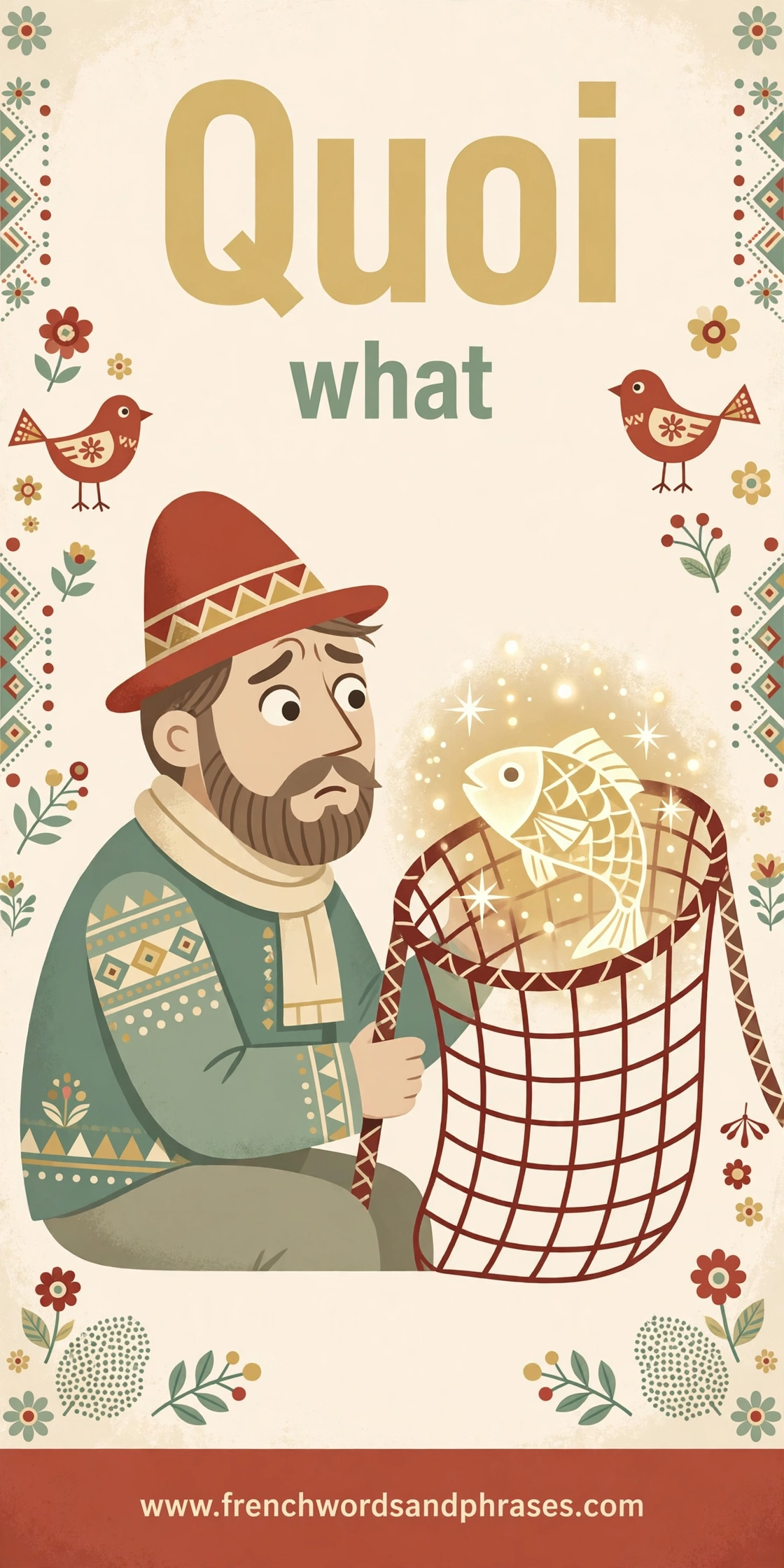
Quoi means what.
Two friends are packing a picnic basket on the kitchen table, passing things back and forth. « On met quoi, dans le panier ? » — What are we putting in the basket? Quoi is the French word for asking about things when the question leans on a preposition or stands on its own: the what of ‘with what?’, ‘about what?’, and the surprised ‘What?’ itself.
Let’s explore how quoi works in French, beginning with the whole word on one card.
Understanding the French Pronoun Quoi
Quoi is a French interrogative pronoun — the stressed, strong form of the question word for things. Where que slips quietly in front of a verb, quoi stands firm after prepositions and on its own, and it never changes shape.
It means what. The picture it paints is an open hand: de quoi parles-tu ? — what are you talking about? After à, de, avec, sur and sans, French reaches for quoi, because que is too light to carry a preposition. Standing alone, quoi is also the natural cry of surprise: Quoi ? — What?
Type: Interrogative pronoun — stressed form, for things
Answers the question: It asks the question: Quoi ? — What?
What follows it: A preposition before it (à quoi, de quoi, avec quoi, sur quoi), or nothing at all: Quoi ?
Watch the pair: quoi (after a preposition, or alone) vs que (before a verb) — avec quoi ? = with what?; que fais-tu ? = what are you doing?
One important usage detail: quoi also builds the useful pattern de quoi + infinitive, meaning ‘something to…’ — de quoi manger (something to eat), de quoi écrire (something to write with), de quoi vivre (enough to live on). And in il n’y a pas de quoi, it answers a thank-you: don’t mention it.
Experience the Word
Quoi is the strong form of the question — the what that can stand on its own two feet, lean on a preposition, or ring out in pure surprise.
Imagine a grandson telling his grandmother about his new job in a laboratory, full of long words. She leans forward, delighted and lost: tu fais quoi, exactement ? — you do what, exactly?
You have not just asked about a thing. You have given the question weight — quoi lands like a stone, where que would skim.
How to Use Quoi in French: Complete Guide
Let’s explore how quoi works in French, beginning with the whole word on one card.
Quoi at a Glance
The Whole Word on One Card
Meaning, job, partners and twin — quoi in four lines.
| Point | Quoi |
|---|---|
| Meaning | what (strong form) |
| Job | interrogative pronoun — asks about things, after prepositions or alone |
| Its partners | à, de, avec, sur, sans + quoi |
| Its light twin | que — the same question, but only before a verb |
Example
Tu penses à quoi ?
What are you thinking about?
The Pattern in Action: The What That Carries Weight
Quoi connects a question to a thing — whenever a preposition or a pause gives it room to stand.
| Pattern | Example |
|---|---|
| after à | à quoi penses-tu ? — what are you thinking about? |
| after de | de quoi parlez-vous ? — what are you talking about? |
| after avec / sur | avec quoi écrit-elle ? — what does she write with?; sur quoi est-il assis ? — what is he sitting on? |
| standing alone | quoi ? — what? (surprise, or asking someone to repeat) |
Example
De quoi avez-vous besoin ?
What do you need?
Quick Quiz 1
Which form follows a preposition — que or quoi?
Reveal the answer
quoi — prepositions need the strong form: avec quoi, de quoi, sur quoi.
Avec quoi ouvre-t-on cette boîte ?
What do we open this box with?
The Tricky Bit: Que Before the Verb, Quoi Everywhere Else
One question, two forms — the choice depends entirely on what stands next to the word.
| Situation | The form |
|---|---|
| que + verb | que fais-tu ? que veux-tu ? — que leans on the verb that follows it (and becomes qu’ before a vowel) |
| preposition + quoi | the preposition comes first and quoi carries it: à quoi, de quoi, avec quoi, sur quoi |
| quoi at the end | in relaxed speech the question word drops to the end: tu fais quoi ? — what are you doing? |
| quoi as an exclamation | quoi ! can carry surprise or indignation all by itself: Quoi ! Encore de la pluie ? |
Example
Tu fais quoi ce soir ? — Je lis. Et toi, que lis-tu ?
What are you doing this evening? — I am reading. And you, what are you reading?
Where It Goes: After the Preposition, or on Its Own
Quoi is heavy, so it sits where heavy words sit — after its preposition, at the end, or completely alone.
| Position / pattern | Example |
|---|---|
| after the preposition, before the verb | de quoi parle-t-elle ? — what is she talking about? |
| at the end of a spoken question | vous cherchez quoi ? — what are you looking for? |
| in de quoi + infinitive | je n’ai pas de quoi écrire — I have nothing to write with |
| alone, as a full question | quoi ? — what? / pardon? |
Example
Il y a de quoi manger dans le frigo.
There is something to eat in the fridge.
Quick Quiz 2
Complete: Tu écris avec ______ ? (What do you write with?)
Reveal the answer
quoi — avec needs the strong form after it.
Tu écris avec quoi ?
What do you write with?
Everyday Expressions with Quoi
Quoi hides inside some of the most useful phrases in spoken French.
| Expression | In English |
|---|---|
| quoi de neuf ? | what is new? / what’s up? |
| il n’y a pas de quoi | don’t mention it / you are welcome |
| n’importe quoi | nonsense / anything at all |
| quoi qu’il arrive | whatever happens |
Example
Quoi de neuf chez toi ?
What’s new at your place?
Close Cousins: Quoi, Que, Qui, Ce que
Four forms of asking and telling — the difference is position and weight.
| Word | The difference |
|---|---|
| que | what, before a verb: que dis-tu ? — what are you saying? |
| qui | who — for people: qui est là ? — never quoi for a person |
| quoi | what, after prepositions or alone: de quoi ? quoi ? |
| ce que | what in statements, not questions: je sais ce que tu veux — I know what you want |
Example
Je ne sais pas ce que tu veux, alors dis-moi : tu veux quoi ?
I do not know what you want, so tell me: what do you want?
Quick Quiz 3
You ask a friend “What are you doing?” with the verb right after the question word. Que or quoi?
Reveal the answer
que — before a verb, French uses the light form: que fais-tu ?
Que fais-tu ce matin ?
What are you doing this morning?
Quoi and Its Neighbours
The question shelf: the whole interrogative family, side by side.
| French | In English |
|---|---|
| qui | who |
| que / quoi | what |
| où / d’où | where / from where |
| quand / comment / pourquoi | when / how / why |
| combien | how much / how many |
Example
Qui vient, et on apporte quoi ?
Who is coming, and what are we bringing?
Watch Out: The Traps Around Quoi
The traps: que after a preposition, quoi for a person, and a missed de quoi pattern.
| Trap | The truth |
|---|---|
| saying ‘avec que’ | after a preposition it is always quoi: avec quoi, sur quoi, de quoi |
| using quoi before a verb in careful French | que fais-tu ? is the careful form; tu fais quoi ? is the relaxed, spoken one |
| asking about a person with quoi | people take qui: avec qui pars-tu ? — who are you leaving with? |
| forgetting de quoi + infinitive | ‘something to eat’ is de quoi manger — a pattern English speakers often miss |
Example
Sur quoi travaille-t-elle en ce moment ?
What is she working on at the moment?
Quick Quiz 4
Complete: De ______ parle le professeur ? (What is the teacher talking about?)
Reveal the answer
quoi — de stands before it, so the strong form quoi is required.
De quoi parle le professeur ?
What is the teacher talking about?
Quoi in Everyday French: Real-Life Examples
Now that you know the word, let’s see how quoi appears in everyday French.
Example Example 1 — Shopping
On achète quoi pour le dîner ?
What are we buying for dinner?
Example Example 2 — At work
À quoi sert cet outil ?
What is this tool for?
Example Example 3 — Conversation
De quoi parliez-vous quand je suis arrivé ?
What were you talking about when I arrived?
Example Example 4 — Surprise
Quoi ? Tu pars déjà ?
What? You are leaving already?
Example Example 5 — Planning
Il nous faut de quoi écrire la liste.
We need something to write the list with.
Example Example 6 — Politeness
Merci beaucoup ! — Il n’y a pas de quoi.
Thank you very much! — Don’t mention it.
Beyond Translation: The Meaning of Quoi
French asks about things with two voices: que, quick and light, and quoi, slow and heavy — the form that can stand alone in a room and demand an answer. Quoi ? is the sound of a whole conversation stopping.
To say quoi is to give the question a body — it can carry prepositions, end sentences, and express pure surprise.
No wonder quoi hides inside everyday treasures: quoi de neuf ? (what is new?), pas de quoi (nothing to thank for) — the strong little word that French leans on whenever ‘what’ has to bear weight.
How to Remember the French Pronoun Quoi
Remember it this way: Remember it this way: Quoi is the strong what — if a preposition comes first, or the word stands alone, it must be quoi.
- You feel the weight — a preposition? Then quoi: à quoi, de quoi, avec quoi, sur quoi.
- You keep que for verbs — que fais-tu ? — and let quoi end the relaxed question: tu fais quoi ?
- You collect its treasures — quoi de neuf ?, pas de quoi, de quoi manger.
The key idea is quoi means what in its strong form — after prepositions (à quoi, de quoi, avec quoi, sur quoi) and standing alone; que is the form before a verb.
Test Your Knowledge of Quoi
Let’s see how much you’ve learned. Try answering these questions before revealing the answers.
Question 1
What does quoi mean?
Reveal the answer
What — the strong, stressed interrogative pronoun for things.
Question 2
Why does French say ‘avec quoi’ and not ‘avec que’?
Reveal the answer
Que is too light to follow a preposition — after à, de, avec, sur or sans, French always uses quoi.
Question 3
Translate: What are you talking about?
Reveal the answer
De quoi parles-tu ?
Question 4
How do you say ‘something to eat’ with quoi?
Reveal the answer
De quoi manger — de quoi + infinitive means ‘something to…’.
Question 5
Complete the sentence:
Tu penses à ______ ? (What are you thinking about?)
Reveal the answer
quoi
Tu penses à quoi ?
What are you thinking about?
Your Final Challenge
Can You Use It?
How would you say this in French?
“How would you say this in French?”
Reveal the answer
Tu as besoin de quoi pour le voyage ?
What do you need for the trip?
A little French. A little curiosity. A richer everyday life.
LEARN FRENCH ONE WORD AT A TIME