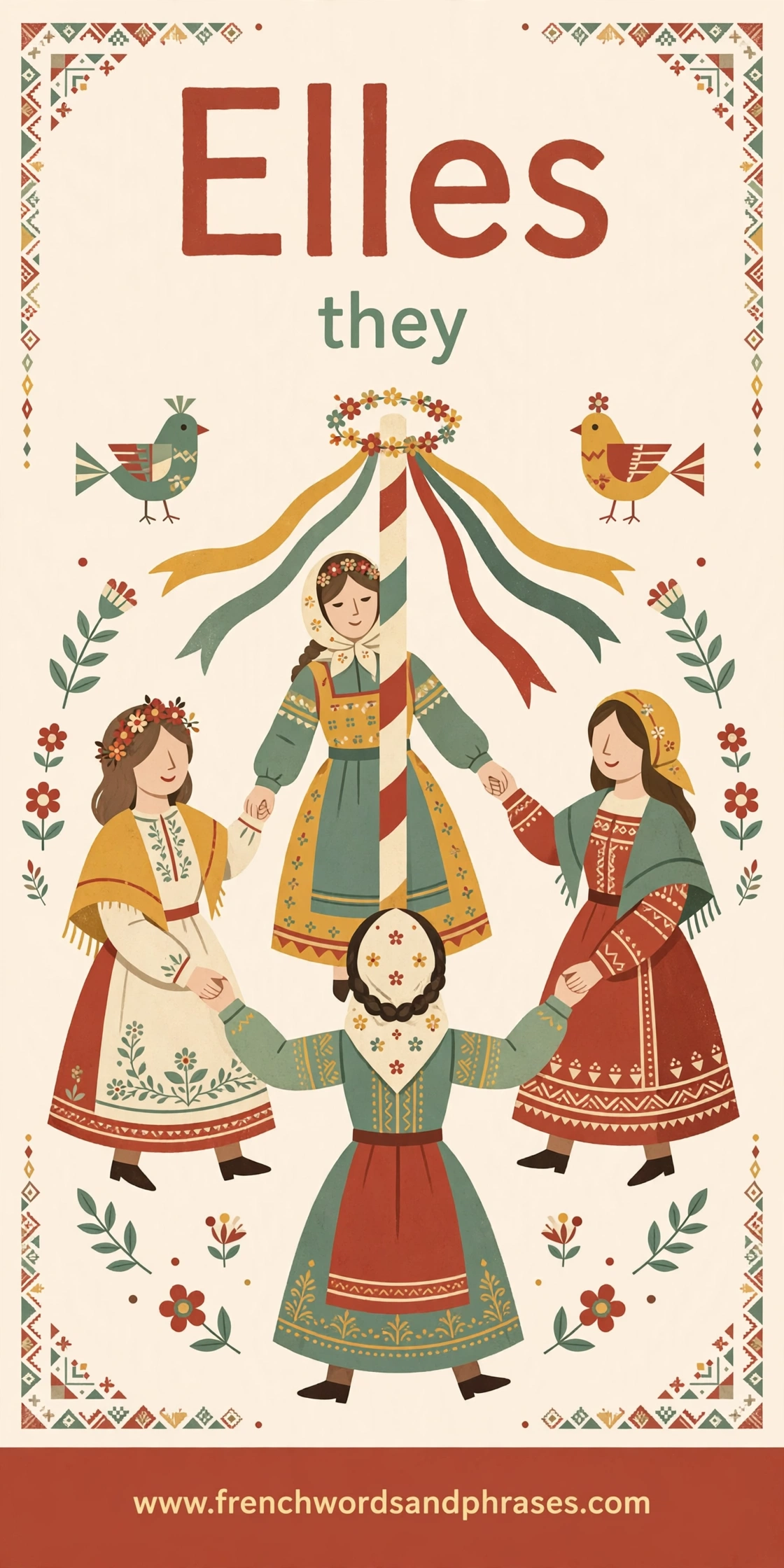
A French Word to Live By
Translate Elles to English
/ɛl/
Elles means they.
Six friends spill out of the little cinema into the evening, all of them laughing about the ending. « Elles ont adoré le film » — they loved the film. Elles is the French word for they when the whole group is female: sisters, friends, a team of women — one word that carries the whole group at once.
Let’s explore how elles works in French, beginning with the whole word on one card.
Understanding the French Pronoun Elles
Elles is a French subject pronoun — the feminine plural of the set je / tu / il / elle / nous / vous / ils / elles. It stands in for a group made entirely of women, girls, or feminine nouns, and it takes the verb in the third person plural.
It means they — but only the feminine they. The picture it paints is a group photograph with no men in it: three sisters at a table, a class of schoolgirls, the nurses on the ward. If the group is all female, French says elles; the moment a man joins, the group becomes ils.
Type: Subject pronoun — feminine plural (third person)
Answers the question: Qui ? — Who? (Answer: they, a group of women or feminine things)
What follows it: A verb in the third person plural: elles parlent, elles sont, elles ont
Watch the pair: elles (an all-female group) vs ils (all-male or mixed) — one man in the group and elles becomes ils
One important usage detail: elles also replaces feminine plural nouns, not just people — les tables sont vieilles, elles sont vieilles (the tables are old, they are old). In French, things have a gender too, and elles speaks for all of them.
Experience the Word
Elles is the pronoun of the all-female group — sisters on a train, friends at a café, a whole choir of women taking their seats.
Imagine four sisters meeting at the station with suitcases and flowers, hugging and talking over each other: elles arrivent, elles rient, elles racontent tout en même temps — they arrive, they laugh, they tell everything at once.
You have not just said ‘they’. You have told your listener exactly who is in the picture — women, every one of them.
How to Use Elles in French: Complete Guide
Let’s explore how elles works in French, beginning with the whole word on one card.
Elles at a Glance
The Whole Word on One Card
Meaning, job, pattern and pair — elles in four lines.
| Point | Elles |
|---|---|
| Meaning | they (feminine — an all-female group) |
| Job | subject pronoun — carries the action of the verb |
| What it stands for | a group of women, girls or feminine nouns already mentioned: les sœurs → elles |
| Its partner | ils — the same ‘they’ for men or for any mixed group |
Example
Elles arrivent demain matin.
They are arriving tomorrow morning.
The Pattern in Action: The Group Takes the Verb
Elles connects a sentence to a group that is already on the table — and quietly takes its place.
| Pattern | Example |
|---|---|
| a group of women acting | elles préparent le repas — they are preparing the meal |
| replacing a feminine noun | les fleurs sont belles, elles parfument la pièce — the flowers are beautiful, they scent the room |
| with être verbs | elles sont parties tôt — they left early (parties agrees, feminine plural) |
| asking about the group | elles viennent ? — are they coming? |
Example
Mes cousines habitent à Lyon ; elles viennent nous voir en été.
My cousins live in Lyon; they come to see us in summer.
Quick Quiz 1
Your group is two sisters and their brother. Do you say elles or ils?
Reveal the answer
ils — one man in the group is enough: French switches the whole group to ils.
Ils arrivent demain.
They are arriving tomorrow.
The Tricky Bit: One Man Changes Everything
Elles has one famous rule: the group must be entirely female, or the word gives way to ils.
| Situation | What happens |
|---|---|
| the rule | an all-female group takes elles; any man at all — even one among ten women — makes the group ils |
| the old saying | le masculin l’emporte — ‘the masculine wins’: mixed groups are grammatically masculine |
| agreement follows | with ils the adjectives go masculine: ils sont contents; with elles, feminine: elles sont contentes |
| things count too | a group of feminine nouns takes elles, but one masculine noun in the list brings ils |
Example
Anna, Léa et Paul sont arrivés — ils sont arrivés ensemble.
Anna, Léa and Paul arrived — they arrived together.
Where It Goes: First Place, Before the Verb
Elles simply takes the seat of the group it replaces — at the head of the sentence, glued to its verb.
| Position / pattern | Example |
|---|---|
| subject, before the verb | elles chantent — they are singing (French never drops its subject pronoun) |
| in questions, after the verb | viennent-elles ? — are they coming? (the pronoun flips behind the verb) |
| with two verbs | elles veulent partir — they want to leave (elles stays with the first verb) |
| after a preposition, stressed | chez elles, pour elles — at their place, for them (the stressed elles follows prepositions) |
Example
Elles veulent visiter le musée cet après-midi.
They want to visit the museum this afternoon.
Quick Quiz 2
Can you drop elles and just say parlent français for “they speak French”?
Reveal the answer
No — French keeps its subject pronouns; the sentence needs elles.
Elles parlent français.
They speak French.
Everyday Expressions with Elles
Elles turns up whenever French speakers talk about the women of the group — together, themselves, at home.
| Expression | In English |
|---|---|
| elles aussi | them too / they too |
| elles-mêmes | themselves (feminine) — elles l’ont fait elles-mêmes, they did it themselves |
| elles deux | the two of them (feminine) |
| chez elles | at their house / at their place (feminine group) |
Example
Elles ont préparé le gâteau elles-mêmes.
They made the cake themselves.
Close Cousins: Elles, Ils, Elle, On
Four look-alikes that people mix up — here is who does what.
| Word | The difference |
|---|---|
| ils | they for men or mixed groups — the twin of elles |
| elle | she — the singular of elles: one woman takes elle, several take elles |
| on | we / one / people in general — on parle français ici, French is spoken here |
| elles-mêmes | the stressed form: themselves, for emphasis or after prepositions |
Example
Elle chante, et elles chantent avec elle.
She sings, and they sing with her.
Quick Quiz 3
Which cousin means “she” — the singular of elles?
Reveal the answer
elle — one woman is elle; the group becomes elles.
Elle est là, et elles arrivent.
She is here, and they are arriving.
Elles and Its Neighbours
The subject shelf: the whole family of people-words, line by line.
| French | In English |
|---|---|
| je / tu | I / you (singular) |
| il / elle | he / she |
| nous / vous | we / you (plural or polite) |
| ils / elles | they (masculine or mixed / feminine) |
Example
Nous chantons, vous chantez, elles chantent le plus fort.
We sing, you sing, they sing the loudest.
Watch Out: The Traps Around Elles
The traps: the mixed group, the missing pronoun, and the object that needs another word.
| Trap | The truth |
|---|---|
| using elles for a mixed group | one man makes it ils: mes sœurs et mon frère → ils |
| dropping the pronoun | French verbs need their subject: elles parlent, never just ‘parlent’ |
| forgetting adjective agreement | elles sont fatiguées — the adjective takes the feminine plural -es |
| using elles as an object | as a direct object, ‘them’ is les: je les vois — I see them |
Example
Elles sont fatiguées après la longue marche.
They are tired after the long walk.
Quick Quiz 4
Complete: Elles ______ contentes. (They are happy.)
Reveal the answer
sont — elles takes the third person plural of être, and contentes agrees, feminine plural.
Elles sont contentes.
They are happy.
Elles in Everyday French: Real-Life Examples
Now that you know the word, let’s see how elles appears in everyday French.
Example Example 1 — Sisters
Elles se téléphonent tous les dimanches.
They phone each other every Sunday.
Example Example 2 — At the market
Elles choisissent les légumes les plus frais.
They choose the freshest vegetables.
Example Example 3 — Sport
Elles jouent au football le samedi matin.
They play football on Saturday mornings.
Example Example 4 — Travel
Elles sont parties en train à sept heures.
They left by train at seven o’clock.
Example Example 5 — Flowers
Ces fleurs sont magnifiques ; elles viennent du jardin.
These flowers are magnificent; they come from the garden.
Example Example 6 — Evening
Elles rient encore de la blague de leur père.
They are still laughing at their father’s joke.
Beyond Translation: The Meaning of Elles
English ‘they’ is a door that swings both ways — it tells you nothing about who stands behind it. French makes the group declare itself: elles is a they with only women in it, and the grammar remembers what English forgets.
To say elles is to describe the group, not just count it.
That is why a French speaker hears a photograph in the word: elles at a wedding, elles on the train — faces you can almost see, and every one of them female.
How to Remember the French Pronoun Elles
Remember it this way: Remember it this way: Elles is the all-female they — check the group before you choose, because a single man turns the whole group into ils.
- You scan the group — all women? Then elles; one man? Then ils.
- You keep the pronoun — French sentences never drop it: elles parlent, always.
- You agree around it — elles sont contentes, with feminine plural endings everywhere.
The key idea is elles means they for an all-female group — one man in the group switches it to ils, and adjectives around it go feminine plural.
Test Your Knowledge of Elles
Let’s see how much you’ve learned. Try answering these questions before revealing the answers.
Question 1
What does elles mean?
Reveal the answer
They — the subject pronoun for a group made entirely of women, girls or feminine nouns.
Question 2
Your group is five women and one man. Elles or ils?
Reveal the answer
Ils — a single man makes the whole group masculine: le masculin l’emporte.
Question 3
Translate: They are arriving by train.
Reveal the answer
Elles arrivent en train.
Question 4
Can elles replace things as well as people?
Reveal the answer
Yes — feminine plural nouns take elles too: les chaises sont là, elles sont là (the chairs are there).
Question 5
Complete the sentence:
Elles ______ prêtes. (They are ready.)
Reveal the answer
sont
Elles sont prêtes.
They are ready.
Your Final Challenge
Can You Use It?
How would you say this in French?
“How would you say this in French?”
Reveal the answer
Elles chantent ensemble dans la chorale du village.
They sing together in the village choir.
A little French. A little curiosity. A richer everyday life.
LEARN FRENCH ONE WORD AT A TIME