A French Word to Live By
Translate Ils to English
/il/
Ils means they.
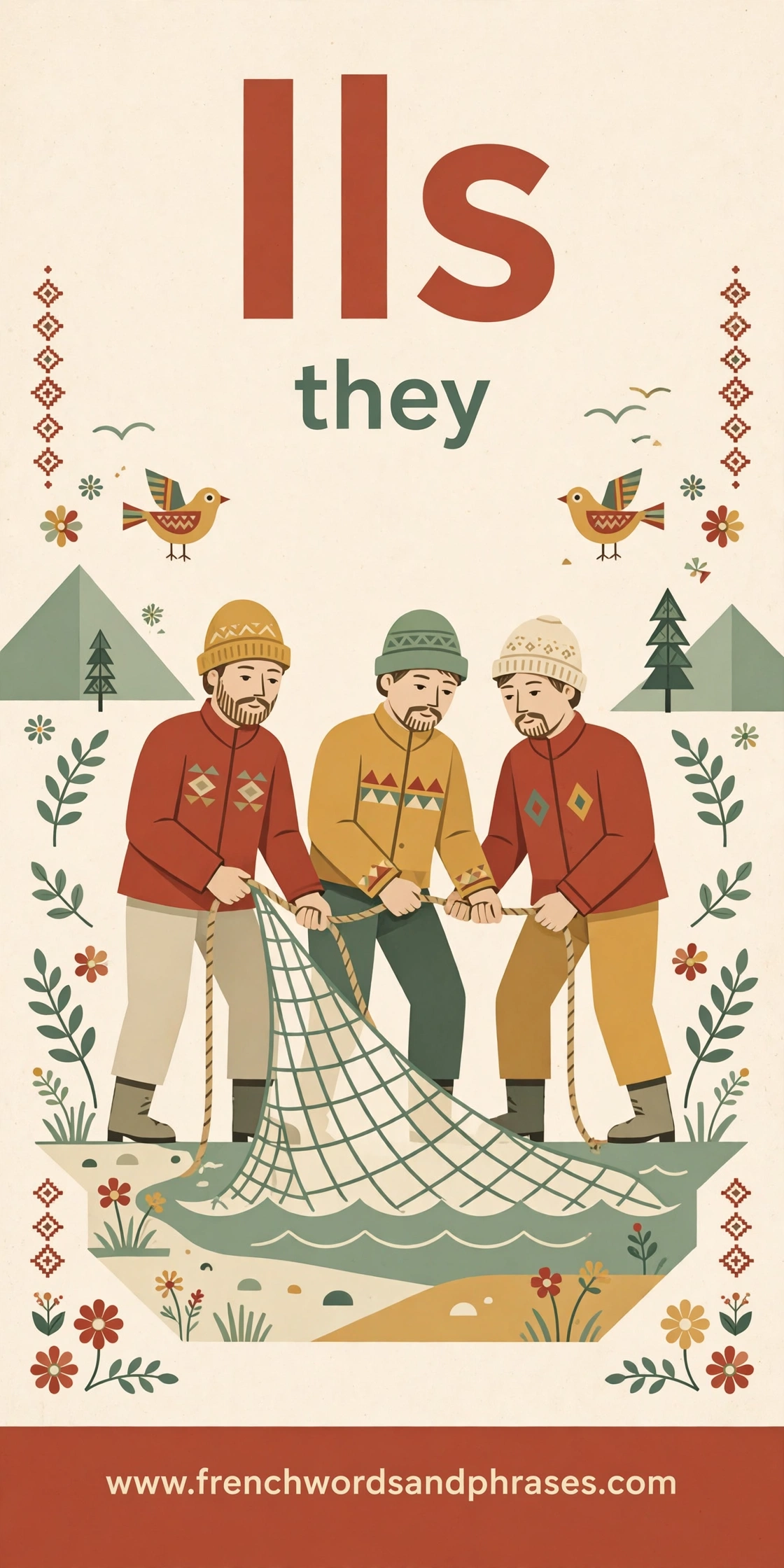
Two fishermen haul a net onto the deck in the grey light before sunrise, working in silence, side by side. « Ils partent en mer tous les matins » — they go out to sea every morning. Ils is the French subject pronoun for a group of men, a mixed group, or masculine nouns: they act together, and the verb turns plural behind them.
Let’s explore how ils works in French, beginning with the whole word on one card.
Understanding the French Pronoun Ils
Ils is a French subject pronoun — third person, masculine plural. It replaces two or more men, a mixed group of men and women, or masculine plural nouns, and it commands a plural verb.
It means they. The picture it paints is a team photograph: brothers, neighbours, sailors, or a shelf of masculine nouns — les livres sont becomes ils sont. One man among a hundred women still tips the whole group into ils: in French grammar, the masculine carries the group.
Type: Subject pronoun — masculine plural, third person
Answers the question: Qui ? — Who? (Answer: they, the group doing the action)
What follows it: A verb in the third person plural: ils parlent, ils ont, ils sont
Watch the pair: ils (masculine or mixed group) vs elles (a group of women or feminine nouns only)
One important usage detail: the s of ils is silent most of the time — ils parlent sounds like ‘il parl’. It wakes up only in a liaison, before a vowel: ils ont, ils arrivent, where you hear a soft z between the two words.
Experience the Word
Ils is the pronoun of the crew and the crowd — many people, one verb, moving together.
Imagine the village football team trotting onto a muddy pitch on a Sunday morning: ils courent, ils s’appellent, ils rient — they run, they call to each other, they laugh, eleven players under one small word.
You have not just counted a group. You have set it in motion — ils makes the whole team the subject of the sentence.
How to Use Ils in French: Complete Guide
Let’s explore how ils works in French, beginning with the whole word on one card.
Ils at a Glance
The Whole Word on One Card
Meaning, job, pattern and pair — ils in four lines.
| Point | Ils |
|---|---|
| Meaning | they |
| Job | subject pronoun — a group of men, a mixed group, or masculine nouns |
| What it stands for | les hommes, les enfants, les livres → ils: any plural group that is not all feminine |
| Its sound | /il/ — the s is silent, except in liaison before a vowel: ils ont |
Example
Ils travaillent dans les champs depuis l’aube.
They have been working in the fields since dawn.
The Pattern in Action: The Group Acts as One
Ils connects a plural verb to its group — men, mixed company, or masculine things standing together.
| Pattern | Example |
|---|---|
| a group of men | ils jouent aux cartes le dimanche — they play cards on Sundays |
| a mixed group | Paul et Marie sont arrivés, ils sont fatigués — Paul and Marie have arrived, they are tired |
| masculine things | les trains sont en retard, ils arrivent à midi — the trains are late, they arrive at noon |
| with avoir and être | ils ont un chien, ils sont voisins — they have a dog, they are neighbours |
Example
Ils construisent une cabane au fond du jardin.
They are building a hut at the bottom of the garden.
Quick Quiz 1
Marc and Sophie are arriving together. Which pronoun — ils or elles?
Reveal the answer
ils — a mixed group takes ils; elles is only for a group that is entirely feminine.
Ils arrivent ensemble.
They are arriving together.
The Tricky Bit: The Silent S That Wakes Before a Vowel
Ils is written with an s you almost never hear — except when the next word begins with a vowel.
| Situation | What happens |
|---|---|
| before a consonant, s is silent | ils parlent /il paʁl/, ils viennent /il vjɛn/ — no s sound at all |
| before a vowel, liaison wakes the s | ils ont /il.zɔ̃/, ils arrivent /il.za.ʁiv/ — the s sounds like a z |
| in writing, the s is always there | ils sont, ils font, ils disent — the plural s never leaves the page |
| the verb ending confirms the plural | ils parlent (with -ent, also silent) — spelling carries what the ear cannot |
Example
Ils ont un bateau et ils partent demain.
They have a boat and they are leaving tomorrow.
Where It Goes: First, Before the Verb
As a subject, ils leads the sentence; its stressed twin eux takes over after prepositions and for emphasis.
| Position / pattern | Example |
|---|---|
| subject, before the verb | ils lisent le journal — they read the newspaper |
| after a preposition (stressed: eux) | avec eux, chez eux, pour eux — with them, at their place, for them |
| for emphasis, doubled | eux, ils préfèrent le train — they, they prefer the train |
| c’est eux qui… | c’est eux qui ont gagné — they are the ones who won |
Example
C’est eux qui gardent la maison pendant les vacances.
They are the ones looking after the house during the holidays.
Quick Quiz 2
In ils arrivent, do you hear the s of ils?
Reveal the answer
Yes — before the vowel of arrivent, the s wakes up as a z sound: /il.za.ʁiv/.
Ils arrivent par le train de midi.
They are arriving on the midday train.
Everyday Expressions with Ils
Ils runs through reports, arrivals and the doings of every group in daily talk.
| Expression | In English |
|---|---|
| ils arrivent | they are coming / they are on their way |
| ils disent que… | they say that… |
| ils sont là | they are here |
| chez eux | at their place / to their place |
| eux aussi | them too / they too |
Example
Ils disent que la fête commence à huit heures.
They say the party starts at eight o’clock.
Close Cousins: Ils, Elles, Il, Eux
Four neighbours around a group — gender, number, and who carries the stress.
| Word | The difference |
|---|---|
| elles | the all-feminine plural: elles parlent — they speak (women, or feminine nouns) |
| il | the singular: il parle — he speaks; one man or one masculine noun |
| eux | the stressed form of ils: eux aussi, avec eux — after prepositions and for emphasis |
| ils | the subject for men, mixed groups and masculine nouns: ils parlent |
Example
Elles chantent et ils écoutent.
They (the women) sing and they (the men) listen.
Quick Quiz 3
Les tables sont dans la salle. Which pronoun replaces les tables — ils or elles?
Reveal the answer
elles — table is feminine, so its plural pronoun is elles.
Elles sont dans la salle.
They are in the room.
Ils and Its Neighbours
The subject shelf: the whole family, with ils in the masculine plural seat.
| French | In English |
|---|---|
| je / tu | I / you (familiar) |
| il / elle | he, it / she, it |
| nous / vous | we / you (formal or plural) |
| ils / elles | they (masculine or mixed) / they (feminine) |
| on | one / we (everyday) |
Example
Ils et elles partent en excursion demain.
They (the boys) and they (the girls) are going on a trip tomorrow.
Watch Out: The Traps Around Ils
The traps: the ever-present s, the all-feminine group, and feminine things in disguise.
| Trap | The truth |
|---|---|
| pronouncing the s everywhere | the s sleeps before consonants: ils parlent — it wakes only before a vowel: ils ont |
| using ils for an all-female group | women and girls together take elles: mes sœurs, elles voyagent |
| using ils for feminine things | les chaises, les portes, les idées all take elles: elles sont neuves |
| forgetting that one man changes everything | a mixed group, even mostly women, takes ils: un homme et dix femmes, ils arrivent |
Example
Les garçons sont prêts ; ils attendent devant l’école.
The boys are ready; they are waiting in front of the school.
Quick Quiz 4
Complete: Mes frères sont musiciens, ______ jouent de la guitare. (they play the guitar)
Reveal the answer
ils — the subject pronoun for a masculine plural group.
Mes frères sont musiciens, ils jouent de la guitare.
My brothers are musicians, they play the guitar.
Ils in Everyday French: Real-Life Examples
Now that you know the word, let’s see how ils appears in everyday French.
Example Example 1 — Morning
Ils se lèvent avant le soleil en été.
They get up before the sun in summer.
Example Example 2 — Work
Ils réparent le toit de la vieille grange.
They are repairing the roof of the old barn.
Example Example 3 — A mixed group
Ils ont décidé de partir plus tôt.
They decided to leave earlier.
Example Example 4 — Things
Les pains sont encore chauds, ils sortent du four.
The loaves are still warm, they have just come out of the oven.
Example Example 5 — Travel
Ils prennent le car pour aller en ville.
They take the coach to go into town.
Example Example 6 — Evening
Ils racontent des histoires autour du feu.
They tell stories around the fire.
Beyond Translation: The Meaning of Ils
English “they” asks no questions; French asks one every time — who exactly is in this group? Ils is the answer when a man is present, or when the nouns are masculine: a rule learners find stubborn, and French children absorb with their first stories.
To say ils is to muster the whole group under one banner — mixed company included.
And its silent s is a small lesson in French itself: written always, heard only when a vowel invites it out — ils parlent in a hush, ils ont in a link.
How to Remember the French Pronoun Ils
Remember it this way: Remember it this way: Ils is the team captain — if a single man or masculine noun joins the group, ils leads it.
- You check the group — all feminine takes elles; any man or mixed company takes ils.
- You keep the s silent — ils parlent sounds like ‘il parl’, until a vowel wakes it: ils ont.
- You switch to eux under stress — avec eux, chez eux, eux aussi.
The key idea is ils means they for men, mixed groups and masculine nouns — its s is silent except in liaison before a vowel, and elles is reserved for all-feminine groups.
Test Your Knowledge of Ils
Let’s see how much you’ve learned. Try answering these questions before revealing the answers.
Question 1
What does ils mean?
Reveal the answer
They — for a group of men, a mixed group, or masculine plural nouns.
Question 2
When do you use elles instead of ils?
Reveal the answer
When the group is entirely feminine — women, girls, or feminine nouns: elles parlent.
Question 3
Translate: They are building a house.
Reveal the answer
Ils construisent une maison.
Question 4
When can you hear the s of ils?
Reveal the answer
In liaison, before a vowel — ils ont, ils arrivent. Before a consonant it is silent: ils parlent.
Question 5
Complete the sentence:
______ sont arrivés à midi. (They arrived at noon — a mixed group.)
Reveal the answer
Ils
Ils sont arrivés à midi.
They arrived at noon.
Your Final Challenge
Can You Use It?
How would you say this in French?
“How would you say this in French?”
Reveal the answer
Ils jouent dans la cour.
They are playing in the courtyard.
A little French. A little curiosity. A richer everyday life.
LEARN FRENCH ONE WORD AT A TIME