A French Word to Live By
Translate Vous to English
/vu/
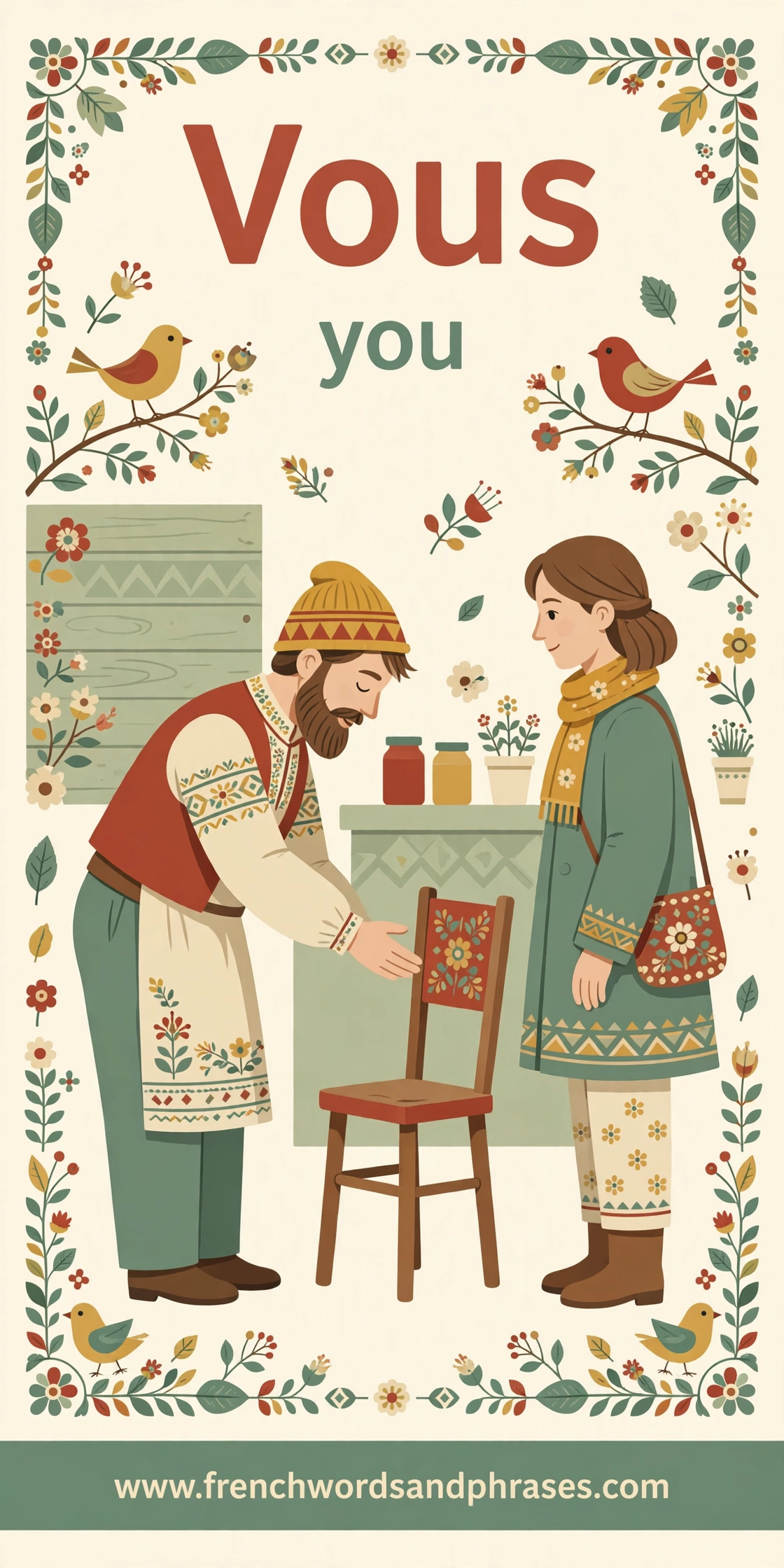
Vous means you.
At the door of a small hotel, the owner greets an arriving couple with a warm smile. « Vous avez fait bon voyage ? » — did you have a good journey? Vous is the French subject pronoun of respect and of numbers: one person you address formally, or any group you speak to — and its verb answers in -ez.
Let’s explore how vous works in French, beginning with the whole word on one card.
Understanding the French Pronoun Vous
Vous is a French subject pronoun — second person, used for the plural (two or more people) and for one person addressed formally. It always takes the same verb form, the -ez form, whoever stands in front of you.
It means you — all of you, or the one of you whom politeness keeps at arm’s length. The picture it paints is a slight bow built into grammar: vous to the doctor, the elder, the stranger; tu to the friend, the child, the dog.
Type: Subject pronoun — second person plural and formal singular
Answers the question: Qui ? — Who? (Answer: you — the one or ones being spoken to)
What follows it: A verb in -ez: vous parlez, vous chantez, vous finissez
Watch the pair: vous (formal or plural) vs tu (familiar singular) — vous parlez to a stranger, tu parles to a friend
One important usage detail: when vous speaks to ONE person, adjectives and past participles still describe that real person — a woman alone hears vous êtes arrivée, a man vous êtes arrivé. The verb keeps -ez; the ending of the participle tells the truth about who is there.
Experience the Word
Vous is the pronoun of the open hand and the straight back — it keeps a respectful distance while it speaks.
Imagine the mayor welcoming visitors to the village fête: vous êtes les bienvenus, vous allez voir, vous allez goûter — you are welcome, you will see, you will taste, one word embracing the whole square.
You have not just said ‘you’. You have chosen your distance — vous is politeness you can hear.
How to Use Vous in French: Complete Guide
Let’s explore how vous works in French, beginning with the whole word on one card.
Vous at a Glance
The Whole Word on One Card
Meaning, job, pattern and pair — vous in four lines.
| Point | Vous |
|---|---|
| Meaning | you |
| Job | subject pronoun — one person formally, or two or more people |
| What it stands for | a stranger, an elder, an official — or any group spoken to |
| Its signature ending | -ez on the verb: vous parlez, vous avez, vous êtes |
Example
Vous arrivez à quelle heure demain ?
What time are you arriving tomorrow?
The Pattern in Action: One Word, Two Audiences
Vous connects its verb to the listener — a single respected person or a whole room, with the same -ez shape.
| Pattern | Example |
|---|---|
| to one person, formally | vous avez raison, madame — you are right, madame |
| to a group | vous venez tous avec nous ? — are you all coming with us? |
| with avoir and être | vous avez le temps, vous êtes en avance — you have time, you are early |
| giving an instruction politely | vous tournez à gauche, puis vous continuez — turn left, then carry on |
Example
Vous trouverez la gare au bout de la rue.
You will find the station at the end of the street.
Quick Quiz 1
Which ending belongs to vous — parles or parlez?
Reveal the answer
parlez — vous always takes the -ez form.
Vous parlez très bien français.
You speak French very well.
The Tricky Bit: The Politeness Rules
Vous is a social instrument — choosing it (or refusing it) says something before the sentence even starts.
| Situation | How it works |
|---|---|
| strangers, officials, elders | vous is the safe default: vous désirez ? — what would you like? |
| any group of two or more | vous covers them all, friends included: vous venez, les enfants ? |
| friends, family, children, animals | tu is the warm form — vous to a close friend sounds like a joke or a reproach |
| switching to tu | it is offered, not taken: on peut se tutoyer ? — shall we use tu? |
Example
Vous permettez que je m’asseye ici ?
May I sit here? (formal, to a stranger)
Where It Goes: Before the Verb — and Around It
Subject vous leads the verb; the same word returns as object, reflexive and stressed pronoun.
| Position / pattern | Example |
|---|---|
| subject, before the verb | vous lisez le menu — you read the menu |
| object, before the verb | je vous écoute — I am listening to you |
| reflexive | vous vous levez tôt — you get up early |
| stressed, after prepositions | chez vous, pour vous, avec vous — at your place, for you, with you |
Example
Je vous attends devant la porte.
I am waiting for you in front of the door.
Quick Quiz 2
You meet your friend’s grandmother for the first time. Tu or vous?
Reveal the answer
vous — elders and new acquaintances get vous until they offer tu.
Vous êtes la grand-mère de Paul ?
Are you Paul’s grandmother?
Everyday Expressions with Vous
Vous fills the phrases of welcome, service and polite daily life.
| Expression | In English |
|---|---|
| vous désirez ? | what would you like? (in a shop) |
| je vous en prie | you are welcome / please, go ahead |
| vous avez raison | you are right |
| chez vous | at your place |
| vous-même / vous-mêmes | yourself / yourselves |
Example
Je vous en prie, entrez.
Please, come in.
Close Cousins: Vous, Tu, Votre, On
Four neighbours around ‘you’ — distance, number, and who owns what.
| Word | The difference |
|---|---|
| tu | the familiar singular: tu parles — friends, family, children; one person, no distance |
| votre / vos | the determiners ‘your’: votre nom, vos clés — they stand before nouns, vous before verbs |
| le vôtre | the pronoun ‘yours’, standing alone: le vôtre est prêt — yours is ready |
| vous | the subject: vous parlez — formal for one, natural for any group |
Example
Votre chambre est prête ; vous montez ?
Your room is ready; are you going up?
Quick Quiz 3
Two old friends meet. Does one say vous venez or tu viens to the other?
Reveal the answer
tu viens — between close friends, tu is the warm form; vous is for one stranger or any group.
Tu viens à la fête samedi ?
Are you coming to the party on Saturday?
Vous and Its Neighbours
The subject shelf: the whole family, with vous in the second person seat of honour.
| French | In English |
|---|---|
| je / tu | I / you (familiar) |
| il / elle | he, it / she, it |
| nous / vous | we / you (formal or plural) |
| ils / elles | they (masculine or mixed) / they (feminine) |
| on | one / we (everyday) |
Example
Vous et nous, nous préparons la fête ensemble.
You and we, we are preparing the party together.
Watch Out: The Traps Around Vous
The traps: tu too soon, the wrong verb ending, and forgetting the group.
| Trap | The truth |
|---|---|
| using tu with a stranger or official | vous is the safe start: vous pouvez répéter ? — tu can offend where vous never does |
| giving vous the tu ending | vous takes -ez: vous parlez, vous finissez — ‘vous parles’ mixes two worlds |
| forgetting vous for two people | two friends together are vous, even if each alone is tu: vous partez quand, tous les deux ? |
| missing the agreement clue | vous êtes arrivé (one man), arrivée (one woman), arrivés (a group) — the participle tells who vous is |
Example
Vous êtes arrivée en avance, madame.
You have arrived early, madame. (vous = one woman)
Quick Quiz 4
Complete: ______ êtes prêts ? (Are you ready? — to a group)
Reveal the answer
Vous — êtes is the vous form of être.
Vous êtes prêts ?
Are you ready?
Vous in Everyday French: Real-Life Examples
Now that you know the word, let’s see how vous appears in everyday French.
Example Example 1 — At a hotel
Vous restez combien de nuits ?
How many nights are you staying?
Example Example 2 — Directions
Vous tournez à droite après le pont.
You turn right after the bridge.
Example Example 3 — A group
Vous apportez le dessert, d’accord ?
You are bringing the dessert, all right?
Example Example 4 — Polite talk
Vous habitez dans le quartier ?
Do you live in the neighbourhood?
Example Example 5 — Service
Vous payez par carte ou en espèces ?
Are you paying by card or in cash?
Example Example 6 — An invitation
Vous venez dîner à la maison samedi ?
Are you coming to dinner at our place on Saturday?
Beyond Translation: The Meaning of Vous
English flattened its pronouns centuries ago and lost the polite “you” — French kept the choice alive. Vous is grammar with manners: it measures the space between two people and holds it, respectfully, until they agree to close it with tu.
To say vous is to bow a little with every sentence — distance, offered as respect.
And when the room fills, the same word opens its arms: vous for the elder alone, vous for the whole village — one pronoun for respect and for crowds.
How to Remember the French Pronoun Vous
Remember it this way: Remember it this way: Vous is the pronoun with good manners — one stranger or a whole crowd, and its verb always ends in -ez.
- You start with vous — strangers, elders, officials: vous is safe everywhere, tu is earned.
- You listen for -ez — vous parlez, vous avez, vous êtes: the ending is the signature of vous.
- You count the room — two people or twenty, a group is always vous, even between friends.
The key idea is vous means you for one person formally and for any group, and it always takes the -ez verb form — tu is the familiar singular.
Test Your Knowledge of Vous
Let’s see how much you’ve learned. Try answering these questions before revealing the answers.
Question 1
What does vous mean?
Reveal the answer
You — speaking formally to one person, or to two or more people.
Question 2
What verb ending goes with vous?
Reveal the answer
-ez — vous parlez, vous finissez, vous attendez (vous avez, vous êtes for avoir and être).
Question 3
Translate: You are very kind. (formal, to one person)
Reveal the answer
Vous êtes très gentil. (to a man) — Vous êtes très gentille. (to a woman)
Question 4
When do you use tu instead of vous?
Reveal the answer
With friends, family, children and people you know well — tu is the familiar singular; vous keeps a polite distance.
Question 5
Complete the sentence:
______ venez d’où ? (Where do you come from? — polite)
Reveal the answer
Vous
Vous venez d’où ?
Where do you come from?
Your Final Challenge
Can You Use It?
How would you say this in French?
“How would you say this in French?”
Reveal the answer
Vous avez le plan de la ville ?
Do you have the map of the town?
A little French. A little curiosity. A richer everyday life.
LEARN FRENCH ONE WORD AT A TIME