A French Word to Live By
Translate Nous to English
/nu/
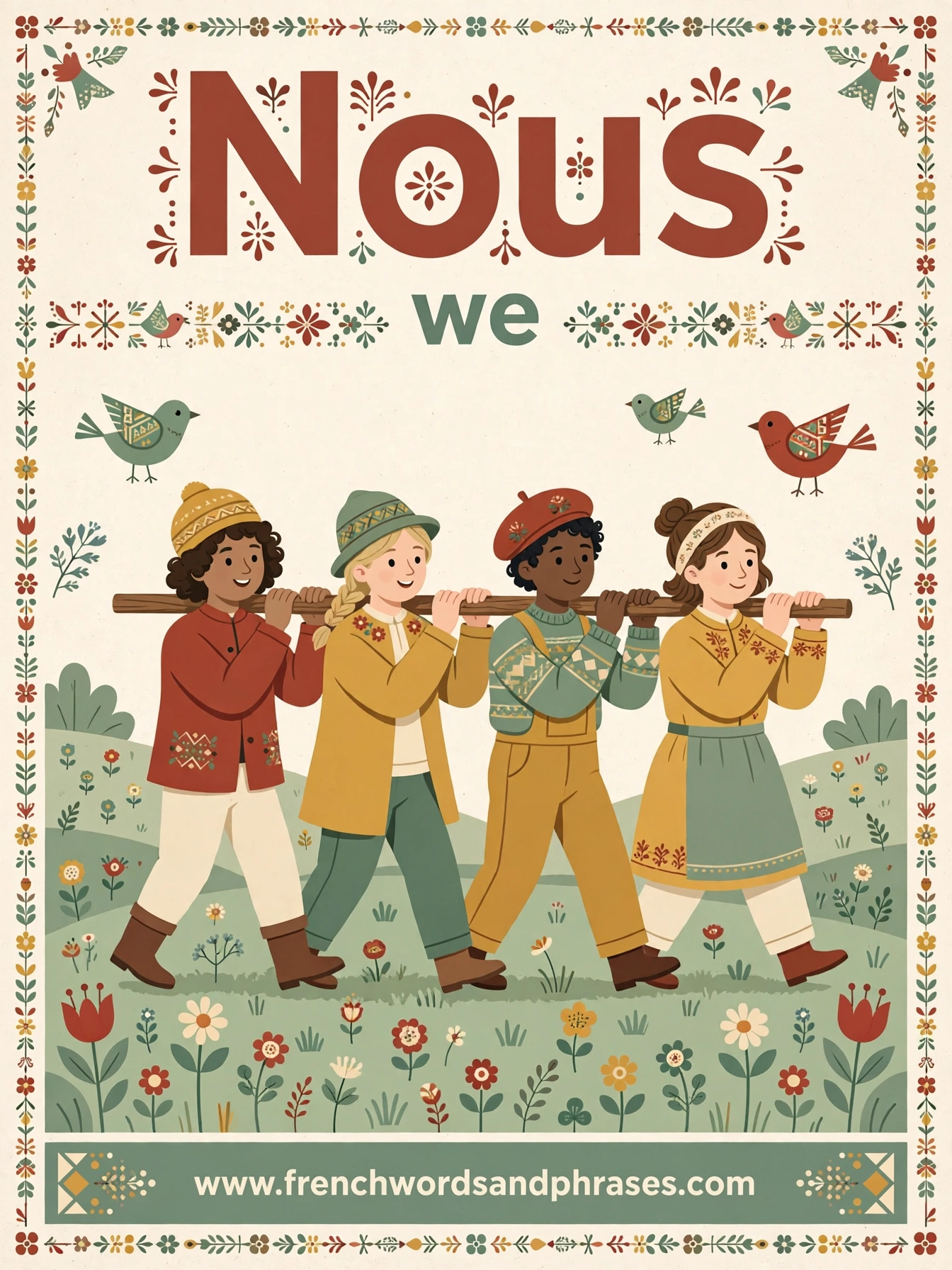
Nous means we.
A group of friends spreads a map across a café table, tracing a route along the coast with one finger. « Nous partons vendredi matin » — we are leaving on Friday morning. Nous is the French subject pronoun for a group that includes the speaker: we plan, we go, we decide together.
Let’s explore how nous works in French, beginning with the whole word on one card.
Understanding the French Pronoun Nous
Nous is a French subject pronoun — first person plural. It replaces the speaker plus at least one other person, and it commands a verb ending all of its own: the famous -ons.
It means we. The picture it paints is a circle with the speaker inside it: moi et toi, moi et vous — the moment a group speaks as one, nous takes the floor. In careful French it is the only word for the job; in everyday speech it shares the stage with on.
Type: Subject pronoun — first person plural
Answers the question: Qui ? — Who? (Answer: we, the speaker and company)
What follows it: A verb in -ons: nous parlons, nous mangeons, nous finissons
Watch the pair: nous (subject: nous parlons) vs nous (object or reflexive: il nous voit, nous nous levons)
One important usage detail: spoken French often replaces nous with on — on part demain sounds like everyday talk, while nous partons is the written, careful form. The verb gives it away: on takes the il/elle form (on parle), nous takes -ons (nous parlons).
Experience the Word
Nous is the pronoun of togetherness — the speaker steps into a group and the group answers with one voice.
Imagine a village choir rehearsing on a Thursday evening: nous chantons, nous respirons, nous recommençons — we sing, we breathe, we start again, thirty people breathing as one.
You have not just named a group. You have joined it — nous always includes the person speaking.
How to Use Nous in French: Complete Guide
Let’s explore how nous works in French, beginning with the whole word on one card.
Nous at a Glance
The Whole Word on One Card
Meaning, job, pattern and pair — nous in four lines.
| Point | Nous |
|---|---|
| Meaning | we |
| Job | subject pronoun — the speaker plus at least one other person |
| What it stands for | moi + toi, moi + lui, moi + vous: any group with me inside it |
| Its signature ending | -ons on the verb: nous parlons, nous avons, nous sommes |
Example
Nous habitons dans une rue calme.
We live on a quiet street.
The Pattern in Action: The Group Speaks as One
Nous connects the group to its verb — and the verb answers with -ons, avoir or être in their plural shapes.
| Pattern | Example |
|---|---|
| an -er verb | nous regardons le ciel — we are watching the sky |
| an -ir or -re verb | nous finissons le travail, nous attendons le bus — we finish the work, we wait for the bus |
| with avoir and être | nous avons faim, nous sommes prêts — we are hungry, we are ready |
| in the past | nous avons mangé, nous sommes partis — we ate, we left |
Example
Nous préparons le dîner ensemble ce soir.
We are preparing dinner together this evening.
Quick Quiz 1
Which verb ending belongs to nous — -ez or -ons?
Reveal the answer
-ons — nous parlons, nous chantons, nous dansons.
Nous chantons dans la chorale.
We sing in the choir.
The Tricky Bit: Nous or On?
French has two ways to say ‘we’ — nous, the full formal form, and on, the everyday favourite borrowed from ‘one’.
| Word | How it works |
|---|---|
| nous + -ons | the complete, careful form: nous partons demain — writing, speeches, polite speech |
| on + il/elle verb form | the everyday form: on part demain — same meaning, lighter feel |
| on is everywhere in speech | on va au cinéma ? — shall we go to the cinema? (friends talking) |
| the verb betrays the choice | on parle (third person) vs nous parlons (first plural) — never ‘on parlons’ |
Example
Nous écrivons la lettre, et ce soir on la poste.
We are writing the letter, and this evening we will post it.
Where It Goes: Before the Verb — and Everywhere Else
Subject nous leads the verb, but the same word returns as object, reflexive and stressed pronoun.
| Position / pattern | Example |
|---|---|
| subject, before the verb | nous lisons le journal — we read the newspaper |
| object, before the verb | il nous écoute — he listens to us |
| reflexive | nous nous levons tôt — we get up early |
| stressed, after prepositions | chez nous, avec nous, pour nous — at our place, with us, for us |
Example
Vous pouvez venir chez nous samedi.
You can come to our place on Saturday.
Quick Quiz 2
“We are leaving” in relaxed spoken French — nous partons or on part?
Reveal the answer
on part — everyday speech prefers on; nous partons is the careful written form.
On part dans cinq minutes.
We are leaving in five minutes.
Everyday Expressions with Nous
Nous fills the phrases of shared plans, invitations and arrivals.
| Expression | In English |
|---|---|
| nous voici | here we are |
| chez nous | at our place / at home |
| nous aussi | us too / we too |
| entre nous | between us |
| nous-mêmes | ourselves |
Example
Nous voici enfin à la maison.
Here we are at home at last.
Close Cousins: Nous, On, Vous, Je
Four neighbours on the subject shelf — who is inside the group, and how the verb answers.
| Word | The difference |
|---|---|
| on | everyday ‘we’ with an il/elle verb: on mange — we eat (also ‘one/people’ in general) |
| vous | you (formal or plural) with -ez: vous parlez — the group spoken TO, not speaking |
| je | the singular of nous: je parle — I speak; add others and je becomes nous |
| nous | we with -ons: nous parlons — the group that includes the speaker |
Example
Je propose une pause, et nous décidons ensemble.
I suggest a break, and we decide together.
Quick Quiz 3
Is on parlons correct?
Reveal the answer
No — on takes the il/elle form: on parle. The -ons ending belongs to nous alone.
On parle français ici.
We speak French here.
Nous and Its Neighbours
The subject shelf: the whole family, with nous in the first person plural seat.
| French | In English |
|---|---|
| je / tu | I / you (familiar) |
| il / elle | he, it / she, it |
| nous / vous | we / you (formal or plural) |
| ils / elles | they (masculine or mixed) / they (feminine) |
| on | one / we (everyday) |
Example
Nous et eux, nous formons une bonne équipe.
We and they, we make a good team.
Watch Out: The Traps Around Nous
The traps: the missing -ons, on with the wrong verb, and dropping the subject altogether.
| Trap | The truth |
|---|---|
| saying ‘on parlons’ | on never takes -ons: on parle; nous takes -ons: nous parlons |
| using the je form after nous | the verb must match: nous sommes, nous avons — not ‘nous je suis’ patterns |
| dropping nous before the verb | French needs its subject: nous mangeons — never bare ‘mangeons’ for ‘we eat’ in a statement |
| confusing subject nous with object nous | nous le voyons (we see him) vs il nous voit (he sees us) — position before the verb, meaning from the sentence |
Example
Nous nous retrouvons devant la mairie à midi.
We are meeting in front of the town hall at noon.
Quick Quiz 4
Complete: ______ sommes en retard. (We are late.)
Reveal the answer
Nous — sommes is the nous form of être.
Nous sommes en retard.
We are late.
Nous in Everyday French: Real-Life Examples
Now that you know the word, let’s see how nous appears in everyday French.
Example Example 1 — Plans
Nous partons en vacances la semaine prochaine.
We are going on holiday next week.
Example Example 2 — At home
Nous regardons un film après le dîner.
We watch a film after dinner.
Example Example 3 — Work
Nous commençons la réunion à neuf heures.
We start the meeting at nine o’clock.
Example Example 4 — Weather talk
Nous avons froid sans nos manteaux.
We are cold without our coats.
Example Example 5 — Travel
Nous prenons le train de huit heures.
We are taking the eight o’clock train.
Example Example 6 — An invitation
Nous vous invitons à dîner dimanche.
We invite you to dinner on Sunday.
Beyond Translation: The Meaning of Nous
English “we” is one flat word; French gives the group two voices. Nous is the full-dress form — the we of letters, speeches and careful conversation, with its proud -ons ending marching behind it.
To say nous is to speak for the group in full — speaker included, verb in step.
And its shadow, on, whispers the same thing in the café and the kitchen — French keeps both, one for the page and one for the street.
How to Remember the French Pronoun Nous
Remember it this way: Remember it this way: Nous is the group with you inside it — and it always marches with -ons.
- You listen for the ending — nous parlons, nous finissons, nous attendons: -ons is the sound of nous.
- You save on for the street — on part, on mange, with the small il/elle verb form.
- You never mix the pair — it is nous parlons or on parle, never ‘on parlons’.
The key idea is nous means we and commands the -ons ending; everyday speech often swaps it for on with the il/elle verb form.
Test Your Knowledge of Nous
Let’s see how much you’ve learned. Try answering these questions before revealing the answers.
Question 1
What does nous mean?
Reveal the answer
We — the speaker plus at least one other person.
Question 2
What verb ending goes with nous?
Reveal the answer
-ons — nous parlons, nous mangeons, nous finissons (with nous sommes and nous avons for être and avoir).
Question 3
Translate: We are waiting for the bus.
Reveal the answer
Nous attendons le bus.
Question 4
What is the everyday spoken alternative to nous?
Reveal the answer
On — on attend le bus, with the verb in the il/elle form, not -ons.
Question 5
Complete the sentence:
______ avons deux enfants. (We have two children.)
Reveal the answer
Nous
Nous avons deux enfants.
We have two children.
Your Final Challenge
Can You Use It?
How would you say this in French?
“How would you say this in French?”
Reveal the answer
Nous chantons une vieille chanson.
We are singing an old song.
A little French. A little curiosity. A richer everyday life.
LEARN FRENCH ONE WORD AT A TIME