A French Word to Live By
Translate Une to English
/yn/
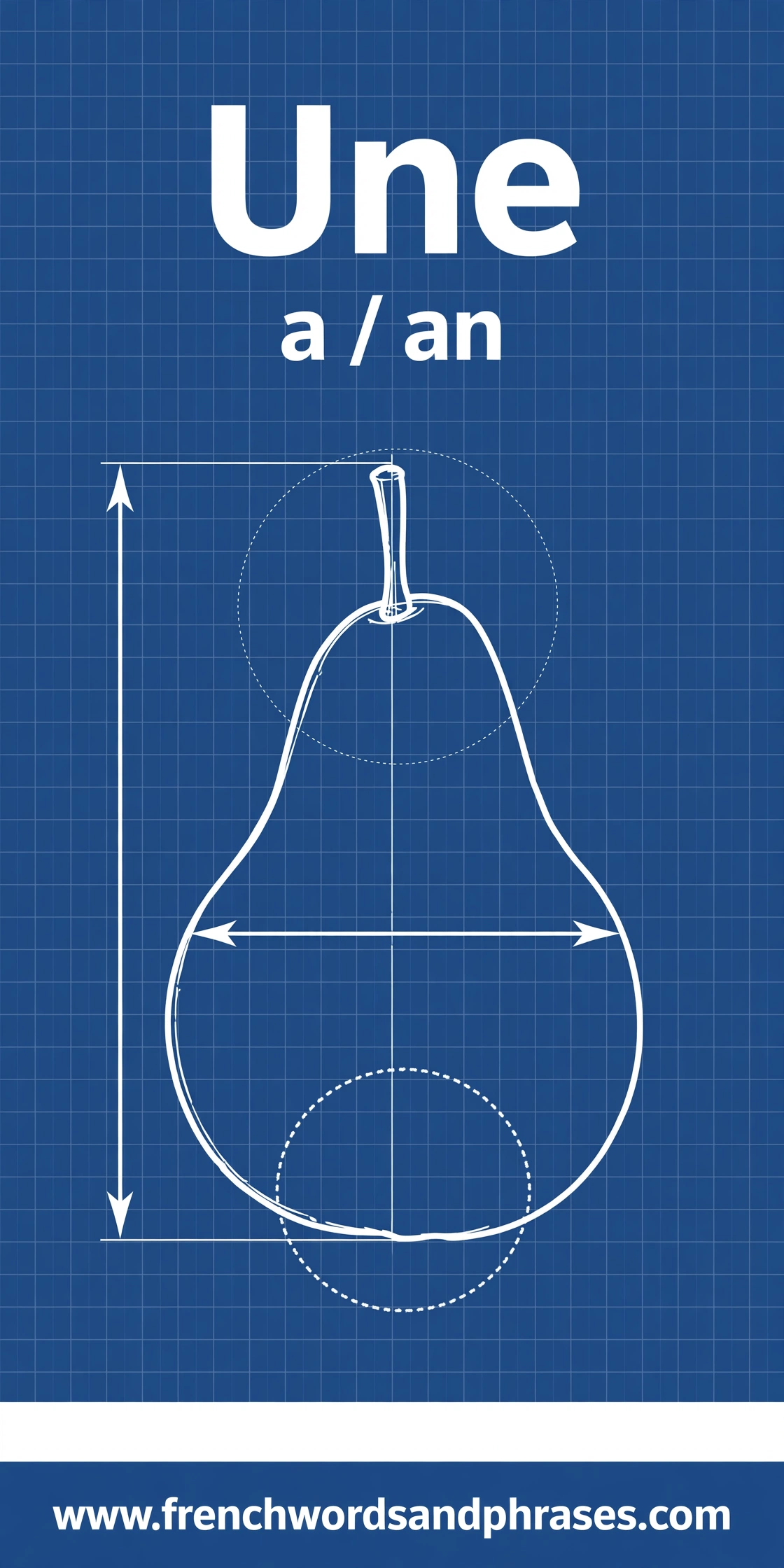
Une means a / an.
A swallow cuts across the evening sky above the rooftops. « Une hirondelle ne fait pas le printemps » — one swallow does not make a spring, says the old proverb. Une is the feminine twin of un: the French word for a single, new thing — a letter, a house, an idea never mentioned before.
Let’s explore how une works in French, beginning with the whole word on one card.
Understanding the French Determiner Une
Une is a French indefinite article — the feminine singular form of ‘a’ or ‘an’. It stands in front of a noun and announces that the thing is new to the conversation: one of them, not yet identified.
It means a or an. The picture it paints is a door opening: une femme entre (a woman comes in) — we have never met her before, and une introduces her. English ‘a’ changes to ‘an’ before a vowel; French une never changes at all — une amie, une école, the n simply links the two words in speech.
Type: Indefinite article — feminine singular
Answers the question: Combien ? — How many? (Answer: one, newly mentioned)
What follows it: A feminine singular countable noun: une pomme, une maison, une idée
Watch the pair: une (a, unspecified) vs la (the, specific) — une pomme = an apple, la pomme = the apple
One important usage detail: in a negative sentence, une vanishes into de — elle n’a pas de sœur (she does not have a sister), il n’y a pas de problème. The same happens to un and des: pas de is the shadow of all three.
Experience the Word
Une is the article of first meetings — a stranger, a new idea, a thing the listener has never heard of before.
Imagine a storyteller beginning a tale by the fire: il était une fois une reine, une forêt, une rivière — once upon a time there was a queen, a forest, a river; everything is new, and une opens each door.
You have not just counted a thing. You have introduced it: here is one, it exists, now we can talk about it.
How to Use Une in French: Complete Guide
Let’s explore how une works in French, beginning with the whole word on one card.
Une at a Glance
The Whole Word on One Card
Meaning, job, family and signal — une in four lines.
| Point | Une |
|---|---|
| Meaning | a / an |
| Job | indefinite article — introduces a new, unspecified noun |
| The family | une (fem. sg.), un (masc. sg.), des (plural) |
| What it signals | one of them, mentioned for the first time — not yet identified |
Example
Une étoile brille au-dessus de la colline.
A star is shining above the hill.
The Pattern in Action: Something New Walks In
Une connects a noun to the listener’s curiosity — something new, something single, something about to matter.
| Pattern | Example |
|---|---|
| introducing a new thing | il y a une lettre pour toi — there is a letter for you (first mention) |
| one single one | une seule fois suffit — one single time is enough |
| a certain person | une femme m’a demandé l’heure — a woman asked me the time (one particular, unnamed) |
| in stories | il était une fois une reine — once upon a time there was a queen |
Example
Une inconnue m’a souri dans le train.
A stranger smiled at me on the train.
Quick Quiz 1
In il y a une lettre pour toi, do we already know this letter?
Reveal the answer
No — une introduces it for the first time; it is a new one, just arrived.
Il y a une lettre pour toi.
There is a letter for you.
The Tricky Bit: When Une Disappears — and When It Refuses To
Une vanishes in negatives like its brothers — but unlike le and la, it never melts into the next word.
| Situation | What happens |
|---|---|
| in a negative, une becomes de | elle n’a pas de sœur — she does not have a sister |
| professions take no article | elle est médecin — she is a doctor; elle est actrice — she is an actress |
| but c’est brings une back | c’est une actrice très connue — she is a very well-known actress (an adjective also brings it back) |
| no elision before a vowel | une amie, une école — une stays whole; the n links in speech, never ‘un amie’ |
Example
Elle est actrice, et c’est une actrice très connue.
She is an actress, and she is a very well-known actress.
Where It Goes: Stuck to the Front of the Noun
Une stands at the very front of its noun phrase: article first, then any adjective, then the noun.
| Position / pattern | Example |
|---|---|
| directly before the noun | une pomme, une maison, une idée — the article leads, the noun follows |
| before an adjective + noun | une petite maison, une grande idée — une still stands first |
| agreement in gender | feminine takes une; masculine takes un: une sœur, un frère |
| after il y a and c’est | il y a une question, c’est une surprise — une introduces what exists |
Example
Une vieille église se dresse sur la colline.
An old church stands on the hill.
Quick Quiz 2
“She is a doctor” — elle est une médecin or elle est médecin?
Reveal the answer
elle est médecin — after être, a profession takes no article.
Elle est médecin.
She is a doctor.
Everyday Expressions with Une
Une measures out the small change of daily life — once, an hour, an idea, a lucky chance.
| Expression | In English |
|---|---|
| une fois | once / one time |
| une heure | one o’clock — and also ‘an hour’ |
| une idée | an idea — avoir une idée, to have an idea |
| une question | a question — poser une question, to ask a question |
| une chance | a chance / luck — quelle chance ! what luck! |
Example
Une fois, j’ai vu la mer en hiver.
Once, I saw the sea in winter.
Close Cousins: Une, La, De la
Three small words before a feminine noun — the difference is how well you know the thing, and whether you can count it.
| Word | The difference |
|---|---|
| une | a / an — one of many, not yet identified: une pomme (an apple, any apple) |
| la | the — a specific, known thing: la pomme sur la table (the apple on the table) |
| de la | some — an uncountable amount: de la soupe (some soup, a portion of it) |
| un / des | the same ‘a’ in other shapes: un (masculine singular), des (plural) |
Example
Je voudrais une pomme, la plus rouge.
I would like an apple, the reddest one.
Quick Quiz 3
Which cousin means “the” — une or la?
Reveal the answer
la — la points to a known thing; une introduces a new one.
La pomme est sur la table.
The apple is on the table.
Une and Its Neighbours
The article shelf: the indefinites on one side, the definites and partitives on the other.
| French | In English |
|---|---|
| une | a / an (feminine singular) |
| un | a / an (masculine singular) |
| des | some (plural) |
| la / le / les | the (definite) |
| de la / du | some (partitive, uncountable) |
Example
Une femme, un enfant et des amis arrivent à la fête.
A woman, a child and some friends are arriving at the party.
Watch Out: The Traps Around Une
The traps: an une where French drops it, an elision French never makes, and a missing de where French demands it.
| Trap | The truth |
|---|---|
| adding une before a profession | French drops it: elle est médecin, elle est actrice — the article returns only with c’est or an adjective |
| keeping une in a negative | absence takes de: elle n’a pas de voiture — never ‘pas une voiture’ for ‘no car’ |
| eliding une before a vowel | une never elides: une école, une amie — the n simply links the words in speech |
| using une for uncountable ‘some’ | soup and jam take de la: de la soupe, de la confiture — une soupe means one whole bowl, ordered as a dish |
Example
Elle n’a pas de voiture, mais elle a une bicyclette.
She does not have a car, but she has a bicycle.
Quick Quiz 4
Complete: Elle n’a pas ______ sœur. (She does not have a sister.)
Reveal the answer
de — in a negative, une becomes de.
Elle n’a pas de sœur.
She does not have a sister.
Une in Everyday French: Real-Life Examples
Now that you know the word, let’s see how une appears in everyday French.
Example Example 1 — On the table
Une pomme et une poire sont sur la table.
An apple and a pear are on the table.
Example Example 2 — A letter
Une lettre t’attend dans la boîte aux lettres.
A letter is waiting for you in the letterbox.
Example Example 3 — Neighbours
Une nouvelle voisine habite en face.
A new neighbour lives opposite.
Example Example 4 — Music
Une chanson douce passe à la radio.
A gentle song is playing on the radio.
Example Example 5 — Tea time
Je voudrais une tasse de thé, s’il vous plaît.
I would like a cup of tea, please.
Example Example 6 — Night sky
Une étoile filante traverse le ciel.
A shooting star crosses the sky.
Beyond Translation: The Meaning of Une
English “a” becomes “an” before a vowel and otherwise minds its own business; French une does something more revealing — it announces the gender of everything new before the noun even arrives. Every first meeting in French begins with a small act of classification.
To say une is to open a door: here is one, she is new, now we can talk about her.
That is why tales begin with it — une reine, une forêt, une rivière — each new thing stepping forward with une in front of it, counted and introduced in a single breath.
How to Remember the French Determiner Une
Remember it this way: Remember it this way: Une is the knock on the door — it introduces one new feminine thing that nobody has mentioned yet.
- You ask have we met it? — if the thing is brand new and feminine, the word is une.
- You let it vanish in negatives — pas de sœur, pas de voiture, never pas une for simple absence.
- You never elide it — une amie, une école stay whole; the n only links in speech.
The key idea is une means a / an for a feminine singular noun — it becomes de in negatives, drops before professions, and never elides before a vowel.
Test Your Knowledge of Une
Let’s see how much you’ve learned. Try answering these questions before revealing the answers.
Question 1
What does une mean?
Reveal the answer
A / an — the indefinite article for a feminine singular noun.
Question 2
What are the three indefinite articles in French?
Reveal the answer
Un, une and des — un (masculine singular), une (feminine singular), des (plural).
Question 3
Translate: There is a house on the hill.
Reveal the answer
Il y a une maison sur la colline.
Question 4
What happens to une in a negative sentence?
Reveal the answer
It becomes de — elle n’a pas de sœur (she does not have a sister).
Question 5
Complete the sentence:
Il y a ______ pomme sur la table. (There is an apple on the table.)
Reveal the answer
une
Il y a une pomme sur la table.
There is an apple on the table.
Your Final Challenge
Can You Use It?
How would you say this in French?
“How would you say this in French?”
Reveal the answer
Elle a eu une idée brillante.
She had a brilliant idea.
A little French. A little curiosity. A richer everyday life.
LEARN FRENCH ONE WORD AT A TIME