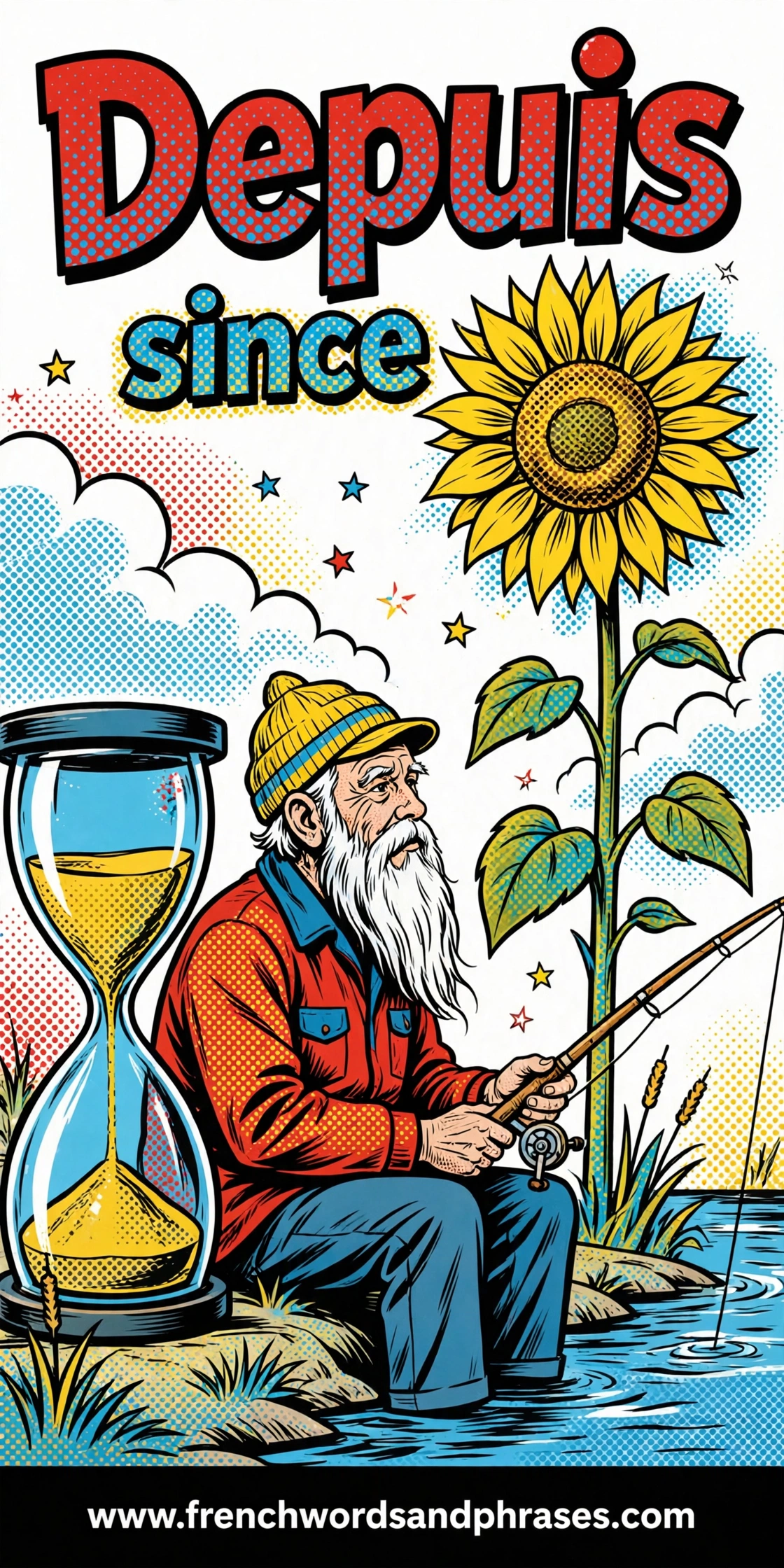
A French Word to Live By
Translate Depuis to English
/də.pɥi/
Depuis means since / for.
An old baker dusts his hands, looks out at the street he has known for forty years, and smiles. « Je travaille ici depuis 1985 » — I have worked here since 1985. Depuis is the French word for the starting line of time: since a moment, for a stretch that is still going on. It is the preposition that anchors an action to the moment it began — and tells you it has not stopped.
Let’s explore how depuis works in French, beginning with the whole word on one card.
Understanding the French Preposition Depuis
Depuis is a true French preposition of time — and, by extension, of place (from a point). Its home territory is duration: since when something started, or for how long an ongoing action has lasted. It is the number-one partner of the present tense in French.
It means since or for. The picture is a timeline with an arrow: an action starts at a point — Monday, 1985, a rainy morning — and the arrow runs on to now. For a completed stretch, French uses pendant (for) instead; depuis insists the action is still happening.
Type: Preposition — time (duration, ongoing) and place (starting point)
Answers the question: Depuis quand ? — Since when? (Answer: since that moment)
What follows it: A moment or duration: depuis lundi, depuis trois ans
Watch the pair: depuis (since, ongoing) vs pendant (for, finished stretch) vs il y a (ago)
One important usage detail: with depuis, French uses the PRESENT tense where English uses the present perfect — je travaille ici depuis 1985 means “I have worked here since 1985”. This is the single most common depuis mistake in English, and it catches everyone.
Experience the Word
Depuis is the preposition of the long view — the baker’s forty years, the couple’s fifty summers, the tree planted when you were small.
Imagine a friendship that began on a school bench in 1998: depuis ce jour-là, they have never stopped talking. The word carries the whole stretch in one breath.
You have not just said when something happened. You have tied the past to the present, and shown it is still alive.
How to Use Depuis in French: Complete Guide
Let’s explore how depuis works in French, beginning with the whole word on one card.
Depuis at a Glance
The Whole Word on One Card
Meaning, job, pattern and pair — depuis in four lines.
| Point | Depuis |
|---|---|
| Meaning | since / for (an action still going on) |
| Job | anchors an ongoing action to the moment it began |
| What follows | a moment (depuis lundi) or a duration (depuis trois ans) |
| Tense partner | the present — never the perfect in French |
Example
Elle habite à Lyon depuis 2010.
She has lived in Lyon since 2010.
The Pattern in Action: The Arrow That Runs to Now
Depuis opens a stretch of time that is still open — the action started, and it is still running.
| Pattern | Example |
|---|---|
| since a day | je suis malade depuis lundi — I have been ill since Monday |
| for a duration | nous attendons depuis deux heures — we have been waiting for two hours |
| since a moment | je ne l’ai pas vu depuis hier — I haven’t seen him since yesterday |
| with toujours | il pleut depuis ce matin, toujours — it has been raining since this morning, still |
Example
Nous sommes amis depuis l’école.
We have been friends since school.
Quick Quiz 1
“She has lived here since 2010” — which French tense: present or perfect?
Reveal the answer
The present — with depuis, French says elle habite ici depuis 2010.
J’habite ici depuis 2010.
I have lived here since 2010.
The Tricky Bit: Depuis + Present — and Its Three Rivals
The signature difficulty is the tense: English needs the perfect (‘have lived’), French needs the present. And depuis’s rivals split the time question three ways.
| Word | The difference |
|---|---|
| depuis + present | ongoing action, still true: il pleut depuis lundi — it has been raining since Monday |
| pendant + past | a finished stretch: il a plu pendant trois jours — it rained for three days |
| il y a + duration | ago, looking back: il y a trois jours — three days ago |
| depuis que + clause | since + a whole sentence: depuis qu’il est parti — since he left |
Example
Il y a dix ans, il a travaillé pendant six mois, et depuis, il ne s’arrête jamais.
Ten years ago, he worked for six months, and since then he has never stopped.
Where It Goes: Between the Verb and the Starting Point
Depuis sits after the verb and before the moment or duration — and its cousin depuis que opens a full clause.
| Position / pattern | Example |
|---|---|
| verb + depuis + moment | j’attends depuis midi — I’ve been waiting since noon |
| verb + depuis + duration | elle étudie le français depuis trois ans — she has been studying French for three years |
| depuis que + clause | depuis que tu es là, tout va mieux — since you got here, everything is better |
| depuis combien de temps ? | the question that asks for depuis: depuis combien de temps habites-tu ici ? |
Example
Depuis combien de temps attends-tu ? — Depuis une heure.
How long have you been waiting? — For an hour.
Quick Quiz 2
“It rained FOR three days” (finished) — depuis or pendant?
Reveal the answer
pendant — a finished stretch takes pendant, not depuis.
Il a plu pendant trois jours.
It rained for three days.
Everyday Expressions with Depuis
Depuis turns up in questions about time, in life stories, and in one famous French shrug.
| Expression | In English |
|---|---|
| depuis quand ? | since when? / how long? |
| depuis combien de temps ? | for how long? |
| depuis toujours | forever / since always |
| depuis peu | recently / for a short while |
| depuis lors | since then |
Example
Tu habites ici depuis quand ? — Depuis toujours.
How long have you lived here? — Forever.
Close Cousins: The Time Family
Four ways to measure time — each one looks at the stretch from a different end.
| Word | The difference |
|---|---|
| depuis | since — the stretch is still open, present tense |
| pendant | for — a closed, measured stretch, past tense |
| il y a | ago — distance from now, looking back |
| pour | for — a planned future stretch: il part pour deux semaines |
Example
Il y a cinq ans, il a étudié pendant un an, et il parle français depuis.
Five years ago, he studied for a year, and he has spoken French ever since.
Quick Quiz 3
Which cousin means “ago” — depuis or il y a?
Reveal the answer
il y a — the backwards-looking one.
Je l’ai vu il y a trois jours.
I saw him three days ago.
Depuis and Its Neighbours
The time shelf around depuis, from the far past to the open future.
| French | In English |
|---|---|
| il y a | ago (looking back) |
| depuis | since (stretch still open) |
| pendant | for (closed stretch) |
| pour | for (planned ahead) |
| jusqu’à | until |
Example
Je travaille ici depuis deux ans, pour deux ans de plus.
I have worked here for two years, for two more years.
Watch Out: The Traps Around Depuis
The traps: the English perfect tense, the finished stretch, and the missing duration.
| Trap | The truth |
|---|---|
| using the French perfect | never je ai habité ici depuis — the present is compulsory: j’habite ici depuis 2010 |
| using depuis for a finished stretch | three finished days take pendant: il a plu pendant trois jours |
| confusing depuis with il y a | il y a looks back (‘ago’); depuis looks at the open stretch (‘since’) |
| dropping the duration | depuis alone is an unfinished sentence — it always needs a moment or a number after it |
Example
Elle apprend le piano depuis janvier.
She has been learning the piano since January.
Quick Quiz 4
Complete: Nous attendons ______ deux heures. (We have been waiting for two hours.)
Reveal the answer
depuis — the waiting is still going on.
Nous attendons depuis deux heures.
We have been waiting for two hours.
Depuis in Everyday French: Real-Life Examples
Now that you know the word, let’s see how depuis appears in everyday French.
Example Example 1 — Work
Je travaille ici depuis 2015.
I have worked here since 2015.
Example Example 2 — Waiting
Nous attendons depuis une heure.
We have been waiting for an hour.
Example Example 3 — Friendship
Nous sommes amis depuis l’école.
We have been friends since school.
Example Example 4 — Weather
Il pleut depuis lundi.
It has been raining since Monday.
Example Example 5 — Home
Ils habitent à Marseille depuis dix ans.
They have lived in Marseille for ten years.
Example Example 6 — Question
Depuis combien de temps étudies-tu le français ?
How long have you been studying French?
Beyond Translation: The Meaning of Depuis
English says “I have been waiting for two hours” and packs the past into a perfect tense. French says j’attends depuis deux heures — I wait since two hours — and packs the same idea into a present tense plus a little word. The philosophy is different: in French, an action that has not stopped is still happening now.
To say depuis is to hold the past open, with one foot still in it.
That is why depuis que — since + a whole sentence — is one of French’s most useful hinges: depuis que je te connais, everything has changed. Since I met you.
How to Remember the French Preposition Depuis
Remember it this way: Remember it this way: Depuis is the arrow that starts in the past and runs into now — and it always pairs with the present tense.
- You use the present — j’habite ici depuis 2010, never the French perfect.
- You check the stretch — still open is depuis, closed is pendant, looking back is il y a.
- You ask with it — depuis combien de temps ? is the question that opens every long story.
The key idea is depuis means since or for with the present tense, pendant is for finished stretches, and il y a means ago.
Test Your Knowledge of Depuis
Let’s see how much you’ve learned. Try answering these questions before revealing the answers.
Question 1
What does depuis mean?
Reveal the answer
Since / for — the start of an ongoing action: depuis lundi, depuis trois ans.
Question 2
Which tense goes with depuis, the present or the perfect?
Reveal the answer
The present — j’habite ici depuis 2010 means “I have lived here since 2010”.
Question 3
Translate: I have worked here since 2015.
Reveal the answer
Je travaille ici depuis 2015.
Question 4
How do you say “for how long?” in French?
Reveal the answer
Depuis combien de temps ?
Question 5
Complete the sentence:
Elle apprend le français ______ trois ans. (She has been learning French for three years.)
Reveal the answer
depuis
Elle apprend le français depuis trois ans.
She has been learning French for three years.
Your Final Challenge
Can You Use It?
How would you say this in French?
“How would you say this in French?”
Reveal the answer
Je travaille ici depuis 2015.
I have worked here since 2015.
A little French. A little curiosity. A richer everyday life.
LEARN FRENCH ONE WORD AT A TIME