
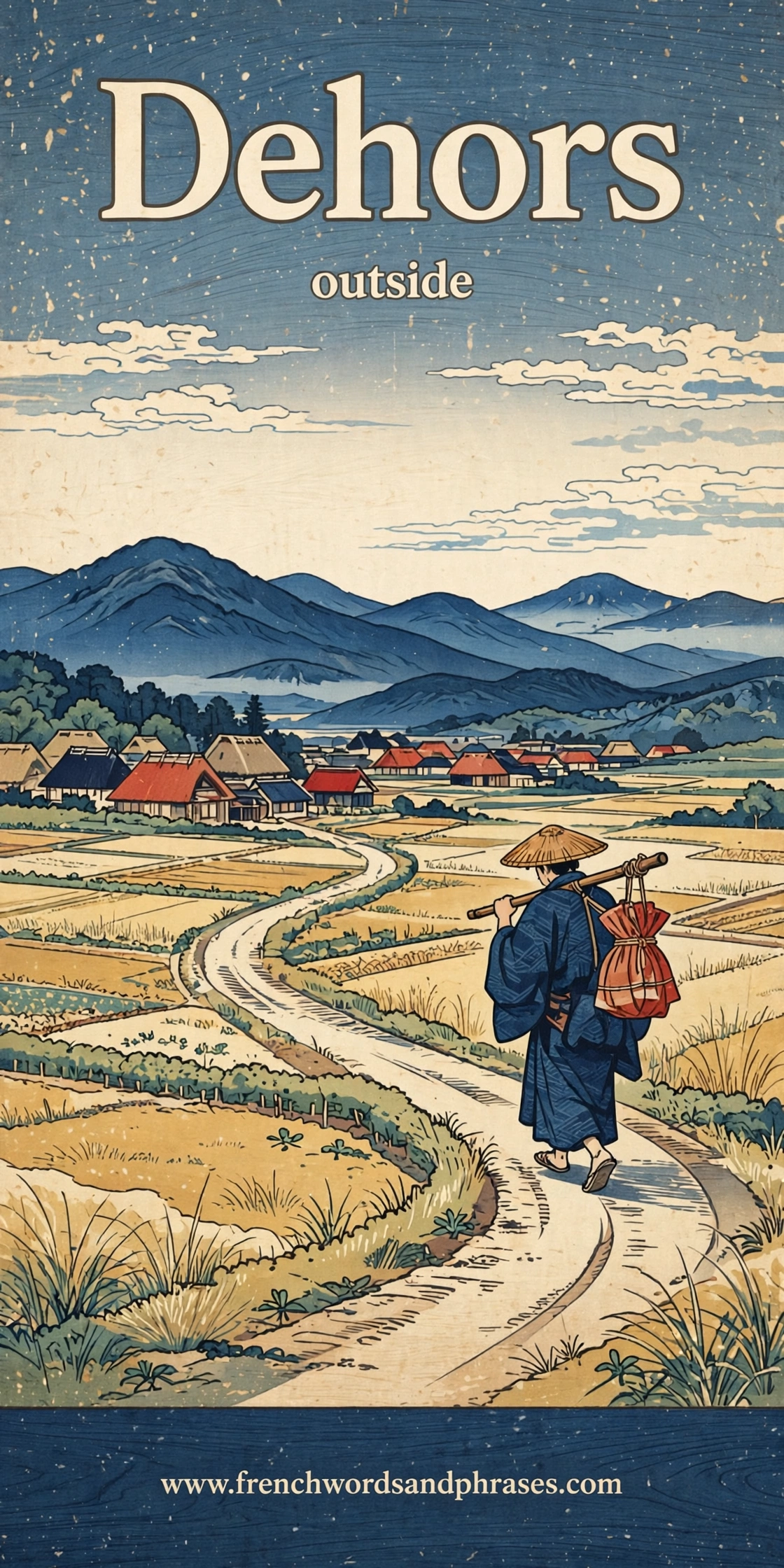
A French Word to Live By
Translate Dehors to English
/də.ɔʁ/
Dehors means outside.
The classroom windows steam up, the bell rings, and twenty children burst through the doors into the cold bright air. « On joue dehors ! » — we’re playing outside! Dehors is the French word for outside: not a room, not a building, just the open world on the other side of the door. It is honestly an adverb, taught here with the place words because it answers the same question — where?
Let’s explore how dehors works in French, beginning with the whole word on one card.
Understanding the French Preposition Dehors
Dehors is honestly an adverb of place, not a true preposition — on its own it introduces nothing. It is taught here with the place words because it answers où (where), and because its partner phrase en dehors de works as a compound preposition meaning outside of or apart from.
It means outside — out of doors, in the open air, beyond the walls. The picture is a threshold: inside there are rooms and roofs; dehors there is sky. A dog waits dehors, children play dehors, and in summer the whole village eats dehors.
Type: Adverb of place — outside (honest label: not a true preposition)
Answers the question: Où ? — Where? (Answer: out there, beyond the door)
What follows it: Nothing — it follows the verb; its preposition twin is en dehors de + noun
Watch the pair: dehors (outside) vs dedans (inside) — the great French threshold pair
One important usage detail: en dehors de does double duty. Literally it means outside of (en dehors de la ville, outside the town); figuratively it means apart from or except for — en dehors de ça, apart from that. Dehors alone can never carry a noun: you cannot say “dehors la maison”.
Experience the Word
Dehors is the word on the other side of every door — the one children shout and dogs understand instantly.
Imagine the first warm evening of spring: windows open, tables carried out, and a whole street dining dehors under the plane trees, because nobody wants to be inside.
You have not named a room or a street. You have simply pointed past the walls, at the open air.
How to Use Dehors in French: Complete Guide
Let’s explore how dehors works in French, beginning with the whole word on one card.
Dehors at a Glance
The Whole Word on One Card
Meaning, job, pattern and pair — dehors in four lines.
| Point | Dehors |
|---|---|
| Meaning | outside / out of doors |
| Job | places the action beyond the walls, in the open air |
| Pattern | verb + dehors: les enfants jouent dehors |
| Its opposite | dedans — inside |
Example
Le chien attend dehors.
The dog is waiting outside.
The Pattern in Action: Beyond the Door
Dehors follows the verb and opens the walls — the action happens out in the world.
| Pattern | Example |
|---|---|
| playing | les enfants jouent dehors — the children are playing outside |
| eating | nous mangeons dehors ce soir — we’re eating outside tonight |
| waiting | il attend dehors — he is waiting outside |
| sleeping | le chat dort dehors — the cat sleeps outside |
Example
Il fait beau, allons dehors !
The weather is lovely, let’s go outside!
Quick Quiz 1
Can dehors be followed directly by a noun — “dehors la maison”?
Reveal the answer
No — dehors is an adverb. With a noun, use en dehors de.
En dehors de la maison, il y a un jardin.
Outside the house, there is a garden.
The Tricky Bit: Dehors the Adverb vs En dehors de the Preposition
One word, two jobs. Alone, dehors is an adverb that stands after the verb; wrapped as en dehors de, it becomes a preposition that can carry a noun — and a figurative meaning too.
| Form | The difference |
|---|---|
| dehors (alone) | adverb, no noun after it: sors dehors ! — go outside! |
| en dehors de + noun | outside of: en dehors de la ville — outside the town |
| en dehors de (figurative) | apart from / except for: en dehors de ça, tout va bien — apart from that, all is well |
| dehors ! (command) | out! — the word you say to the dog, or the referee to a player |
Example
En dehors de quelques nuages, le ciel est bleu et les enfants jouent dehors.
Apart from a few clouds, the sky is blue and the children are playing outside.
Where It Goes: After the Verb, at the End of the Idea
Dehors parks itself after the verb or at the end of the sentence — it is a full stop with fresh air.
| Position / pattern | Example |
|---|---|
| after the verb | elle travaille dehors — she works outside |
| end of sentence | il préfère rester dehors — he prefers to stay outside |
| with aller / sortir | on sort dehors ? — shall we go outside? (everyday doubling, very common in speech) |
| là-dehors | out there — with là for pointing: regarde là-dehors ! |
Example
Les enfants veulent rester dehors.
The children want to stay outside.
Quick Quiz 2
“Apart from that, everything is fine” — which form: dehors or en dehors de?
Reveal the answer
en dehors de — the figurative ‘apart from’ needs the full phrase.
En dehors de ça, tout va bien.
Apart from that, everything is fine.
Everyday Expressions with Dehors
Dehors turns up in weather talk, schoolyards, and one unforgettable order.
| Expression | In English |
|---|---|
| il fait beau dehors | the weather is nice outside |
| dehors ! | out! / get out! |
| mettre quelqu’un dehors | to throw someone out / to fire someone (informal) |
| en dehors de ça | apart from that |
| la vie dehors | life outdoors / the outdoor life |
Example
Il fait froid dehors, prends un manteau.
It’s cold outside, take a coat.
Close Cousins: The Threshold Family
French draws the inside/outside line with a small family of words — dehors is the everyday champion.
| Word | The difference |
|---|---|
| dehors | outside — the everyday adverb: les enfants sont dehors |
| dedans | inside — the mirror twin: le chat est dedans |
| à l’extérieur | outside / outdoors — slightly more formal, also ‘abroad’ for countries in some contexts |
| en plein air | in the open air — for activities: un cinéma en plein air, an open-air cinema |
Example
Le chat est dedans et le chien est dehors.
The cat is inside and the dog is outside.
Quick Quiz 3
Which cousin means “inside” — dehors or dedans?
Reveal the answer
dedans — the exact mirror of dehors.
Mets le lait dedans.
Put the milk inside.
Dehors and Its Neighbours
The threshold shelf: in, out, up, down, and far away.
| French | In English |
|---|---|
| dedans | inside |
| dehors | outside |
| en haut | upstairs / up above |
| en bas | downstairs / down below |
| loin | far away |
Example
Les vélos sont en bas et les enfants jouent dehors.
The bikes are downstairs and the children are playing outside.
Watch Out: The Traps Around Dehors
The traps: hanging a noun on it, and confusing it with its en dehors de twin.
| Trap | The truth |
|---|---|
| ‘dehors la maison’ | impossible — dehors takes no noun; say en dehors de la maison or devant la maison |
| using dehors for ‘except’ | ‘apart from’ is en dehors de ça, never plain dehors |
| confusing dehors and hors | hors de means out of (hors de la ville, hors de prix) — close, but a different, more literary phrase |
| spelling | dehors has an h in the middle and a silent s — do not write ‘deor’ |
Example
En dehors de la ville, les enfants peuvent jouer dehors.
Outside the town, the children can play outside.
Quick Quiz 4
Complete: ______ de la ville, tout est calme. (Outside the town, everything is calm.)
Reveal the answer
En dehors — a noun follows, so the full preposition is needed.
En dehors de la ville, tout est calme.
Outside the town, everything is calm.
Dehors in Everyday French: Real-Life Examples
Now that you know the word, let’s see how dehors appears in everyday French.
Example Example 1 — Children
Les enfants jouent dehors.
The children are playing outside.
Example Example 2 — Weather
Il fait très froid dehors.
It’s very cold outside.
Example Example 3 — Pets
Le chien veut aller dehors.
The dog wants to go outside.
Example Example 4 — Eating
Ce soir, nous mangeons dehors.
Tonight we’re eating outside.
Example Example 5 — Waiting
Le taxi attend dehors.
The taxi is waiting outside.
Example Example 6 — Apart from
En dehors de ça, tout est parfait.
Apart from that, everything is perfect.
Beyond Translation: The Meaning of Dehors
English “outside” is a tidy compound; French dehors is an old, round, spoken word that smells of fresh air. It belongs to the great French pair dedans/dehors — inside/outside — two words that between them organise a child’s whole world: where the dog sleeps, where the game happens, where you are allowed to be.
To say dehors is to open the door in a single word.
And its grown-up twin, en dehors de, quietly runs the second meaning — apart from — so the same word that sends children out to play also lets adults make exceptions.
How to Remember the French Preposition Dehors
Remember it this way: Remember it this way: Dehors is the shout at the door — an adverb that stands alone; give it a noun and it must dress up as en dehors de.
- You pair it — dedans is inside, dehors is outside, the two halves of every doorway.
- You respect its grammar — no noun after dehors; nouns need en dehors de.
- You steal the bonus — en dehors de ça means apart from that.
The key idea is dehors means outside and takes no noun, en dehors de means outside of or apart from, and dedans is its opposite.
Test Your Knowledge of Dehors
Let’s see how much you’ve learned. Try answering these questions before revealing the answers.
Question 1
What does dehors mean?
Reveal the answer
Outside — out of doors, beyond the walls, in the open air.
Question 2
Why can you not say “dehors la maison”?
Reveal the answer
Dehors is an adverb and takes no noun. With a noun, use en dehors de la maison.
Question 3
Translate: The children are playing outside.
Reveal the answer
Les enfants jouent dehors.
Question 4
What does en dehors de ça mean?
Reveal the answer
Apart from that — the figurative use of en dehors de.
Question 5
Complete the sentence:
Le chien attend ______. (The dog is waiting outside.)
Reveal the answer
dehors
Le chien attend dehors.
The dog is waiting outside.
Your Final Challenge
Can You Use It?
How would you say this in French?
“How would you say this in French?”
Reveal the answer
Les enfants jouent dehors.
The children are playing outside.
A little French. A little curiosity. A richer everyday life.
LEARN FRENCH ONE WORD AT A TIME




