A French Word to Live By
Translate Par to English
/paʁ/
Par means through / by.
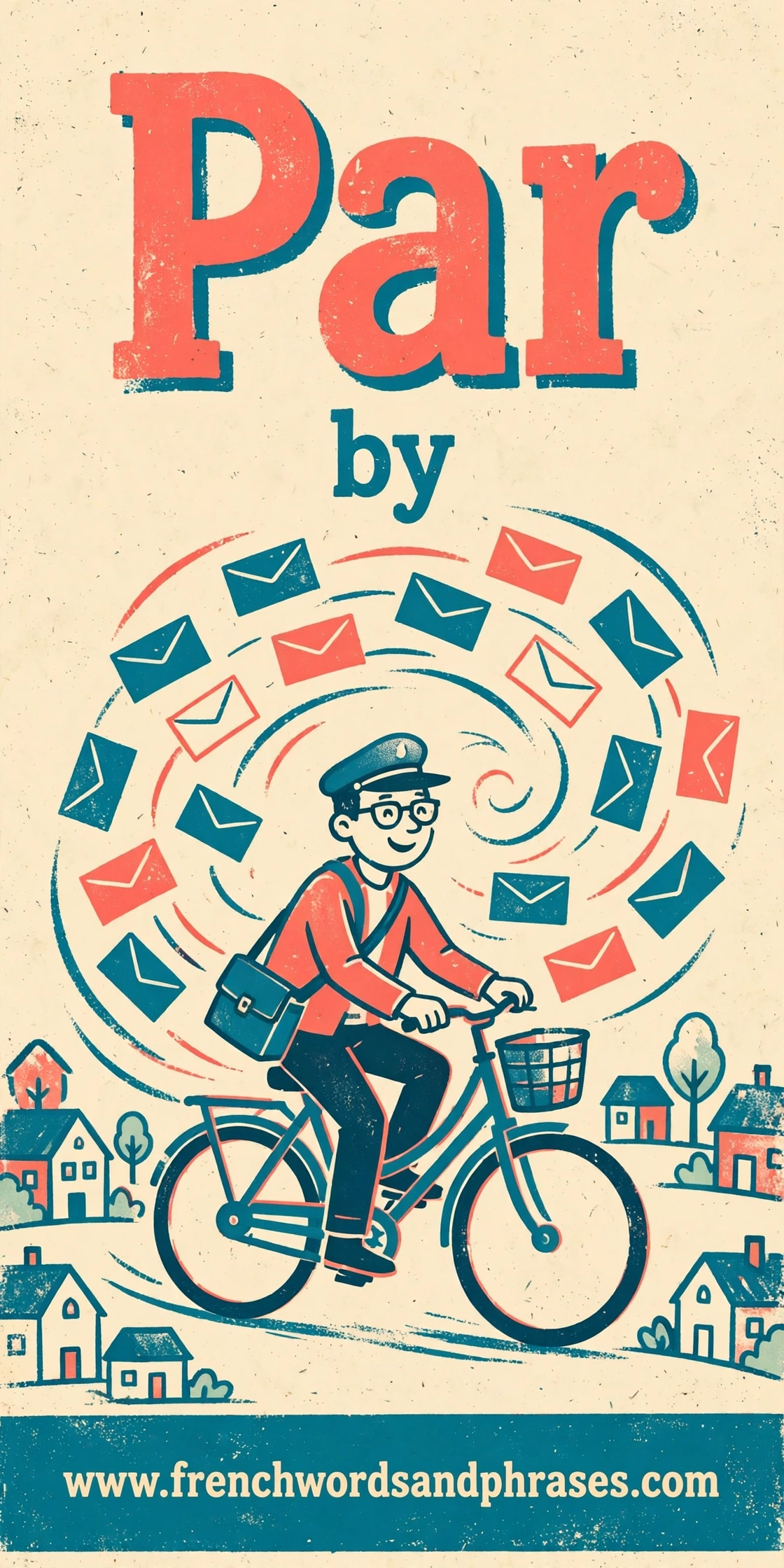
A postman cycles through the narrow lanes of a hilltop village, his bag full of letters written by hand. « Les lettres sont livrées par le facteur » — the letters are delivered by the postman. Par is the French word for the channel things travel through and the hand that does the deed: through the window, by train, written by a friend.
Let’s explore how par works in French, beginning with the whole word on one card.
Understanding the French Preposition Par
Par is a French preposition of movement and means. It marks the route something passes through, the agent who performs an action (the “by” of the passive), and the rate at which something is counted — par jour, par personne.
It means through and by. The picture it paints is a passage: light through a window, a road through a forest, a parcel sent by post. When nothing moves, par still names the doer behind a passive verb — ce livre a été écrit par un enfant, this book was written by a child.
Type: Preposition — movement, means and agent
Answers the question: Par où ? / Par qui ? — Through where? / By whom?
What follows it: A noun, a pronoun, or a means of transport: par la fenêtre, par lui, par avion
Watch the pair: par (through / by) vs pour (for) — par le train = by train, pour le train = for the train
One important usage detail: par is the word of rates and distribution — deux fois par semaine (twice a week), dix euros par personne (ten euros per person), un par un (one by one). Whenever English says “per” or “a” in counting, French reaches for par.
Experience the Word
Par is the preposition of the journey’s middle — not the start, not the arrival, but the way through.
Imagine a riverboat sliding par la vallée, through the valley, passing under bridges and past vineyards, the whole landscape filing by the window like a slow film.
You have not just said where something went. You have named the channel it travelled through, or the hand that made it happen.
How to Use Par in French: Complete Guide
Let’s explore how par works in French, beginning with the whole word on one card.
Par at a Glance
The Whole Word on One Card
Meaning, jobs, pattern and pair — par in four lines.
| Point | Par |
|---|---|
| Meaning | through / by / per |
| Jobs | route through a place, agent of a passive, means, rate |
| What follows | a noun or pronoun — la porte, moi, le train |
| Its counting use | par jour, par semaine, par personne — per day, per week, per person |
Example
Elle est entrée par la petite porte.
She came in through the little door.
The Pattern in Action: Through, By and Per
Par connects an action to its route, its doer or its rate — three jobs, one small word.
| Pattern | Example |
|---|---|
| a route through | nous passons par le village — we are going through the village |
| the agent of a passive | le pont a été construit par les Romains — the bridge was built by the Romans |
| a means of transport | ils voyagent par le train — they are travelling by train |
| a rate | il nage trois fois par semaine — he swims three times a week |
Example
Le soleil entre par la fenêtre ouverte.
The sun comes in through the open window.
Quick Quiz 1
In ce gâteau a été fait par ma sœur, what does par tell you?
Reveal the answer
Who did it — par names the agent of the passive: the cake was made BY my sister.
Ce gâteau a été fait par ma sœur.
This cake was made by my sister.
The Tricky Bit: Three Jobs Learners Mix Up
Par does three different jobs — the passive agent, the route, and the rate. Here is how to keep them straight.
| Job | How it works |
|---|---|
| passive ‘by’ | after être + past participle, par names the doer: la lettre est signée par le directeur — the letter is signed by the director |
| route ‘through’ | with verbs of movement, par names the way: passer par Lyon — to go through Lyon |
| rate ‘per’ | with numbers and time words: deux cafés par jour — two coffees per day |
| not ‘for’ | purpose and gifts take pour: ce cadeau est pour toi — this gift is for you |
Example
La ville est traversée par une rivière.
The town is crossed by a river.
Where It Goes: Between the Verb and the Channel
Par sits right after the verb or participle, glued to the noun that names the route, the means or the doer.
| Position / pattern | Example |
|---|---|
| verb + par + place | regarder par la fenêtre — to look through the window |
| participle + par + agent | aimé par tous — loved by everyone |
| par + transport, no article change | par avion, par bateau, par la route — by plane, by boat, by road |
| par-ci, par-là | here and there: des fleurs par-ci, par-là — flowers here and there |
Example
Il a jeté la balle par-dessus le mur.
He threw the ball over the wall.
Quick Quiz 2
“Twice a week” — par or pour?
Reveal the answer
par — rates and counting use par.
Elle court deux fois par semaine.
She runs twice a week.
Everyday Expressions with Par
Par hides inside some of the most useful phrases in everyday French.
| Expression | In English |
|---|---|
| par exemple | for example |
| par hasard | by chance |
| par cœur | by heart — apprendre par cœur, to learn by heart |
| par terre | on the ground / on the floor |
| par la suite | afterwards, later on |
Example
Nous nous sommes rencontrés par hasard au marché.
We met by chance at the market.
Close Cousins: Par, Pour, À Travers, Avec
Four small words that English blurs into by, for and through — French keeps their jobs separate.
| Word | The difference |
|---|---|
| par | through a place, by an agent, per unit: par la forêt, par Paul, par jour |
| pour | for a person or a purpose: pour toi, pour aider — for you, in order to help |
| à travers | through the middle of something spread out: à travers la foule — through the crowd |
| avec | with, the tool in your hand: écrire avec un stylo — to write with a pen |
Example
Il a traversé la place à travers la foule, guidé par un ami.
He crossed the square through the crowd, guided by a friend.
Quick Quiz 3
Which cousin means “through the middle of the crowd” — par or à travers?
Reveal the answer
à travers — it pushes through something spread out; par marks the route more simply.
Elle se fraye un chemin à travers la foule.
She makes her way through the crowd.
Par and Its Neighbours
The channel shelf: the words that say how things travel and who makes them happen.
| French | In English |
|---|---|
| à travers | through (the middle of) |
| par | through / by / per |
| avec | with (tool, company) |
| sans | without |
| pour | for (person, purpose) |
Example
On peut y aller par le sentier, avec ou sans guide.
You can get there by the path, with or without a guide.
Watch Out: The Traps Around Par
The traps: pour where par belongs, a missing par in the passive, and ‘by’ for transport.
| Trap | The truth |
|---|---|
| saying ‘pour le train’ for by train | means of transport takes par: voyager par le train |
| dropping par in the passive | the agent needs par: le repas a été préparé par le chef, not just le chef |
| using par for a gift | gifts and purposes take pour: un cadeau pour maman |
| forgetting par in rates | English ‘a week’ is par in French: une fois par semaine |
Example
Ce colis a été envoyé par avion pour ma sœur.
This parcel was sent by plane for my sister.
Quick Quiz 4
Complete: Le dîner a été préparé ______ le chef. (prepared BY the chef)
Reveal the answer
par — the passive agent is introduced by par.
Le dîner a été préparé par le chef.
The dinner was prepared by the chef.
Par in Everyday French: Real-Life Examples
Now that you know the word, let’s see how par appears in everyday French.
Example Example 1 — A route
Nous rentrons par le chemin de la rivière.
We are going home by the river path.
Example Example 2 — The passive
Ce tableau a été peint par ma grand-mère.
This painting was painted by my grandmother.
Example Example 3 — Transport
Ils sont arrivés par le train de nuit.
They arrived by the night train.
Example Example 4 — A rate
Je lis vingt pages par jour.
I read twenty pages per day.
Example Example 5 — Weather
Par ce froid, mieux vaut rester à la maison.
In this cold weather, it is better to stay at home.
Example Example 6 — Distribution
Il a donné un bonbon par enfant.
He gave one sweet per child.
Beyond Translation: The Meaning of Par
English splits the work between “through”, “by” and “per”; French hands all three to one small word, par. The logic is a channel: a letter travels through the post, a bridge is built by hands, a week is measured out coffee by coffee — something passes, and par names the passage.
To say par is to point at the way things get from one side to the other.
It is also the word of fairness in small doses: un par un, one by one, chacun par chacun — everyone gets their turn through the same narrow gate.
How to Remember the French Preposition Par
Remember it this way: Remember it this way: Par is the channel word — routes run through it, passives are done by it, and rates are counted per it.
- You ask two questions — through where? and by whom? — and both answers start with par.
- You keep the gift apart — presents and purposes are pour, journeys and doers are par.
- You count with it — par jour, par semaine, par personne whenever English says per.
The key idea is par means through, by and per — the route, the agent and the rate all flow through the same word.
Test Your Knowledge of Par
Let’s see how much you’ve learned. Try answering these questions before revealing the answers.
Question 1
What does par mean?
Reveal the answer
Through, by and per — the route something takes, the doer of a passive, and the unit of a rate.
Question 2
Which word introduces the doer in a French passive sentence?
Reveal the answer
Par — la maison a été construite par des artisans (the house was built by craftsmen).
Question 3
Translate: We go through the village.
Reveal the answer
Nous passons par le village.
Question 4
How do you say “three times a day” in French?
Reveal the answer
Trois fois par jour — rates are counted with par.
Question 5
Complete the sentence:
La lettre a été écrite ______ ma sœur. (The letter was written by my sister.)
Reveal the answer
par
La lettre a été écrite par ma sœur.
The letter was written by my sister.
Your Final Challenge
Can You Use It?
How would you say this in French?
“How would you say this in French?”
Reveal the answer
Elle regarde par la fenêtre.
She is looking through the window.
A little French. A little curiosity. A richer everyday life.
LEARN FRENCH ONE WORD AT A TIME