A French Word to Live By
Translate Sale to English
/sal/
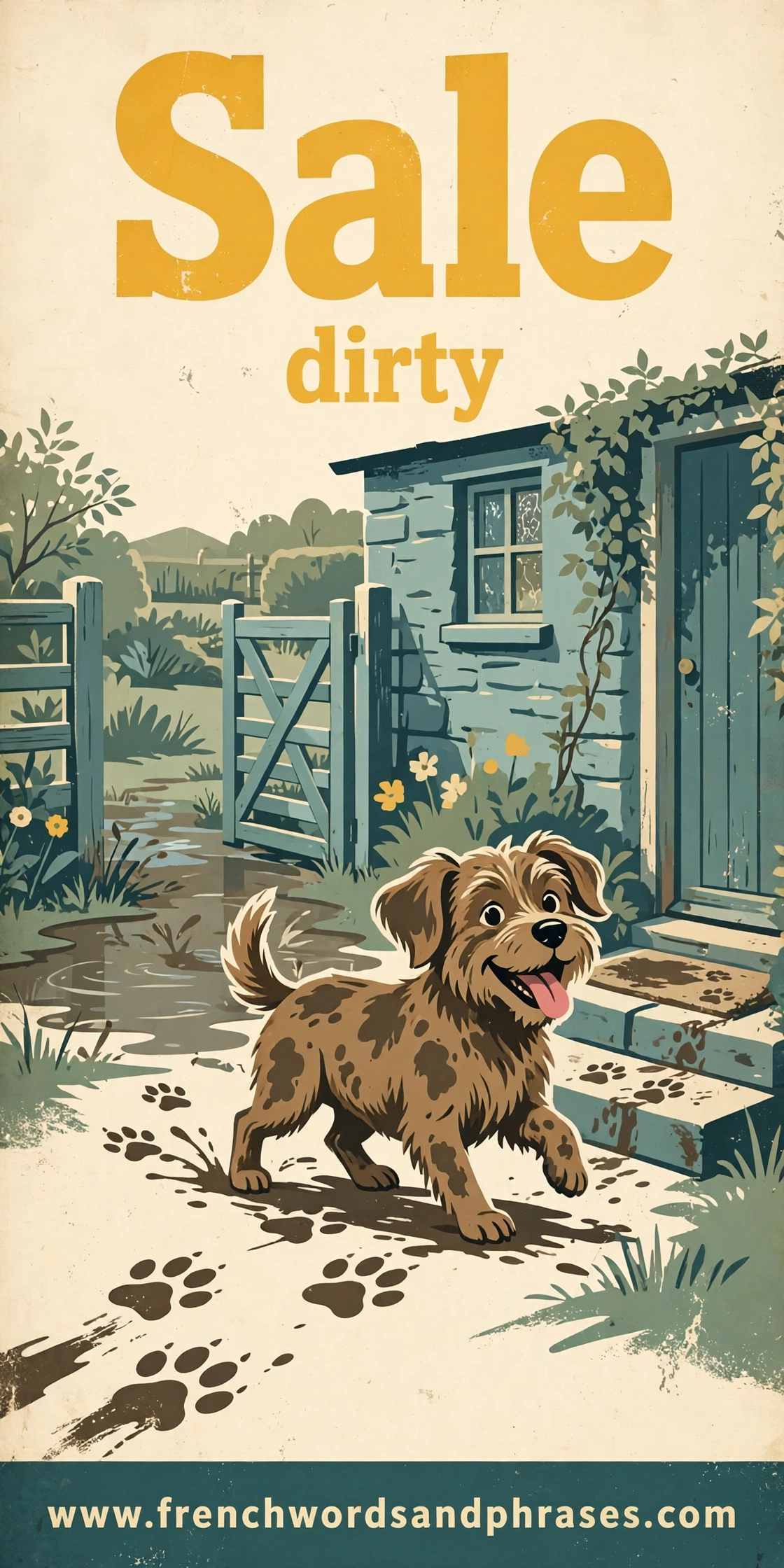
Sale means dirty.
Rain on a building site, a dog overjoyed to see you, and a white shirt that met both of them. Some days end with cuffs grey, shoes brown and a story to tell. The shirt, at least, has a word for its condition: sale.
In this guide, you’ll learn what sale means in English, why its form never changes between masculine and feminine, how it can also mean nasty, and the one-accent trap that separates it from salé, salty. Explore French examples, English translations, and practice quizzes.
Understanding the French Adjective Sale
Sale is a French adjective of quality — the adjective of mud, dust and neglected housekeeping. It already ends in -e, so masculine and feminine share one form; the plural adds a silent -s. It is the natural opposite of propre, clean.
It means dirty — marked by earth, work or time: des mains sales, dirty hands. But sale has a second, figurative life in front of the noun, where it means nasty, unpleasant: un sale temps, nasty weather; un sale caractère, a foul temper.
Type: Adjective of quality — dirtiness
Answers the question: What is it like? — dirty; (before the noun) nasty
Changes form: Barely — sale for him and her; sales in the plural
English equivalents: Dirty; filthy; (before the noun) nasty, foul.
One important usage detail: after the noun, sale is literal — une chemise sale, a dirty shirt. Before the noun, it turns figurative — un sale temps is not dirty weather but nasty weather. And never confuse it with salé: one accent changes dirt into salt.
Experience the Word
Sale is the adjective of real life — of gardens dug, engines repaired and children set free in a park after rain.
Imagine a potter at the end of the day: apron stiff with clay, hands grey to the wrist, and a smile of pure satisfaction. « Les mains sales, le travail propre » — dirty hands, clean work.
You have not just pointed at a stain. You have described a day that was actually lived.
How to Use Sale in French: Complete Guide
Let’s explore how sale works in French, beginning with the whole word on one card.
Sale at a Glance
Before the details, here is the whole word on one card.
The Whole Word on One Card
Meaning, type, position and forms — sale in four lines.
| Point | Sale |
|---|---|
| Meaning | dirty |
| Type | adjective of quality — dirtiness |
| Usual position | after the noun — des mains sales; before it, nasty |
| Form | sale / sale / sales / sales — one form for him and her |
Example
Les enfants ont les mains sales.
The children have dirty hands.
The Four Forms of Sale
Sale ends in -e, so the feminine costs nothing; the plural adds a silent -s for everyone.
| Form | Sale | Example |
|---|---|---|
| Masculine singular | sale | un drap sale — a dirty sheet |
| Feminine singular | sale | une serviette sale — a dirty towel |
| Masculine plural | sales | des draps sales — dirty sheets |
| Feminine plural | sales | des serviettes sales — dirty towels |
Example
Un torchon sale et des verres sales partout.
A dirty cloth and dirty glasses everywhere.
Quick Quiz 1
Which form of sale goes with mains (feminine plural)?
Reveal the answer
sales
Des mains sales.
Dirty hands.
The Feminine: Nothing to Add
Sale already ends in -e, so masculine and feminine are one word. Your only work is the plural -s.
| Situation | Example |
|---|---|
| Masculine singular | un sol sale — a dirty floor |
| Feminine singular | une vitre sale — the same word, nothing added |
| Both plurals | des sols sales, des vitres sales — just add -s |
| After être | tout est sale — everything is dirty |
Example
La vitre est sale et le sol est sale aussi.
The window is dirty and the floor is dirty too.
Where Sale Goes: After for Dirt, Before for Nasty
Sale follows propre’s rule in reverse: after the noun it is literal dirt; before the noun it becomes a judgement — nasty, foul, beastly.
| Pattern | Example |
|---|---|
| After the noun — dirty | une chemise sale — a dirty shirt |
| Before the noun — nasty | un sale temps — nasty weather |
| Before the noun — nasty | un sale caractère — a foul temper |
| After être | le linge est sale — the laundry is dirty |
Example
Quel sale temps ! Et ma chemise propre est devenue sale.
What nasty weather! And my clean shirt has got dirty.
Quick Quiz 2
Un sale temps — is the weather dirty, or nasty?
Reveal the answer
Nasty — before the noun, sale is a judgement, not a description of dirt.
Un sale temps — nasty weather.
Dirtier: Comparing with Sale
Sale compares in the regular way — the superlative is a verdict no kitchen wants to win.
| Degree | Example |
|---|---|
| As dirty as | aussi sale que — as dirty as |
| Dirtier | plus sale — dirtier |
| Less dirty | moins sale — less dirty |
| The dirtiest (masc.) | le plus sale — le torchon le plus sale |
| The dirtiest (fem.) | la plus sale — la chambre la plus sale |
Example
Après la fête, la cuisine était la pièce la plus sale.
After the party, the kitchen was the dirtiest room.
Everyday Expressions with Sale
In front of the noun, sale does the judging: weather, tempers, tricks and ugly affairs all pass before it.
| Expression | In English |
|---|---|
| un sale temps | nasty weather |
| un sale caractère | a foul temper |
| jouer un sale tour à quelqu’un | to play a dirty trick on someone |
| une sale histoire | a nasty business, an ugly affair |
| sale comme un peigne | filthy (literally: dirty as a comb) |
| un sale type | a nasty piece of work (a man) |
Example
Il m’a joué un sale tour avec cette vieille voiture.
He played a dirty trick on me with that old car.
Quick Quiz 3
What does jouer un sale tour mean?
Reveal the answer
To play a dirty trick
Il m’a joué un sale tour.
He played a dirty trick on me.
Sale and Its Neighbours
Dirt has degrees, from the muddy boot to the formal souillé — and propre, spotless, waiting at the clean end.
| French | In English |
|---|---|
| crasseux | grimy, filthy |
| souillé | soiled (formal) |
| dégoûtant | disgusting |
| boueux | muddy |
| propre | clean — the opposite |
| impeccable | spotless — the happy opposite |
Example
Des bottes boueuses et un manteau crasseux : tout est sale.
Muddy boots and a grimy coat: everything is dirty.
Watch Out: The Traps Around Sale
One accent separates sale from a different word entirely — and position separates dirt from judgement.
| Trap | The truth |
|---|---|
| salé | means SALTY or salted, not dirty: un plat salé, a salty dish; une addition salée, a steep bill |
| sale temps | the weather is nasty, not dirty — before the noun, sale is figurative |
| sale caractère | a foul temper, not a dirty character in a book |
| the plural -s | sales in writing, silent in speech |
Example
La soupe est trop salée et la nappe est sale.
The soup is too salty and the tablecloth is dirty.
Quick Quiz 4
A salty dish — sale or salé?
Reveal the answer
salé — with the accent, it is salt; without it, dirt.
Un plat salé — a salty dish.
Sale in Everyday French: Real-Life Examples
Now that you know the word, let’s see how sale appears in everyday French.
Example 1 — After the park
Regarde tes mains, elles sont sales ! Va te laver.
Look at your hands, they’re dirty! Go and wash.
Example 2 — Laundry
Mets ta chemise sale dans le panier à linge.
Put your dirty shirt in the laundry basket.
Example 3 — Weather
Quel sale temps aujourd’hui, il pleut depuis ce matin.
What nasty weather today, it’s been raining since this morning.
Example 4 — At the garage
Le mécanicien a toujours les mains sales à la fin de la journée.
The mechanic always has dirty hands at the end of the day.
Example 5 — A complaint
Les vitres sont sales, on ne voit presque rien.
The windows are dirty, you can hardly see anything.
Example 6 — A character
Il a un sale caractère quand il est fatigué.
He has a foul temper when he’s tired.
See sale in a story: The State of Clothes: French Vocabulary (L’état des Vêtements) — laundry day with the Martin family.
Beyond Translation: The Meaning of Sale
English says dirty for the meaning of sale — and sale carries the same double edge: dirt you can wash off, and dirt you cannot, in tricks, tempers and ugly affairs.
To call something sale is to say the day has left its mark on it.
French keeps the two honesties side by side: propre for what is clean and your own, sale for what the world has handled. Between the two words, a whole philosophy of housekeeping.
How to Remember the French Adjective Sale
Remember it this way: Sale is propre’s muddy twin — one form for everyone, literal after the noun, and pure judgement in front of it.
- You see the pair standing still — sale, sale — masculine and feminine identical.
- You read the position like a sign — une chemise sale, dirty; un sale temps, nasty.
- You watch the accent like a hawk — sale is dirt, salé is salt.
The key idea is sale after the noun = dirty, before the noun = nasty; and salé (salty) is a different word.
Test Your Knowledge of Sale
Let’s see how much you’ve learned. Try answering these questions before revealing the answers.
Question 1
What does sale mean?
Reveal the answer
Dirty — and, before the noun, nasty.
Question 2
What are the forms of sale?
Reveal the answer
sale, sale, sales, sales — the same for masculine and feminine.
Question 3
Translate: dirty hands.
Reveal the answer
Des mains sales.
Question 4
Which word means salty — sale or salé?
Reveal the answer
salé — sale means dirty.
Question 5
Complete the sentence:
Quel ______ temps ! Il pleut encore.
Reveal the answer
sale
Quel sale temps ! Il pleut encore.
What nasty weather! It’s raining again.
Your Final Challenge
Can You Use It?
How would you say this in French?
“What nasty weather! My hands are dirty and the soup is too salty.”
Reveal the answer
Quel sale temps ! J’ai les mains sales et la soupe est trop salée.
What nasty weather! My hands are dirty and the soup is too salty.
A little French. A little curiosity. A richer everyday life.
LEARN FRENCH ONE WORD AT A TIME