A French Word to Live By
Translate Faible to English
/fɛbl/
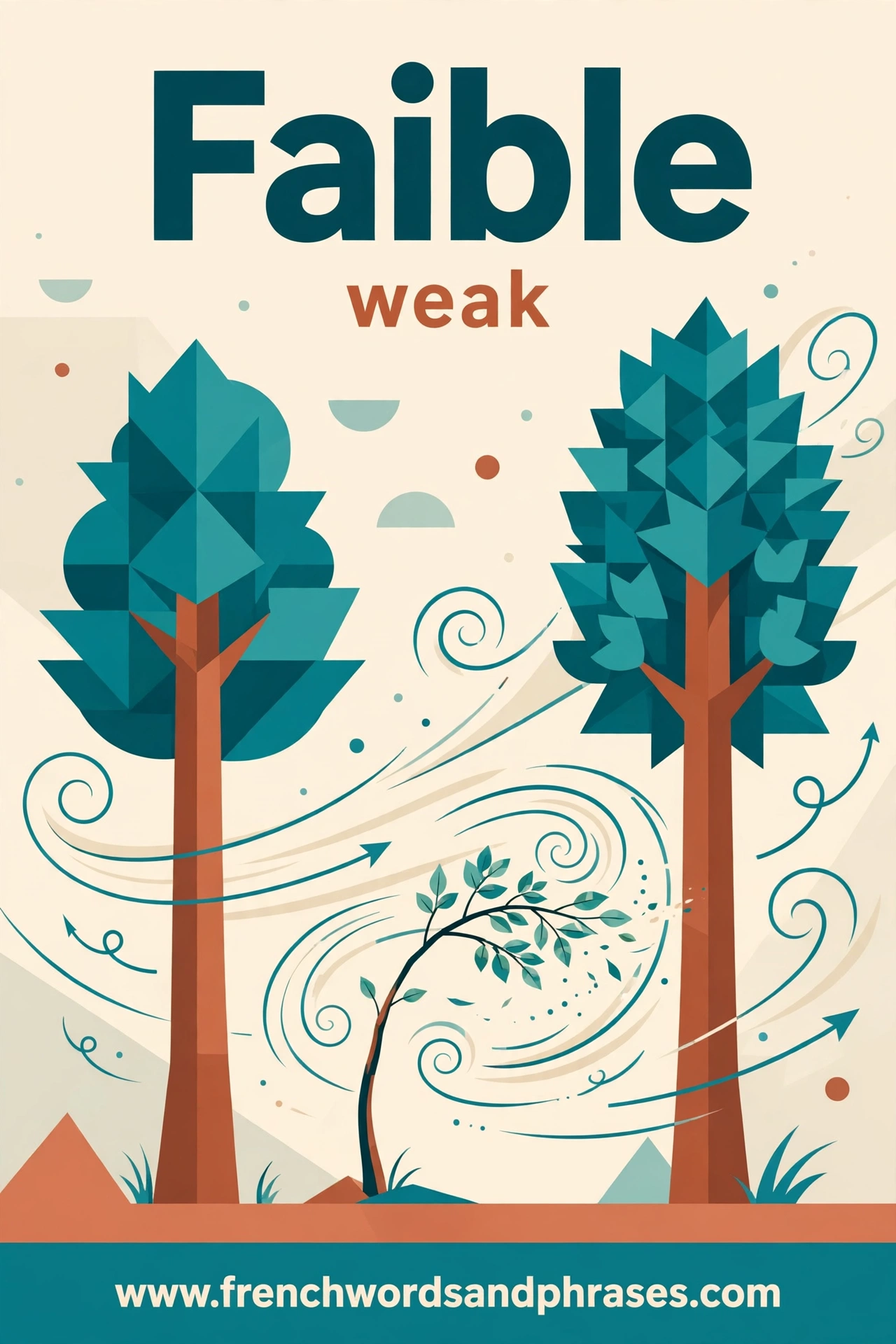
Faible means weak.
Evening light through a small window: an old radio crackling at the edge of its range, a candle flame bending in a draught, a voice on the phone fading in and out. When a signal, a light or a body loses its strength, French reaches for faible.
In this guide, you’ll learn what faible means in English, why it keeps one form for masculine and feminine, how it describes everything from weak tea to a weak signal, and how its noun, la faiblesse, names the soft spots we all have. Explore French examples, English translations, and practice quizzes.
Understanding the French Adjective Faible
Faible is a French adjective of strength — or rather, of strength missing. It ends in -e, so it is identical for masculine and feminine nouns: un signal faible, une lumière faible. Only the plural adds an -s.
It means weak — low in strength, power or intensity. Its territory is wide: un café faible (weak coffee), une voix faible (a faint voice), un élève faible en maths (a pupil who is weak at maths), un faible bruit (a faint noise). Where fort is the fist, faible is the whisper.
Type: Adjective of strength — weakness, faintness
Answers the question: What is it like? — weak
Changes form: Only in the plural — faible / faibles; masculine and feminine identical
English equivalents: Weak; faint; low.
One important usage detail: faible follows the noun — un vent faible, une équipe faible. To say someone is weak AT a subject, French uses faible en: il est faible en histoire, he is weak at history.
Experience the Word
Faible is the adjective of low batteries and long evenings — the word for everything that is still there, but only just.
Imagine a lighthouse keeper at the end of a winter night, watching the lamp turn through the fog. The light is faible now, pale against the coming morning — not gone, never gone, just soft. That gentleness is inside the word.
You have not just measured strength. You have noticed something quietly holding on.
How to Use Faible in French: Complete Guide
Let’s explore how faible works in French, beginning with the whole word on one card.
Faible at a Glance
Before the details, here is the whole word on one card.
The Whole Word on One Card
Meaning, type, position and forms — faible in four lines.
| Point | Faible |
|---|---|
| Meaning | weak, faint |
| Type | adjective of strength — weakness |
| Usual position | after the noun — un signal faible |
| Form | faible (masc. and fem.) / faibles (plural) |
Example
Le signal est faible dans cette vallée.
The signal is weak in this valley.
The Four Forms of Faible
Faible ends in -e, so masculine and feminine are the same word. The plural adds a silent -s, and that is the whole story of its agreement.
| Form | Faible | Example |
|---|---|---|
| Masculine singular | faible | un café faible — a weak coffee |
| Feminine singular | faible | une voix faible — a faint voice |
| Masculine plural | faibles | des cafés faibles — weak coffees |
| Feminine plural | faibles | des voix faibles — faint voices |
Example
Après sa maladie, il a encore la voix faible.
After his illness, his voice is still weak.
Quick Quiz 1
Does faible change for a feminine noun?
Reveal the answer
No
Un vent faible, une lumière faible.
A light wind, a dim light — faible stays faible.
The Feminine of Faible: Already There
Because faible ends in -e, the feminine is already written into the word. Nothing to add, nothing to double — one of the calmest agreements in French.
| Pattern | Example |
|---|---|
| Masculine | un moteur faible — a weak engine |
| Feminine | une lumière faible — a dim light (the same form) |
| Plural, both genders | des résultats faibles — weak results |
| With très | très faible — very weak |
Example
La lumière est trop faible pour lire.
The light is too dim to read.
Where Faible Goes: After the Noun
Faible follows the noun it describes, and after être it often brings en with it, to say what someone is weak at.
| Pattern | Example |
|---|---|
| noun + faible | un thé faible — a weak tea |
| être + faible | Elle est encore faible. — She is still weak. |
| faible en + subject | faible en maths — weak at maths |
| Before the noun | un faible thé — never in everyday French; faible follows |
Example
Mon fils est faible en orthographe, mais fort en sport.
My son is weak at spelling, but strong at sport.
Quick Quiz 2
How do you say ‘weak at history’ — faible à l’histoire or faible en histoire?
Reveal the answer
faible en histoire
Il est faible en histoire.
He is weak at history.
Weaker Still: Comparing with Faible
Faible compares the regular way, with plus, moins and aussi — the agreement never changes, so the comparison stays simple.
| Degree | Example |
|---|---|
| As weak as | aussi faible que — as weak as |
| Weaker | plus faible — weaker |
| Less weak | moins faible — less weak |
| The weakest (masc.) | le plus faible — le plus faible de l’équipe |
| The weakest (fem.) | la plus faible — la plus faible du groupe |
Example
Le deuxième café est plus faible que le premier.
The second coffee is weaker than the first.
Everyday Expressions with Faible
Faible is a word of hospitals, weather reports and school reports — and of one lovely expression, un faible pour, that means a soft spot.
| Expression | In English |
|---|---|
| un faible pour quelqu’un | a soft spot for someone — j’ai un faible pour elle |
| la faiblesse | weakness — and also a fond weakness for a pleasure |
| un point faible | a weak point |
| à voix faible | in a faint voice |
| un faible revenu | a low income |
| faible en | weak at (a subject) |
Example
J’ai un faible pour les vieux livres et le chocolat.
I have a soft spot for old books and chocolate.
Quick Quiz 3
What does j’ai un faible pour le chocolat mean?
Reveal the answer
I have a soft spot for chocolate
Un faible pour quelque chose — a fond weakness for something.
I have a soft spot for chocolate.
Faible and Its Neighbours
Faible sits at the low end of the strength scale. Learn it with its neighbours and you can grade anything from a whisper to a hurricane.
| French | In English |
|---|---|
| léger | light, slight — un vent léger, a light wind |
| fragile | fragile, delicate |
| épuisé | exhausted — strength completely spent |
| délicat | delicate — for health, slightly formal |
| fort | strong — the direct opposite |
| puissant | powerful — the far end of the scale |
Example
Le vent est faible ce matin, presque léger.
The wind is weak this morning, almost light.
Watch Out: The Traps Around Faible
Two traps matter most: faible judges strength, not quantity — and for prices and volume, French often prefers a different word.
| Trap | The truth |
|---|---|
| faible vs peu | faible = weak in strength; peu = little in quantity — un café faible, peu de café |
| faible vs bas | for volume and prices French often prefers bas: un prix bas, a low price |
| faible d’esprit | an old, unkind expression for simple-minded — know it, don’t use it |
| English ‘feeble’ | stronger and more mocking than faible — faible is neutral and everyday |
Example
Il reste peu de thé, et il est faible en plus.
There is little tea left, and it is weak as well.
Quick Quiz 4
Which is ‘a weak coffee’ — un café faible or un café peu?
Reveal the answer
un café faible
Peu counts quantity; faible judges strength.
Un café faible — a weak coffee.
Faible in Everyday French: Real-Life Examples
Now that you know the word, let’s see how faible appears in everyday French.
Example 1 — On the phone
Parle plus fort, ta voix est faible et la ligne est mauvaise.
Speak up, your voice is faint and the line is bad.
Example 2 — At the doctor’s
Après la grippe, grand-mère est encore un peu faible.
After the flu, grandmother is still a little weak.
Example 3 — At school
Il est faible en maths, mais il adore l’histoire.
He is weak at maths, but he loves history.
Example 4 — In the café
Un café faible pour moi, s’il vous plaît, sinon je ne dors pas.
A weak coffee for me, please, otherwise I won’t sleep.
Example 5 — Weather
Un vent faible et un ciel clair : parfaite journée pour naviguer.
A light wind and a clear sky: a perfect day for sailing.
Example 6 — A confession
J’ai un faible pour les croissants encore chauds.
I have a soft spot for croissants that are still warm.
Beyond Translation: The Meaning of Faible
English says weak for the meaning of faible — but faible has a gentleness the English word lacks. It covers the faint light, the low voice, the small income, without ever sounding like an insult.
To call something faible is to say it is still there — just softly.
And French, being French, turns the weakness into a tenderness: un faible pour quelqu’un, a soft spot for someone — the one weakness nobody wants to cure.
How to Remember the French Adjective Faible
Remember it this way: Faible is the quiet word — one form for everyone, a whisper of an adjective that never raises its voice.
- You add nothing for the feminine — un café faible, une voix faible.
- You say what someone is weak at with en — faible en maths, faible en histoire.
- You park it after the noun — un signal faible, une lumière faible.
The key idea is faible never changes for gender, stands after the noun, and takes en for school subjects.
Test Your Knowledge of Faible
Let’s see how much you’ve learned. Try answering these questions before revealing the answers.
Question 1
What does faible mean?
Reveal the answer
Weak — also faint and low: une voix faible, a faint voice.
Question 2
What are the forms of faible?
Reveal the answer
faible for masculine and feminine singular, faibles for both plurals.
Question 3
Translate: a weak tea.
Reveal the answer
Un thé faible.
Question 4
Complete: elle est faible ______ géographie. (weak at geography)
Reveal the answer
en
Elle est faible en géographie.
She is weak at geography.
Question 5
What does un point faible mean?
Reveal the answer
A weak point — son point faible, his weak point.
Your Final Challenge
Can You Use It?
How would you say this in French?
“His voice is still weak, and the light in the room is too dim to read.”
Reveal the answer
Sa voix est encore faible, et la lumière dans la chambre est trop faible pour lire.
His voice is still weak, and the light in the room is too dim to read.
A little French. A little curiosity. A richer everyday life.
LEARN FRENCH ONE WORD AT A TIME