A French Word to Live By
Translate Cher to English
/ʃɛʁ/
Cher means expensive.
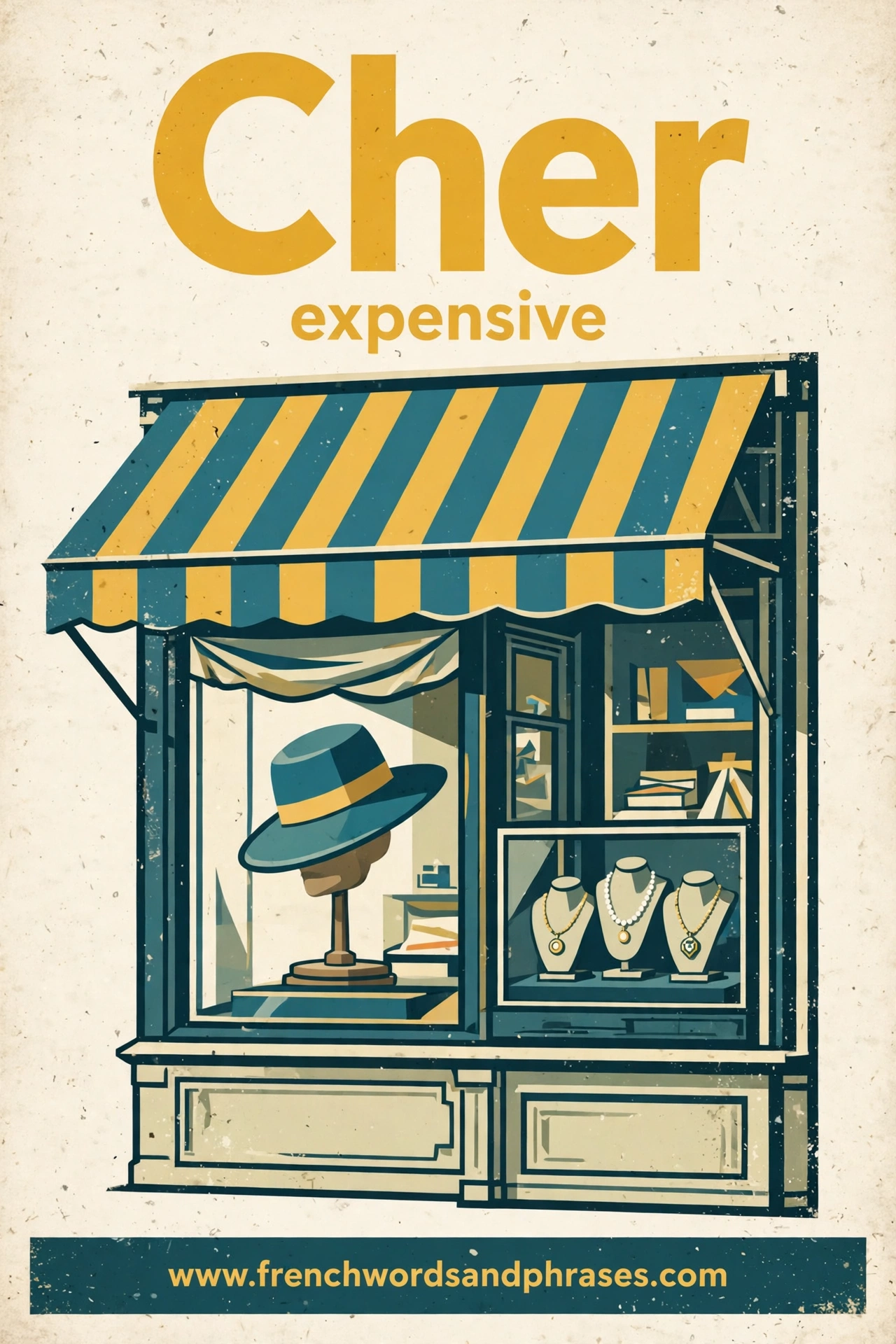
A jeweller’s window on a quiet Paris street: one watch, alone on velvet, and a price tag so small you have to lean in to read it. You lean, you read, you step back. French has a word for that step back — cher. But the same word, in a grandmother’s handwriting, opens every letter she has ever sent you.
In this guide, you’ll learn what cher means in English, why its position in front of or behind the noun changes everything, how its feminine takes an accent, and how the French open their letters with it. Explore French examples, English translations, and practice quizzes.
Understanding the French Adjective Cher
Cher is a French adjective with two lives: the price of things and the worth of people. It agrees like any adjective — cher, chère, chers, chères — and its feminine is written with a grave accent. Which of its two lives it is living depends entirely on where it stands.
After the noun, cher means expensive: un sac cher, an expensive bag; une montre chère, an expensive watch. Before the noun, it means dear, beloved: mon cher ami, my dear friend; chère Marie, at the head of a letter. One word weighs both your wallet and your heart.
Type: Adjective of quality — price and affection
Answers the question: What is it like? — expensive, or dear
Changes form: Yes — cher, chère, chers, chères
English equivalents: Expensive; dear (beloved).
One important usage detail: position is everything with cher. Un manteau cher is an expensive coat; mon cher ami is a dear friend. And in letters, French begins with Cher Monsieur, Chère Madame — pure politeness, with no thought of price at all.
Experience the Word
Cher is the adjective of the boutique window and the family letter — the same four letters guarding a price tag in one street and a signature in another.
Imagine your grandmother’s handwriting at the top of a page: « Ma chère Léa… ». Nothing in that letter is for sale. The word that made you step back from the jeweller’s window now pulls you closer.
You have not just learned an adjective. You have learned how French weighs things — in euros, or in love.
How to Use Cher in French: Complete Guide
Let’s explore how cher works in French, beginning with the whole word on one card.
Cher at a Glance
Before the details, here is the whole word on one card.
The Whole Word on One Card
Meaning, type, position and forms — cher in four lines.
| Point | Cher |
|---|---|
| Meaning | expensive — and dear |
| Type | adjective of quality — price and affection |
| Usual position | after the noun = expensive; before the noun = dear |
| Form | cher / chère / chers / chères |
Example
Cette montre est chère.
This watch is expensive.
The Four Forms of Cher
Cher agrees with the noun it describes. These examples all use its price meaning — the adjective standing after the noun.
| Form | Cher | Example |
|---|---|---|
| Masculine singular | cher | un sac cher — an expensive bag |
| Feminine singular | chère | une robe chère — an expensive dress |
| Masculine plural | chers | des vins chers — expensive wines |
| Feminine plural | chères | des chaussures chères — expensive shoes |
Example
Ce sac est cher, et ces chaussures sont chères aussi.
This bag is expensive, and these shoes are expensive too.
Quick Quiz 1
Which form of cher goes with robe (feminine)?
Reveal the answer
chère
Une robe chère.
An expensive dress.
Chère: The Feminine with an Accent
The feminine of cher is written chère: the plain e of cher opens into an è with a grave accent. Your ear hears no difference — cher and chère sound exactly the same — but your pen must not forget the accent.
| Situation | Example |
|---|---|
| The rule | cher becomes chère — the e takes a grave accent |
| The sound | cher and chère sound the same: /ʃɛʁ/ |
| Masculine plural | chers — des hôtels chers |
| Feminine plural | chères — des montres chères |
Example
Cette bague est très chère.
This ring is very expensive.
Where Cher Goes: The Position Changes the Meaning
Cher is the great lesson in French word order. Behind the noun it talks about money; in front of it, about affection. The same sentence can hold both at once.
| Pattern | Example |
|---|---|
| After the noun = price | un restaurant cher — an expensive restaurant |
| Before the noun = dear | mon cher ami — my dear friend |
| At the start of a letter | Chère Marie, … — Dear Marie, … |
| After être | ce manteau est cher — this coat is expensive |
Example
Mon cher Paul, ce restaurant est trop cher pour nous.
My dear Paul, this restaurant is too expensive for us.
Quick Quiz 2
In mon cher ami, does cher mean expensive or dear?
Reveal the answer
Dear
Before the noun, cher means beloved.
Mon cher ami — my dear friend.
More Expensive: Comparing with Cher
Cher compares the regular way, with plus, moins and aussi — and the superlative keeps the agreement: le plus cher, la plus chère.
| Degree | Example |
|---|---|
| As expensive as | aussi cher que — as expensive as |
| More expensive | plus cher — more expensive |
| Less expensive | moins cher — less expensive |
| The most expensive (masc.) | le plus cher — le plus cher des hôtels |
| The most expensive (fem.) | la plus chère — la plus chère des robes |
Example
Ce modèle est plus cher que l’autre.
This model is more expensive than the other one.
Everyday Expressions with Cher
From market stalls to letterheads, cher is everywhere — including in its own negation, pas cher, the two happiest words in French shopping.
| Expression | In English |
|---|---|
| coûter cher | to cost a lot, to be expensive |
| payer cher | to pay dearly — in money, or in consequences |
| pas cher | cheap, inexpensive — ne coûte pas cher |
| mon cher / ma chère | my dear — to family and close friends |
| Cher Monsieur, Chère Madame | Dear Sir, Dear Madam — the classic letter opening |
| trop cher pour moi | too expensive for me |
Example
Ce vélo ne coûte pas cher, c’est une bonne affaire.
This bike isn’t expensive, it’s a good deal.
Quick Quiz 3
What does pas cher mean?
Reveal the answer
Not expensive — cheap
Ces fraises ne sont pas chères.
These strawberries aren’t expensive.
Cher and Its Neighbours
Around cher gathers the whole vocabulary of price — from the formal coûteux to the joyful opposite, bon marché, and the best price of all: gratuit.
| French | In English |
|---|---|
| coûteux | costly — the formal cousin of cher |
| hors de prix | outrageously expensive, out of reach |
| précieux | precious — valuable and cherished |
| bon marché | cheap, good value — the happy opposite |
| gratuit | free — costs nothing at all |
Example
Ce sac coûteux est hors de prix pour moi.
This costly bag is way too expensive for me.
Watch Out: The Traps Around Cher
The traps here are famous: the wandering meaning, the forgotten accent, and the letter opening that has nothing to do with money.
| Trap | The truth |
|---|---|
| Position | un cher manteau suggests a beloved coat; un manteau cher is an expensive one |
| Dear Sir | in a letter, Cher Monsieur is politeness, never a comment on price |
| Spelling | the feminine needs the grave accent — chère, never ‘chere’ |
| Agreement | shoes are feminine plural: des chaussures chères |
Example
Ma chère amie, ce cadeau est trop cher !
My dear friend, this present is too expensive!
Quick Quiz 4
In un manteau cher, does cher mean expensive or dear?
Reveal the answer
Expensive
After the noun, cher talks about price.
Un manteau cher — an expensive coat.
Cher in Everyday French: Real-Life Examples
Now that you know the word, let’s see how cher appears in everyday French.
Example 1 — Shopping
Cette robe est belle, mais elle est trop chère.
This dress is beautiful, but it’s too expensive.
Example 2 — At a restaurant
Le vin est cher dans ce restaurant.
The wine is expensive in this restaurant.
Example 3 — A letter
Chère Marie, merci pour ton invitation.
Dear Marie, thank you for your invitation.
Example 4 — A bargain
Ces fraises ne sont pas chères aujourd’hui.
These strawberries aren’t expensive today.
Example 5 — Family
Mon cher oncle arrive ce soir.
My dear uncle is arriving this evening.
Example 6 — Comparing
L’hôtel près de la gare est moins cher.
The hotel near the station is less expensive.
Beyond Translation: The Meaning of Cher
English keeps its two ideas apart — expensive for things, dear for people — but French refuses to separate them. Cher is one word for what costs much and for what matters much, as if price and love were weighed on the same scale.
To say cher in French is to say: this has value — count it in euros, or count it in affection.
That is why the word can open a letter to a stranger (Cher Monsieur) and to a grandmother (ma chère grand-mère) with exactly the same warmth of form.
How to Remember the French Adjective Cher
Remember it this way: Cher is the two-faced adjective — it prices what stands behind it and loves what stands in front of it.
- You price with it behind the noun — un sac cher, une robe chère.
- You love with it in front — mon cher ami, ma chère sœur.
- You write the feminine with an accent — chère, always with the grave accent.
The key idea is cher after the noun = expensive; cher before the noun = dear; the feminine is chère.
Test Your Knowledge of Cher
Let’s see how much you’ve learned. Try answering these questions before revealing the answers.
Question 1
What does cher mean after the noun?
Reveal the answer
Expensive — un sac cher, an expensive bag.
Question 2
What is the feminine of cher?
Reveal the answer
chère — with a grave accent on the e.
Question 3
Translate: my dear friend (a man).
Reveal the answer
Mon cher ami.
Question 4
Complete the sentence:
Cette montre est trop ______ .
Reveal the answer
chère
Cette montre est trop chère.
This watch is too expensive.
Question 5
How do you begin a formal letter to Madame Lopez?
Reveal the answer
Chère Madame Lopez, — cher before the name is pure politeness.
Your Final Challenge
Can You Use It?
How would you say this in French?
“Dear Marie, this hotel is too expensive for us.”
Reveal the answer
Chère Marie, cet hôtel est trop cher pour nous.
Dear Marie, this hotel is too expensive for us.
A little French. A little curiosity. A richer everyday life.
LEARN FRENCH ONE WORD AT A TIME