A French Word to Live By
Translate Trop to English
/tʁo/
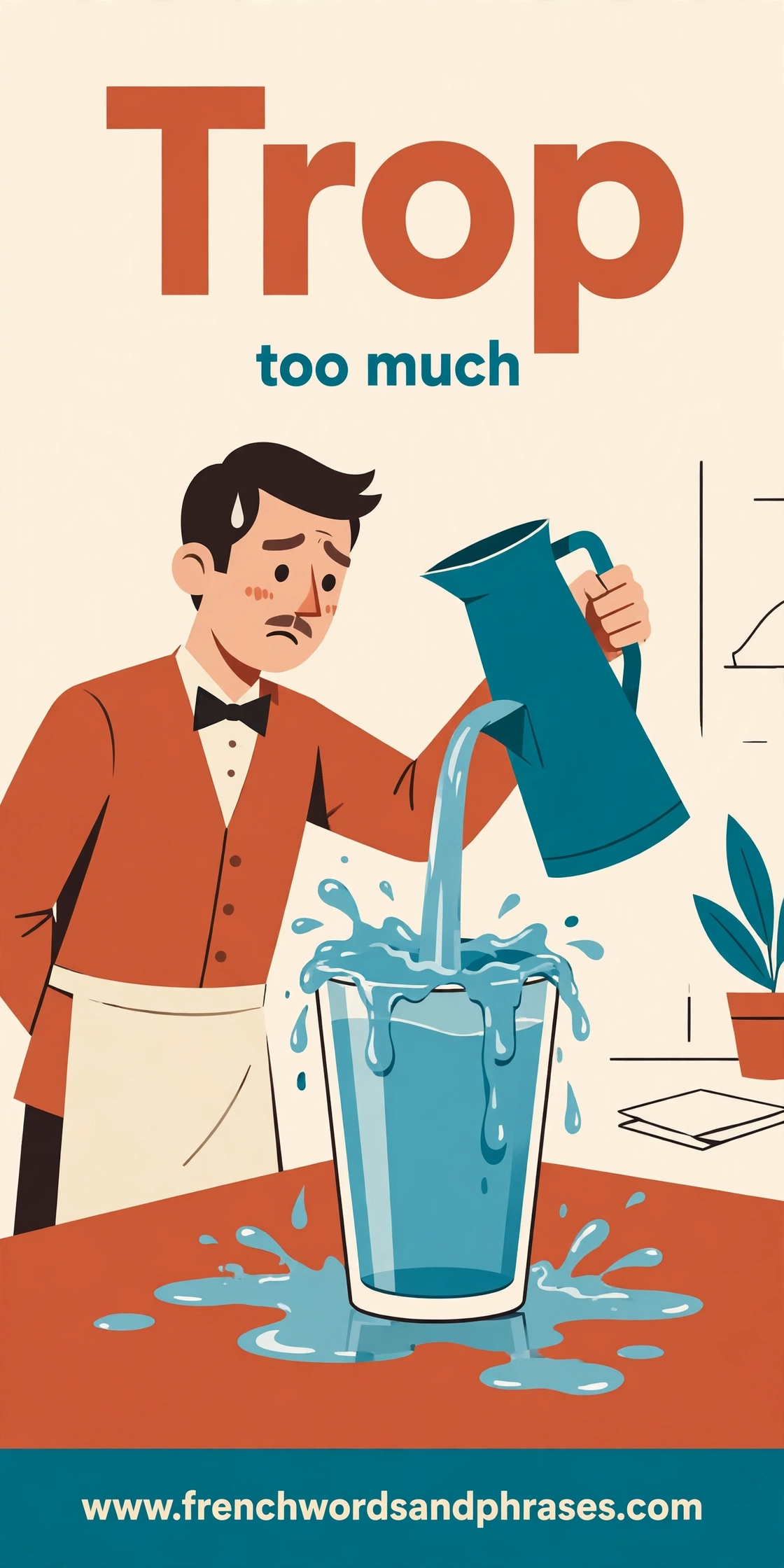
Trop means too much or too many.
The market seller keeps adding plums to the bag — one more, and one more for the road — until the paper gives a small, warning creak. The cook tastes the soup and reaches back for the salt she has already added twice. Wonderful things, both of them, right up to the line where they become trop.
In this guide, you’ll learn what trop means in English, how it works before adjectives and nouns, why it always means too and never just very, and how to say me too without it. Explore French examples, English translations, and practice quizzes.
Understanding the French Adverb Trop
Trop is a French adverb of degree and quantity — the one guest from the quantity family on a list of time words, and welcome for it: few words are used more often in a French day. Adverbs do not change their form, and trop never does. One word, trop, works everywhere.
It means too much — or, with things you can count, too many; and before an adjective, simply too: trop grand, too big. It answers the question how much? with a warning: trop always points past a limit — more than is wanted, more than is good, more than fits. Where très says very and is content, trop says too and shakes its head.
Type: Adverb of degree and quantity
Answers the question: How much?
Changes form: Never — trop is invariable
English equivalents: Too much; too many; too.
One important usage detail: trop is never the word for me too. ‘Me too’ is moi aussi — aussi, not trop. Keep trop for the moment something crosses the line: too hot, too late, too many people, too much noise. And keep it apart from très, which means very and is happy to praise.
Experience the Word
Trop is the adverb of the full glass and the overflowing suitcase. It is spoken at market stalls, at dinner tables, in front of mirrors — wherever more stops being better.
Imagine the grandmother filling a plate for the third time while her grandson waves both hands, laughing: « Non, mamie, c’est trop ! » Everyone at the table understands: the love is not in question, only the quantity.
You have not just counted something. You have found the exact line where enough becomes too much.
How to Use Trop in French: Complete Guide
Let’s explore how trop works in French, beginning with its favourite position: right in front of the word it judges.
Trop at a Glance
Before the details, here is the whole word on one card.
Before the details, here is the whole word on one card.
| Point | Trop |
|---|---|
| Meaning | too, too much, too many |
| Type | adverb of degree and quantity |
| Usual position | before an adjective or adverb, or before de + a noun |
| Form | invariable — and always ‘too’, never just ‘very’ |
Example
Ce café est trop fort pour moi.
This coffee is too strong for me.
Trop before Adjectives and Adverbs
Trop stands directly in front of the word it pushes past the limit — adjectives, adverbs, and even its old friends from this list, tôt and tard.
| Combination | In English |
|---|---|
| trop grand | too big |
| trop cher | too expensive |
| trop vite | too fast |
| trop souvent | too often |
| trop tard | too late |
| trop tôt | too early |
Example
Tu conduis trop vite sur cette petite route.
You drive too fast on this little road.
Quick Quiz 1
What does trop tard mean?
Reveal the answer
Too late
Nous sommes arrivés trop tard, le film avait commencé.
We arrived too late, the film had started.
Trop de + a Noun: Too Much, Too Many
Before a noun, trop takes de — and de never changes, whether the noun is singular, plural, or begins with a vowel (trop d’eau).
| French | In English |
|---|---|
| trop de travail | too much work |
| trop de bruit | too much noise |
| trop de gens | too many people |
| trop de livres | too many books |
| trop d’eau | too much water |
| trop de choses à faire | too many things to do |
Example
Il y a trop de monde dans ce magasin aujourd’hui.
There are too many people in this shop today.
Trop Standing Alone, and C’est Trop
Trop can also stand on its own after a verb — to eat too much, to talk too much — and it powers two of the most expressive exclamations in French.
| French | In English |
|---|---|
| manger trop | to eat too much |
| parler trop | to talk too much |
| c’est trop ! | that’s too much! |
| c’en est trop ! | that’s enough! (I have had it) |
| de trop | extra, one too many — un invité de trop |
| trop peu | too little, too few |
Example
Il travaille trop et il dort trop peu.
He works too much and sleeps too little.
Quick Quiz 2
Complete the sentence:
Il y a trop ______ bruit dans la rue.
Reveal the answer
de
Il y a trop de bruit dans la rue.
There is too much noise in the street. (Trop always takes de before a noun.)
Everyday Expressions with Trop
From warm thank-yous to proverbs, trop is woven all through daily French — sometimes, surprisingly, as a compliment.
| Expression | In English |
|---|---|
| c’est trop gentil | that’s so kind of you (a warm thank-you) |
| pas trop tôt ! | about time! |
| trop beau pour être vrai | too good to be true |
| un de trop | one too many |
| trop, c’est trop | enough is enough |
| merci, c’est trop ! | thank you, that’s too much! (said of a generous gift) |
Example
Un cadeau pour moi ? C’est trop gentil !
A present for me? That’s so kind of you!
Trop or Très? The Line Between Very and Too
The most useful contrast on this page. Très is very — happy to praise. Trop is too — it has crossed a line.
| Pair | In English |
|---|---|
| très grand / trop grand | very big / too big |
| très bien / trop bien | very well / too well (or, in street French, brilliant!) |
| très tôt / trop tôt | very early / too early |
| très content / trop content | very happy / too happy (happiness seldom overflows) |
| très cher / trop cher | very expensive / too expensive |
Example
Ce pull est très beau, mais il est trop cher pour moi.
This jumper is very beautiful, but it is too expensive for me.
Quick Quiz 3
A friend gives you a beautiful gift. What warm words use trop as a compliment?
Reveal the answer
C’est trop gentil !
C’est trop gentil, merci mille fois !
That’s so kind of you, thank you so much!
Trop and Its Neighbours
Quantity has a whole shelf of words. Trop is the one that announces the shelf is full.
| French | In English |
|---|---|
| beaucoup | a lot — happily positive |
| assez | enough — the balance point |
| tellement | so (much) — tellement beau, so beautiful |
| si | so — si tôt, so early |
| pas assez | not enough — the opposite shortage |
| trop peu | too little — trop’s own opposite twin |
Example
Il y a assez de pain, beaucoup de fromage, mais trop peu de vin.
There is enough bread, a lot of cheese, but too little wine.
Watch Out: Me Too Is Not Trop
The classic trap — plus one surprise: on the street, young French speakers use trop bien ! to mean brilliant! Delightful, but informal; in careful French, trop keeps its head-shake.
| Idea | Correct French |
|---|---|
| Me too! | Moi aussi ! (never ‘moi trop’) |
| I love it too | Moi aussi, je l’adore |
| Too good (careful French) | trop beau pour être vrai — too good to be true |
| Brilliant! (street French, informal) | Trop bien ! |
Example
— Je pars demain. — Moi aussi !
— I’m leaving tomorrow. — Me too!
Quick Quiz 4
How do you say Me too in French?
Reveal the answer
Moi aussi
— J’adore ce film. — Moi aussi !
Aussi, not trop: trop is only for what crosses the line.
Trop in Everyday French: Real-Life Examples
Now that you know the word, let’s see how trop appears in everyday French.
Example 1 — At the market
Il y a trop de monde devant l’étal de fromages.
There are too many people in front of the cheese stall.
Example 2 — At the table
Ne mets pas trop de sel dans la soupe.
Don’t put too much salt in the soup.
Example 3 — About the weather
Il fait trop chaud pour travailler dans le jardin.
It is too hot to work in the garden.
Example 4 — At the station
Nous sommes arrivés trop tard pour le dernier train.
We arrived too late for the last train.
Example 5 — A thank-you
Un cadeau pour moi ? C’est trop gentil !
A present for me? That’s so kind of you!
Example 6 — A gentle complaint
Tu parles trop vite, je ne comprends pas tout.
You speak too fast, I don’t understand everything.
Beyond Translation: The Meaning of Trop
English says too much for the meaning of trop — but trop is more than a measure; it is a judgement, the moment quantity becomes character. The French even keep a proverb for it: trop, c’est trop.
To say trop is to draw the line that turns plenty into excess.
And yet the same word, warmed by a smile, becomes the politest thank-you in the language — c’est trop gentil — as if kindness, too, could overflow. Trop is France arguing with itself about the right amount of everything, and enjoying the argument.
How to Remember the French Adverb Trop
Remember it this way: Trop is the word of the line crossed — too much, too many, too — always past the limit, never just very.
- You see the bag about to burst — c’est trop, assez !
- You bolt it in front of the word — trop tard, trop de bruit.
- You answer ‘me too’ with the other word — moi aussi, jamais moi trop.
The key idea is trop = too, past the limit; très = very; moi aussi = me too.
Test Your Knowledge of Trop
Let’s see how much you’ve learned. Try answering these questions before revealing the answers.
Question 1
What does trop always mean — very, or too?
Reveal the answer
Too — past the limit. Very is très.
Question 2
How do you say too much noise?
Reveal the answer
Trop de bruit. (Trop always takes de before a noun.)
Question 3
Translate: There are too many people here.
Reveal the answer
Il y a trop de monde ici.
Question 4
How do you say me too?
Reveal the answer
Moi aussi — never moi trop.
Question 5
Complete the sentence:
Ce pantalon est ______ petit pour moi. (too)
Reveal the answer
trop
Ce pantalon est trop petit pour moi.
These trousers are too small for me.
Your Final Challenge
Can You Use It?
How would you say this in French?
“There is too much noise in the street, and too many people.”
Reveal the answer
Il y a trop de bruit dans la rue, et trop de monde.
There is too much noise in the street, and too many people.
A little French. A little curiosity. A richer everyday life.
LEARN FRENCH ONE WORD AT A TIME