A French Word to Live By
Translate Tout le temps to English
/tul.tɑ̃/
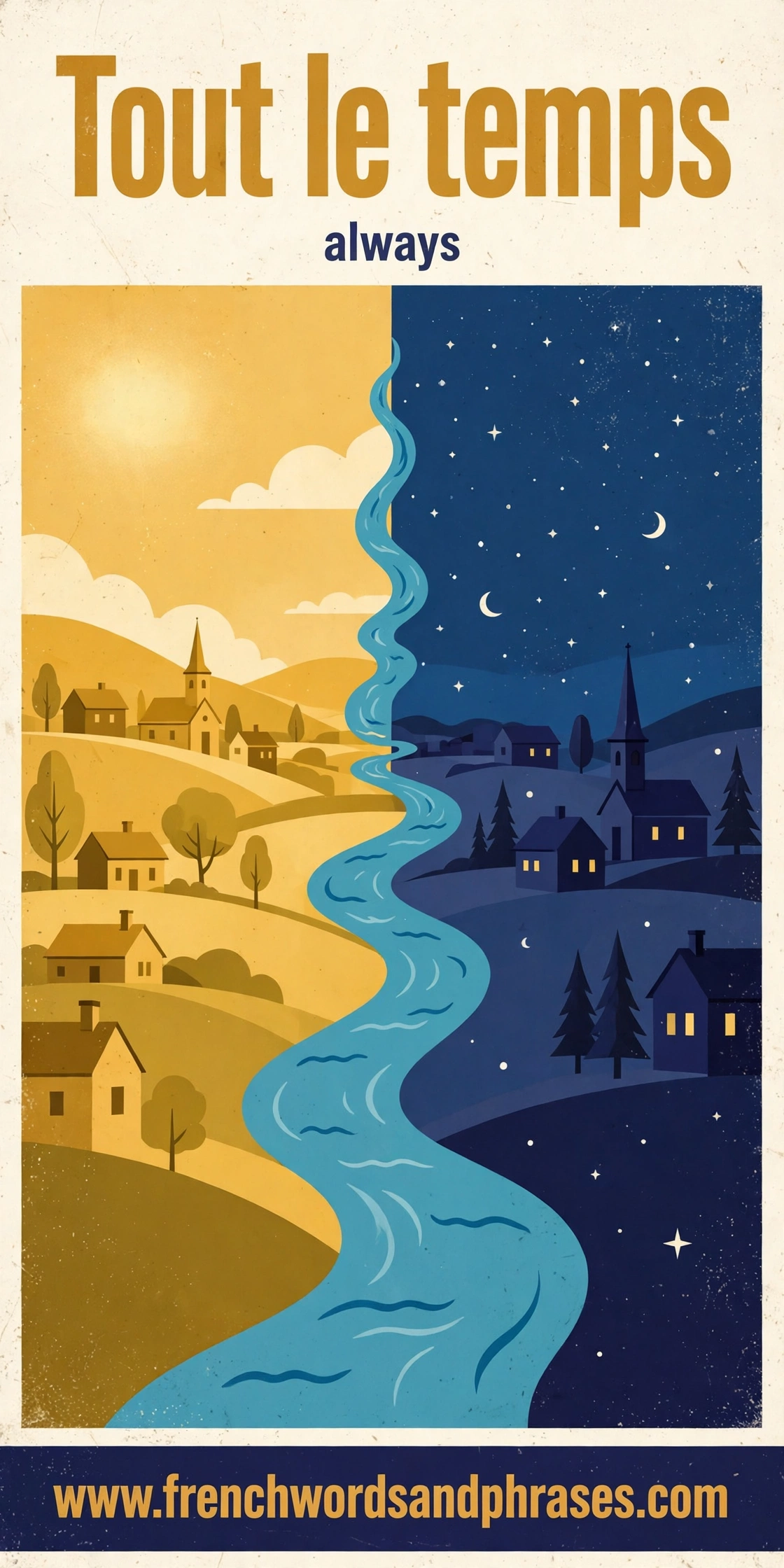
Tout le temps means always — literally “all the time”.
In the little port town, the foghorn sounds in every season, the baker’s shutter rattles up every morning of the year, and old Jacques tells the same story about the storm of ’87 to anyone who sits down. Some things never stop. They happen tout le temps.
In this guide, you’ll learn what tout le temps means in English, where it stands in a sentence, how it differs from toujours, and why it sometimes sounds like a loving complaint. Explore French examples, English translations, and practice quizzes.
Understanding the French Adverb Tout le temps
Tout le temps is a French adverbial phrase — literally, all the time. Three words travel as one adverb, and the phrase never changes its form: le temps sits fixed inside it like a stone in a ring.
It means always — but always with its sleeves rolled up. Where toujours is the clean, simple always, tout le temps stretches the idea across the hours: it stresses duration and constant repetition, something that fills the time without a gap. The rain that never stops, the child who never stops asking questions — tout le temps.
Type: Adverb phrase of frequency and duration
Answers the question: How often? — or for how long?
Changes form: Never — tout le temps is invariable
English equivalents: Always; all the time.
One important usage detail: position. Toujours tucks itself inside the passé composé — j’ai toujours dit, I have always said — but tout le temps waits at the end of the sentence: j’ai parlé tout le temps, I talked the whole time. Put them in each other’s places and the sentence wobbles; French ears notice at once.
Experience the Word
Tout le temps is the adverb of things that fill the days completely — the sea against the harbour wall, the market bell, the grandmother whose soup seems to be on the stove whenever you visit.
Imagine a lighthouse keeper’s logbook: the same entry, in the same hand, for thirty years — wind, tide, lamp lit. Nothing dramatic. Everything constant.
You have not just said always. You have described a life with no gaps in it.
How to Use Tout le temps in French: Complete Guide
Let’s explore how tout le temps works in French, beginning with the place it claims at the end of the sentence.
Tout le Temps at a Glance
Before the details, here is the whole phrase on one card.
Before the details, here is the whole phrase on one card.
| Point | Tout le temps |
|---|---|
| Meaning | always — literally, all the time |
| Type | adverb phrase of frequency and duration |
| Usual position | at the end of the sentence |
| Form | invariable — le temps never changes inside it |
Example
Dans ce village, il pleut tout le temps en novembre.
In this village, it rains all the time in November.
Where Tout le Temps Goes in the Sentence
Unlike toujours, tout le temps is an end-of-sentence phrase: it closes the door after the verb and everything the verb carries.
| Position | Example |
|---|---|
| End of the sentence (its home) | Il pleut tout le temps. |
| After the past participle | J’ai marché tout le temps. |
| At the head, for emphasis | Tout le temps, il faut répéter la même chose. |
| As a complete answer | — Tu viens souvent ? — Tout le temps ! |
Example
Pendant la randonnée, nous avons chanté tout le temps.
During the hike, we sang the whole time.
Quick Quiz 1
Where does tout le temps usually stand in a sentence?
Reveal the answer
At the end
Il se plaint tout le temps.
He complains all the time.
Tout le Temps with Different Tenses
The phrase never changes — only its neighbours do. Here is tout le temps filling the hours across the main tenses.
| Tense | Example |
|---|---|
| Present | Les enfants posent des questions tout le temps. |
| Passé composé | On a marché tout le temps sous la pluie. |
| Imparfait | Autrefois, les trains arrivaient en retard tout le temps. |
| Future | Il fera beau tout le temps pendant les vacances. |
| Conditional | Avec un tel jardin, je serais dehors tout le temps. |
Example
Quand j’étais petit, je lisais tout le temps, même à table.
When I was little, I read all the time, even at the table.
Tout le Temps or Toujours?
The two phrases both translate as always, but they are not interchangeable. Toujours is the clean idea of every time; tout le temps insists that the hours are full.
| Idea | The Right Phrase |
|---|---|
| Every time, without exception | toujours — elle prend toujours le train de sept heures |
| All the time, non-stop | tout le temps — il parle tout le temps |
| The whole time (duration) | tout le temps — on a marché tout le temps |
| Still (the second sense) | toujours — il dort toujours |
| Inside the passé composé | j’ai toujours dit — but j’ai parlé tout le temps |
Example
Elle a toujours aimé la mer, et là-bas, elle nage tout le temps.
She has always loved the sea, and when she is there, she swims all the time.
Quick Quiz 2
Which phrase can mean the whole time — toujours or tout le temps?
Reveal the answer
tout le temps
On a marché tout le temps.
We walked the whole time. Toujours cannot do this job.
Everyday Expressions with Tout le Temps
From gentle complaints to unhurried kindness, these are the tout le temps phrases of daily life.
| Expression | In English |
|---|---|
| tout le temps en train de + infinitive | always in the middle of — il est tout le temps en train de téléphoner |
| c’est tout le temps la même chose | it’s always the same thing |
| prendre tout son temps | to take all the time one needs |
| avoir tout le temps de + infinitive | to have plenty of time to — tu as tout le temps de finir |
| tout le temps ! | all the time! (as an answer) |
Example
Prends tout ton temps, le train ne part pas avant midi.
Take all the time you need, the train doesn’t leave before noon.
The Frequency Scale: Where Tout le Temps Stands
On the ladder of frequency, tout le temps shares the very top rung with toujours — above it, there is nothing.
| Adverb | How often? |
|---|---|
| toujours | always — every time |
| tout le temps | always — all the time, without a pause |
| souvent | often — many times |
| parfois / quelquefois | sometimes — now and then |
| rarement | rarely — hardly ever |
| jamais | never — not once |
Example
Il travaille tout le temps, il ne se repose jamais.
He works all the time, he never rests.
Quick Quiz 3
What does Prends tout ton temps mean?
Reveal the answer
Take all the time you need
Prends tout ton temps, nous ne sommes pas pressés.
Take all the time you need, we are not in a hurry.
Tout le Temps and Its Neighbours
Learn tout le temps with its companions and its far pole, and the whole country of constancy falls into place.
| French | In English |
|---|---|
| toujours | always (and still) — the clean twin |
| sans cesse | non-stop, incessantly |
| constamment | constantly |
| à longueur de journée | all day long |
| en permanence | permanently, always on (a service, a watch) |
| jamais | never — the far pole |
Example
La boulangerie est ouverte en permanence, du matin au soir.
The bakery is open all the time, from morning to evening.
Watch Out: The Sigh Inside Tout le Temps
Two things to feel your way around: its place at the end of the sentence, and its tone — tout le temps often carries a small sigh of complaint that neutral toujours does not.
| Point | Example |
|---|---|
| Neutral habit (toujours) | elle prend toujours son café à huit heures |
| Constant — with a sigh (tout le temps) | elle est tout le temps sur son téléphone |
| Wrong place | j’ai tout le temps parlé — the phrase belongs at the end: j’ai parlé tout le temps |
| Fixed spelling | tout le temps — le temps is masculine; never ‘toute la temps’ |
Example
Les enfants sont tout le temps en train de rire.
The children are always laughing.
Quick Quiz 4
Correct this sentence:
J’ai tout le temps écouté pendant le cours.
Reveal the answer
J’ai écouté tout le temps pendant le cours.
Tout le temps closes the sentence; it does not sit inside the passé composé like toujours.
Tout le temps in Everyday French: Real-Life Examples
Now that you know the word, let’s see how tout le temps appears in everyday French.
Example 1 — At home
Les enfants sont tout le temps en train de jouer dans le jardin.
The children are always playing in the garden.
Example 2 — Weather
Sur cette côte, il y a du vent tout le temps.
On this coast, it is windy all the time.
Example 3 — At work
Il est tout le temps en réunion, on ne le voit jamais.
He is in meetings all the time, we never see him.
Example 4 — With friends
Tu parles tout le temps de ton voyage !
You talk about your trip all the time!
Example 5 — On holiday
Pendant les vacances, on a eu du soleil tout le temps.
During the holidays, we had sunshine the whole time.
Example 6 — A small complaint
Mon frère écoute la même chanson tout le temps.
My brother listens to the same song all the time.
Beyond Translation: The Meaning of Tout le temps
English says all the time for the meaning of tout le temps — and the French phrase keeps the clock inside it: le temps, time itself, gathered up whole.
To say tout le temps is to say: there was no gap, no pause, no exception.
It is warmer and wearier than toujours — the phrase of full days and full hearts, and sometimes of the fond complaint: the rain, the questions, the same beloved song, tout le temps.
How to Remember the French Adverb Tout le temps
Remember it this way: Tout le temps is always with the clock left in — all the time, duration and repetition together.
- You see the hours filling up — il pleut tout le temps, sans un jour de pause.
- You park it at the end of the sentence — je ris tout le temps.
- You hear the fond sigh in it — il parle tout le temps !
The key idea is toujours for every time and still; tout le temps for all the time, at the end of the sentence.
Test Your Knowledge of Tout le temps
Let’s see how much you’ve learned. Try answering these questions before revealing the answers.
Question 1
What does tout le temps literally mean?
Reveal the answer
All the time — tout (all) plus le temps (the time).
Question 2
Where does tout le temps stand in a sentence?
Reveal the answer
At the end — il travaille tout le temps.
Question 3
Translate: We walked the whole time.
Reveal the answer
On a marché tout le temps.
Question 4
Which word means still in il dort toujours — toujours or tout le temps?
Reveal the answer
Toujours — tout le temps cannot mean still.
Question 5
Complete the sentence:
Prends tout ton ______, nous ne sommes pas pressés.
Reveal the answer
temps
Prends tout ton temps, nous ne sommes pas pressés.
Take all the time you need, we are not in a hurry.
Your Final Challenge
Can You Use It?
How would you say this in French?
“During the holidays, we had sunshine the whole time.”
Reveal the answer
Pendant les vacances, nous avons eu du soleil tout le temps.
During the holidays, we had sunshine the whole time.
A little French. A little curiosity. A richer everyday life.
LEARN FRENCH ONE WORD AT A TIME