A French Word to Live By
Translate Tard to English
/taʁ/
Tard means late.
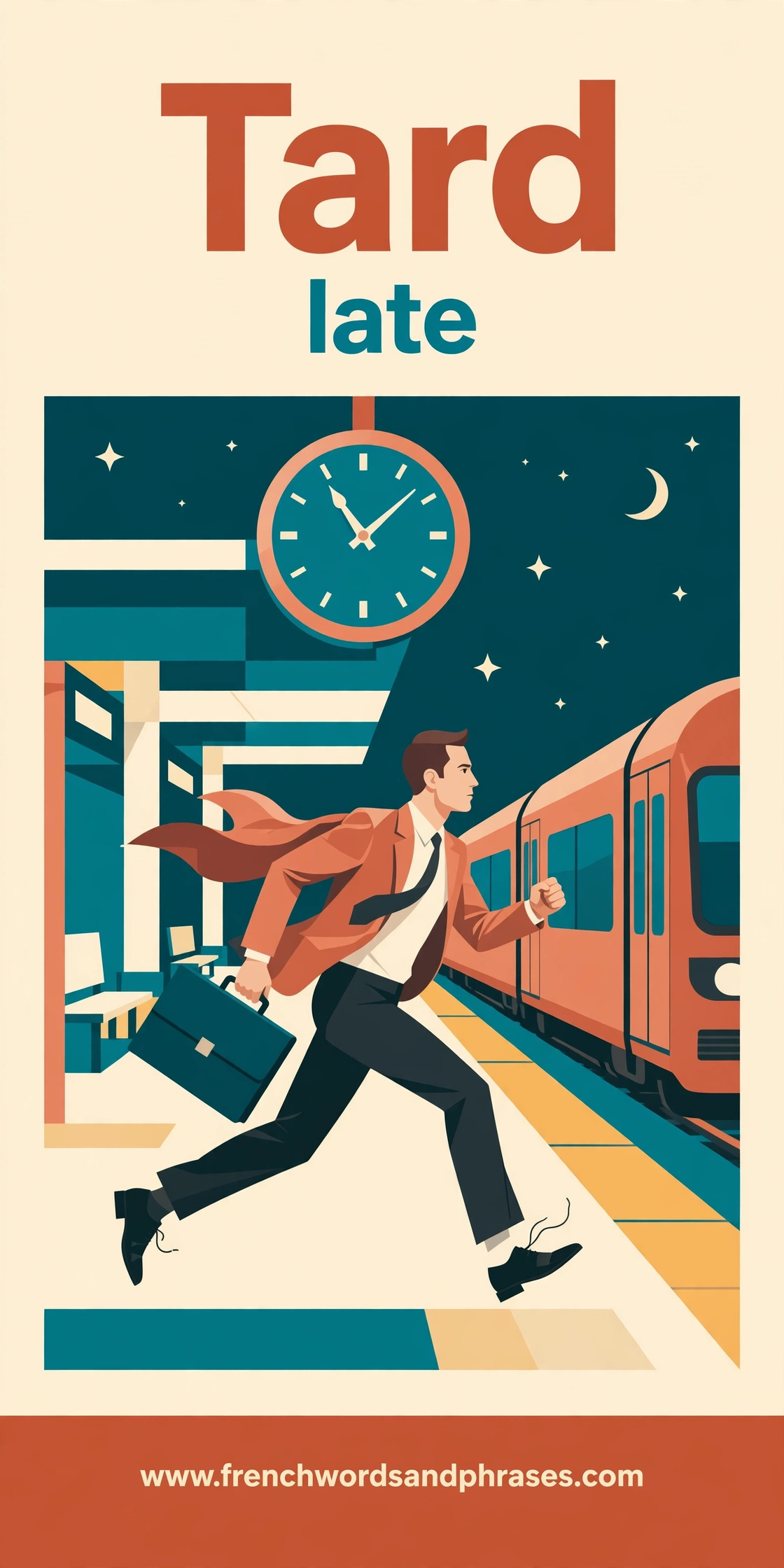
The last train slides into the little station and one passenger steps down, scarf flying, bag half-open, apologising to nobody in particular. The station clock says midnight. He is not in trouble — he is simply, entirely, tard.
In this guide, you’ll learn what tard means in English, where it sits in a French sentence, how it grows into plus tard, and how it differs from en retard. Explore French examples, English translations, and practice quizzes.
Understanding the French Adverb Tard
Tard is a French adverb of time. Adverbs do not change their form — there is no masculine, feminine or plural version to worry about. One word, tard, works everywhere.
It means late. It answers the question when? — after the expected hour, deep into the day or the night. The student who slips into class at ten past, the friend who rings at midnight, the train that finally appears in the dark: all of them live under the sign of tard.
Type: Adverb of time
Answers the question: When?
Changes form: Never — tard is invariable
English equivalents: Late.
One important usage detail: French splits English late in two. Tard is late on the clock — je me couche tard, I go to bed late. But late for something, behind schedule and expected somewhere, is en retard: je suis en retard, I am running late. Clock time takes tard; appointments take en retard.
Experience the Word
Tard is the adverb of the long evening. It belongs to night buses, last trains, owls, and bakers who start work when the rest of the town is finishing its dreams.
Imagine a small apartment above a quiet street at one in the morning: one window still lit, a student finishing an essay, a cat unimpressed. The whole town sleeps, and one lamp says tard.
You have not just looked at the clock. You have felt the day stretch past its edges.
How to Use Tard in French: Complete Guide
Let’s explore how tard works in French, beginning with where it belongs in the sentence.
Tard at a Glance
Before the details, here is the whole word on one card.
Before the details, here is the whole word on one card.
| Point | Tard |
|---|---|
| Meaning | late |
| Type | adverb of time |
| Usual position | after the verb, often at the end of the sentence |
| Form | invariable — never changes |
Example
Je rentre tard ce soir, ne m’attends pas.
I am coming home late tonight, don’t wait up for me.
Where Tard Goes in the Sentence
Tard is a relaxed guest: it likes the end of the sentence, after the verb and its objects, and in the passé composé it politely waits until after the past participle.
| Situation | Pattern |
|---|---|
| Simple tense | verb + tard — je travaille tard |
| With a time phrase | tard le soir, tard dans la nuit — late in the evening, late at night |
| Passé composé | after the participle — il est arrivé tard |
| After an infinitive | rentrer tard, veiller tard — to come home late, to stay up late |
| At the head, for colour | Tard dans la nuit, la ville dort enfin |
Example
Elle est rentrée très tard hier soir.
She got home very late last night.
Quick Quiz 1
Complete the sentence:
Nous avons fini le repas très ______.
Reveal the answer
tard
Nous avons fini le repas très tard.
We finished the meal very late.
Tard with Different Tenses
Tard itself never changes — the verbs around it do all the travelling through time.
| Tense | Example |
|---|---|
| Present | Je me couche tard le vendredi. |
| Passé composé | Le train est arrivé tard. |
| Imparfait | Autrefois, les magasins fermaient tard. |
| Future | Demain, nous rentrerons tard. |
| Conditional | Il vaudrait mieux ne pas rentrer trop tard. |
Example
Quand j’étais étudiant, je veillais toujours tard.
When I was a student, I always stayed up late.
Plus Tard: The Word That Points Forward
Put plus in front of tard and late turns into later — the little phrase that organises diaries, promises and goodbyes.
| French | In English |
|---|---|
| plus tard | later |
| plus tard dans la journée | later in the day |
| à plus tard ! | see you later! |
| au plus tard | at the latest |
| pas plus tard qu’hier | only yesterday, no later than yesterday |
Example
On se voit plus tard, après le travail.
See you later, after work.
Quick Quiz 2
What do you say to a friend you will see again in two hours?
Reveal the answer
À plus tard !
À plus tard, devant le cinéma !
See you later, in front of the cinema!
Making Tard Stronger and Softer
Small words tune tard up and down, from a gentle ‘a little late’ to a hopeless ‘far too late’.
| Combination | In English |
|---|---|
| très tard | very late |
| trop tard | too late |
| un peu tard | a bit late |
| si tard | so late |
| plus tard | later (the comparative of tard) |
Example
Il est trop tard pour prendre le train.
It is too late to catch the train.
Everyday Expressions with Tard
From diaries to proverbs, these are the tard phrases the French reach for without thinking.
| Expression | In English |
|---|---|
| tôt ou tard | sooner or later |
| il se fait tard | it is getting late |
| mieux vaut tard que jamais | better late than never |
| sur le tard | late in the day; late in life |
| à plus tard | see you later |
Example
Il se fait tard, rentrons à la maison.
It is getting late, let’s go home.
Quick Quiz 3
What does tôt ou tard mean?
Reveal the answer
Sooner or later
Tôt ou tard, il comprendra.
Sooner or later, he will understand.
Tard and Its Neighbours
Learn tard with the whole clock family, and you can place any event in a French day.
| French | In English |
|---|---|
| tôt | early — the exact opposite |
| en retard | late, behind schedule (for an appointment) |
| à l’heure | on time |
| en avance | early, ahead of schedule |
| après | after, afterwards |
Example
Elle n’est jamais en retard : toujours à l’heure.
She is never late: always on time.
Watch Out: Tard or En Retard?
The one real trap with this word. English late covers both ideas; French insists that you choose.
| Idea | Correct French |
|---|---|
| Late at night (clock time) | je me couche tard — I go to bed late |
| Late for a meeting (behind schedule) | je suis en retard — I am late |
| The bus is late | le bus est en retard |
| Staying up late | veiller tard |
Example
Le bus est en retard, alors je rentrerai tard.
The bus is late, so I will get home late.
Quick Quiz 4
Correct this sentence:
Je suis tard pour mon rendez-vous.
Reveal the answer
Je suis en retard pour mon rendez-vous.
Late for an appointment is en retard; tard is for the hour on the clock.
Tard in Everyday French: Real-Life Examples
Now that you know the word, let’s see how tard appears in everyday French.
Example 1 — At home
Je me couche tard le vendredi soir.
I go to bed late on Friday evenings.
Example 2 — At the station
Le train de Lyon est arrivé très tard.
The Lyon train arrived very late.
Example 3 — At work
Nous avons travaillé tard pour finir le dossier.
We worked late to finish the file.
Example 4 — With friends
À plus tard, on se retrouve devant le café !
See you later, we’ll meet in front of the café!
Example 5 — At night
Tard dans la nuit, on entendait encore de la musique.
Late at night, you could still hear music.
Example 6 — Making plans
On partira plus tard, après la pluie.
We will leave later, after the rain.
Beyond Translation: The Meaning of Tard
English says late for the meaning of tard — but the French word owns the whole end of the day. It is the hour of the last métro, the all-night bakery, the conversation that refuses to end.
To say tard is to say the day is not finished with you yet.
And tucked inside it is a small philosophy the French repeat with a shrug: mieux vaut tard que jamais — better late than never.
How to Remember the French Adverb Tard
Remember it this way: Tard is late on the clock — deep into the day or the night — and plus tard points the same word toward the future.
- You check the clock at midnight — il est tard, tout le monde dort.
- You say goodbye to a friend — à plus tard !
- You miss the bus and shrug — mieux vaut tard que jamais.
The key idea is tard for the hour on the clock, en retard for an appointment, plus tard for later.
Test Your Knowledge of Tard
Let’s see how much you’ve learned. Try answering these questions before revealing the answers.
Question 1
What does tard mean?
Reveal the answer
Late — late in the day or the night.
Question 2
How do you say see you later?
Reveal the answer
À plus tard !
Question 3
Translate: The train arrived very late.
Reveal the answer
Le train est arrivé très tard.
Question 4
You are late for a lesson. Which do you say: je suis tard or je suis en retard?
Reveal the answer
Je suis en retard — tard is for the hour of the clock.
Question 5
Complete the sentence:
Mieux vaut ______ que jamais.
Reveal the answer
tard
Mieux vaut tard que jamais.
Better late than never.
Your Final Challenge
Can You Use It?
How would you say this in French?
“I am coming home late tonight, don’t wait for me.”
Reveal the answer
Je rentre tard ce soir, ne m’attends pas.
I am coming home late tonight, don’t wait for me.
A little French. A little curiosity. A richer everyday life.
LEARN FRENCH ONE WORD AT A TIME