A French Word to Live By
Translate Rarement to English
/ʁaʁ.mɑ̃/
Rarement means rarely.
Once every few years, the old lighthouse keeper climbs down to the village and stays for the festival — the children stare as if a legend had come to life. Things that happen so seldom get their own word: rarement.
In this guide, you’ll learn what rarement means in English, how it is built from the adjective rare, where it stands on the scale from always to never, and why it does not need ne to do its work. Explore French examples, English translations, and practice quizzes.
Understanding the French Adverb Rarement
Rarement is a French adverb of frequency — one of the quietest on the scale. Adverbs do not change their form — there is no masculine, feminine or plural version to worry about. One word, rarement, works everywhere.
It means rarely — hardly ever, on very few occasions. It answers the question how often? with a small shake of the head: it happens, yes, but almost never. Between parfois (sometimes) and jamais (never), rarement keeps the door barely open.
Type: Adverb of frequency
Answers the question: How often?
Changes form: Never — rarement is invariable
English equivalents: Rarely; seldom; hardly ever.
One important usage detail: rarement does its work on its own, in a sentence that stays positive in form — il vient rarement, he rarely comes. You do not wrap it in ne… the way you do with jamais: « il ne vient rarement » is unusual and heavy. Rarement already carries the rarity inside itself, so the sentence needs no negative around it.
Experience the Word
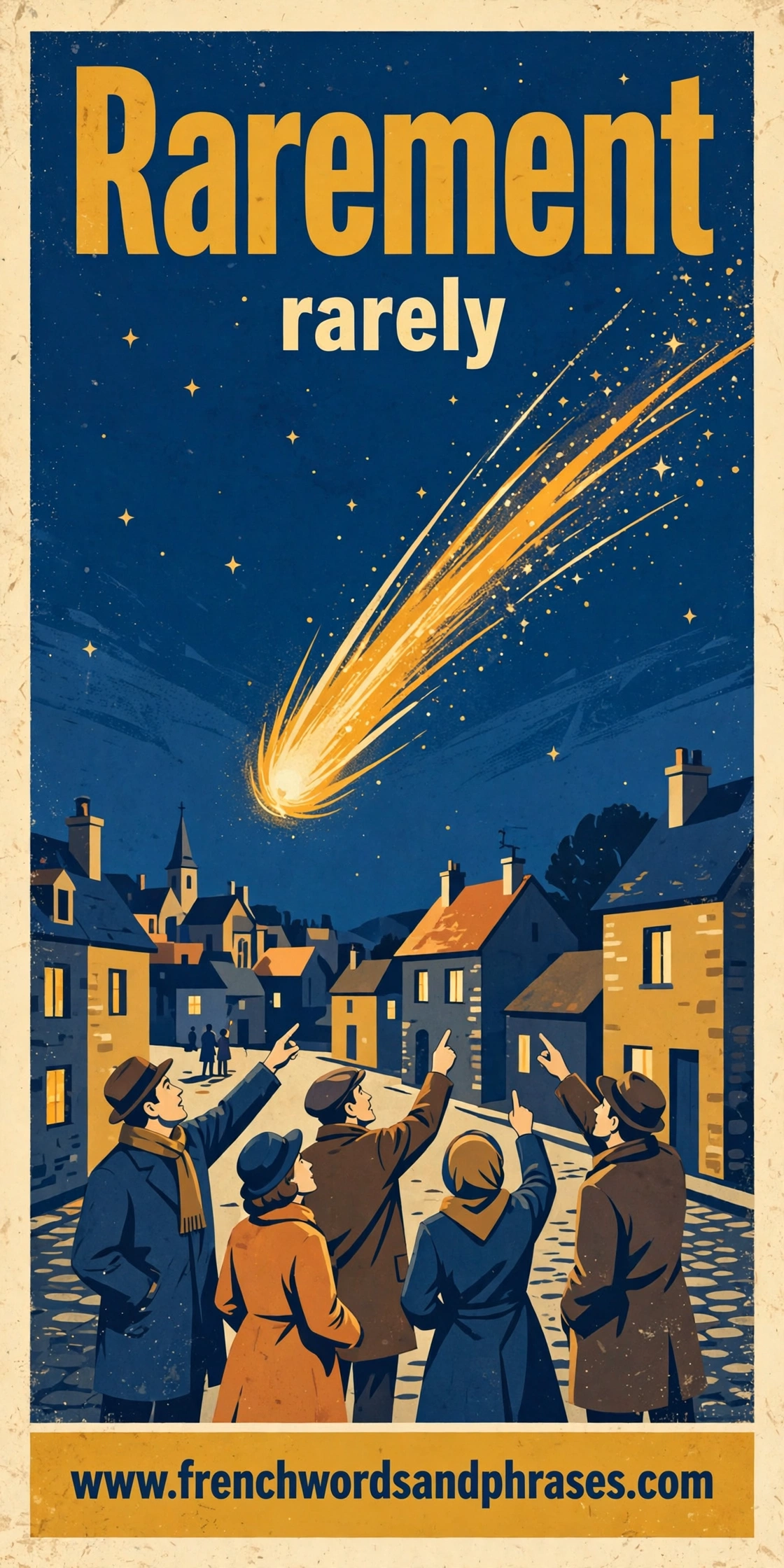
Rarement is the adverb of the almost-never. It is the word for eclipses and comets, for the cousin who writes once a decade, for snow on the Mediterranean coast.
Imagine a village where the church bell rings every hour of every day — and the great festival bell, the one in the tall tower, rings only for weddings and homecomings. When it sounds, everyone stops. That bell is rarement.
You have not just described something uncommon. You have described the event everyone waits for.
How to Use Rarement in French: Complete Guide
Let’s explore how rarement works in French, beginning with where it stands on the scale.
Rarement at a Glance
Before the details, here is the whole word on one card.
Before the details, here is the whole word on one card.
| Point | Rarement |
|---|---|
| Meaning | rarely, hardly ever |
| Type | adverb of frequency |
| Position | right after the verb — and no ne needed |
| Form | invariable — built from rare + -ment |
Example
Il neige rarement dans le sud.
It rarely snows in the south.
Where Rarement Goes — and Why It Stands Alone
Rarement sits right after the verb, and it brings its own rarity with it — no ne required.
| Situation | Pattern |
|---|---|
| Simple tense | verb + rarement — il vient rarement |
| Passé composé | auxiliary + rarement + participle — je suis rarement sorti |
| Head of the sentence | Rarement, + sentence (rare, and literary) |
| With its partner phrase | rarement, sinon jamais — rarely, if ever |
Example
Nous avons rarement vu un hiver si doux.
We have rarely seen such a mild winter.
Quick Quiz 1
Is this sentence natural French?
Il ne vient rarement.
Reveal the answer
No — rarement stands alone
Il vient rarement.
He rarely comes. (No ne is needed: rarement carries the rarity itself.)
Rarement with Different Tenses
The adverb never changes — only its neighbours do. Here is rarement at work across the main tenses.
| Tense | Example |
|---|---|
| Present | Elle mange rarement de la viande. |
| Passé composé | Nous avons rarement pris le bateau. |
| Imparfait | Autrefois, on voyageait rarement loin. |
| Future | Tu auras rarement une telle chance. |
| Conditional | Il sortirait rarement sans son écharpe. |
Example
Quand j’étais enfant, nous allions rarement au restaurant.
When I was a child, we rarely went to a restaurant.
The Frequency Scale: Where Rarement Stands
French frequency adverbs form a ladder from always to never. Rarement stands one step from the bottom — it happens, but barely.
| Adverb | How often? |
|---|---|
| toujours | always — every time |
| souvent | often — many times |
| parfois / quelquefois | sometimes — now and then |
| rarement | rarely — hardly ever |
| jamais | never — not once |
Example
Il fait souvent beau en été, mais il pleut rarement en août.
The weather is often fine in summer, but it rarely rains in August.
Quick Quiz 2
Which is less frequent: rarement or parfois?
Reveal the answer
Rarement
Rarement means rarely; parfois means sometimes — a step higher on the scale.
How Rarement Is Formed
Rarement is built the simple way: the adjective rare ends in a vowel sound, so -ment simply attaches itself.
| Step | French |
|---|---|
| The adjective | rare (rare, uncommon) |
| Add the ending | rare + -ment |
| The result | rarement |
| Same pattern | vrai → vraiment (really) |
| Same pattern | poli → poliment (politely) |
| Contrast | fréquent → fréquemment (adjectives in -ent change more) |
Example
Un tel événement est rarement annoncé à l’avance.
Such an event is rarely announced in advance.
Everyday Expressions with Rarement
Rarement in the phrases where French sums up the almost-never.
| Expression | In English |
|---|---|
| rarement, sinon jamais | rarely, if ever |
| c’est rarement le cas | that is rarely the case |
| rarement vu, rarement égalé | rarely seen, rarely equalled |
| rarement seul | rarely alone |
| on le voit rarement | you rarely see it |
Example
C’est rarement le cas en hiver.
That is rarely the case in winter.
Quick Quiz 3
What does rarement, sinon jamais mean?
Reveal the answer
Rarely, if ever
Il se plaint rarement, sinon jamais.
He rarely, if ever, complains.
Rarement and Its Neighbours
The quiet end of the scale — and the word that faces rarement from the top of it.
| French | In English |
|---|---|
| peu souvent | not often, rarely (its everyday cousin) |
| presque jamais | almost never |
| parfois | sometimes (one step up) |
| souvent | often (the opposite) |
Example
Il sort peu souvent depuis l’hiver.
He has rarely been out since winter.
Watch Out: Common Mistakes with Rarement
The biggest trap is habit: adding the ne that rarement does not need.
| Mistake | Correct French |
|---|---|
| Il ne vient rarement. (ne added out of habit) | Il vient rarement. |
| Rarement il vient, as the everyday order (English style) | Il vient rarement. — rarement opens a sentence only in literary French. |
| Un oiseau rarement (adverb where the adjective belongs) | Un oiseau rare. |
| Rarement used to mean never | Jamais means never — rarement still happens, just barely. |
Example
Un arc-en-ciel en décembre, on en voit rarement.
A rainbow in December — you rarely see one.
Quick Quiz 4
Does rarement need ne before the verb?
Reveal the answer
No
Il vient rarement.
He rarely comes. (Rarement carries the rarity itself.)
Rarement in Everyday French: Real-Life Examples
Now that you know the word, let’s see how rarement appears in everyday French.
Example 1 — Weather
Il neige rarement dans cette région.
It rarely snows in this region.
Example 2 — At work
Mon chef part rarement avant dix-neuf heures.
My boss rarely leaves before seven in the evening.
Example 3 — Food
Nous mangeons rarement au restaurant.
We rarely eat at a restaurant.
Example 4 — Travel
Elle prend rarement l’avion.
She rarely flies.
Example 5 — Habits
Je regarde rarement la télévision le matin.
I rarely watch television in the morning.
Example 6 — Nature
On voit rarement des cerfs près du village.
You rarely see deer near the village.
Beyond Translation: The Meaning of Rarement
English says rarely for the meaning of rarement — seldom, hardly ever. The French word keeps the adjective rare inside it, the same word used for a rare stamp, a rare talent, a rare bird: scarcity gives rarement its value.
To say rarement is to say: treasure it when it comes.
The eclipse, the letter from the faraway cousin, the perfect peach summer — rarement things are the ones stories are made of. What happens every day becomes the background; what happens rarement becomes the memory.
How to Remember the French Adverb Rarement
Remember it this way: Rarement is rare plus -ment — rarely, standing alone without ne, one step above never.
- You see the adjective inside it — rare, then rarement.
- You leave ne at home — il vient rarement, tout simplement.
- You place it on the ladder — below parfois, above jamais: rarement.
The key idea is rarely, from rare, positive in form — rarement, sinon jamais.
Test Your Knowledge of Rarement
Let’s see how much you’ve learned. Try answering these questions before revealing the answers.
Question 1
What does rarement mean?
Reveal the answer
Rarely — hardly ever, on very few occasions.
Question 2
Does rarement need ne before it?
Reveal the answer
No — il vient rarement. Rarement carries the rarity itself; ne… rarement is unusual.
Question 3
Translate: It rarely snows in the south.
Reveal the answer
Il neige rarement dans le sud.
Question 4
What separates rarement from jamais?
Reveal the answer
Jamais means never — not once. Rarement still happens, just barely.
Question 5
Complete the sentence:
Nous avons ______ vu un hiver si doux.
Reveal the answer
rarement
Nous avons rarement vu un hiver si doux.
We have rarely seen such a mild winter.
Your Final Challenge
Can You Use It?
How would you say this in French?
“We rarely eat at a restaurant.”
Reveal the answer
Nous mangeons rarement au restaurant.
We rarely eat at a restaurant.
A little French. A little curiosity. A richer everyday life.
LEARN FRENCH ONE WORD AT A TIME