A French Word to Live By
Translate Puis to English
/pɥi/
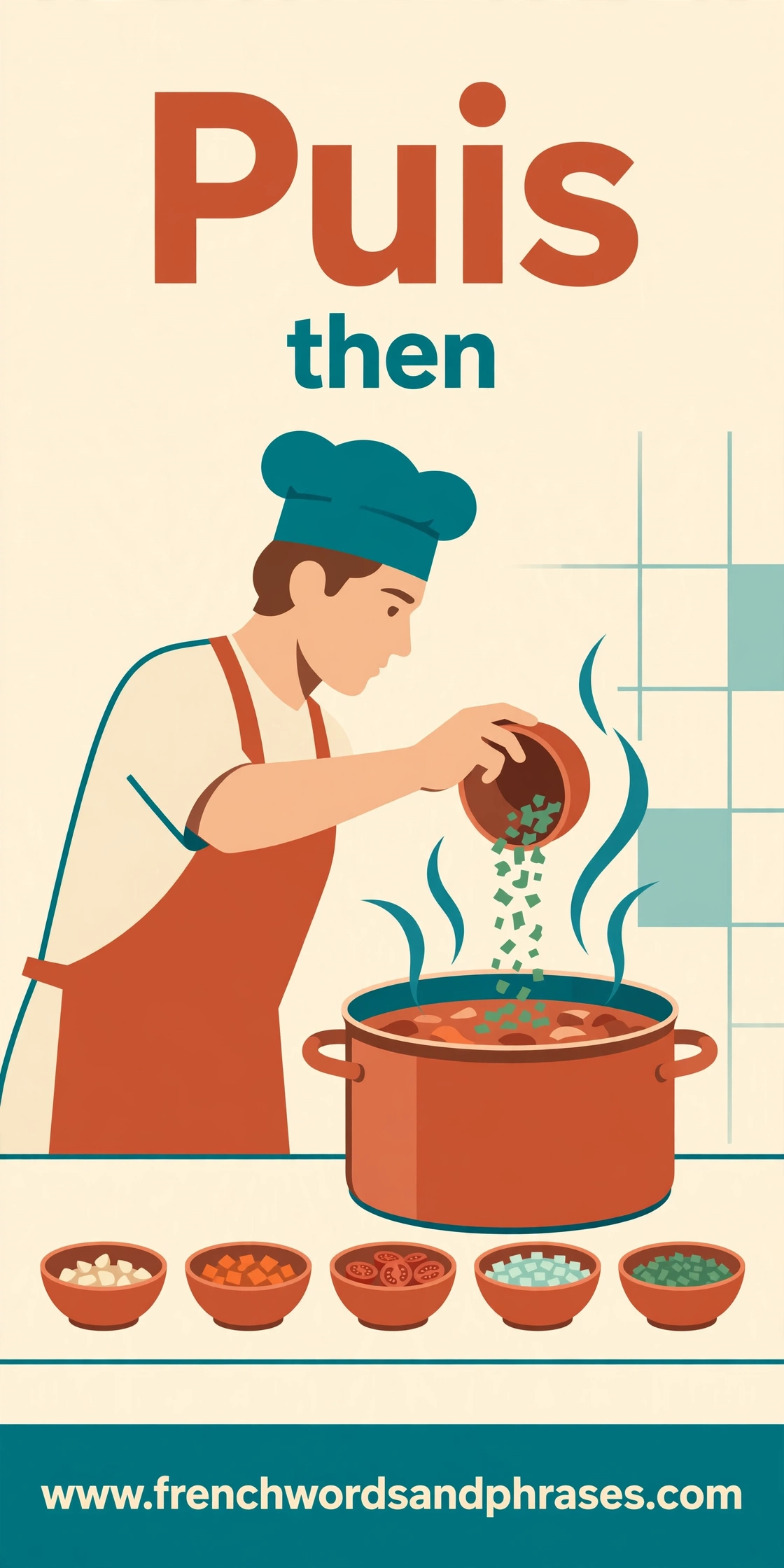
Puis means then.
First the flour, then the water, then the long wait while the dough rises — the baker counts the morning in small steps. Between each step, one small word does the carrying: puis.
In this guide, you’ll learn what puis means in English, how it marches in the sequence family with d’abord, ensuite and enfin, and how et puis adds its own flavour of ‘and then’ — and ‘besides’. Explore French examples, English translations, and practice quizzes.
Understanding the French Adverb Puis
Puis is a French adverb of sequence — the storyteller’s adverb. Adverbs do not change their form — there is no masculine, feminine or plural version to worry about. One word, puis, works everywhere.
It means then — next, after that. It answers the question what happens next? and moves a story, a recipe or a set of instructions one step forward. It is a very short word with a very big job: without puis, nothing in French would ever reach the second step.
Type: Adverb of sequence (time)
Answers the question: What happens next?
Changes form: Never — puis is invariable
English equivalents: Then; next.
One important usage detail: do not confuse puis with depuis. They look like brothers but do opposite jobs: puis moves the story forward (then), while depuis looks back over a stretch of time (since, for — depuis lundi, since Monday). One word hides inside the other, and the difference is everything.
Experience the Word
Puis is the adverb of the next step. It is the word of recipes, journeys and life stories — the small hinge on which every narrative swings.
Imagine a grandmother teaching a child to make crêpes: first the flour, puis the eggs, puis the milk, puis — the hardest part — the waiting. Each puis is a gentle hand on the child’s shoulder, guiding them to the next bowl.
You have not just listed events. You have set a story in motion.
How to Use Puis in French: Complete Guide
Let’s explore how puis works in French, beginning with the family it belongs to.
Puis at a Glance
Before the details, here is the whole word on one card.
Before the details, here is the whole word on one card.
| Point | Puis |
|---|---|
| Meaning | then, next |
| Type | adverb of sequence |
| Family | d’abord — puis — ensuite — enfin |
| Form | invariable — never changes |
Example
Il a ouvert la porte, puis il est entré.
He opened the door, then he went in.
The Sequence Family: D’abord, Puis, Ensuite, Enfin
Puis marches in a famous line of four. Learn them together and you can tell any story in French.
| Word | In English |
|---|---|
| d’abord | first, first of all |
| puis | then, next (the step after the first) |
| ensuite | then, afterwards (the steps that follow) |
| après | after, afterwards |
| enfin | finally, at last |
Example
D’abord on trie les lettres, puis on les distribue.
First we sort the letters, then we deliver them.
Quick Quiz 1
Which word opens a sequence: puis or d’abord?
Reveal the answer
D’abord
D’abord le café, puis le travail.
First coffee, then work.
Where Puis Goes in a Sentence
Puis sits between two actions, like a bridge — usually just before the subject of the next step.
| Situation | Pattern |
|---|---|
| Between two actions | action, puis + subject + verb — il est arrivé, puis il a téléphoné |
| After et | et puis — and then |
| In a chain | d’abord…, puis…, puis…, enfin… |
| As a question | Et puis ? — And then? |
Example
Elle a payé, puis elle est partie.
She paid, then she left.
Puis Tells the Story: In Every Kind of Sentence
Stories, instructions, plans — puis drives them all forward, whatever the tense.
| Use | Example |
|---|---|
| Telling what happened | Il a sonné, puis il est entré. |
| Scene, then event | Tout dormait ; puis un bruit a réveillé la maison. |
| Giving instructions | Vous mélangez, puis vous laissez reposer. |
| Making plans | Nous partirons, puis nous visiterons le musée. |
Example
Vous tournez à gauche, puis vous continuez tout droit.
You turn left, then you carry straight on.
Quick Quiz 2
Complete the instruction:
Vous mélangez la pâte, ______ vous la laissez reposer.
Reveal the answer
puis
Vous mélangez la pâte, puis vous la laissez reposer.
You mix the dough, then you leave it to rest.
Et Puis: And Then — and Besides
With et in front of it, puis gains a second life: it adds not just a next step, but a next reason.
| Combination | In English |
|---|---|
| et puis | and then |
| et puis aussi | and then also |
| et puis ? | and then? / so what? |
| et puis après tout | and besides, after all |
| et puis voilà | and that’s that, and there you go |
Example
Il a pris son manteau, et puis il est sorti sans un mot.
He took his coat, and then he went out without a word.
Everyday Expressions with Puis
Puis at work in stories, plans and kitchen instructions.
| Expression | In English |
|---|---|
| d’abord… puis… | first… then… |
| puis un jour | then one day |
| puis soudain | then suddenly |
| puis ensuite | then next (the friendly pair) |
| et puis c’est tout | and then that’s all |
Example
Puis un jour, la petite maison fut vendue.
Then one day, the little house was sold.
Quick Quiz 3
What does et puis c’est tout mean?
Reveal the answer
And then that’s all
Il a dit merci, et puis c’est tout.
He said thank you, and then that’s all.
Puis and Its Neighbours
The words that share puis’s work — each with its own shade of then.
| French | In English |
|---|---|
| ensuite | then, afterwards (its closest partner) |
| après | after that |
| alors | so, well then (the spoken favourite) |
| deuxièmement | secondly (in formal lists) |
Example
Il a déjeuné, puis il a fait une sieste.
He had lunch, then he took a nap.
Watch Out: Common Mistakes with Puis
The traps here are famous: a look-alike word, and a question that is not the adverb at all.
| Mistake | Correct French |
|---|---|
| Depuis, il est entré. (depuis means since, for) | Puis il est entré. |
| Taking puis-je for the adverb puis + je | Puis-je…? means May I…? — it is the verb pouvoir in a question. |
| « OK then » translated by puis | Alors / bon — puis links steps; it does not close a conversation. |
| Puis in every single clause of a story | Vary the chain: d’abord, puis, ensuite, enfin. |
Example
Puis-je entrer ?
May I come in?
Quick Quiz 4
What does puis-je mean — and is it the adverb puis?
Reveal the answer
May I…? — and no.
Puis-je vous aider ?
May I help you? (Puis-je is the verb pouvoir turned into a question.)
Puis in Everyday French: Real-Life Examples
Now that you know the word, let’s see how puis appears in everyday French.
Example 1 — A recipe
Ajoutez le lait, puis mélangez doucement.
Add the milk, then mix gently.
Example 2 — Directions
Tournez à gauche, puis continuez tout droit.
Turn left, then carry straight on.
Example 3 — A story
Il est rentré tard, puis il a préparé le dîner.
He came home late, then he made dinner.
Example 4 — Travel
Nous avons visité Rome, puis Florence.
We visited Rome, then Florence.
Example 5 — At school
D’abord les maths, puis l’histoire.
First maths, then history.
Example 6 — A phone call
Je finis ce travail, puis je t’appelle.
I’ll finish this job, then I’ll call you.
Beyond Translation: The Meaning of Puis
English says then for the meaning of puis — a good, plain word. But puis carries the whole French art of order: the recipe that must not be rushed, the story that unfolds step by step, the day arranged from d’abord to enfin.
To say puis is to promise that something follows.
It is the smallest of hinges, and everything swings on it — doors, stories, lives. And in its friendly form, et puis, it does a second job: it adds one more reason, one more thing — and then, and besides, and after all.
How to Remember the French Adverb Puis
Remember it this way: Puis is the second step of every French story — then, next, the hinge between actions.
- You chant the family — d’abord, puis, ensuite, enfin.
- You keep it apart from its look-alike — puis goes forward, depuis looks back.
- You hear it in the kitchen — ajoutez, puis mélangez.
The key idea is then — the second step, never to be confused with depuis.
Test Your Knowledge of Puis
Let’s see how much you’ve learned. Try answering these questions before revealing the answers.
Question 1
What does puis mean?
Reveal the answer
Then — next, after that.
Question 2
Name the sequence family in order.
Reveal the answer
D’abord (first), puis (then), ensuite (then), enfin (finally).
Question 3
Translate: First the flour, then the eggs.
Reveal the answer
D’abord la farine, puis les œufs.
Question 4
What does puis-je mean — and is it the adverb?
Reveal the answer
May I…? — no: puis-je is the verb pouvoir turned into a question, not the adverb puis.
Question 5
Complete the sentence:
Nous sommes arrivés, ______ nous avons dîné.
Reveal the answer
puis
Nous sommes arrivés, puis nous avons dîné.
We arrived, then we had dinner.
Your Final Challenge
Can You Use It?
How would you say this in French?
“Turn left, then carry straight on.”
Reveal the answer
Tournez à gauche, puis continuez tout droit.
Turn left, then carry straight on.
A little French. A little curiosity. A richer everyday life.
LEARN FRENCH ONE WORD AT A TIME