A French Word to Live By
Translate Précédemment to English
/pʁe.se.da.mɑ̃/
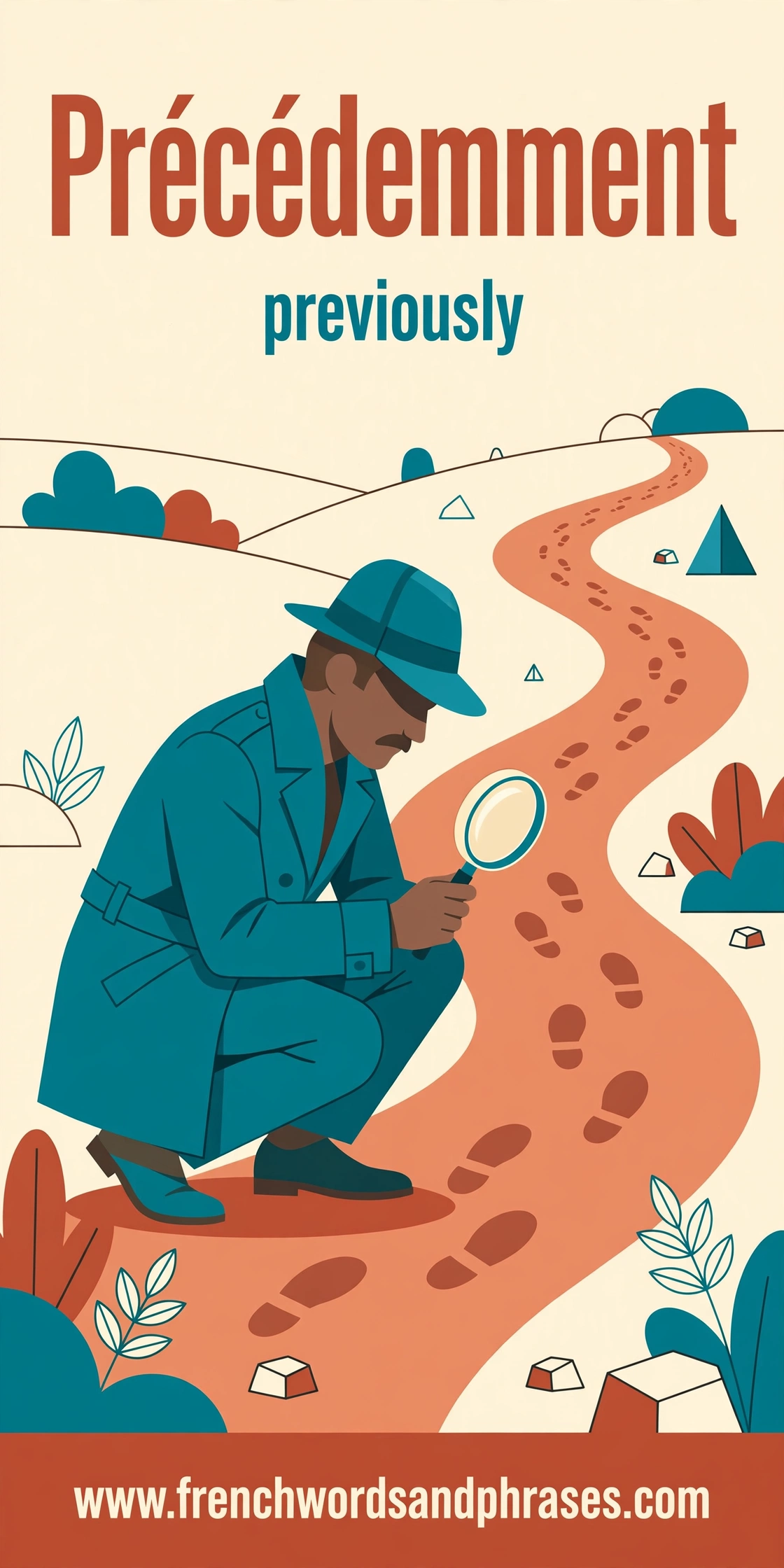
Précédemment means previously.
The letter begins: « Comme je vous l’ai écrit précédemment… » — as I wrote to you before. The reader turns back a page, and the story doubles back on itself. That step backwards is précédemment.
In this guide, you’ll learn what précédemment means in English, how it is built from the adjective précédent, where it points in a text, and how it differs from auparavant and autrefois. Explore French examples, English translations, and practice quizzes.
Understanding the French Adverb Précédemment
Précédemment is a French adverb of time. Adverbs do not change their form — there is no masculine, feminine or plural version to worry about. One word, précédemment, works everywhere.
It means previously — at an earlier point, before the moment you have reached. It answers the question when? by pointing backwards: to an earlier page, an earlier job, an earlier chapter of a story. It is a word of documents and narratives — the finger that taps the line above and says: we have been here before.
Type: Adverb of time
Answers the question: When? — at an earlier point
Changes form: Never — précédemment is invariable
English equivalents: Previously; earlier; before.
One important usage detail: précédemment is a word of writing — reports, letters, instructions, stories. In everyday speech, the French more often say avant or auparavant (before, beforehand). Reaching for précédemment gives a sentence a careful, official flavour — exactly right for pointing back to something said earlier.
Experience the Word
Précédemment is the adverb of the thread through the labyrinth. It is the word that keeps a long story — or a long life — from losing its way.
Imagine a notary reading a will aloud: names, dates, a house, a field, each clause leaning on one written before it. « Comme indiqué précédemment… » — as stated earlier — and the whole room turns back through the pages together.
You have not just pointed at the past. You have tied the present sentence to the one before it.
How to Use Précédemment in French: Complete Guide
Let’s explore how précédemment works in French, beginning with how the word is built.
Précédemment at a Glance
Before the details, here is the whole word on one card.
Before the details, here is the whole word on one card.
| Point | Précédemment |
|---|---|
| Meaning | previously, earlier |
| Type | adverb of time |
| Home ground | writing, reports and stories |
| Form | invariable — never changes |
Example
Comme dit précédemment, le magasin ferme à midi.
As said previously, the shop closes at noon.
How Précédemment Is Formed
Adjectives ending in -ent build their adverb in -emment, and précédent follows the rule.
| Step | French |
|---|---|
| The adjective | précédent (previous) |
| The rule | final -ent becomes -emment |
| The result | précédemment |
| Same pattern | récent → récemment |
| Same pattern | évident → évidemment |
| How it sounds | the ending is pronounced « a-man » |
Example
Le chapitre précédent annonçait déjà ce personnage.
The previous chapter already introduced this character.
Quick Quiz 1
How does the ending of précédemment sound?
Reveal the answer
Like « a-man » — the -emment ending sounds the same as -amment.
Comme expliqué précédemment…
As explained previously…
Where Précédemment Goes in the Sentence
Précédemment loves the head of a sentence and the company of comme — as in comme dit précédemment.
| Situation | Pattern |
|---|---|
| Head of the sentence | Précédemment, + sentence — its favourite place |
| In the frame comme… | comme mentionné précédemment |
| After the verb | il a précédemment travaillé à Lyon |
| Before a past participle | précédemment cité — previously mentioned |
Example
Précédemment, elle habitait à Nantes.
Previously, she lived in Nantes.
Précédemment Points Back: With the Past Tenses
A word that points backwards naturally keeps company with the past tenses.
| Tense | Example |
|---|---|
| Passé composé | Il a précédemment vécu en Italie. |
| Imparfait | Précédemment, elle travaillait dans une banque. |
| Plus-que-parfait | Comme il l’avait précédemment expliqué, le plan avait changé. |
| Passé simple (in stories) | Précédemment, le village connut une grande sécheresse. |
Example
Précédemment, la famille habitait une petite maison près de la rivière.
Previously, the family lived in a small house near the river.
Quick Quiz 2
Complete the sentence:
______, elle travaillait dans une banque. (Previously)
Reveal the answer
Précédemment
Précédemment, elle travaillait dans une banque.
Previously, she worked in a bank.
Précédemment, Auparavant, Avant: The Words of Before
French has several words for looking back. Each points at a slightly different before.
| French | In English |
|---|---|
| précédemment | previously (an earlier point in a text or story) |
| auparavant | before that, beforehand (an earlier moment in time) |
| avant | before (mostly a preposition: avant midi) |
| autrefois | in the old days (long ago) |
| plus tôt | earlier (sooner than expected) |
Example
Auparavant, il faut lire ce qui a été écrit précédemment.
Beforehand, you must read what was written previously.
Everyday Expressions with Précédemment
Précédemment lives in letters, reports and instructions — these are its set phrases.
| Expression | In English |
|---|---|
| comme dit précédemment | as said previously |
| comme mentionné précédemment | as mentioned previously |
| voir précédemment | see earlier (above) |
| précédemment publié | previously published |
| précédemment connu sous le nom de… | previously known as… |
Example
Le groupe, précédemment connu sous un autre nom, joue ce soir.
The group, previously known by another name, is playing tonight.
Quick Quiz 3
What does comme dit précédemment mean?
Reveal the answer
As said previously
Comme dit précédemment, la réunion est reportée.
As said previously, the meeting is postponed.
Précédemment and Its Neighbours
The family of looking back — from the recent past to the distant one.
| French | In English |
|---|---|
| auparavant | beforehand, before that |
| avant | before |
| autrefois | formerly, in the old days |
| jadis | long ago (literary) |
| déjà | already (its forward-looking cousin) |
Example
Jadis, les rois passaient par cette route.
Long ago, kings passed along this road.
Watch Out: Common Mistakes with Précédemment
The ending is the trap — and so is using this written word where speech wants a simpler one.
| Mistake | Correct French |
|---|---|
| précédament (wrong ending) | précédemment — adjectives in -ent take -emment |
| previousement (a word that does not exist) | précédemment |
| Il a travaillé avant à Lyon, in a formal report (too bare) | Il a précédemment travaillé à Lyon. |
| Avant, je vous l’ai dit. (avant alone, pointing into a text) | Comme je vous l’ai dit précédemment. |
Example
Comme indiqué précédemment, les inscriptions ferment vendredi.
As indicated previously, registrations close on Friday.
Quick Quiz 4
From which adjective is précédemment built?
Reveal the answer
Précédent (previous) — adjectives in -ent form their adverb in -emment.
Le chapitre précédent, comme dit précédemment…
The previous chapter, as said previously…
Précédemment in Everyday French: Real-Life Examples
Now that you know the word, let’s see how précédemment appears in everyday French.
Example 1 — In a letter
Comme je vous l’ai écrit précédemment, la réunion est reportée.
As I wrote to you previously, the meeting is postponed.
Example 2 — At work
Il a précédemment travaillé dans une banque à Lyon.
He previously worked in a bank in Lyon.
Example 3 — In a story
Précédemment, la famille habitait près de la rivière.
Previously, the family lived near the river.
Example 4 — In instructions
Voir précédemment pour la liste des documents.
See earlier for the list of documents.
Example 5 — In the news
Le ministre, précédemment maire de la ville, revient demain.
The minister, previously the town’s mayor, returns tomorrow.
Example 6 — Talking about a book
Le héros, précédemment prisonnier, s’échappe enfin.
The hero, previously a prisoner, finally escapes.
Beyond Translation: The Meaning of Précédemment
English says previously for the meaning of précédemment — and the two words are cousins, both built on the idea of going before. But the French word keeps the shape of the adjective précédent: the one that goes in front, that walks ahead.
To say précédemment is to walk back along your own sentence.
It belongs to notaries and novelists, to reports and long letters — anywhere a text must remember itself. Every précédemment is a small act of honesty: what I say now stands on what was said before.
How to Remember the French Adverb Précédemment
Remember it this way: Précédemment is précédent plus the -emment ending — previously, the pointing-back word of written French.
- You see the adjective inside it — précédent, then précédemment.
- You remember the rule — adjectives in -ent take -emment: récent, récemment; précédent, précédemment.
- You save it for writing — in speech, avant and auparavant carry you.
The key idea is previously, built on précédent, at home in writing.
Test Your Knowledge of Précédemment
Let’s see how much you’ve learned. Try answering these questions before revealing the answers.
Question 1
What does précédemment mean?
Reveal the answer
Previously — at an earlier point, before now.
Question 2
From which adjective is précédemment built?
Reveal the answer
Précédent (previous) — adjectives in -ent form their adverb in -emment.
Question 3
Translate: As said previously, the meeting is postponed.
Reveal the answer
Comme dit précédemment, la réunion est reportée.
Question 4
Which words would you use in conversation instead of précédemment?
Reveal the answer
Avant or auparavant — précédemment belongs mainly to writing.
Question 5
Complete the sentence:
______, elle habitait à Nantes.
Reveal the answer
Précédemment
Précédemment, elle habitait à Nantes.
Previously, she lived in Nantes.
Your Final Challenge
Can You Use It?
How would you say this in French?
“Previously, the family lived near the river.”
Reveal the answer
Précédemment, la famille habitait près de la rivière.
Previously, the family lived near the river.
A little French. A little curiosity. A richer everyday life.
LEARN FRENCH ONE WORD AT A TIME