
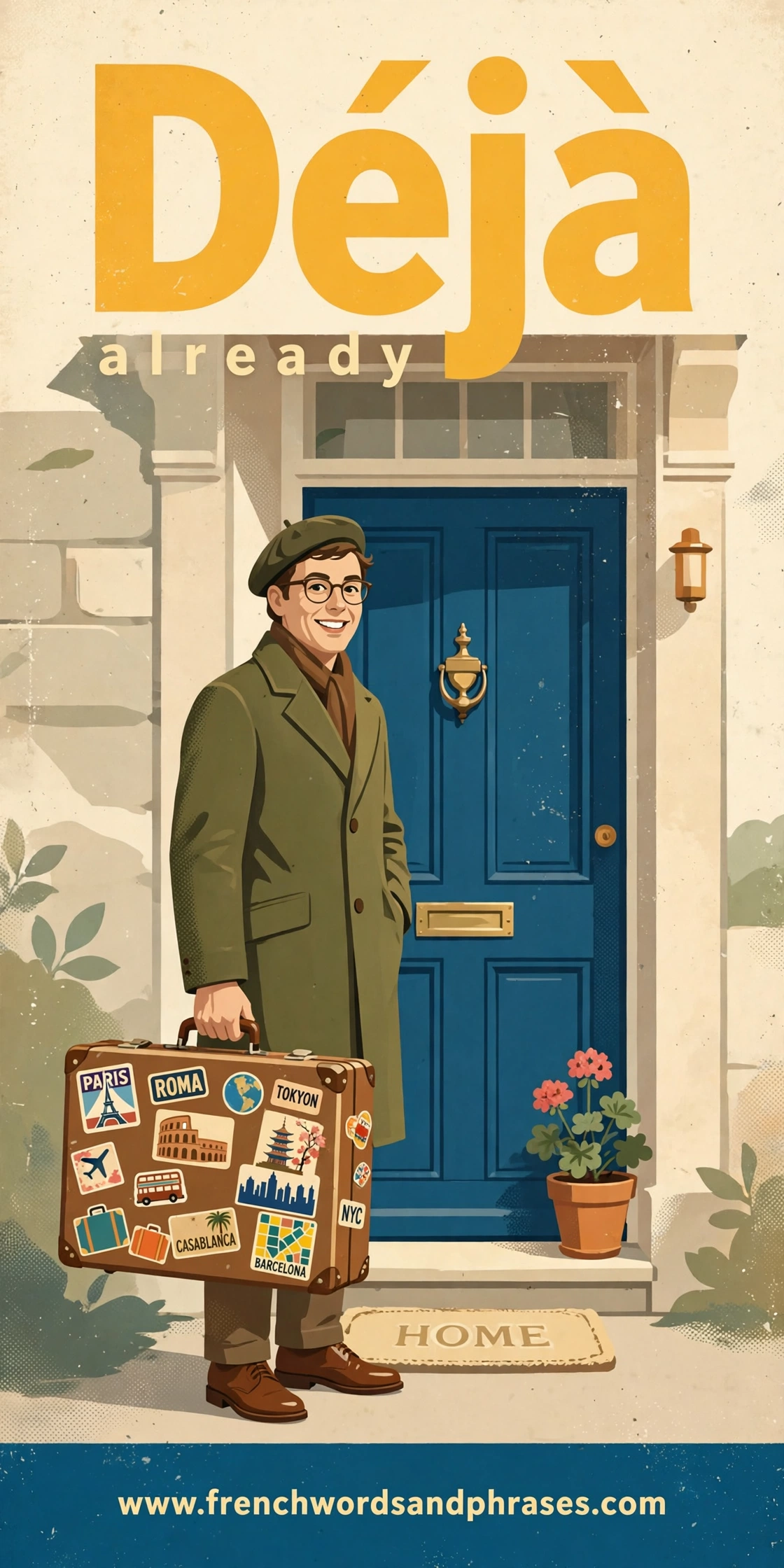
A French Word to Live By
Translate Déjà to English
/de.ʒa/
Déjà means already.
The train has not even left the station and the little boy has finished his sandwich, opened his book and asked twice if they are nearly there. His mother laughs: already? That impatience, that surprise, is déjà.
In this guide, you’ll learn what déjà means in English, where it sits in a sentence, how it partners with the passé composé, and how the French use it to say « remind me ». Explore French examples, English translations, and practice quizzes.
Understanding the French Adverb Déjà
Déjà is a French adverb of time. It is a small word with two old pieces inside — dès and jà, both once meaning « by now » — but today it is simply one word, and like every adverb it never changes its form.
It means already: something has happened sooner than expected, or before the moment we are talking about. Tu as déjà fini ? — have you already finished? carries a little gasp of surprise. In questions about experience — Tu es déjà allé à Paris ? — it does the work of the English « ever »: have you ever been to Paris?
Type: Adverb of time
Answers the question: By when? — by now, by then?
Changes form: Never — déjà is invariable
English equivalents: Already; ever (in questions about experience).
One important usage detail: déjà sits right after the verb in simple tenses — je sais déjà — and between the auxiliary and the past participle in the passé composé: j’ai déjà lu ce livre. It almost never waits at the end of the sentence the way « already » can in English.
Experience the Word
Déjà is the adverb of surprise at the speed of life. It is the word of children grown tall between two summers, of trains that leave too soon, of letters answered before you expected.
Imagine returning to a village after twenty years and finding the little café repainted, the baker retired, his daughter at the counter. Déjà ? you think. Already?
You have not just noted a fact about time. You have felt time move.
How to Use Déjà in French: Complete Guide
Let’s explore how déjà works in French, beginning with the word on one card.
Déjà: Sooner Than You Thought
Déjà is the sound of the clock moving faster than expected — a tiny word, but it changes the temperature of every sentence it touches.
Déjà at a Glance
Before the details, here is the whole word on one card.
| Point | Déjà |
|---|---|
| Meaning | already |
| Type | adverb of time |
| Usual position | right after the verb; before the past participle |
| Form | invariable — never changes |
Example
Le bébé dort déjà.
The baby is already asleep.
Where Déjà Goes in the Sentence
Déjà hugs the verb. In simple tenses it follows the conjugated verb; in compound tenses it slips between the auxiliary and the participle; in a question about your name, it waits charmingly at the end.
| Situation | Pattern |
|---|---|
| Simple tense | verb + déjà — tu sais déjà |
| Passé composé | auxiliary + déjà + participle — j’ai déjà mangé |
| Emphasis | Déjà + verb — déjà fini ? |
| The « remind me » question | …, déjà ? — tu t’appelles comment, déjà ? |
Example
Nous avons déjà réservé l’hôtel.
We have already booked the hotel.
Quick Quiz 1
Where does déjà go in this sentence?
Elle a ______ lu le journal.
Reveal the answer
déjà goes between the auxiliary and the participle
Elle a déjà lu le journal.
She has already read the newspaper.
Déjà with Different Tenses
Déjà looks backwards from any point in time — now, then, or a moment in a story — and says: by this point, it was done.
| Tense | Example |
|---|---|
| Present | Il fait déjà nuit. |
| Passé composé | J’ai déjà vu ce film. |
| Imparfait | Il faisait déjà nuit quand nous sommes partis. |
| Plus-que-parfait | À midi, elle avait déjà fini. |
| Future | À ton arrivée, nous aurons déjà mangé. |
| Conditional | Sans ton aide, il aurait déjà abandonné. |
Example
Quand je suis arrivé, le spectacle avait déjà commencé.
When I arrived, the show had already begun.
Déjà in Questions: Experience and « Remind Me »
In questions, déjà does two charming jobs: it asks about life experience, like the English « ever », and it politely asks someone to repeat a forgotten detail.
| Question | In English |
|---|---|
| Tu as déjà goûté ce plat ? | Have you ever tasted this dish? |
| Vous êtes déjà venu ici ? | Have you been here before? |
| Comment tu t’appelles, déjà ? | What is your name again? (remind me) |
| C’est quel jour, déjà ? | What day is it again? |
| On se retrouve à quelle heure, déjà ? | What time are we meeting again? |
Example
Tu as déjà visité le château de Chambord ?
Have you ever visited the château de Chambord?
Quick Quiz 2
What does « Tu t’appelles comment, déjà ? » really ask?
Reveal the answer
« Remind me of your name »
Déjà at the end of a question asks for a forgotten detail: What was your name again?
Déjà and Encore: Already and Not Yet
Déjà and encore are dance partners. Déjà celebrates what is done; pas encore mourns — or patiently awaits — what is not.
| French | In English |
|---|---|
| c’est déjà fait | it is already done |
| pas encore | not yet |
| Tu as déjà mangé ? | Have you eaten already? |
| Non, pas encore. | No, not yet. |
| Il est déjà tard, mais le train n’est pas encore là. | It is already late, but the train is not here yet. |
Example
Le gâteau est déjà au four, mais il n’est pas encore cuit.
The cake is already in the oven, but it is not cooked yet.
Everyday Expressions with Déjà
Déjà pops up in exclamations and small mercies all over French conversation.
| Expression | In English |
|---|---|
| Déjà ! | Already! (a cry of surprise) |
| c’est déjà ça | that is something, at least |
| c’est déjà pas mal | that is not bad at all, that is a good start |
| déjà vu | déjà vu (borrowed by English, French for « already seen ») |
| tu as déjà fini ?! | you have finished already?! |
Example
Cent euros pour ce travail ? C’est déjà pas mal.
A hundred euros for this job? That is not bad at all.
Quick Quiz 3
How do you say « not yet » in French?
Reveal the answer
Pas encore
Il n’est pas encore arrivé.
He has not arrived yet.
Déjà and Its Neighbours
Learn déjà among its time-word neighbours and the whole clock of French falls into place.
| French | In English |
|---|---|
| encore | still; again — and pas encore, not yet |
| toujours | still (in questions: tu dors toujours ?) |
| bientôt | soon — presque déjà, almost already |
| maintenant | now — déjà makes now look early |
| jamais | ever, with a negative: tu n’as jamais…? |
Example
Tu travailles toujours ici ? Je croyais que tu étais déjà parti.
You still work here? I thought you had already left.
Watch Out: Common Mistakes with Déjà
Two traps: one of position, one of meaning — English « yet » is not déjà.
| Mistake | Correct French |
|---|---|
| J’ai mangé déjà. (adverb stranded at the end) | J’ai déjà mangé. |
| Using déjà for « yet » in a negative sentence | pas encore — il n’est pas encore là |
| Forgetting the surprise inside déjà | déjà always hints « sooner than expected » — for a plain fact, it may not be needed |
| Writing « déja » without the accent | déjà — the accent is part of the word |
Example
Elle n’a pas encore répondu, mais lui a déjà téléphoné.
She has not replied yet, but he has already phoned.
Quick Quiz 4
Correct this sentence:
Nous avons visité déjà trois musées.
Reveal the answer
Nous avons déjà visité trois musées.
Déjà belongs between the auxiliary and the past participle.
Déjà in Everyday French: Real-Life Examples
Now that you know the word, let’s see how déjà appears in everyday French.
Example 1 — Surprise at home
Tu as déjà fini tes devoirs ?!
You have already finished your homework?!
Example 2 — At the station
Le train est déjà parti, hélas.
The train has already left, alas.
Example 3 — Talking about a film
J’ai déjà vu ce film deux fois.
I have already seen this film twice.
Example 4 — Experience
Tu es déjà allé en Provence ?
Have you ever been to Provence?
Example 5 — A forgotten detail
Ton frère s’appelle comment, déjà ?
What is your brother’s name again?
Example 6 — Small mercies
Il ne pleut plus : c’est déjà ça.
It has stopped raining: that is something, at least.
Beyond Translation: The Meaning of Déjà
English says already for the meaning of déjà — but déjà carries a raised eyebrow inside it. It is never quite neutral: it marvels, it protests, it teases. The child is already tall; the holidays are already over; you have already forgotten my name?
To say déjà is to argue gently with the clock.
It evokes grandparents measuring grandchildren against a door frame, travellers watching the countryside rush past, and the whole bittersweet French awareness that time flies — le temps passe, et déjà, c’est fini.
How to Remember the French Adverb Déjà
Remember it this way: Déjà means already — sooner than expected — and it hugs the verb, slipping before the past participle in the passé composé.
- You marvel at a finished task — tu as déjà fini ?
- You ask about experience — tu es déjà allé à Paris ?
- You fish for a forgotten name — tu t’appelles comment, déjà ?
The key idea is déjà = already and ever, placed before the participle; pas encore = not yet.
Test Your Knowledge of Déjà
Let’s see how much you’ve learned. Try answering these questions before revealing the answers.
Question 1
What does déjà mean?
Reveal the answer
Already — and in questions about experience, it works like « ever ».
Question 2
Where does déjà go in the passé composé?
Reveal the answer
Between the auxiliary and the past participle — j’ai déjà fini.
Question 3
Translate: Have you already eaten?
Reveal the answer
Tu as déjà mangé ?
Question 4
How do you say « not yet »?
Reveal the answer
Pas encore — the partner of déjà.
Question 5
Complete the sentence:
Ils sont ______ arrivés à l’hôtel.
Reveal the answer
déjà
Ils sont déjà arrivés à l’hôtel.
They have already arrived at the hotel.
Your Final Challenge
Can You Use It?
How would you say this in French?
“We have already visited the castle twice.”
Reveal the answer
Nous avons déjà visité le château deux fois.
We have already visited the castle twice.
A little French. A little curiosity. A richer everyday life.
LEARN FRENCH ONE WORD AT A TIME




