A French Word to Live By
Translate Main to English
/mɛ̃/
Une main means a hand.
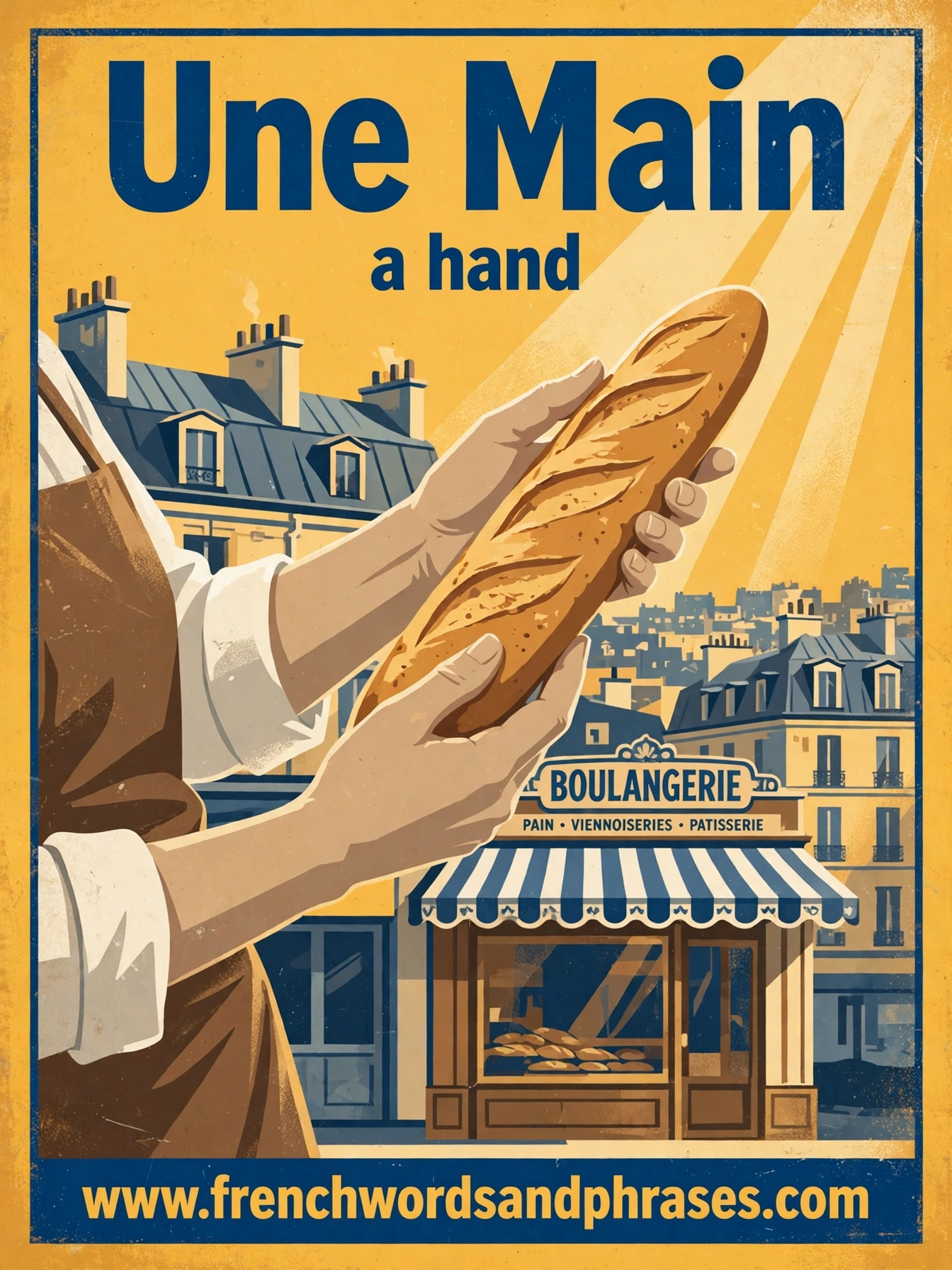
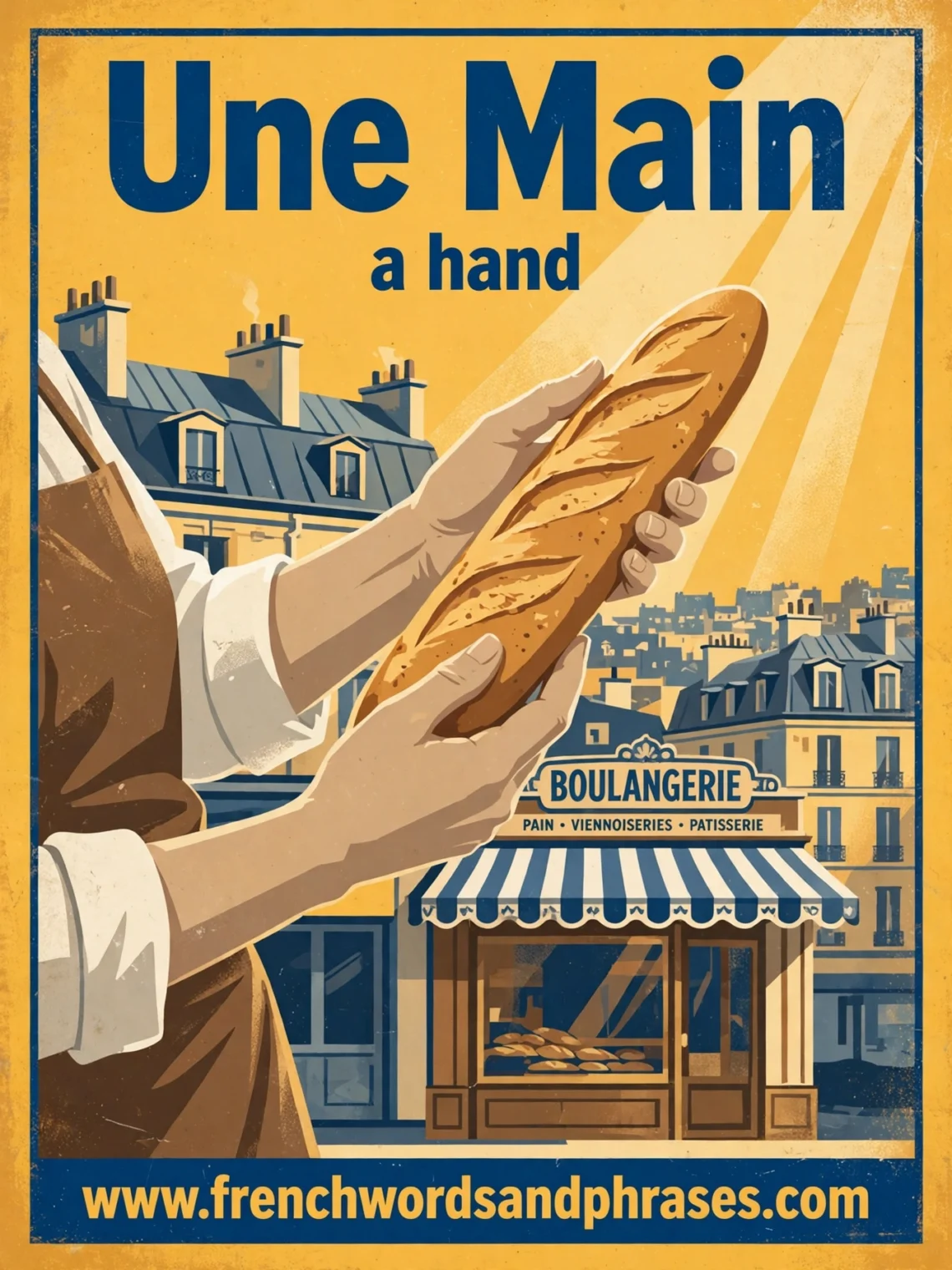
The baker passes the warm loaf across the counter, the old man at the next table folds his newspaper, a child waves at the passing train. Everything in France seems to pass, sooner or later, through two hands: that is la main.
In this guide, you’ll learn what main means in English, how to use it with its articles, how to form its plural, and how it appears in everyday French. Explore French examples, English translations, and practice quizzes.
Understanding the French Noun Main
Main is a feminine French noun. Like every French noun, it has a gender, and it is learned together with its article: une main.
It means a hand — and it reaches far beyond the wrist. Main is the handshake that opens every working day, the helping hand of un coup de main, the handwriting on a letter, the cards in a game of poker, and the workmanship in fait main, handmade. French does almost everything with its mains.
Gender: Feminine
Definite article: la — la main (the hand)
Indefinite article: une — une main (a hand)
Plural: les mains (the hands)
English equivalents: A hand; a helping hand (un coup de main); handwriting.
One golden rule for body parts: French uses the definite article where English uses a possessive. Je me lave les mains is ‘I wash my hands’, and Lève la main is ‘raise your hand’ — the la and les do the work, with the reflexive pronoun saying whose hands they are. Once this clicks, a hundred sentences fall into place.
Experience the Word
Main is more than a body part in France. It is the instrument of greeting, of cooking, of making — the part of us that meets the world first.
Imagine the bakery at opening time: the hand that takes the warm bread, the hand that counts the coins, the hand raised in greeting to a neighbour — a whole morning conducted in gestures.
You have not just used your hands. You have spoken with them.
How to Use Main in French: Complete Guide
Let’s explore how main works in French, beginning with its articles.
Main and Its Articles
French nouns are almost never used alone. The small word in front of the noun — the article — does a great deal of work.
Main with the Definite Article (La, Les)
Used for hands in general — and, by the golden rule, for your own hands after a reflexive verb.
| Number | French |
|---|---|
| Singular | la main |
| Plural | les mains |
Example
Il écrit de la main gauche.
He writes with his left hand.
Main with the Indefinite Article (Une, Des)
Used to count or introduce hands — one hand free, both hands full.
| Number | French |
|---|---|
| Singular | une main |
| Plural | des mains |
Example
Elle tient le bébé d’une main et le téléphone de l’autre.
She holds the baby in one hand and the phone in the other.
Main, Right and Left (Droite, Gauche)
Hands come in pairs, and French names them constantly — in directions, in gloves, in writing.
| Meaning | French |
|---|---|
| the right hand | la main droite |
| the left hand | la main gauche |
| both hands | les deux mains |
| by hand | à la main |
| handmade | fait main |
Example
Ce pull est fait main par ma grand-mère.
This sweater is handmade by my grandmother.
Quick Quiz 1
How do you say ‘Raise your hand’ in French — with la or ta?
Reveal the answer
Lève la main.
Lève la main si tu connais la réponse.
Raise your hand if you know the answer. (Body parts take la, not ta.)
The Plural of Main
The plural adds the usual silent -s: les mains — the pair you do everything with.
| Number | French |
|---|---|
| Singular | la main |
| Plural | les mains |
Example
Elle se lave les mains avant de manger.
She washes her hands before eating.
Main with Possessive Adjectives (Ma, Ta, Sa…)
Possessives agree with the noun — main is feminine, so ma, ta, sa. French often prefers la main with a reflexive, but possessives appear when the hand belongs to someone else, or needs emphasis.
| Owner | French |
|---|---|
| my | ma main |
| your (tu) | ta main |
| his / her | sa main |
| our | notre main |
| your (vous) | votre main |
| their | leur main |
Example
Elle a posé sa main sur mon épaule.
She put her hand on my shoulder.
Quick Quiz 2
Complete the sentence:
Je me lave ______ mains avant le dîner.
Reveal the answer
les
Je me lave les mains avant le dîner.
I wash my hands before dinner.
Main with Demonstrative Adjectives (Cette, Ces)
Used to point: this hand here, those hands there.
| Number | French |
|---|---|
| Singular | cette main |
| Plural | ces mains |
Example
Regarde cette main : elle est couverte de farine !
Look at this hand: it is covered in flour!
Main with Adjectives
Adjectives agree with main — feminine — and come after it.
| Adjective | With Main |
|---|---|
| droite (right) | la main droite |
| gauche (left) | la main gauche |
| propre (clean) | une main propre |
| douce (soft) | une main douce |
| forte (strong) | une main forte |
| chaude (warm) | une main chaude |
Example
Le chirurgien a une main forte et précise.
The surgeon has a strong, precise hand.
Quick Quiz 3
Why les mains in ‘je me lave les mains’ — not mes mains?
Reveal the answer
Because French body parts take the definite article
Je me lave les mains.
I wash my hands. (The reflexive me already says whose hands they are.)
Everyday Expressions with Main
Main shakes, helps, waves and works — its expressions run through the whole French day.
| Expression | In English |
|---|---|
| un coup de main | a helping hand |
| serrer la main à quelqu’un | to shake someone’s hand |
| lever la main | to raise one’s hand |
| main dans la main | hand in hand |
| mettre la main à la pâte | to pitch in, to lend a hand |
| avoir la main verte | to have a green thumb |
Example
Tu peux me donner un coup de main ?
Can you give me a hand?
Words from the Same Family as Main
Learn these together and the whole world of hands, handles and handshakes falls into place.
| French | In English |
|---|---|
| une poignée de main | a handshake |
| manuel | manual, done by hand |
| une manche | a sleeve |
| une manette | a lever; a game controller |
| manipuler | to handle, to operate |
| la main-d’œuvre | labour, the workforce |
Example
Ils se sont dit bonjour avec une poignée de main.
They greeted each other with a handshake.
Quick Quiz 4
What is un coup de main?
Reveal the answer
A helping hand
Tu peux me donner un coup de main ?
Can you give me a hand?
Main in Everyday French: Real-Life Examples
Now that you know the word, let’s see how main appears in everyday French.
Example 1 — In class
À l’école, on lève la main avant de parler.
At school, you raise your hand before speaking.
Example 2 — Before dinner
Je me lave les mains avant le dîner.
I wash my hands before dinner.
Example 3 — Asking for help
Tu peux me donner un coup de main avec ces valises ?
Can you give me a hand with these suitcases?
Example 4 — A greeting
En arrivant au bureau, il serre la main à tout le monde.
When he arrives at the office, he shakes everyone’s hand.
Example 5 — Hand in hand
Les enfants marchent main dans la main dans le parc.
The children walk hand in hand in the park.
Example 6 — A green thumb
Elle a la main verte : son jardin est magnifique.
She has a green thumb: her garden is magnificent.
Beyond Translation: The Meaning of Main
English says hand for the meaning of main — but the French word carries the whole culture of touch: the morning round of handshakes at the office, the cook’s hand in the dough, the maker’s hand in everything fait main.
To say main is to say what a person can do.
It evokes help offered and accepted, work done properly, and greetings exchanged one hand at a time — a country that still shakes hands with its mornings.
How to Remember the French Noun Main
Remember it this way: Main is the hand that greets, helps and makes — feminine, and nearly always introduced by la.
- You ask a question in class — tu lèves la main.
- You wash before dinner — tu te laves les mains.
- You ask for help — un coup de main, s’il te plaît.
The key idea is la main for your own hand, un coup de main for help.
Test Your Knowledge of Main
Let’s see how much you’ve learned. Try answering these questions before revealing the answers.
Question 1
Is main masculine or feminine?
Reveal the answer
Feminine — la main, une main.
Question 2
Translate: Can you give me a hand?
Reveal the answer
Tu peux me donner un coup de main ?
Question 3
Why les mains in ‘je me lave les mains’?
Reveal the answer
Body parts take the definite article, and the reflexive me says whose they are.
Question 4
What is une poignée de main?
Reveal the answer
A handshake.
Question 5
Complete the sentence:
Ils se serrent ______ main.
Reveal the answer
la
Ils se serrent la main.
They shake hands.
Your Final Challenge
Can You Use It?
How would you say this in French?
“Can you give me a hand with these bags?”
Reveal the answer
Tu peux me donner un coup de main avec ces sacs ?
Can you give me a hand with these bags?
A little French. A little curiosity. A richer everyday life.
LEARN FRENCH ONE WORD AT A TIME