A French Word to Live By
Translate Place to English
/plas/
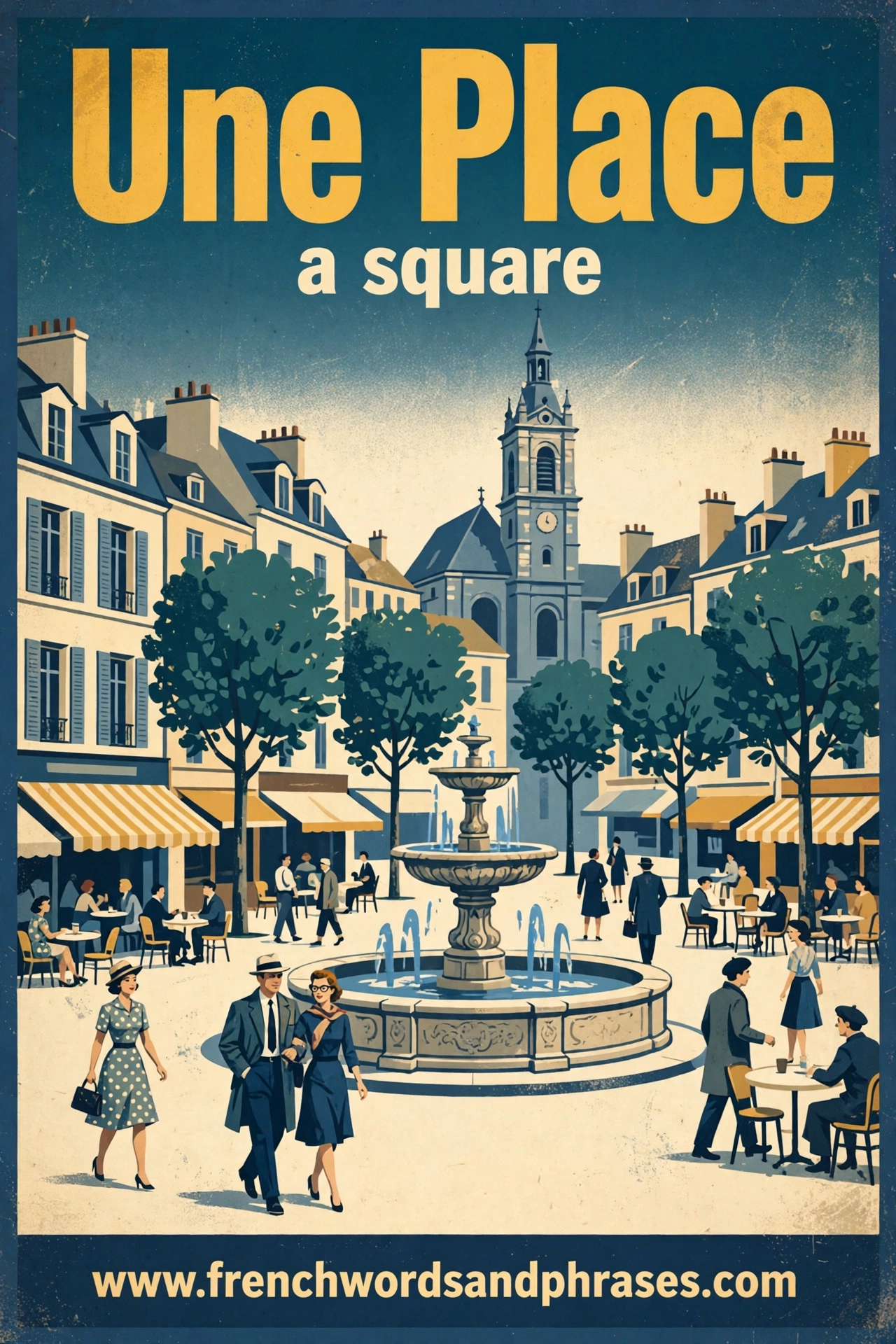
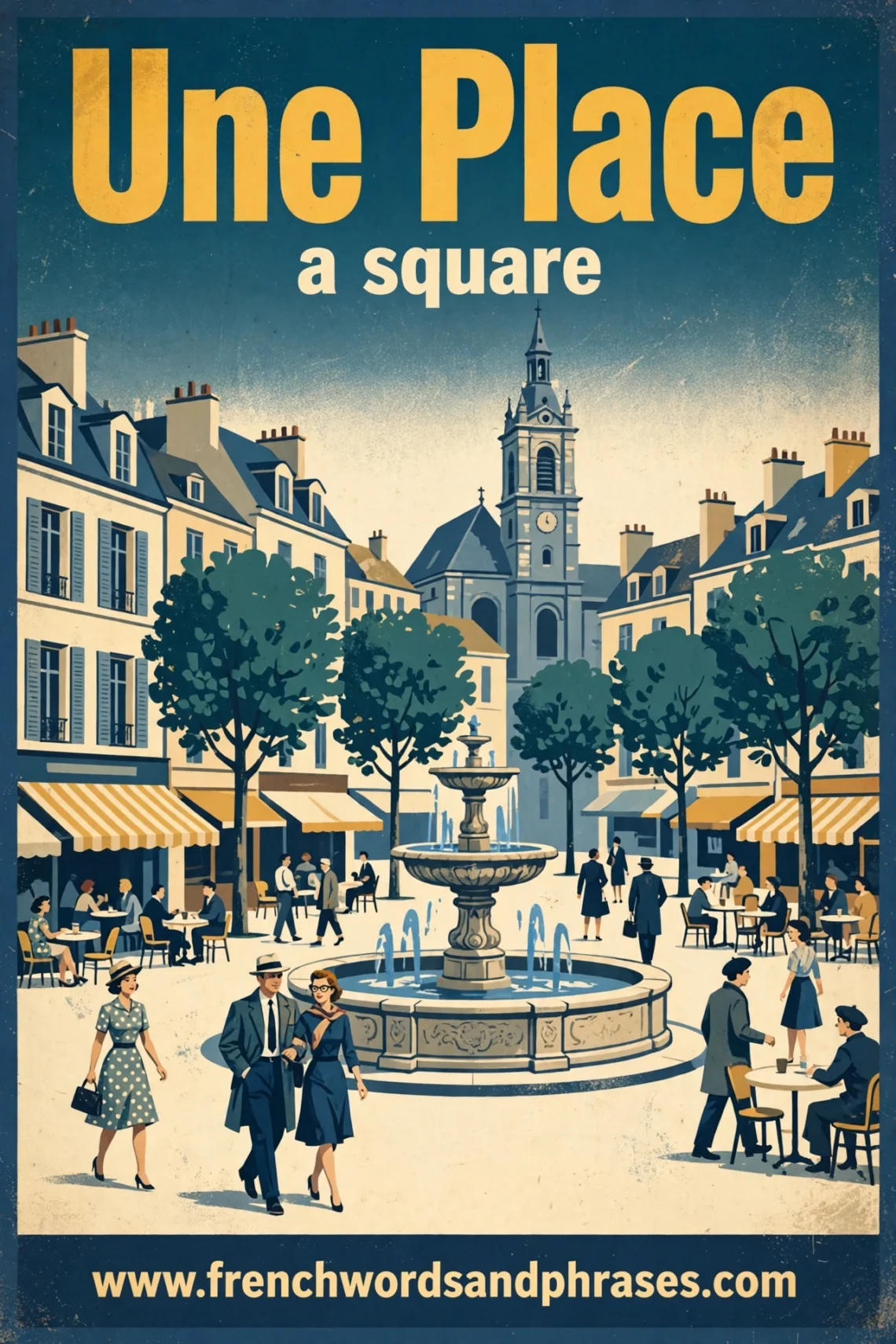
Une place means a square.
Morning in the old town: café chairs scraping on stone, the market stalls going up under their awnings, pigeons in full possession of the fountain. Every French town begins here, at its centre — that is la place.
In this guide, you’ll learn what place means in English, how to use it with its articles, how to form its plural, and how it appears in everyday French. Explore French examples, English translations, and practice quizzes.
Understanding the French Noun Place
Place is a feminine French noun. Like every French noun, it has a gender, and it is learned together with its article: une place.
It means a square — the open public space at the heart of a town, like the place de la Concorde in Paris. But place leads a second, equally everyday life: it is also a seat, and the space a person or a thing takes up — une place de cinéma, a cinema seat, and il n’y a plus de place, there is no room left. One word for the square you cross and the seat you keep.
Gender: Feminine
Definite article: la — la place (the square; the seat)
Indefinite article: une — une place (a square; a seat)
Partitive article: de la — de la place (some room, some space)
Plural: les places (the squares; the seats)
English equivalents: A square; a seat; a space, room.
One important detail: context decides which place you mean. An arrangement to meet — rendez-vous sur la place — is the square. At the cinema or in a full car, place is a seat or room: deux places, s’il vous plaît, two seats, please. And à la place de quelqu’un means instead of someone — a third life for the same little word.
Experience the Word
Place is more than an open space in France. It is the town’s living room — where the market sets up, where the café puts out its chairs, and where everyone eventually passes.
Imagine the square at eight in the morning: the baker’s shutters rising, the fountain running, old men already installed with their newspapers, arguing about the weather as if it were politics.
You have not just crossed a square. You have crossed the heart of the town.
How to Use Place in French: Complete Guide
Let’s explore how place works in French, beginning with its articles.
Place and Its Articles
French nouns are almost never used alone. The small word in front of the noun — the article — does a great deal of work.
Place with the Definite Article (La, Les)
Used for a square or a seat both speakers know about.
| Number | French |
|---|---|
| Singular | la place |
| Plural | les places |
Example
La place est pleine de monde le samedi matin.
The square is full of people on Saturday morning.
Place with the Indefinite Article (Une, Des)
Used to introduce a square or a seat: one, or some.
| Number | French |
|---|---|
| Singular | une place |
| Plural | des places |
Example
Il reste des places pour le concert de ce soir.
There are still seats left for tonight’s concert.
Place with the Partitive (De la — Room, Space)
For the second meaning — space, room — place behaves like a mass noun and takes de la.
| Meaning | French |
|---|---|
| some room | de la place |
| no room left | plus de place |
Example
Il y a de la place pour tout le monde dans la voiture.
There is room for everyone in the car.
Quick Quiz 1
How do you say there is no room left?
Reveal the answer
Il n’y a plus de place.
Il n’y a plus de place dans le train.
There is no room left on the train.
The Plural of Place
Like most French nouns, place adds an -s in the plural — squares and seats alike.
| Number | French |
|---|---|
| Singular | la place |
| Plural | les places |
Example
Les grandes places de Paris sont célèbres dans le monde entier.
The great squares of Paris are famous all over the world.
Place with Possessive Adjectives (Ma, Ta, Sa…)
Possessives agree with the noun — place is feminine, so ma, ta, sa. Ma place is the sentence every cinema-goer needs.
| Owner | French |
|---|---|
| my | ma place |
| your (tu) | ta place |
| his / her | sa place |
| our | notre place |
| your (vous) | votre place |
| their | leur place |
Example
Gardez ma place, je reviens tout de suite.
Please keep my seat, I will be right back.
Quick Quiz 2
Complete the sentence:
Il reste deux ______ pour le spectacle.
Reveal the answer
places
Il reste deux places pour le spectacle.
There are two seats left for the show.
Place with Demonstrative Adjectives (Cette, Ces)
Used to point: this square here, those seats there.
| Number | French |
|---|---|
| Singular | cette place |
| Plural | ces places |
Example
Cette place est magnifique le soir.
This square is magnificent in the evening.
Place with Adjectives
Adjectives agree with place — feminine. Some regulars come before it (grande, vieille, petite), most come after.
| Adjective | With Place |
|---|---|
| grande (big) | la grande place |
| animée (lively) | une place animée |
| principale (main) | la place principale |
| célèbre (famous) | une place célèbre |
| vieille (old) | la vieille place |
| ombragée (shady) | une place ombragée |
Example
La grande place est le cœur du village.
The big square is the heart of the village.
Quick Quiz 3
In ‘il n’y a plus de place dans le train’, is place a square or a seat?
Reveal the answer
A seat — space on the train
Il n’y a plus de place dans le train.
There is no room left on the train.
Everyday Expressions with Place
Place is woven into the phrases of French daily life — meeting, eating in, and standing in for someone.
| Expression | In English |
|---|---|
| à la place de | instead of |
| sur place | on site; (in a café) to eat in |
| prendre place | to take a seat, to sit down |
| faire place | to make room |
| mettre en place | to set up, to put in place |
| rester en place | to stay in place, to stay put |
Example
Sur place ou à emporter ? — Sur place, merci.
To eat in or to take away? — To eat in, thank you.
Words from the Same Family as Place
Learn these together and you can place almost anything in French.
| French | In English |
|---|---|
| le lieu | a place (the formal partner word) |
| un emplacement | a spot, a pitch |
| placer | to place, to put |
| se placer | to take up a position |
| la placette | a small square |
| un placement | an investment; a seating plan |
Example
Cet emplacement est parfait pour la tente.
This pitch is perfect for the tent.
Quick Quiz 4
A café asks: ‘Sur place ou à emporter ?’ What are they asking?
Reveal the answer
Whether you want to eat in or take away
Sur place ou à emporter ? — Sur place, merci.
To eat in or to take away? — To eat in, thank you.
Place in Everyday French: Real-Life Examples
Now that you know the word, let’s see how place appears in everyday French.
Example 1 — A meeting point
On se donne rendez-vous sur la place du marché à midi.
Let’s meet on the market square at noon.
Example 2 — At the cinema
Deux places pour le film de vingt heures, s’il vous plaît.
Two seats for the eight o’clock film, please.
Example 3 — A full car
Désolé, il n’y a plus de place dans la voiture.
Sorry, there is no room left in the car.
Example 4 — Instead of
Je viendrai à la place de Paul, il est malade.
I will come instead of Paul; he is ill.
Example 5 — Eating in
Sur place ou à emporter ? — Sur place, merci.
To eat in or to take away? — To eat in, thank you.
Example 6 — Keeping a seat
Tu me gardes ma place ? Je reviens dans une minute.
Will you keep my seat? I will be back in a minute.
Beyond Translation: The Meaning of Place
English needs two words, square and seat, for the meaning of place — French keeps one, because in French life they are the same idea: the space that is yours, in the middle of everything.
To say place is to claim your spot in the world.
It evokes the square with its fountain and café chairs, and the small daily diplomacy of seats kept, room made and places taken — a whole social life in five letters.
How to Remember the French Noun Place
Remember it this way: Place is the square you cross and the seat you keep — feminine, and always in the middle of things.
- You arrange to meet friends — rendez-vous sur la place du marché.
- You book the cinema — deux places, s’il vous plaît.
- The car is full — il n’y a plus de place.
The key idea is la place for the square, une place for the seat.
Test Your Knowledge of Place
Let’s see how much you’ve learned. Try answering these questions before revealing the answers.
Question 1
Is place masculine or feminine?
Reveal the answer
Feminine — la place, une place.
Question 2
What does à la place de Paul mean?
Reveal the answer
Instead of Paul.
Question 3
Translate: There is no room left.
Reveal the answer
Il n’y a plus de place.
Question 4
How do you ask for two seats for the film?
Reveal the answer
Deux places pour le film, s’il vous plaît.
Question 5
Complete the sentence:
Sur place ou ______ ?
Reveal the answer
à emporter
Sur place ou à emporter ?
To eat in or to take away?
Your Final Challenge
Can You Use It?
How would you say this in French?
“Let’s meet at the square at eight o’clock.”
Reveal the answer
Rendez-vous sur la place à vingt heures.
Let’s meet at the square at eight o’clock.
A little French. A little curiosity. A richer everyday life.
LEARN FRENCH ONE WORD AT A TIME